Editor’s Note: ComplexDiscovery has covered Russia’s war in Ukraine since the full-scale invasion began in February 2022. Our reporting has drawn heavily on the daily assessments produced by the Institute for the Study of War (ISW), whose rigorous methodology and open-source intelligence analysis provide a reliable foundation for understanding the conflict’s evolution. This article is part of that ongoing coverage.
This week’s developments mark a troubling escalation. Ukrainian intelligence has disclosed that Russian forces are actively planning strikes on electrical substations serving the country’s nuclear power plants—infrastructure essential not just for power generation but for reactor cooling and nuclear safety. The campaign to systematically destroy Ukraine’s energy grid is not new; we have reported on it through four winters. But the explicit targeting of nuclear-adjacent infrastructure during the coldest temperatures Ukraine has experienced in years represents a deliberate intensification of pressure on the civilian population.
We continue this coverage because the war’s trajectory matters—to international security, to the rules-based order, and to the millions of ordinary people enduring its consequences. Our audience includes professionals whose work sometimes intersects with these events, and we acknowledge those practical dimensions where relevant. But we have never treated Ukraine primarily as a case study for professional practice, and we do not do so here. The human stakes are what justify sustained attention. We will continue reporting as events develop.
Content Assessment: Freezing a Nation Into Submission: Russia's Nuclear Substation Campaign and the Human Cost of Infrastructure Warfare
Information - 93%
Insight - 90%
Relevance - 90%
Objectivity - 92%
Authority - 94%
92%
Excellent
A short percentage-based assessment of the qualitative benefit expressed as a percentage of positive reception of the recent article from ComplexDiscovery OÜ titled, "Freezing a Nation Into Submission: Russia's Nuclear Substation Campaign and the Human Cost of Infrastructure Warfare."
Russo-Ukrainian Conflict Update* – Geopolitics Beat
Freezing a Nation Into Submission: Russia’s Nuclear Substation Campaign and the Human Cost of Infrastructure Warfare
ComplexDiscovery Staff
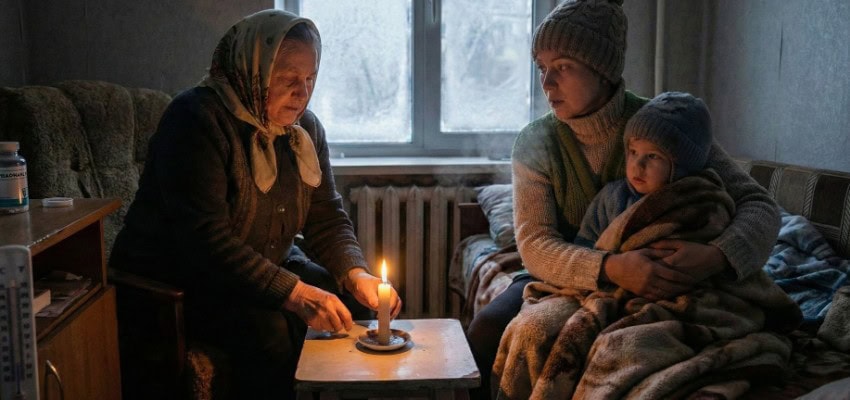
Scenes like this are playing out across Ukraine: In an apartment in Kyiv, a family huddles under blankets in a room where breath fogs the air. The power has been out for eighteen hours. The temperature outside is well below freezing; inside, it’s not much better. A grandmother rations candles. A mother worries whether the pharmacy two blocks away will have power to process her child’s prescription. These are the people Russia is trying to break.
Ukrainian intelligence disclosed on January 17 that Russian forces have conducted reconnaissance of at least ten critical energy infrastructure sites across nine regions, targeting the electrical substations that keep Ukraine’s nuclear power plants connected to the grid. The goal, according to Ukraine’s Main Military Intelligence Directorate, is to disconnect nuclear facilities from the unified power system entirely—collapsing what remains of Ukraine’s electricity generation during the coldest winter months the country has experienced in years. This is not a military strategy aimed at battlefield advantage. It is a deliberate campaign to inflict suffering on civilians who have no say in the geopolitical contest being waged over their heads, a Cold War-era calculus that seeks to break national will by making daily life unbearable for millions of ordinary people.
The Arithmetic of Suffering
Foreign Minister Andrii Sybiha warned international partners that Moscow is pursuing what he called a “genocidal” campaign to deprive civilians of power and heat. The numbers support the characterization. Since February 2022, Russian forces have struck every power plant in Ukraine, accumulating 612 documented attacks on energy infrastructure according to Energy Minister Denys Shmyhal. Since the current heating season began in October 2025, investigators have recorded 256 air attacks specifically targeting energy facilities and heating systems—including 49 precision strikes on thermal power plants, 45 attacks on combined heat and power facilities, and 151 strikes on electrical substations.
President Volodymyr Zelensky reported that Ukraine requires approximately 18 gigawatts to meet domestic consumption during winter, but current generation capacity produces only 11 gigawatts. Successful strikes against nuclear power plant substations would slash this figure dramatically—Ukraine’s three operating nuclear plants at Rivne, Khmelnytskyi, and South Ukraine provide the backbone of remaining generation capacity. Kyiv Mayor Vitaliy Klitschko stated that the capital currently operates on half the electricity it needs, urging residents who can leave the city to do so. For the elderly, the poor, and those with nowhere else to go, leaving is not an option.
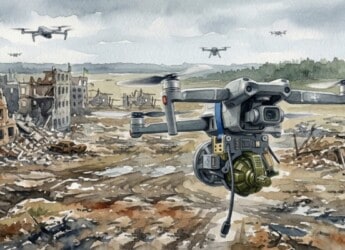
On the night of January 17 to 18 alone, Russian forces launched 201 drones—including 120 Shahed-type systems—from launch points spanning Kursk, Oryol, Rostov Oblast, Krasnodar Krai, occupied Crimea, and occupied Donetsk. Thirty struck locations including critical infrastructure in Kharkiv and Zaporizhzhia cities and in Odesa Oblast. This past week saw more than 1,300 attack drones, roughly 1,050 guided aerial bombs, and 29 missiles targeting Ukraine, according to Zelensky. Each strike lands on infrastructure that, while technically serving both military and civilian purposes, primarily keeps hospitals warm, keeps food refrigerated, and keeps elderly residents alive through the night.
Nuclear Safety on a Single Wire
International Atomic Energy Agency Director General Rafael Mariano Grossi confirmed that military activity damaged an electrical substation critical to Chornobyl Nuclear Power Plant operations over the past week. IAEA teams have reported military activities or air raid alarms at all five nuclear sites in Ukraine in recent days, with explosions heard near the Zaporizhzhya Nuclear Power Plant—Europe’s largest nuclear facility, which Russia has occupied since March 2022.
The Zaporizhzhya plant currently depends on a single functioning 750 kV power line after damage to its last remaining backup 330 kV line on January 2. The IAEA brokered a fourth temporary local ceasefire to allow Ukrainian technicians to begin repairs—a process Grossi called evidence of the agency’s “indispensable role” but also a measure of how precarious the situation has become. Nuclear plants require continuous external power for cooling systems; loss of grid connection forces reliance on diesel generators with finite fuel supplies. The Zaporizhzhya plant has experienced eight complete losses of external power since Russia’s full-scale invasion began. A meltdown at Europe’s largest nuclear facility would create consequences far beyond Ukraine’s borders—a fact that does not appear to deter the targeting.
The IAEA announced it is preparing another expert mission to assess Ukrainian substations, following missions in December 2025. “These substations are critical for nuclear safety and security as they supply electricity for reactor cooling and other essential safety systems,” Grossi stated. “The IAEA has the expertise to assess the direct implications of the continued deterioration of Ukraine’s power grid on the safety of its nuclear power plants.”
Breaking Will, Not Lines
The Institute for the Study of War assesses that Russia has been attempting to split Ukraine’s energy grid and create “energy islands” cut off from electricity generation, deliveries, and transmission systems—fragmenting the unified network along an east-west divide. But the military terminology obscures the human intent. This is not about degrading Ukraine’s capacity to wage war; Ukraine’s military operations do not depend on whether grandmothers in Kyiv can heat their apartments. This is about punishment. It is about making the civilian population suffer until they pressure their government to accept whatever terms Moscow dictates.
The strategy has historical antecedents. Targeting civilian infrastructure to break national will was a fixture of Cold War thinking—and of conflicts long before that. What distinguishes the current campaign is its systematic, documented, and openly acknowledged nature. Ukrainian intelligence stated that the Kremlin’s intentions “once again demonstrate the genocidal nature of Russia’s war against Ukraine.” Whether the legal definition of genocide applies, the operational logic is clear: make life impossible for ordinary people until something gives.
Official Russian government sources have not directly addressed Ukrainian intelligence warnings about the planned targeting of nuclear substations. For those who remember the evolution of infrastructure attacks, however, the current campaign represents a grim progression. In December 2015, cyberattacks on three Ukrainian distribution companies used BlackEnergy malware to compromise Supervisory Control and Data Acquisition systems, remotely opening breakers at roughly 30 substations and cutting power to more than 200,000 customers. Those attacks demonstrated that critical infrastructure could be reached through digital means. What malware accomplished then, missiles and drones accomplish now—with the added effect of physical destruction that cannot be patched or restored with a software update.
The Diplomatic Freeze
These attacks unfold against ongoing peace negotiations involving the United States, European Union, and Ukraine, with the most recent round of Ukraine-U.S. talks occurring in Miami on January 16. Yet signals from Moscow suggest little appetite for compromise. Viktor Medvedchuk—the Kremlin-affiliated former Ukrainian politician whom the Institute for the Study of War describes as someone Putin initially sought to install in Kyiv following the 2022 invasion—told Russian state news agency TASS on January 17 that peace would not come to Ukraine in 2026.
Medvedchuk framed the conflict as a broader struggle between Russia and the West, stating that “time is working for Russia” and characterizing Zelensky as “a superfluous link” in any arrangements. Russian state media amplified these statements widely. The timing—amid active diplomatic efforts and intensified civilian suffering—appears calculated to signal that no amount of negotiation will yield results while Ukraine can still be squeezed harder.
Zelensky addressed the implications directly: “Each such Russian strike on the energy sector amid such a harsh winter weakens and undermines the efforts of key states—in particular the United States—to end this war.” The strikes continue regardless.
A Note on Perspective
For readers of this publication, the Ukrainian energy crisis creates downstream professional implications: preservation notices that go unanswered because counterparties have no power, custodians who evacuate and become unreachable, data centers operating on generators with uncertain fuel supplies, courts that will eventually need standards for evaluating evidence collected under infrastructure collapse. These concerns are real, and practitioners handling cross-border matters involving Ukrainian entities face them now.
But let us be clear about proportion. The professional inconveniences that flow from Ukraine’s grid collapse are vanishingly small against the human catastrophe that constitutes the actual story. A delayed document production is an annoyance. A family freezing in an apartment because their country’s infrastructure has been systematically destroyed is a tragedy—and, if the intent is to break civilian will through suffering, a crime. The eDiscovery implications exist, and acknowledging them is appropriate for this audience, but they are a footnote to events that matter on an entirely different scale.
The people enduring rolling blackouts, rationing heat, and wondering whether tonight will be the night something essential fails—they are not parties to the geopolitical dispute being conducted through their suffering. They are, in the coldest sense of the phrase, collateral damage in a strategy designed to make their lives unbearable enough that someone, somewhere, capitulates. That is the story. Everything else is detail.
As another wave of drones launches toward Ukrainian cities tonight, the question is not whether your next cross-border matter will face collection challenges. The question is how long the international community will watch a civilian population be frozen into submission—and what, if anything, it intends to do about it.
Accessed Control of Terrain
Russo-Ukrainian-War-January-18-2026Primary News Sources
- Russian Offensive Campaign Assessment, January 18, 2026 | ISW
- Geopolitics Archives – ComplexDiscovery
Additional News Sources
- Ukraine Warns Russia May Target Nuclear Power Substations in New Energy Blackmail (Kyiv Post)
- Update 337 – IAEA Director General Statement on Situation in Ukraine (IAEA)
- Russia Plans Strikes on Nuclear Power Plant Substations Amid US Peace Talks (Euromaidan Press)
- Peace in Ukraine Unlikely in 2026 — Ukrainian Politician (TASS)
- Responding to Russian Attacks on Ukraine’s Power Sector (Center for Strategic and International Studies)
- Cyber-Attack Against Ukrainian Critical Infrastructure (CISA)
- Attacks on Ukraine’s Electric Grid: Insights for U.S. Infrastructure Security (Congressional Research Service)
Background Note: ComplexDiscovery’s staff offers distinctive perspectives on the Russo-Ukrainian war and Middle Eastern conflicts, informed by their military experience on the West German, East German, and Czechoslovakian borders during the Cold War, as well as in Sinai as part of Camp David Accord compliance activities, during the timeframe of the first Persian Gulf War. This firsthand regional knowledge has been further enhanced by recent staff travels to Eastern European countries, including Estonia, Finland, Latvia, Lithuania, and Poland. These visits have provided up-to-date, on-the-ground insights into the current geopolitical climate in regions directly impacted by the ongoing conflict.
Combined with cybersecurity, information governance, and eDiscovery proficiency, this multifaceted experience enables comprehensive analysis of these conflicts, including the critical impact of cyber warfare, disinformation, and digital forensics on modern military engagements. This unique background positions ComplexDiscovery to provide valuable insights for conflict-related investigations and litigation, where understanding the interplay of technology, data, and geopolitical factors is crucial.
Assisted by GAI and LLM Technologies
* Sourced and shared with permission from the Institute for the Study of War (ISW).
Additional Reading
- Ballistic Blackmail and Maritime Shell Games: Russia’s Evolving Hybrid Front
- Anchor Drag or Hybrid Attack? Finland Detains’ Fitburg’ Crew Amid Cable Sabotage Fears
- Valdai, Veracity, and the Winter War: Russia’s Claims Collide with Evidence
- Narva May Not Be as Far Away as One Thinks: The Challenge of Cyber and Physical Borders
- Europe’s War at a Crossroads: Berlin’s “NATO-like” Assurances, Novorossiysk, and the Battle for Power
- The Fatal Ambiguity: How the Budapest Memorandum Haunts European Security
- How Finland Is Reshaping Defense: BORDERLAND at Slush 2025
- When Rails Become Battlefields: How Infrastructure Warfare Reshapes European Security
- NATO’s Counter-Drone Solution: Inside the Merops Deployment Reshaping European Air Defense
- Infrastructure Strike Escalation: Ukraine and Russia Trade Blows Across Critical Nodes
- From Dissent to OSINT? Understanding, Influencing, and Protecting Roles, Reputation, and Revenue
- Data Embassies: Sovereignty, Security, and Continuity for Nation-States
Source: ComplexDiscovery OÜ

ComplexDiscovery’s mission is to enable clarity for complex decisions by providing independent, data‑driven reporting, research, and commentary that make digital risk, legal technology, and regulatory change more legible for practitioners, policymakers, and business leaders.