
Editor’s Note: Arriving at an inflection point in the Russia-Ukraine conflict, the launch of Russia’s Spring-Summer 2026 offensive against the Fortress Belt marks the opening of what ISW projects will be a multi-year campaign for control of Ukraine’s most heavily fortified urban corridor in Donetsk Oblast. For cybersecurity professionals, the first-ever destruction of an attack helicopter by a fiber-optic FPV drone signals a new chapter in the electronic warfare arms race — one where physical-layer countermeasures are neutralizing the RF jamming systems that Russia has invested billions in deploying. For information governance and eDiscovery practitioners, the escalating European seizure campaign against Russia’s shadow fleet is producing cross-jurisdictional evidence chains of a complexity rarely seen outside major international litigation. And the establishment of the UK-backed A1 Defense AI Center raises pressing questions about data governance, export controls, and algorithmic accountability in allied defense partnerships. These are not distant developments — they are shaping the technology, regulatory, and legal landscapes that these professionals navigate daily.
This article is specifically relevant to cybersecurity, information governance, and eDiscovery professionals for three reasons. First, the fiber-optic FPV drone strike and the A1 Defense AI Center represent the cutting edge of the electronic warfare and autonomous systems arms race, with direct implications for defense cybersecurity, counter-drone technology, and the digital supply chains that support military AI development. Second, the shadow fleet seizure campaign is generating multi-jurisdictional digital evidence — AIS vessel-tracking data, satellite imagery, financial records, and communications — that poses novel preservation, processing, and production challenges for eDiscovery practitioners working in sanctions enforcement. Third, the sheer volume of battlefield data being generated in eastern Ukraine, from drone footage to signals intelligence, will likely become central to future international accountability proceedings, creating information governance obligations around long-term preservation, chain-of-custody, and cross-border data transfer that professionals should be tracking now.
Content Assessment: Russia Launches Spring Offensive Against Ukraine’s Fortress Belt as Diplomats Gather in Miami
Information - 93%
Insight - 92%
Relevance - 90%
Objectivity - 93%
Authority - 94%
92%
Excellent
A short percentage-based assessment of the qualitative benefit expressed as a percentage of positive reception of the recent article from ComplexDiscovery OÜ titled, "Russia Launches Spring Offensive Against Ukraine’s Fortress Belt as Diplomats Gather in Miami."
Russo-Ukrainian Conflict Update* – Geopolitics Beat
Russia Launches Spring Offensive Against Ukraine’s Fortress Belt as Diplomats Gather in Miami
ComplexDiscovery Staff
The war in Ukraine sharpened this week when the Institute for the Study of War confirmed that Russian forces have likely launched their anticipated Spring-Summer 2026 offensive against Ukraine’s Fortress Belt — the network of fortified cities that forms Kyiv’s last major defensive line in Donetsk Oblast. The assessment, published on March 21, arrived on the same day that Ukrainian and American negotiators sat down in Miami for bilateral talks that could shape the trajectory of the conflict, underscoring the growing disconnect between battlefield escalation and diplomatic maneuvering.
The Fortress Belt — a 50-kilometer defensive corridor running north to south along the H-20 Kostyantynivka-Slovyansk highway — encompasses four urban centers: Slovyansk, Kramatorsk, Druzhkivka, and Kostyantynivka. With a combined pre-war population exceeding 380,000, these cities have been fortified since 2014 with bunkers, trenches, minefields, and anti-tank obstacles. Their fall would open a path deeper into Ukrainian-held Donetsk Oblast and deal a devastating blow to Kyiv’s defensive posture in the east. Yet according to ISW analysts, Russian forces remain unlikely to seize the belt in 2026, though tactical gains at considerable cost are expected.
The offensive appears to be taking shape along multiple axes. Russian forces have intensified ground operations in the Lyman direction, pressing toward Slovyansk from the northeast. On March 19, Ukrainian military reports described a battalion-level mechanized assault involving over 500 Russian soldiers, dozens of armored vehicles, and a fleet of light vehicles, including motorcycles and buggies — the kind of combined-arms push that signals preparation for sustained operations rather than probing attacks. As of March 21, Russian forces were reportedly attacking in seven directions simultaneously on the Lyman front alone. ISW assessed that Russian forces are also setting conditions for intensified operations toward Kramatorsk and Kostyantynivka from the south, with observers tracking equipment redeployments, increased artillery strikes, and expanded use of strike drones and FPV unmanned aerial vehicles.
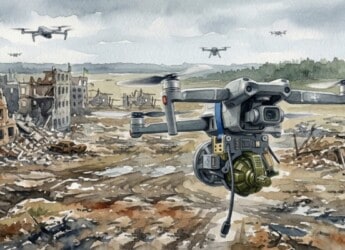
The evolving drone warfare dimension offers the week’s most consequential development — and one with direct relevance for cybersecurity professionals tracking the electronic warfare arms race. On March 20, operators from the “Predators of the Heights” battalion of Ukraine’s 59th Separate Assault Brigade destroyed a Russian Ka-52 “Alligator” attack helicopter using a fiber-optic FPV drone, marking the first confirmed instance of an FPV drone downing an attack helicopter in combat. The fiber-optic detail matters: unlike radio-frequency-controlled drones, fiber-optic systems transmit commands via a physical tether, making them immune to RF jamming and GPS spoofing that Russia has deployed extensively across the front. The strike represents a hardware-level countermeasure in the escalating cycle between electronic attack and electronic protection — a dynamic that cybersecurity professionals will recognize from network defense. The Ka-52, valued at approximately $16 million according to Ukrainian military estimates, went down in the Nadiivka area of the Donetsk region. Following an emergency landing, the helicopter crew attempted to escape but was eliminated by follow-up drone strikes from the 414th Brigade’s “Magyar’s Birds” unit. President Volodymyr Zelenskyy awarded Orders of Courage to the operators involved. According to Ukraine’s General Staff — whose tallies have not been independently verified — the strike brought the total count of Russian helicopters destroyed since the full-scale invasion began to 350.
A day later, Ukrainian forces downed a second Russian military helicopter, making it two in 48 hours — a tempo that reflects both the maturation of Ukraine’s drone forces and the growing vulnerability of Russian rotary-wing assets to relatively inexpensive unmanned systems. Organizations tracking military technology trends should note that Ukraine’s Ministry of Defense announced on March 17 the establishment of the A1 Defense AI Center, built with UK support, to operationalize battlefield data into autonomous systems and expand capabilities across drone warfare. The center represents a step toward integrating artificial intelligence into targeting, reconnaissance, and strike coordination — raising immediate questions about the provenance of training data, algorithmic accountability, and the governance frameworks needed when AI-driven defense tools cross international boundaries under technology transfer agreements. For information governance professionals, the UK-Ukraine AI defense partnership creates a new category of controlled data that spans allied nations and demands compliance with export controls at every layer of the technology stack.
The overnight hours before the Miami talks brought a grim reminder of the war’s human toll. Russia launched 154 drones against Ukrainian targets, with Ukrainian air defenses intercepting 148 of them. In Zaporizhzhia, a strike killed a couple in their home and left their two children injured. The attack pattern has become a near-nightly feature of the conflict, straining Ukraine’s air defense networks and civilian infrastructure.
In Miami, the Ukrainian delegation — led by Secretary of the National Security and Defence Council Rustem Umierov and Head of the President’s Office Kyrylo Budanov, along with First Deputy Serhii Kyslytsia and Servant of the People faction leader Davyd Arakhamia — met with White House Special Envoy Steve Witkoff and Jared Kushner, son-in-law of President Donald Trump. The agenda included security guarantees, sanctions policy, continuation of the PURL program for US weapons procurement, and a bilateral drone agreement. The Kremlin confirmed that the talks were strictly bilateral and did not involve Russian participation. The discussions were set to continue on March 22, according to the Kyiv Independent.
The diplomatic picture is further complicated by the question of Ukrainian elections. Kyiv remains committed in principle to holding free and fair elections, but its Central Election Commission has stated that the pre-election period cannot begin until at least six months after a sustainable ceasefire is established — a position rooted in constitutional requirements barring national elections under martial law. With the spring offensive now underway and no ceasefire in sight, Ukrainian officials have effectively ruled out presidential elections in 2026, according to reporting from The Times. Zelenskyy himself has framed the issue plainly, telling reporters in February: “Make a ceasefire, there will be elections… First comes security, then politics.” The Kremlin, meanwhile, has shown no willingness to commit to the ceasefire conditions that would make elections possible, even as it and its allies criticize Kyiv for delaying them.
Away from the contact line, Ukraine’s counteroffensive efforts are producing mixed results. Ukrainian forces have confirmed advances near Kupyansk in the northeast and have pushed into Russian positions at the junction of the Dnipropetrovsk and Zaporizhzhia regions, forcing Moscow to redeploy elite units from multiple oblasts. However, those redeployments came at a cost: to execute the southern counterattacks, the Ukrainian command pulled units from the defense of northern Pokrovsk, allowing Russian forces to launch new offensive operations toward Dobropillia. The tradeoffs illustrate the resource constraints facing Ukrainian commanders as they balance active defense with localized counterattacks across an extended front.
Meanwhile, European enforcement actions against Russia’s shadow fleet of sanctions-busting oil tankers continued to escalate. On March 20, France seized the oil tanker Deyna in the Mediterranean, suspected of flying a false Mozambican flag. Belgium had earlier seized the tanker Ethera in its waters, and Sweden detained the Sea Owl I with a Russian captain arrested for document forgery. EU foreign policy chief Kaya Kallas characterized tanker seizures as potentially “the most effective way of pressure,” marking a shift from symbolic boardings toward sustained maritime law enforcement aimed at raising the financial costs of Russia’s sanctions evasion. For eDiscovery and information governance professionals, the maritime enforcement wave is generating complex cross-jurisdictional data challenges. Each seizure produces vessel tracking records, Automatic Identification System (AIS) data, satellite imagery, crew communications, and financial transaction logs spanning multiple flag states and beneficial ownership structures — all of which must be preserved, processed, and potentially produced across different legal frameworks. The digital evidence chains from a single tanker seizure can implicate entities in half a dozen countries, creating the kind of multi-party, multi-jurisdiction discovery scenario that tests the limits of existing protocols.
The convergence of events on March 21 — an active spring offensive, a record-setting drone engagement, high-level diplomacy, and tightening sanctions enforcement — captures the war’s current character. The battlefield is intensifying as Russia pushes toward Ukraine’s most fortified positions, while the diplomatic track remains constrained by what analysts describe as deeply opposed demands over ceasefires, elections, and territorial sovereignty. The scale of military operations in eastern Ukraine is also generating unprecedented volumes of battlefield data — drone footage, signals intelligence, geolocation records, communications intercepts — that will likely become central to future accountability proceedings and war crimes investigations, creating long-term preservation and chain-of-custody obligations that information governance and eDiscovery practitioners should be preparing for now.
What happens when an FPV drone costing a few hundred dollars can reliably destroy a $16 million attack helicopter — and what does that asymmetry mean for the future of defense technology, procurement, and the digital systems that support them?
Accessed Control of Terrain
Russo-Ukrainian-War-March-21-2026News Sources
- Russia Attacks Ukraine’s Key Donetsk Stronghold Zone — ISW (RBC-Ukraine)
- Ukrainian FPV Drone Downed Russian Ka-52 Helicopter – Then Magyar’s Birds Came Back to Finish the Crew (Euromaidan Press)
- Russia Launches 154 Drones Over Ukraine, Killing a Couple at Home and Injuring Their Children (Euronews)
- Ukraine Lands in Miami for Talks That May Shape the War’s Endgame (Euromaidan Press)
- Ukrainian Delegation Meets Witkoff, Kushner in Miami, Plan to Continue Talks on March 22 (Kyiv Independent)
- Ukraine Will Only Hold Elections After Security Guarantees and Ceasefire in Place, Zelenskyy Says (Euronews)
- France Detains Another Shadow Fleet Tanker (Pravda EN)
- Belgium Seizes Russian Shadow Fleet Tanker in North Sea Sanctions Crackdown (Euronews)
- Ukraine Launches Massed Drone Attacks on Russia. Day 1483 of the War (OSW Centre for Eastern Studies)
- Battlefield Analysis: What Ukraine’s Recent Front-Line Gains Really Mean (Kyiv Independent)
- Russian Offensive Campaign Assessment, March 21, 2026 (Institute for the Study of War)
- Total Russian Combat Losses in Ukraine as of March 22, 2026 (Ukrainian Ministry of Defense)
Background Note: ComplexDiscovery’s staff offers distinctive perspectives on the Russo-Ukrainian war and Middle Eastern conflicts, informed by their military experience on the West German, East German, and Czechoslovakian borders during the Cold War, as well as in Sinai as part of Camp David Accord compliance activities, during the timeframe of the first Persian Gulf War. This firsthand regional knowledge has been further enhanced by recent staff travels to Eastern European countries, including Estonia, Finland, Latvia, Lithuania, and Poland. These visits have provided up-to-date, on-the-ground insights into the current geopolitical climate in regions directly impacted by the ongoing conflict.
Combined with cybersecurity, information governance, and eDiscovery proficiency, this multifaceted experience enables comprehensive analysis of these conflicts, including the critical impact of cyber warfare, disinformation, and digital forensics on modern military engagements. This unique background positions ComplexDiscovery to provide valuable insights for conflict-related investigations and litigation, where understanding the interplay of technology, data, and geopolitical factors is crucial.
Assisted by GAI and LLM Technologies
* Sourced and shared with permission from the Institute for the Study of War (ISW).
Additional Reading
- Platform as Trap: The Kremlin’s Max App and the Architecture of Digital Control
- Rails, Water, and Public Security as the War Nears Its Fifth Year
- Negotiations Amid Escalation: Strategic Intransigence and the Enduring Consequences of the War in Ukraine
- Negotiating Peace in a Drone War: Telemetry, Compliance, and Strategic Risk from Abu Dhabi to the Front
- Freezing a Nation Into Submission: Russia’s Nuclear Substation Campaign and the Human Cost of Infrastructure Warfare
- Ballistic Blackmail and Maritime Shell Games: Russia’s Evolving Hybrid Front
- Anchor Drag or Hybrid Attack? Finland Detains’ Fitburg’ Crew Amid Cable Sabotage Fears
- Valdai, Veracity, and the Winter War: Russia’s Claims Collide with Evidence
- Narva May Not Be as Far Away as One Thinks: The Challenge of Cyber and Physical Borders
Source: ComplexDiscovery OÜ

ComplexDiscovery’s mission is to enable clarity for complex decisions by providing independent, data‑driven reporting, research, and commentary that make digital risk, legal technology, and regulatory change more legible for practitioners, policymakers, and business leaders.