
Editor’s Note: FutureLaw 2026 arrives as legal innovation shifts from product demos to infrastructure decisions. Legal tech conferences are no longer just marketplaces; they’ve become negotiation spaces where governance standards, vendor risk posture, and cross-border data strategies take shape in real time. This preview tracks the collision of Small Language Models (SLMs), eDiscovery, and sovereign digital policy—and explains why Tallinn may be one of the most practical venues in 2026 for cybersecurity, privacy, compliance, and information governance leaders to compare notes before commitments harden into operating reality. ComplexDiscovery OÜ will be on site in Tallinn, covering FutureLaw 2026 with practitioner-focused reporting and post-event analysis for cybersecurity, privacy, regulatory compliance, and eDiscovery professionals.
Content Assessment: FutureLaw 2026 Preview: The Practical Path to Defensible AI in Legal Workflows
Information - 95%
Insight - 95%
Relevance - 92%
Objectivity - 92%
Authority - 93%
93%
Excellent
A short percentage-based assessment of the qualitative benefit expressed as a percentage of positive reception of the recent article from ComplexDiscovery OÜ titled, "FutureLaw 2026 Preview: The Practical Path to Defensible AI in Legal Workflows."
Industry News – eDiscovery Beat
FutureLaw 2026 Preview: The Practical Path to Defensible AI in Legal Workflows
Security, eDiscovery, and the Theatre of Legal Innovation
ComplexDiscovery Staff
The Data Sovereignty Imperative
By 2026, legal AI is defined by a persistent tension: the push for automation at scale versus the hard limits of data sovereignty. For eDiscovery, information governance, and cybersecurity professionals, cloud-hosted Large Language Models (LLMs) introduce a risk profile that can’t be wished away. The potential ingestion of sensitive litigation data, telemetry from complex cross-border investigations, and proprietary corporate intelligence into public-facing AI tools represents an expansion of the enterprise attack surface that many organizations are unwilling to accept.
It is worth noting that major enterprise API providers—including OpenAI, Anthropic, Google, and Microsoft—now offer contractual guarantees against using customer data for model training, along with features such as private tenancy, data residency controls, and zero-retention policies. The risk profile of a consumer-facing chatbot is materially different from a properly contracted enterprise deployment. Nevertheless, for organizations handling the most sensitive litigation materials, particularly in cross-border contexts where regulatory regimes conflict, even contractual assurances may not satisfy compliance requirements. It is in these high-sensitivity workflows where the case for localized AI is strongest.
The Growing Role of Small Language Models
Against this backdrop, a growing number of legal departments and service providers are exploring Small Language Models (SLMs) as a complement—and in some cases an alternative—to cloud-hosted LLMs. These compact models can be deployed locally, entirely behind corporate firewalls, and fine-tuned on curated internal data repositories to achieve high task accuracy for specialized requirements such as privilege review, ESI document categorization, and contract analysis.
The SLM category spans a wide range of model sizes. At the compact end, models like Microsoft’s Phi-4-mini-reasoning, at 3.8 billion parameters, can be fine-tuned on a single GPU workstation and even run on-device, making sophisticated AI analysis accessible to smaller legal teams with limited infrastructure. The flagship Phi-4 model, at 14 billion parameters, delivers performance competitive with much larger systems on mathematical reasoning and complex analytical tasks while remaining deployable on a single GPU. At the upper end of the SLM spectrum, Upstage’s 31-billion-parameter Solar Pro 2 delivers benchmark results competitive with 70B-class systems. Solar Pro 2’s hybrid architecture, which offers selectable Chat and Reasoning modes, is particularly well-suited to legal workflows that alternate between rapid document triage and complex multi-step analysis.
This targeted approach values precision—the ability to distinguish jurisdiction-specific deal-breakers in contract language, or to flag privilege issues calibrated to a firm’s own historical patterns—over the raw, generalist power of massive models.
The Strategic Trade-off: Addressing the “Intelligence Ceiling”
The security benefits of local SLMs are significant, but the 2026 landscape also reveals a practical “reasoning ceiling.” While SLMs excel at pattern matching, extraction, and categorization, frontier cloud-hosted LLMs still maintain an edge in synthesizing high-level strategic summaries and detecting subtle linguistic intent—the kind of nuance that can surface a “smoking gun” document in complex litigation.
To bridge this gap, a tiered intelligence architecture is emerging among organizations with mature information governance practices. In this model, SLMs act as the primary “algorithmic guardrail,” scrubbing PII and processing the bulk of ESI locally, while only anonymized, high-complexity “reasoning fragments” are passed to larger models for final synthesis. This approach allows organizations to contain the most sensitive data within their own perimeter while still accessing frontier-level reasoning where it matters most.
As legal teams move beyond pilot programs, the choice of deployment model has become a matter of defensibility rather than just capability. The following 2026 posture identifies the three primary architectures currently defining the enterprise landscape:
Comparative Posture: 2026 Deployment Models
Cloud-Hosted LLM (Enterprise Tier)
- Data Privacy & eDiscovery: Contractual safeguards against training data use; data residency controls available. Cross-border transfer compliance remains complex.
- Security Vulnerability: Attack surface depends on provider architecture and contract terms. Private tenancy and zero retention reduce but do not eliminate risk.
- Reasoning & Nuance: High: Superior at detecting intent, synthesizing strategy, and surfacing subtle document nuances.
On-Premises SLM (3.8–31B Parameters)
- Data Privacy & eDiscovery: Full data sovereignty; highly defensible for sensitive litigation, PII, and internal audits.
- Security Vulnerability: Minimal external vulnerabilities; fully contained within existing corporate IT infrastructure.
- Reasoning & Nuance: Moderate/Specialized: Exceptional at extraction, categorization, and pattern matching on trained domains.
Tiered / Hybrid Architecture
- Data Privacy & eDiscovery: PII scrubbed locally before anonymized fragments reach cloud models. Balances sovereignty with analytical depth.
- Security Vulnerability: Reduced surface: only non-sensitive, anonymized data leaves the perimeter. Requires robust de-identification pipeline.
- Reasoning & Nuance: High for complex tasks; moderate overhead in orchestration and validation of anonymization quality.
The Adoption Paradox: Cloud Users Are Moving Faster
It would be misleading to present localized SLM deployment as a frictionless transition. As noted in recent analysis by ComplexDiscovery, industry data reveals an instructive paradox: organizations using cloud-based eDiscovery software are significantly more likely to be actively using generative AI than those with on-premises deployments. In the 2025 Everlaw/ACEDS Ediscovery Innovation Report, 27% of cloud users reported they are actively using GenAI, compared to 8% of on-prem users—roughly a 3× gap. The infrastructure overhead of hosting, fine-tuning, and maintaining local models—along with the specialized talent required—creates adoption friction that cloud platforms have largely abstracted away.
The lesson for legal technology leaders is that the security benefits of on-premises SLMs must be weighed against implementation complexity and pace of deployment. For many organizations, the practical path forward will be a hybrid one: cloud-hosted LLMs with robust enterprise agreements handling lower-sensitivity workflows and creative analysis, while secure, specialized SLMs manage the most sensitive internal data. The winning strategy is not ideological commitment to one architecture but disciplined risk assessment applied workflow by workflow.
The Regulatory Catalyst
This shift toward more deliberate, security-conscious AI deployment is deeply intertwined with geopolitical regulatory movements, most notably the implementation of the EU AI Act, evolving U.S. AI industrial policy, and the global focus on sovereign digital infrastructure. Resolving the complex challenges of algorithmic transparency, AI liability, and digital identity requires intensive, cross-border collaboration—and makes high-level industry events more critical than ever.
The nature of these events has evolved. They have become learning laboratories and planning venues where distributed executive teams forge vendor partnerships, stress-test compliance strategies, and establish the governance standards that will define the next decade of legal practice.
FutureLaw 2026: What’s on the Agenda and What Attendees Should Expect
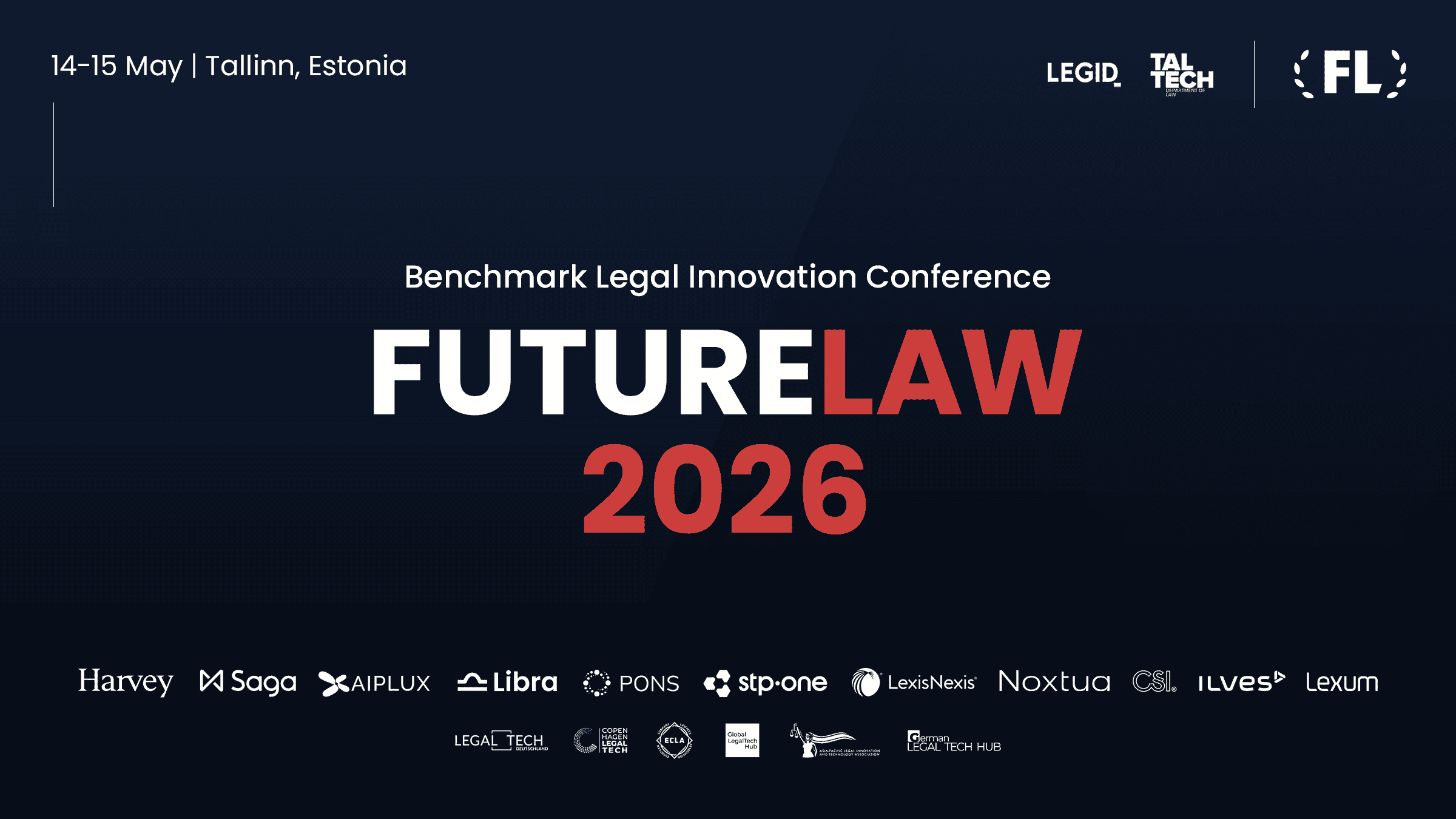
FutureLaw 2026, scheduled for May 14–15 at the Port of Tallinn, Estonia, is positioned as a key venue for these discussions. Estonia, with its advanced e-State architecture—including the X-Road interoperability platform and the recently launched Eesti.ai national AI program—serves as a real-world laboratory for large-scale automation and digital identity, providing concrete context for debates that too often remain abstract.
Several sessions target the specific pain points of the eDiscovery and cybersecurity communities. The Main Stage panel on “Embedded Trust – Privacy Engineering Meets AI Governance” will explore how privacy engineering and AI governance converge to create embedded safeguards, transforming legal principles into technical controls—a direct application of the algorithmic guardrail concept discussed throughout this article.
Pēteris Zilgalvis, Judge at the General Court of the European Union, is expected to discuss the Court’s pilot work involving open-weight AI models in a secure, sovereign European cloud. Public remarks associated with FutureLaw 2025 described an early-stage initiative using two open-weight models within European sovereign infrastructure, aimed at improving access to justice for EU citizens; however, the project’s scope and current status may have evolved since those remarks. An updated briefing from a sitting EU judge on the operational realities—and limitations—of sovereign AI deployment would therefore be particularly valuable.
Beyond the main stage, the conference offers eight expert-led workshops across its two-day program. For security and governance professionals, the value lies not only in session content but in direct access to the policymakers, technologists, and judicial figures shaping the regulatory environment. With approximately 500 attendees drawn from across Europe and beyond, the event is sized for substantive interaction rather than passive attendance.
The Defensibility Question
The legal AI landscape in 2026 is not a simple binary between cloud and on-premises deployment. It is a spectrum of risk-calibrated choices, shaped by the sensitivity of the data, the maturity of the organization’s governance infrastructure, and the specific demands of each workflow. The professionals who will navigate this landscape most effectively are those who resist both the hype of uncritical AI adoption and the inertia of blanket risk aversion.
For those professionals, FutureLaw 2026 offers an opportunity to engage directly with the architects of international digital law, to pressure-test deployment strategies against real regulatory frameworks, and to return with actionable intelligence for their organizations. In an era where the gap between AI capability and governance readiness continues to widen, that kind of grounded, cross-border dialogue is not a luxury—it is a professional necessity.
News Sources
- FutureLaw 2026 – Nordics’ Largest Legal Innovation Event
- Microsoft Phi-4 Technical Report – Model architecture and 14B parameter specification (PDF)
- Phi-Reasoning: Once again redefining what is possible with small and efficient AI (Microsoft Research)
- Solar Pro 2: Fluent. Reasoning. Frontier. (Upstage)
- FutureLaw 2025: Insights to hot legal tech topics from the Nordics & Baltics (Juremy)
- Court of Justice of the European Union: member states’ representatives appoint thirteen judges to the General Court – Consilium (European Council)
- Estonia launches bold AI initiative (Eesti.ai)
- 2025 Ediscovery Innovation Report – Everlaw (PDF)
- The Shrinking Giants: How Small Language Models Are Rewiring Corporate Security and Legal Strategy (ComplexDiscovery OÜ)
FutureLaw 2026 is one of Europe’s most credible and fastest‑growing legal‑innovation conferences — the clear #1 in Northern Europe and a top‑5 global event by thematic depth and institutional relevance. Its focused scale, high‑level regulatory access, and Estonia’s digital‑state context make it uniquely influential for the legaltech and digital‑transformation community.
On 14–15 May 2026, FutureLaw brings together 500+ leaders from law firms, corporate legal departments, legal‑tech companies, academia, and public institutions. The program spans AI in legal practice, digital governance, legal design, ethics, platformization, regulatory innovation, and the future of legal operations — all highly relevant to the EU market and beyond.
We invite the ComplexDiscovery community to join us in Tallinn — a rare opportunity to engage directly with EU‑level policymakers, global innovators, and digital‑state architects of the world.
Use the exclusive partner code EDISCO to receive 20% off your ticket. Explore the full program at FutureLaw 2026 – Nordics’ Largest Legal Innovation Event.




Assisted by GAI and LLM Technologies
Additional Reading
- The 2026 Event Horizon: Early Outlook for eDiscovery, AI, and European Innovation
- Data Provenance and Defense Tech: IG Lessons from Slush 2025
- Lessons from Slush 2025: How Harvey Is Scaling Domain-Specific AI for Legal and Beyond
- Kaja Kallas Warns of Democracy’s Algorithmic Drift at Tallinn Digital Summit
- The Agentic State: A Global Framework for Secure and Accountable AI-Powered Government
- When Founders Have Red Lines: Investing Beyond ROI at Latitude59
- At Latitude59, Estonia Challenges Europe: Innovate Boldly or Be Left Behind
Source: ComplexDiscovery OÜ

ComplexDiscovery’s mission is to enable clarity for complex decisions by providing independent, data‑driven reporting, research, and commentary that make digital risk, legal technology, and regulatory change more legible for practitioners, policymakers, and business leaders.