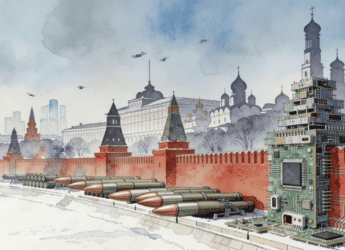

Editor’s Note: Recent geopolitical developments in the Baltic region—buoy removals on the Narva River, airspace violations over the Gulf of Finland, road closures at the Saatse Boot, border-guard incursions at Vasknarva, and cable damage in Swedish waters and the wider Baltic that has raised sabotage concerns—illustrate how localized friction can surface operational questions for cybersecurity, information governance, and eDiscovery leaders. These incidents demonstrate how states probe thresholds through a coordinated mix of physical, legal, and infrastructure pressure. For organizations whose cloud and resilience strategies rely on cross-border connectivity, the boundary between regional tension and broader disruption may be thinner than most network diagrams suggest.
Readers should note that the connection between these events and any specific organization’s infrastructure risk is inferential rather than direct. The November 2024 C-Lion1 cable break, for instance, occurred in Swedish waters east of Öland—separate from the Estonian border incidents—and no causal link between them has been established. The article’s practical recommendations—geo-risk attributes in CMDBs, diversity assurances in contracts, mirrored eDiscovery archives—are prudent, but they are presented here as a framework for assessment, not as a direct threat analysis.
Content Assessment: Narva May Not Be as Far Away as One Thinks: The Challenge of Cyber and Physical Borders
Information - 92%
Insight - 93%
Relevance - 91%
Objectivity - 90%
Authority - 92%
92%
Excellent
A short percentage-based assessment of the qualitative benefit expressed as a percentage of positive reception of the recent article from ComplexDiscovery OÜ titled, "Narva May Not Be as Far Away as One Thinks: The Challenge of Cyber and Physical Borders."
Industry News – Cybersecurity Beat
Narva May Not Be as Far Away as One Thinks: The Challenge of Cyber and Physical Borders
ComplexDiscovery Staff
Narva feels distant until you trace the cables, contracts, and cloud regions that tie your data estate to its riverbank. The closer you look, the more the city stops being a dot on the map and starts reading like a diagram of how modern conflict bleeds from code to concrete, and from border markers to global redundancy plans.
Narva, a city in northeastern Estonia on the border with Russia, sits at the eastern edge of the European Union, where Hermann Castle faces Russia’s Ivangorod Fortress across the Narva River. The view has always been symbolic, but in 2025, it turned operational as a series of incidents shifted the area from “border trivia” to a live case study in hybrid warfare. In May 2024, Russian authorities removed around two dozen navigation buoys on the Narva River, undermining the practical demarcation of the frontier even as formal treaties remained frozen in diplomatic limbo. By May 2025, Estonia had ended what its foreign ministry called “futile” talks over the buoys, and tensions migrated from maritime markers to the broader question of who controls what in and around the border zone.
The pattern only sharpened as the year progressed. On September 19, 2025, three Russian MiG‑31 fighter jets entered Estonian airspace near Vaindloo Island for roughly 12 minutes, flying up to around 10 kilometers inside the country and coming within minutes of Tallinn. NATO aircraft from Italy, Finland, and Sweden intercepted and escorted the jets according to standard procedures, but Estonian officials framed the incursion as a test of the alliance’s resolve and a “dangerous escalation” in an already tense environment. Russia denied any violation, insisting its aircraft remained over international waters, but the episode added kinetic noise to an already crowded threat landscape.
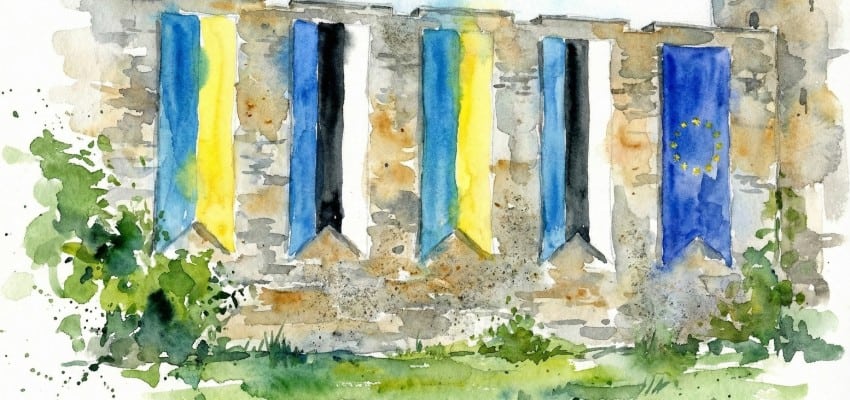
Just weeks later, that pressure shifted south to the peculiar border kink known as the “Saatse Boot,” where a narrow slice of Russian territory cuts into Estonia, and a local road briefly crosses into Russian territory. On October 10, Estonian border guards reported an unusually large presence of Russian border troops along the road, prompting the Police and Border Guard Board to close the route at short notice to prevent possible provocations. The Estonian government then decided on October 16 to keep the transit route through the Saatse Boot section of the Värska–Saatse road closed. For villagers, the decision meant longer detours; for security professionals, it looked like another data point in a campaign of calibrated probes—always just shy of open conflict, always enough to force a new normal.
By December, even the water’s edge around Narva felt less stable. On December 17, three Russian border guards crossed the temporary control line on the Narva River at the Vasknarva breakwater and remained on the Estonian side of the structure for about 20 minutes. Tallinn summoned Russia’s chargé d’affaires and folded the incident into a wider pattern that already included the buoy dispute, the Saatse Boot closures, and the airspace violation. The cumulative effect resembled an artillery preparation—low‑impact shells landing just close enough, just often enough, to grind down attention and normalize a permanent sense of “almost.”
For cybersecurity and information governance professionals, this is where geography and doctrine intersect. Analysts of Russian “hybrid warfare” often link these kinds of operations to the so‑called Gerasimov doctrine, which emphasizes achieving political objectives through a blend of non‑military instruments backed by carefully calibrated shows of force. The goal is attrition: blur the thresholds between peace and conflict, create ambiguity about intent, and stretch adversary attention so thin that each individual incident feels both explainable and unworthy of escalation. Over time, this desensitization can shift defender behavior, turning what should be treated as an early warning into background noise.

The Baltic theatre has already shown how quickly these dynamics reach into what boardrooms still like to think of as purely “technical” dependencies. The region’s seabed hosts dense clusters of subsea cables and energy infrastructure that support connectivity between Nordic and central European hubs. In November 2024, the C-Lion1 subsea cable between Finland and Germany suffered a rupture in the Baltic Sea, east of Sweden’s exclusive economic zone and Öland. German Defense Minister Boris Pistorius stated publicly that “no one believes that these cables were cut accidentally,” describing the incident as likely sabotage. Swedish and Finnish authorities opened criminal investigations and, together with Lithuania, established a Eurojust-supported joint investigation team to examine the C-Lion1 case alongside a separate Baltic cable-damage incident reported in the same timeframe; public reporting has repeatedly placed the Chinese bulk carrier Yi Peng 3 under scrutiny. While no final public attribution has been made, the prevailing view in early official commentary treated intentional interference as a serious possibility—even as the cable operator reported finding no evidence of intentional damage in initial assessments, while criminal investigations have continued. For a global enterprise relying on availability zones in Stockholm or Frankfurt, latency spikes and reduced redundancy are the same whether caused by deliberate interference or accidental anchor drag.
This is the point where the illusion of distance becomes risky. A CISO in London or a general counsel in New York may tell themselves that their firm has no operations in Narva. Yet their disaster‑recovery diagram may rely on a Nordic failover region or an Estonian vendor providing specialized services. While major cloud providers often obscure the exact physical pathing of data packets, making a precise map difficult to generate, the goal is not to trace every fiber but to demand transparency. A practical step is to challenge infrastructure teams and vendors during contract renewals: Can they guarantee that primary and failover workloads are not dependent on the same subsea corridor? Securing “diversity assurances”—contractual promises that your redundancy is physically separated—turns a vague geopolitical worry into a tangible set of checks against procurement and incident‑response planning.
At the governance level, the events around Narva argue for a shift from purely legalistic classifications to what might be called Geopolitical Risk Zones. Traditional data‑mapping exercises typically tag repositories by jurisdiction—EU versus U.S. Hybrid conflict requires an additional overlay that considers physical proximity to active or potential hostilities. A pragmatic way to start is by adding a simple “geo‑risk” attribute to existing configuration management databases (CMDBs)—the systems that track an organization’s infrastructure and services—so geopolitical exposure sits alongside technical data. However, unlike standard compliance fields, which are updated annually, this attribute must be managed on an event-driven basis. In a world where a road can close overnight or a buoy line can disappear in a morning, a governance model that waits for an annual audit is already obsolete.
Security architecture trends already reflect this shift. Zero Trust models—long promoted as a response to increasingly porous networks—fit naturally into a world where some risks originate from the same authorities that issue operating licenses. The practice of “never trust, always verify” extends beyond user identity to the regions that host key datasets. For example, a practical control in 2026 is to configure policies so that when a region is tagged as high‑risk, sensitive workloads are automatically replicated to an alternate region in a different geopolitical bloc.
For eDiscovery teams and legal operations, Narva’s story surfaces another angle: evidentiary continuity. In an environment where borders harden overnight, preserving the chain of custody across jurisdictions becomes more difficult. A defensible approach is to ensure that litigation holds and archives are never exclusively dependent on a single high‑risk region’s infrastructure. While mirroring active matters into a “safe harbor” region creates tension with data minimization principles and doubles storage costs, this expense should be viewed as a risk-adjusted insurance premium. The cost of redundant storage is trivial compared to the cost of court sanctions for spoliation if a border incident creates a digital blackout during a critical production window.
Standing on the riverbank in Narva, the physical distance between castle walls looks small. For years, the digital distance felt larger, padded by abstractions like “the cloud” or “the region.” The experiences of 2024–2025 in Estonia suggest that this padding is thinning. Cable maps and flight paths now sit just a few hops away from board agendas. As more states test how far they can push along the gray zone between peace and open conflict, the question for cybersecurity, information governance, and eDiscovery professionals is no longer whether border incidents matter, but how quickly they are willing to let those incidents reshape their definitions of resilience.
News Sources
- Estonia ends ‘futile’ talks with Russia over border river navigation buoys (ERR)
- Russian Federation aircraft violated Estonian airspace (Estonian Defence Forces)
- Saatse Boot: Estonia-Russia Border Issue Leads to Frayed Nerves (CEPA)
- Prime minister: Roads through Russian territory will remain closed (ERR)
- Russian border guards illegally crossed the temporary control line on the Narva River (Välisministeerium)
- C-Lion1 breaks in the Baltic Sea, no evidence of intentional damage (Submarine Networks)
Background Note: ComplexDiscovery’s staff offers distinctive perspectives on the Russo-Ukrainian war and Middle Eastern conflicts, informed by their military experience on the West German, East German, and Czechoslovakian borders during the Cold War, as well as in Sinai as part of Camp David Accord compliance activities, during the timeframe of the first Persian Gulf War. This firsthand regional knowledge has been further enhanced by recent staff travels to Eastern European countries, including Estonia, Finland, Latvia, Lithuania, and Poland. These visits have provided up-to-date, on-the-ground insights into the current geopolitical climate in regions directly impacted by the ongoing conflict.
Combined with cybersecurity, information governance, and eDiscovery proficiency, this multifaceted experience enables comprehensive analysis of these conflicts, including the critical impact of cyber warfare, disinformation, and digital forensics on modern military engagements. This unique background positions ComplexDiscovery to provide valuable insights for conflict-related investigations and litigation, where understanding the interplay of technology, data, and geopolitical factors is crucial.
Assisted by GAI and LLM Technologies
Additional Reading
- How Finland Is Reshaping Defense: BORDERLAND at Slush 2025
- Tallinn Mechanism Commits €241.7 Million to Ukraine’s Cyber Defense as Russian Attacks Intensify
- How Finland Is Reshaping Defense: BORDERLAND at Slush 2025
- Castles, Borders, and the Battle for Cyberspace (ComplexDiscovery)
- From Dissent to OSINT? Understanding, Influencing, and Protecting Roles, Reputation, and Revenue
- Data Embassies: Sovereignty, Security, and Continuity for Nation-States
Source: ComplexDiscovery OÜ