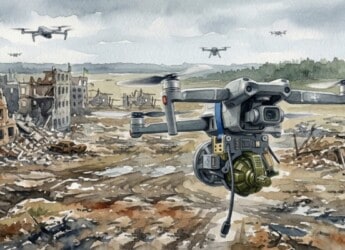

Editor’s Note: Diplomatic negotiations may be inching forward, but the war’s digital and tactical dimensions are accelerating in parallel. This current events analysis—based on developments tracked by the Institute for the Study of War (ISW)—highlights how battlefield technologies, from drones to spectrum warfare, are increasingly shaping the conditions for any sustainable peace. As U.S., Russian, and Ukrainian officials prepare to reconvene in Abu Dhabi, Moscow expands its Unmanned Systems Forces, and Kyiv formalizes its tech-forward defense posture.
This report is aimed at professionals who manage risk at the intersection of technology and law. The Abu Dhabi channel has shifted attention from political abstractions to practical design: verification, attribution, and compliance. Russia’s nationwide recruitment for the Unmanned Systems Forces and Ukraine’s appointment of counter-UAV and electronic warfare advisers show how drone warfare is being institutionalized. That shift reaches deep into corporate and government programs concerned with sanctions, export controls, evidence preservation, and secure data exchange.
For cybersecurity, data privacy, regulatory compliance, and eDiscovery professionals, the implications are immediate and material. Readers should track not only the talks’ content but the monitoring frameworks discussed around them, because those frameworks will determine how telemetry is collected, shared, and used in future litigation and accountability efforts. Verifiable digital records, trustworthy telemetry, and an enforceable chain of custody will be the foundation of any agreement capable of withstanding scrutiny.
Content Assessment: Negotiating Peace in a Drone War: Telemetry, Compliance, and Strategic Risk from Abu Dhabi to the Front
Information - 94%
Insight - 93%
Relevance - 91%
Objectivity - 92%
Authority - 94%
93%
Excellent
A short percentage-based assessment of the qualitative benefit expressed as a percentage of positive reception of the recent article from ComplexDiscovery OÜ titled, "Negotiating Peace in a Drone War: Telemetry, Compliance, and Strategic Risk from Abu Dhabi to the Front."
Russo-Ukrainian Conflict Update* – Geopolitics Beat
Negotiating Peace in a Drone War: Telemetry, Compliance, and Strategic Risk from Abu Dhabi to the Front
ComplexDiscovery Staff
The week’s most consequential moves happened far from the front. In Abu Dhabi, U.S., Russian, and Ukrainian envoys agreed to reconvene on February 1; in Moscow classrooms, defense recruiters pitched one-year contracts for Russia’s new Unmanned Systems Forces; and in Kyiv, the defense ministry elevated drone and electronic-warfare expertise inside its own walls. Together, these strands tell the story of negotiations advancing while the combatants double down on the technologies likely to shape any peace that follows.
Officials on all sides described the first UAE round as constructive and “progress-making,” with another session set for Sunday, February 1. Kyiv says the text of a U.S.–Ukraine security agreement is complete, awaiting a time and place for signature and subsequent ratification. The central fight over territory remains unresolved, and both Moscow and Kyiv publicly hold to long-stated positions even as channels stay open.
Ahead of and around the Abu Dhabi meetings, U.S. envoys Steve Witkoff and Jared Kushner repeatedly engaged senior Russian officials, a pattern of contact documented by independent reporting. The Kremlin, for its part, continues to cast the talks as a venue for advancing its preferred end-state while reiterating that Ukrainian troops must leave the areas of Donbas that Russia claims as its own. The choreography underscores how diplomacy and battlefield pressure are unfolding in parallel.
Moscow’s current line can be read in statements amplified by its foreign ministry and state media. Alexei Polischuk, who directs the Second Department for CIS Countries at Russia’s MFA, told Russian outlets that any settlement must address the “root causes” as Moscow defines them: a neutral, non-nuclear Ukraine; asserted protections for ethnic Russians and Russian speakers; leadership change in Kyiv; and rejection of Western security guarantees or foreign peacekeepers. Russian coverage also continues to invoke an “Anchorage formula” for territorial issues—language publicly associated with Kremlin aide Yuri Ushakov, not Polischuk—illustrating how multiple strands of messaging are being run at once.
Against that backdrop, Russia’s Defense Ministry launched a nationwide recruiting drive for its Unmanned Systems Forces (USF). State-aligned outlets highlight selection points in every region, simulator screening for FPV pilots, and one-year contracts that, in the ministry’s telling, guarantee discharge when the term ends. The campaign targets candidates with IT and radio-technical skills and signals the institutionalization of a drone arm designed to sustain attritional warfare.
Independent and opposition-leaning reporting paints a more complicated picture on campus. At the Higher School of Economics in Moscow, administrators circulated guidance offering students at risk of expulsion a “special” one-year contract in drone units with the promise of resuming studies later. Lawyers and journalists caution that students may actually be signing the standard Defense Ministry contract, which allows reassignment—including to infantry—and limits easy separation after twelve months. However, the legal details shake out, the episode shows how Russia is trying to square the need for specialized operators with the relentless demand for replacements at the front.
Kyiv’s answer this week was to formalize more technical expertise inside the Ministry of Defense. On January 22–23, Defense Minister Mykhailo Fedorov named volunteer Serhii Sternenko an adviser on increasing drone use at the front, a step the ministry announced publicly. On January 25, Ukrainian media and wires reported that Fedorov also appointed Serhiy “Flash” Beskrestnov—well known in radio-electronic warfare and open-source analysis—as an adviser on defense technology focused on counter-UAV and spectrum operations. Both moves point to a tighter loop between battlefield adaptation and ministry decision-making.
Even as diplomats talk, the war’s tempo has not slackened. AP and other outlets describe the UAE track moving in tandem with continuing long-range strikes, a split-screen that has persisted through January. That reality is why many European and U.S. analysts frame any deal in terms of pressure and verification: support that changes the battlefield calculus, sanctions that constrict Russia’s war economy, and monitoring that makes any post-deal violations visible and attributable.
What that monitoring looks like is still under discussion, but public briefings and coverage point in clear directions. European capitals are developing security guarantees and exploring monitoring architectures that blend manned inspections with drone and satellite observation, with the United States providing support. The exact sensor mix, data-sharing rules, and legal authorities remain open questions and should be treated as options on the table, not settled mechanisms.
For cybersecurity, information-governance, and eDiscovery professionals, these developments have practical implications. Any workable security arrangement will rely on trustworthy telemetry, a chain of custody for digital evidence, and audit-ready records that can stand up in court or before international bodies. Russia’s USF drive and Ukraine’s adviser appointments highlight the rising premium on RF engineering, firmware assurance, and the provenance of dual-use components. Those same themes will shape export-control compliance, sanctions screening, and the way digital exhaust—from drone flight logs to spectrum captures—enters formal investigative workflows. As envoys head back to Abu Dhabi, the question is whether verifiable guarantees and enforceable data controls can be put in place faster than both sides innovate on the battlefield.
Accessed Control of Terrain
Russo-Ukrainian-War-January-25-2026Primary News Sources
- Russian Offensive Campaign Assessment, January 25, 2026 (ISW)
- Geopolitics Archives – ComplexDiscovery
Additional News Sources
- Peace Talks Set To Resume Amid Ground Fighting, Severe Power Outages In Ukraine (Radio Free Europe)
- “The state will always deceive you”. Moscow’s elite HSE university lures failing students into “special” military contracts with no way back (Mediazona)
- Fedorov appoints Flesh as adviser on defence technologies (Ukrainian News)
Background Note: ComplexDiscovery’s staff offers distinctive perspectives on the Russo-Ukrainian war and Middle Eastern conflicts, informed by their military experience on the West German, East German, and Czechoslovakian borders during the Cold War, as well as in Sinai as part of Camp David Accord compliance activities, during the timeframe of the first Persian Gulf War. This firsthand regional knowledge has been further enhanced by recent staff travels to Eastern European countries, including Estonia, Finland, Latvia, Lithuania, and Poland. These visits have provided up-to-date, on-the-ground insights into the current geopolitical climate in regions directly impacted by the ongoing conflict.
Combined with cybersecurity, information governance, and eDiscovery proficiency, this multifaceted experience enables comprehensive analysis of these conflicts, including the critical impact of cyber warfare, disinformation, and digital forensics on modern military engagements. This unique background positions ComplexDiscovery to provide valuable insights for conflict-related investigations and litigation, where understanding the interplay of technology, data, and geopolitical factors is crucial.
Assisted by GAI and LLM Technologies
* Sourced and shared with permission from the Institute for the Study of War (ISW).
Additional Reading
- Freezing a Nation Into Submission: Russia’s Nuclear Substation Campaign and the Human Cost of Infrastructure Warfare
- Ballistic Blackmail and Maritime Shell Games: Russia’s Evolving Hybrid Front
- Anchor Drag or Hybrid Attack? Finland Detains’ Fitburg’ Crew Amid Cable Sabotage Fears
- Valdai, Veracity, and the Winter War: Russia’s Claims Collide with Evidence
- Narva May Not Be as Far Away as One Thinks: The Challenge of Cyber and Physical Borders
- Europe’s War at a Crossroads: Berlin’s “NATO-like” Assurances, Novorossiysk, and the Battle for Power
- The Fatal Ambiguity: How the Budapest Memorandum Haunts European Security
- How Finland Is Reshaping Defense: BORDERLAND at Slush 2025
- When Rails Become Battlefields: How Infrastructure Warfare Reshapes European Security
- NATO’s Counter-Drone Solution: Inside the Merops Deployment Reshaping European Air Defense
- Infrastructure Strike Escalation: Ukraine and Russia Trade Blows Across Critical Nodes
- From Dissent to OSINT? Understanding, Influencing, and Protecting Roles, Reputation, and Revenue
- Data Embassies: Sovereignty, Security, and Continuity for Nation-States
Source: ComplexDiscovery OÜ

ComplexDiscovery’s mission is to enable clarity for complex decisions by providing independent, data‑driven reporting, research, and commentary that make digital risk, legal technology, and regulatory change more legible for practitioners, policymakers, and business leaders.