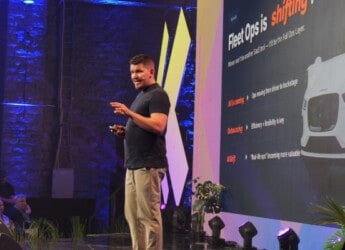

Editor’s Note: ComplexDiscovery will attend Latitude59 in Tallinn in May 2026, reporting from the event for the second consecutive year. Latitude59 occupies a specific and telling position in the European startup landscape. It sits at the intersection of ambition and practicality — drawing early-stage companies that are past the idea stage but not yet hardened by the demands of enterprise sales, cross-border operations, or regulatory scrutiny. That positioning makes it a useful lens for understanding what the next generation of companies will be asked to prove.
For cybersecurity, information governance, and eDiscovery professionals, this is worth watching carefully. The companies that come through competitions like Latitude59 — particularly those building in energy, construction, defence, and adjacent infrastructure categories — will arrive in enterprise procurement conversations faster than their founders often anticipate. When they do, the questions they face will not be limited to product capability. Buyers and investors increasingly treat operational trust as part of commercial viability: Where does the data live? Who has access, and on what terms? What retention and deletion policies are in place? What would an incident response look like at your current size, and what would it look like at three times the size?
These are not abstract concerns. They are the questions that stall deals, delay closes, and occasionally derail raises that seemed certain. For founders, the discipline to build audit trails, access controls, and information governance frameworks early — before they feel necessary — is one of the clearest signals of operational maturity. For investors doing diligence, the absence of that discipline is increasingly a yellow flag, particularly in regulated or infrastructure-adjacent sectors.
Latitude59’s pitch competition does not explicitly test these things. But the founders who go on to scale after the stage are often the ones who were already thinking about them. The event is a window into the questions companies are likely to face next—and whether they are ready to answer them.
ComplexDiscovery’s coverage of Latitude59 will focus on the intersection of technology, trust, and operational readiness as it applies to information governance, cybersecurity, and legal technology professionals.
Latitude59 Opens Pitch Applications as Investors Raise the Bar on Operational Readiness
Information - 93%
Insight - 92%
Relevance - 90%
Objectivity - 92%
Authority - 100%
93%
Excellent
A short percentage-based assessment of the qualitative benefit expressed as a percentage of positive reception of the recent article from ComplexDiscovery OÜ titled, "Latitude59 Opens Pitch Applications as Investors Raise the Bar on Operational Readiness."
Industry News – Technology Beat
Latitude59 Opens Pitch Applications as Investors Raise the Bar on Operational Readiness
The startups most likely to leave Tallinn with a term sheet this May may not just be the ones with the sharpest pitch. Increasingly, they will be the ones who can also answer what happens after the deal closes.
Latitude59, the Baltics’ flagship tech conference, has opened applications for its 2026 pitch competition, inviting early-stage startups to compete for investment when the event returns to Kultuurikatel in Tallinn, Estonia, on May 20–22. The application deadline is April 15, 2026.
CEO Liisi Org said the competition is designed to give ambitious teams a high-visibility shot at momentum, with founders from around the world encouraged to apply. “The Latitude59 stage is where early-stage startups can truly take off,” Org said, “and our goal is to give ambitious teams the chance to deliver a decisive pitch that sets them up for strong future growth.” Organizers said jurors, mentors, and investors will be on hand throughout the event, and expect new standout companies to emerge from this year’s stage.
The competition has grown into one of the largest in the New Nordic region. Last year, Latitude59 received 407 applications from 48 countries — a figure organizers cited as a signal of intensifying global competition for a limited number of stage slots. Winners will be announced on the main stage on May 22.
Organizers are looking for teams with a clear mission, a scalable business model, a functional product, and demonstrated traction or strong market feedback. That last criterion — market feedback — matters more than it might appear: it signals that a company has already faced real procurement and customer conversations, not just internal assumptions about demand.
The selection process runs in three stages. A TOP30 shortlist will be announced on April 29, with those teams entering pre-finals training from May 4–8. From there, 15 semi-finalists advance to compete on the main stage on May 21–22.
Real Capital, Real Scrutiny
The competition delivers tangible investment outcomes. In 2025, €675,000 was committed through the pitch competition, backed by regional business angel networks EstBAN, LatBAN, and LitBAN. Three companies secured investments ranging from €175,000 to €250,000: MarkeDroid, an Estonian green energy solutions developer; Adventum Tech, a Latvian construction startup; and Luna Robotics, a Lithuanian defence technology company. The competition’s longer alumni list includes ÄIO Tech, Flowstep, and Cino — and Estonian unicorn Wise, which gives some indication of the stage’s longer-term pedigree.
What makes those three sectors notable is not only their commercial promise but also their potential to transform the global economy. Energy infrastructure, construction supply chains, and defence technology are all categories where customer and investor diligence tend to sharpen quickly as companies grow. Questions about where data is stored, how access is controlled, what logs exist, and how quickly a company can respond to regulatory or contractual demands can arrive early — sometimes before a second meeting. Winning a pitch competition accelerates that timeline; it does not defer it.
Krista Meinarde, Latitude59’s head of startup and investor relations, said last year’s winners have already moved from stage exposure to measurable milestones. Luna Robotics has raised more than €1 million since the competition. MarkeDroid is scaling across Europe and expanding its team. Adventum Tech is expanding its international footprint, driven by strong revenue growth. “Competition will be fierce again this year,” Meinarde said, “and that’s exactly why we want the world’s most ambitious founders on the Latitude59 stage — ready to test themselves, impress our jury, and then take their impact to the international tech scene.”
Those conversations increasingly include questions that go beyond product features. As Baltic and Nordic investors have become more attentive to operational risk at the early stage, founders in infrastructure-adjacent categories face procurement diligence that can surface questions about information governance and incident response earlier than expected. A company that can demonstrate auditability, strong access controls, and a basic retention and deletion posture is better positioned to close deals after a successful raise, not just to win one.
A Global Stage With Tallinn at the Centre
This year, Latitude59 is framing its broader program under the theme “The Global Village Experiment,” built on the idea that the most valuable connections happen when ecosystems collide. Organizers said they aim to bring founders and ecosystem builders from more than 70 countries to Estonia in 2026, positioning Tallinn as a gateway to the New Nordics.
Meinarde’s point — that the stage accelerates conversations — applies in both directions. For investors, a pitch competition is one of the most efficient ways to surface companies they would not otherwise encounter. For founders, it is a forcing function: a fixed deadline, a strict time limit, and a room full of people whose job is to find the flaw in the story.
The strongest teams on that stage will be the ones who can explain not just what they are building, but how it holds up under pressure — from customers, from regulators, and from the infrastructure demands of scale.
Applications are open now at latitude59.ee. The deadline is April 15, 2026.
News Source
- Latitude59. (2026, March 4). Latitude59 opens applications for its pitch competition in Tallinn, Estonia [Press release]. https://latitude59.ee/pitch-competition/





Assisted by GAI and LLM Technologies
Additional Reading
- FutureLaw 2026 Preview: The Practical Path to Defensible AI in Legal Workflows
- The 2026 Event Horizon: Early Outlook for eDiscovery, AI, and European Innovation
- Data Provenance and Defense Tech: IG Lessons from Slush 2025
- Lessons from Slush 2025: How Harvey Is Scaling Domain-Specific AI for Legal and Beyond
- Kaja Kallas Warns of Democracy’s Algorithmic Drift at Tallinn Digital Summit
- The Agentic State: A Global Framework for Secure and Accountable AI-Powered Government
- When Founders Have Red Lines: Investing Beyond ROI at Latitude59
- At Latitude59, Estonia Challenges Europe: Innovate Boldly or Be Left Behind
Source: ComplexDiscovery OÜ

ComplexDiscovery’s mission is to enable clarity for complex decisions by providing independent, data‑driven reporting, research, and commentary that make digital risk, legal technology, and regulatory change more legible for practitioners, policymakers, and business leaders.