
Editor’s Note: A federal jury in Brooklyn convicted Huawei Technologies Co. on 10 of 12 counts Nov. 24, including conspiracy to steal trade secrets, bank and wire fraud, and violations of the International Emergency Economic Powers Act tied to Iran sanctions. Three subsidiaries, Huawei Device Co., Futurewei Technologies Inc., and Huawei Device USA Inc., were also convicted of conspiring to steal trade secrets and commit wire fraud, according to the verdict sheet.
Jurors acquitted all companies charged with racketeering conspiracy, a count prosecutors used to link roughly two decades of alleged conduct into a single criminal enterprise. Huawei and its U.S. device unit were also acquitted of conspiracy to obstruct justice. Huawei called the remaining charges without merit and said it plans to appeal.
According to Reuters, the Justice Department’s trial presentation included nondisclosure agreements Huawei signed with T-Mobile and antenna maker Quintel, as well as evidence that Huawei engineers copied Cisco router code and wrote Cisco’s name backward within the code. Prosecutors also presented a statement of facts stipulated to by Huawei’s chief financial officer in 2021. Sentencing is scheduled for Sept. 14, 2027. Key developments to watch include forfeiture proceedings, post-trial motions, and any appeal.
Content Assessment: Brooklyn jury convicts Huawei of trade-secret conspiracy and Iran sanctions crimes but rejects racketeering
Information - 93%
Insight - 92%
Relevance - 92%
Objectivity - 91%
Authority - 92%
92%
Excellent
A short percentage-based assessment of the qualitative benefit expressed as a percentage of positive reception of the recent article from ComplexDiscovery OÜ titled, "Brooklyn jury convicts Huawei of trade-secret conspiracy and Iran sanctions crimes but rejects racketeering."
News Analysis – eDiscovery and Information Governance Beat
Brooklyn jury convicts Huawei of trade-secret conspiracy and Iran sanctions crimes but rejects racketeering
ComplexDiscovery Staff
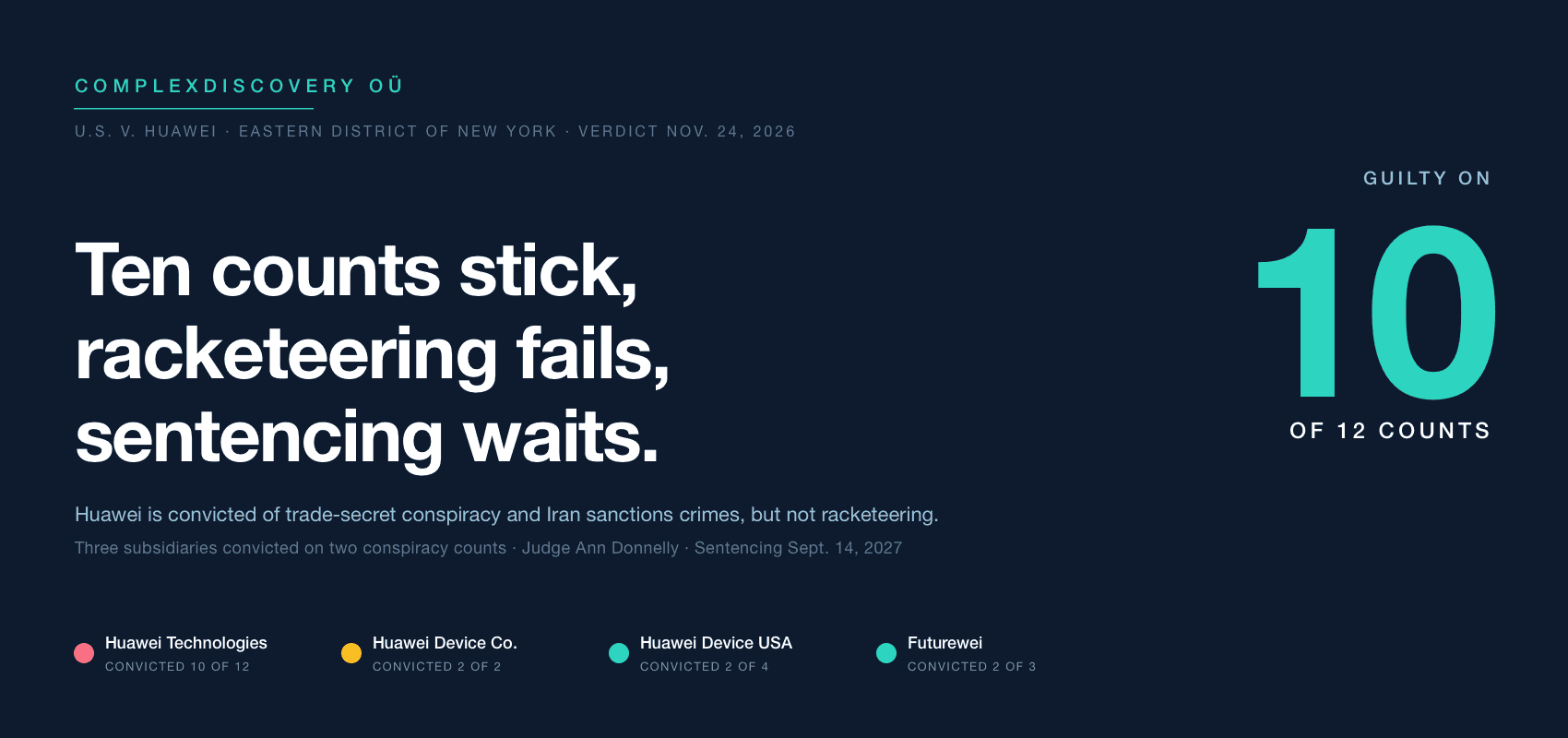
A Brooklyn federal jury convicted Huawei Technologies on 10 of 12 counts Nov. 24, including trade-secret conspiracy and Iran sanctions violations, convicted three subsidiaries on two conspiracy counts and acquitted Huawei of racketeering conspiracy.
Among the evidence the Justice Department says it proved at trial is copied Cisco router source code in which Huawei engineers referred to Cisco by its name spelled backward, “ocsic.”
What the jury decided in Brooklyn
The four defendants were Huawei Technologies Co. Ltd., the parent company, and Huawei Device Co. Ltd., both based in Shenzhen, China, along with two U.S. subsidiaries, Futurewei Technologies Inc. and Huawei Device USA Inc., according to the Brooklyn U.S. attorney’s office. The Justice Department listed the offenses of conviction as conspiracy to steal trade secrets, conspiracy to commit wire and bank fraud, wire fraud and bank fraud. It added conspiracy to defraud the United States, conspiracy to violate the International Emergency Economic Powers Act (IEEPA), substantive IEEPA violations and money laundering conspiracy. The U.S. attorney’s office said one or more of the companies was convicted of each crime it listed, without saying which.
The verdict sheet, a copy of which was posted online by the website ipfray.com, shows how the counts divided. Huawei Technologies was found guilty on Counts 2 through 11 and not guilty on Count 1, racketeering conspiracy, and on Count 12, conspiracy to obstruct justice. Each subsidiary was found guilty on Count 2, conspiracy to steal trade secrets, and on Count 3, conspiracy to commit wire fraud, the only two counts Huawei Device Co. faced. Futurewei and Huawei Device USA were also acquitted on Count 1, and Huawei Device USA on Count 12, so the sanctions, bank fraud and money laundering convictions belong to Huawei Technologies alone.
Neither Nov. 24 government release mentions the acquittals. The racketeering count was the one the AP called the most serious charge Huawei faced, and prosecutors had told jurors that the misconduct reached the top of the company. Assistant U.S. Attorney Meredith Arfa said “the tone was set at the top by Huawei leaders and executives who themselves engaged in criminal conduct,” the AP reported, in remarks Newsweek placed in closing arguments. Those executives, she said, were “trying to interfere with the very criminal investigation that led to this case.” A not-guilty verdict means jurors did not find a count proved beyond a reasonable doubt, and no report reviewed for this article cites any explanation from jurors for either acquittal.
How the case narrowed before trial
The racketeering count was a later addition to a case that began with allegations of misleading banks. Prosecutors added it, along with the trade-secret conspiracy charge, in a 16-count superseding indictment returned in February 2020, according to a department release from that month. The racketeering count sought to join conduct spanning about 20 years into a single criminal agreement, Law Commentary reported. The case then shrank before jurors saw it. In a Sept. 4 filing, prosecutors told U.S. District Judge Ann Donnelly that they would not proceed on two counts of an April 2026 superseding indictment, leaving 12 of 14 counts, according to a Fierce Network opinion column whose author said FNTV obtained the filing.
Jury selection was set for Sept. 8, Reuters reported in June, and the trial opened the next day, Al Jazeera reported. In the weeks that followed, Reuters and Law Commentary reported, over 60 prosecution witnesses and 15 defense witnesses testified before Donnelly in a trial where no individual executive or employee was a defendant.
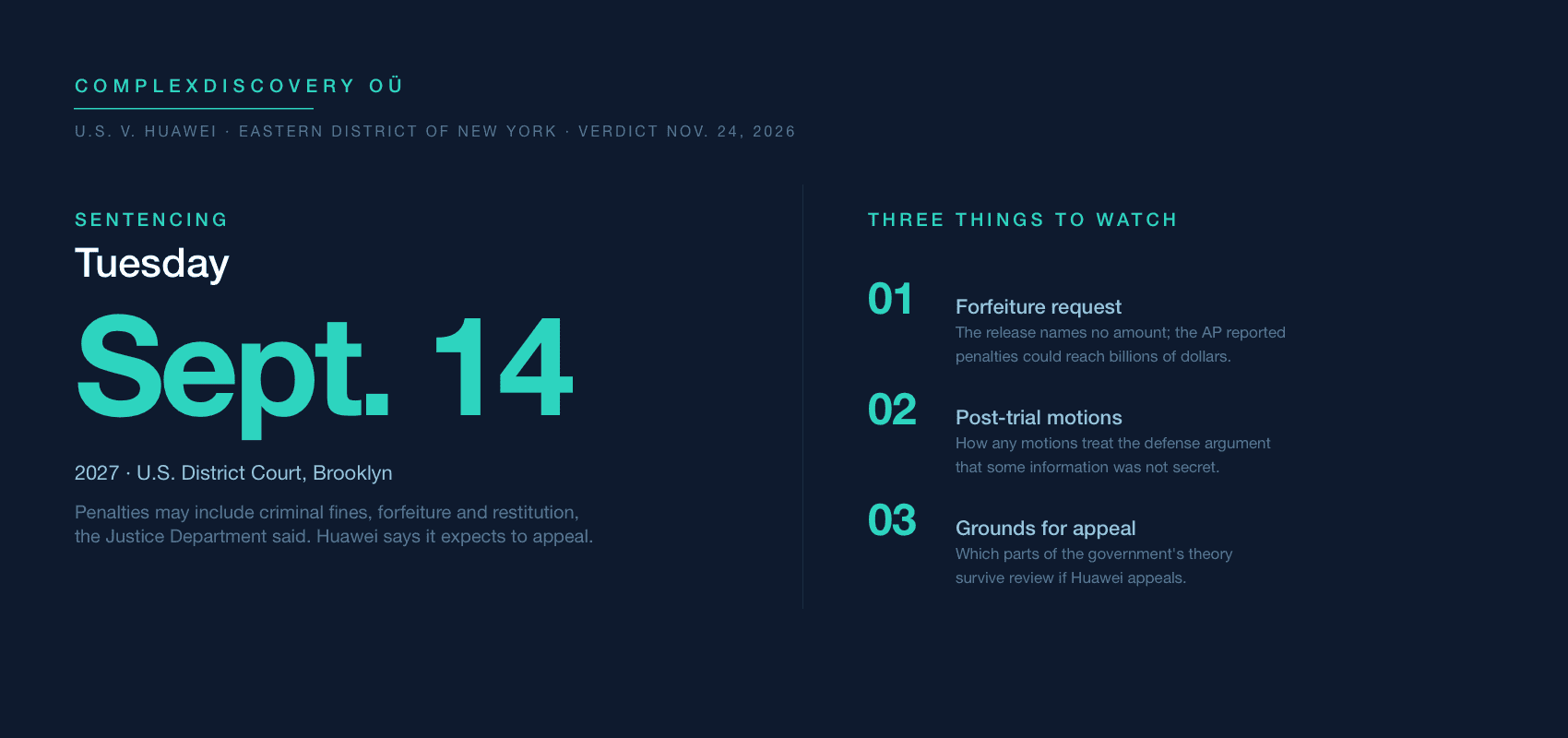
Sentencing is set for Sept. 14, 2027. The department said the companies face criminal fines, forfeiture and restitution, and that a federal district judge will decide any sentence by weighing the U.S. Sentencing Guidelines along with other factors set by statute. The AP reported that the penalties could reach billions of dollars, though the department’s release names no forfeiture amount.
Evidence the government says it proved
The trade-secret count, one of the two counts on which all four companies were convicted, is the part of the case the department describes in the most detail. Its release lists five trade-secret examples among what it calls many proved at trial, and it mentions a nondisclosure agreement (NDA) in two of them. Huawei signed an NDA with T-Mobile covering Tappy, a robot T-Mobile used to test how touch screens respond to a human touch, while “fully intending to violate the agreement,” the department said. Huawei employees in the United States then sent photos of the robot and technical details about it to China. When that data fell short, an employee carried part of the robot out of T-Mobile’s laboratory in his backpack, according to the release. Reuters and Law Commentary reported that jurors were shown video that, according to prosecutors, captured the episode.
The second NDA involved Quintel, a U.S. antenna maker. Huawei obtained Quintel’s confidential information under the agreement and almost immediately applied for a patent on technology built on Quintel’s idea, attaching a confidential Quintel slide to the application, the department said. In a third example, a Huawei employee who was caught photographing Fujitsu equipment carried a badge falsely identifying him as an employee of “Weihua,” according to the release. In a fourth, Huawei hired a university researcher to arrange a collaboration with CNEX, a U.S. technology company that would not work with Huawei directly. That researcher then gave Huawei confidential information and direct access to CNEX hardware without disclosing that he was acting on Huawei’s behalf, the department said.
The fifth example, involving Cisco, left the most memorable paper trail. Huawei copied source code used on Cisco routers, code the release says was identified as the “crown jewel” of Cisco technology, and engineers at Huawei left Cisco’s notes in the code while referring to Cisco as “ocsic,” the department said. U.S. Attorney Joseph Nocella Jr. of the Eastern District of New York called the conduct “blatant thefts from U.S. technology companies.”
The sanctions counts, which only the parent company faced, rest on separate conduct involving a company called Skycom. The department said Huawei operated in Iran under the Skycom name and helped the Iranian government and Zaeim, which the release describes as a component of Iran’s intelligence apparatus, monitor and censor users’ internet access. Huawei lied to banks about that business to secure billions of dollars along with access to clearing services in U.S. dollars, the department said. It also falsely described Skycom to the U.S. government, journalists and banks as a business partner, when Skycom was in fact a subsidiary wholly owned by Huawei, according to the release.
Huawei’s answer and the appeal ahead
Huawei disputes that account and plans to appeal. Defense attorney Brian Heberlig called the racketeering and obstruction acquittals “a vindication of the company and its good-faith compliance culture,” the AP reported. In his closing argument, Heberlig said much of the material the government called stolen was already public, telling jurors, “You can’t steal a secret that isn’t a secret,” according to the AP. That argument turns on the statutory definition: under federal law, information counts as a trade secret only if its owner has taken “reasonable measures to keep such information secret.” The information must also derive “independent economic value, actual or potential, from not being generally known to, and not being readily ascertainable through proper means by,” others who could profit from its disclosure or use.
Heberlig also said that when Huawei discovered the copied Cisco code, it recalled routers it had sold in the United States and offered customers Cisco routers in their place, the AP reported. In a statement posted Nov. 25, Huawei said the five “trade secret-related disputes” the government cited were all civil matters resolved over the past two decades. “No court ever found Huawei liable for willful intellectual property misappropriation, and the company was never ordered to pay damages for trade secret misappropriation,” the company said, calling the remaining charges “equally without legal or factual merit.” Chinese officials have accused Washington of “economic bullying” and of invoking national security as a pretext against Chinese companies, the AP reported.
Why the record matters for information governance
Whoever prevails on appeal, much of the proof the department describes came from records Huawei and its own people created. NDAs, photographs sent abroad, a patent application with a partner’s slide attached and code notes pointing back to their source all appear in the department’s account of the trial evidence.
A pretrial ruling applied the same logic to an executive’s own words. In 2021, Chief Financial Officer Meng Wanzhou signed a deferred prosecution agreement to resolve the criminal charges she faced and stipulated to an attached four-page statement of facts, the agreement shows. In that statement, she admitted she had lied to a financial institution about whether Huawei was complying with sanctions and export control law, Reuters reported. In June, Donnelly ruled that prosecutors could use the statement against Huawei, Reuters reported. As Reuters quoted the ruling, the judge wrote that Meng remained Huawei’s chief financial officer, that the statement concerned what she did in that job and that Huawei had adopted it. Reuters also reported that the judge rejected Huawei’s argument that it kept a right to stay silent notwithstanding the statement. At trial, prosecutors gave jurors the statement attached to Meng’s agreement, Reuters reported; Meng did not testify, and no report reviewed for this article describes how jurors weighed the statement.
For legal and compliance teams, the practical lesson sits in the partner file rather than on the verdict form. Teams that run technical exchanges under NDAs should confirm that their records capture what was shared, by whom and when, because in this case records of that kind became evidence. Security teams should treat physical access to test labs and prototype equipment as part of the confidentiality program rather than a facilities matter, since the T-Mobile episode ended with a component leaving the lab in a backpack. Litigation and investigations teams should note that a statement of facts an executive stipulates to in resolving her own case can later be admitted against the company. Reuters’ account of the ruling points to Meng’s continuing role, the link between the statement and her job, and Huawei’s adoption of it. ComplexDiscovery has not reviewed the order, and the ruling as reported does not establish that every such document comes in against an employer.
What to watch before sentencing
Vendor-risk teams face a different question, because a jury verdict and a sanctions or export designation are separate legal events. The AP describes Huawei as one of the world’s largest suppliers of equipment for wireless networks. The company has been on a U.S. trade blacklist since 2019, Newsweek reported, and the AP reported that the company has been barred for years from selling equipment to American carriers. Those teams should record the conviction in their files on Huawei and its affiliates, noting which company was convicted of what, and watch for any agency action that follows rather than assume the verdict itself changes a screening list.
Several questions remain open before sentencing and through any appeal. The first is what forfeiture the government seeks, and the second is how any post-trial motions treat the defense argument that some information was not secret. The third is which grounds Huawei raises if it appeals, as it has said it expects to, and the answers will shape both what Huawei pays and which parts of the government’s theory survive review.
Cisco’s code surfaced in Huawei software over two decades ago, Heberlig said, and the “ocsic” notes the department describes still reached a Brooklyn jury in 2026, years after the recall he described. Which records in your organization would tell the story of a partnership that went wrong, and who has read them lately?
News Sources
- Chinese Tech Giant Huawei and Subsidiaries Convicted of Sanctions Violations, Fraud, Conspiracy to Steal Trade Secrets, and Money Laundering (U.S. Department of Justice)
- Chinese Telecommunications Conglomerate Huawei and Subsidiaries Convicted of Sanctions Violations, Bank and Wire Fraud, Conspiracy to Steal Trade Secrets, and Money Laundering (U.S. Attorney’s Office, Eastern District of New York)
- Chinese Telecommunications Conglomerate Huawei and Subsidiaries Charged in Racketeering Conspiracy and Conspiracy to Steal Trade Secrets (U.S. Department of Justice)
- United States v. Huawei Technologies Co., Ltd., et al., Verdict Sheet (Court Exhibit 2) (U.S. District Court for the Eastern District of New York, via ipfray.com)
- United States v. Wanzhou Meng, Deferred Prosecution Agreement and Statement of Facts (executed) (U.S. Department of Justice)
- Statement on the Jury Verdict in the U.S. District Court for the Eastern District of New York (Huawei)
- 18 U.S. Code § 1839: Definitions (Legal Information Institute, Cornell Law School)
- China’s Huawei convicted in sprawling US criminal trial over Iran business (Reuters via MarketScreener)
- Chinese Tech Giant Huawei Is Guilty of Conspiracy to Steal Trade Secrets, US Jury Finds (The Associated Press via U.S. News & World Report)
- Why have US prosecutors labelled China’s Huawei a criminal enterprise? (Al Jazeera, with AP and Reuters)
- Huawei CFO’s admissions can be used at criminal trial, US judge rules (Reuters via Al Jazeera)
- Huawei Convicted on 10 Counts, Acquitted of Racketeering (Law Commentary)
- Huawei Racketeering Trial Goes to Jury After Two Months (Law Commentary)
- Huawei convicted in US as Chinese tech giant emerges as Nvidia rival (Newsweek)
- Opinion: Huawei trial opens in Brooklyn as DOJ drops some charges (Fierce Network)





Assisted by GAI and LLM Technologies
Additional reading
- Signal turns on screenshot blocking to limit operating-system AI access to its chats
- Oregon and Virginia sue SpaceX over what Grok’s makers said about safety
- Commerce makes overseas data centers answer for who rents their advanced chips
- Johnson Controls agrees to pay $5 million over alleged security plan gaps in federal contracts
- Officials tie FAA ground stop to contractor router work, not hackers, but the specific fault is still undetermined
Source: ComplexDiscovery OÜ

ComplexDiscovery’s mission is to enable clarity for complex decisions by providing independent, data‑driven reporting, research, and commentary that make digital risk, legal technology, and regulatory change more legible for practitioners, policymakers, and business leaders.