Editor’s Note: Mistral AI Chief Financial Officer Johan Bergqvist told a Slush 2026 audience in Helsinki on Nov. 19 that companies need to own and control their AI and secure the supply chain behind it. He spoke hours before Anthropic began trading on Nasdaq in what CNBC called the biggest IPO on record. His interviewer, Christian Vogel-Claussen, runs Alanda Capital, a London growth equity firm invested in both Mistral and Anthropic. Bergqvist said the strongest open-source models can handle 99 percent of a company’s use cases, a figure he offered without a benchmark; Mistral itself calls its models open-weight, meaning their trained weights are published for others to run. He said Mistral has no plans yet for an IPO date.
For cybersecurity, information governance and eDiscovery professionals, his argument makes model choice a supply-chain question. In June, a U.S. export-control directive barred foreign nationals from two Anthropic models, and Anthropic initially switched both off for every customer; Fable 5, the public model, returned globally July 1. Watch Mistral’s progress toward about 200 megawatts of European compute by the end of 2027.
Content Assessment: Mistral's CFO tells Slush companies need to own and control their AI as Anthropic heads to Nasdaq
Information - 93%
Insight - 94%
Relevance - 95%
Objectivity - 92%
Authority - 94%
94%
Excellent
A short percentage-based assessment of the qualitative benefit expressed as a percentage of positive reception of the recent article from ComplexDiscovery OÜ titled, "Mistral's CFO tells Slush companies need to own and control their AI as Anthropic heads to Nasdaq."
News Analysis – Artificial Intelligence Beat
Mistral’s CFO tells Slush companies need to own and control their AI as Anthropic heads to Nasdaq
ComplexDiscovery Staff
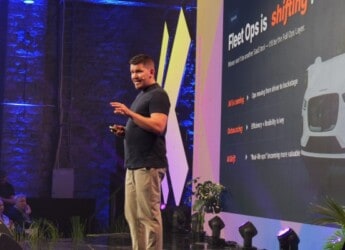
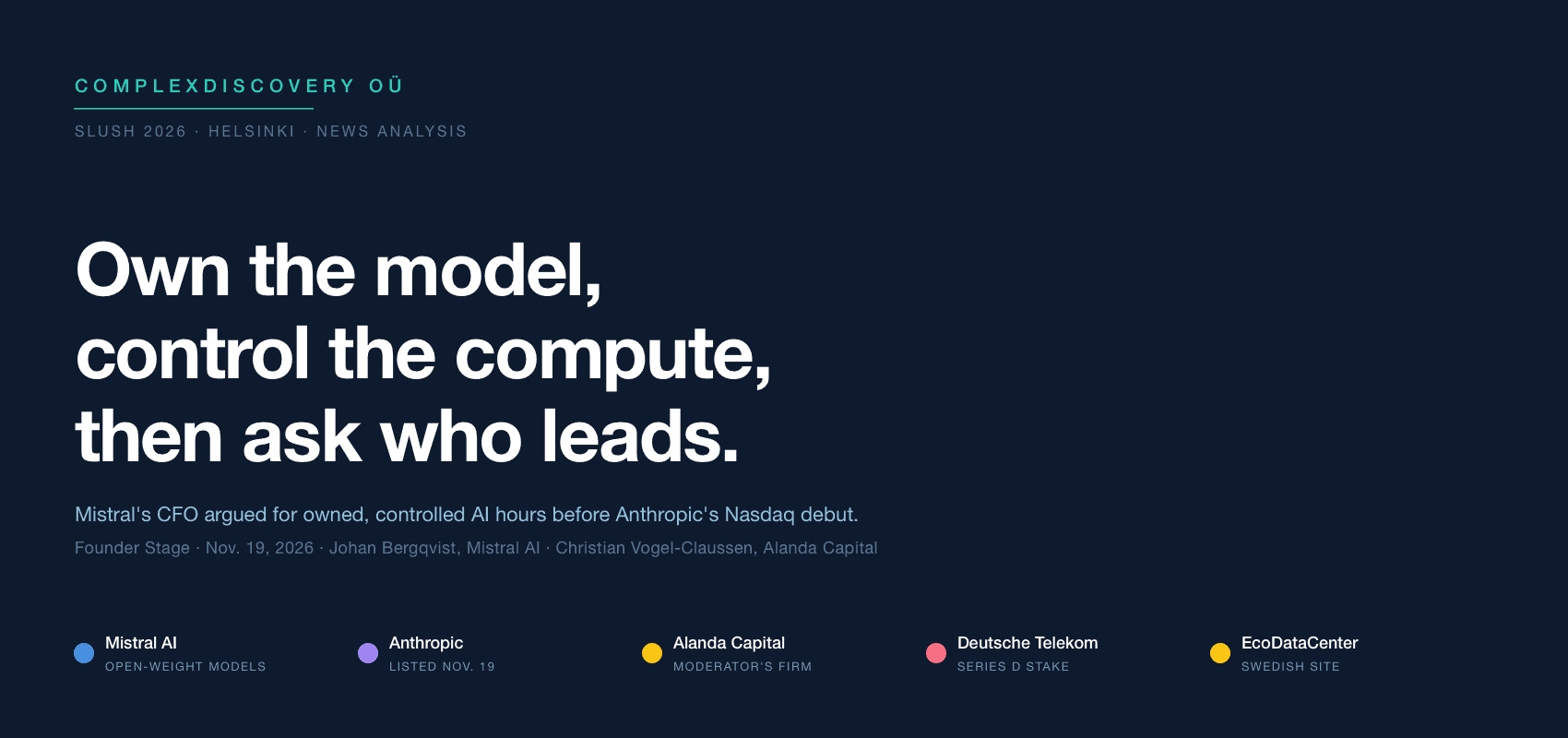
Hours before Anthropic began trading on Nasdaq, Mistral AI Chief Financial Officer Johan Bergqvist told a Slush audience in Helsinki on Nov. 19 that companies need to own and control their AI and the supply chain behind it.
His case for open-source models and owned computing capacity was a financing argument as much as a technical one. It also runs straight into the questions that legal, security and governance teams ask whenever confidential client or corporate data meets a model their organization does not control.
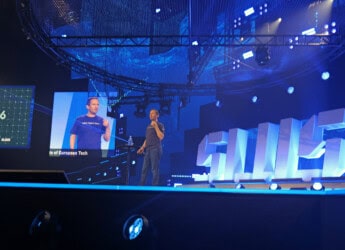
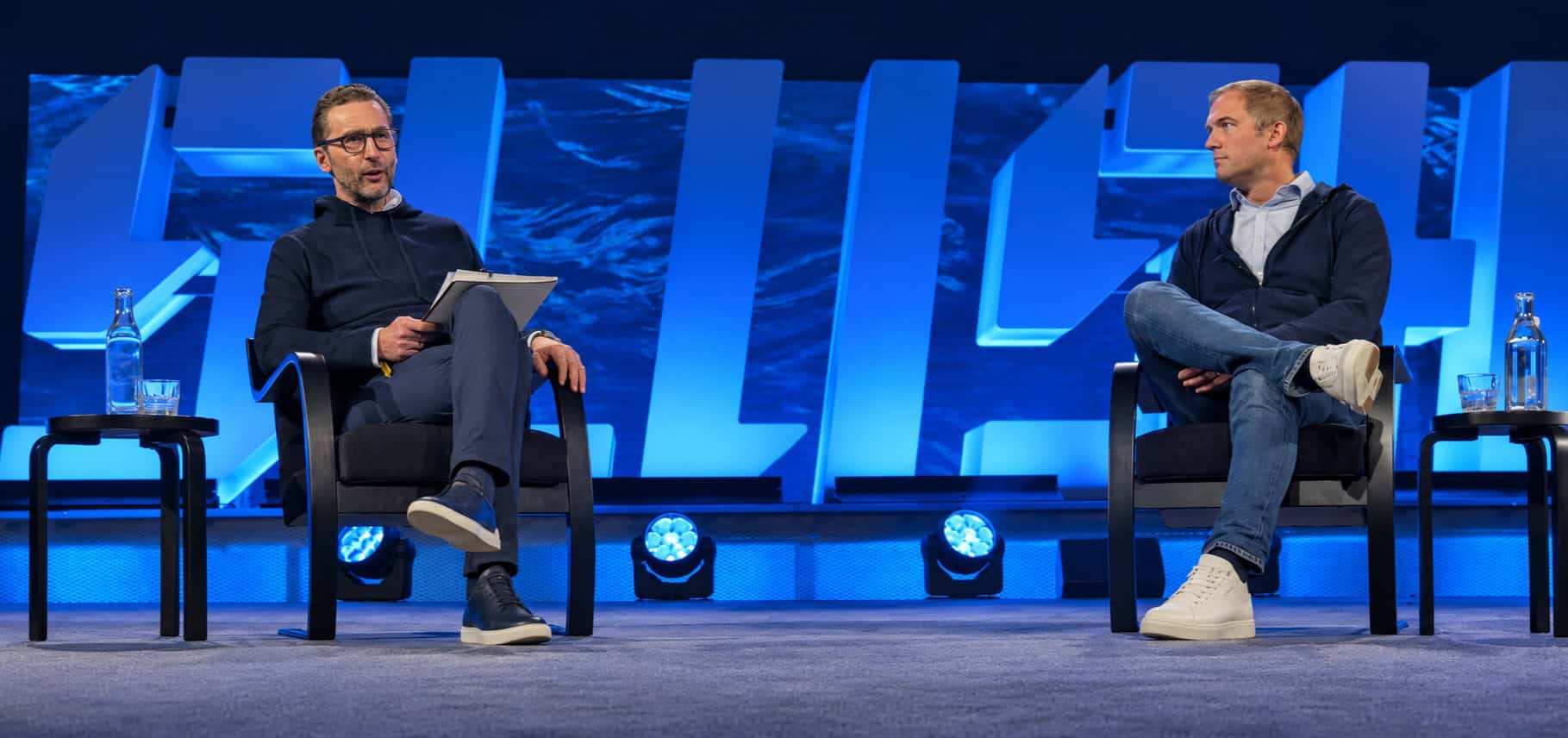
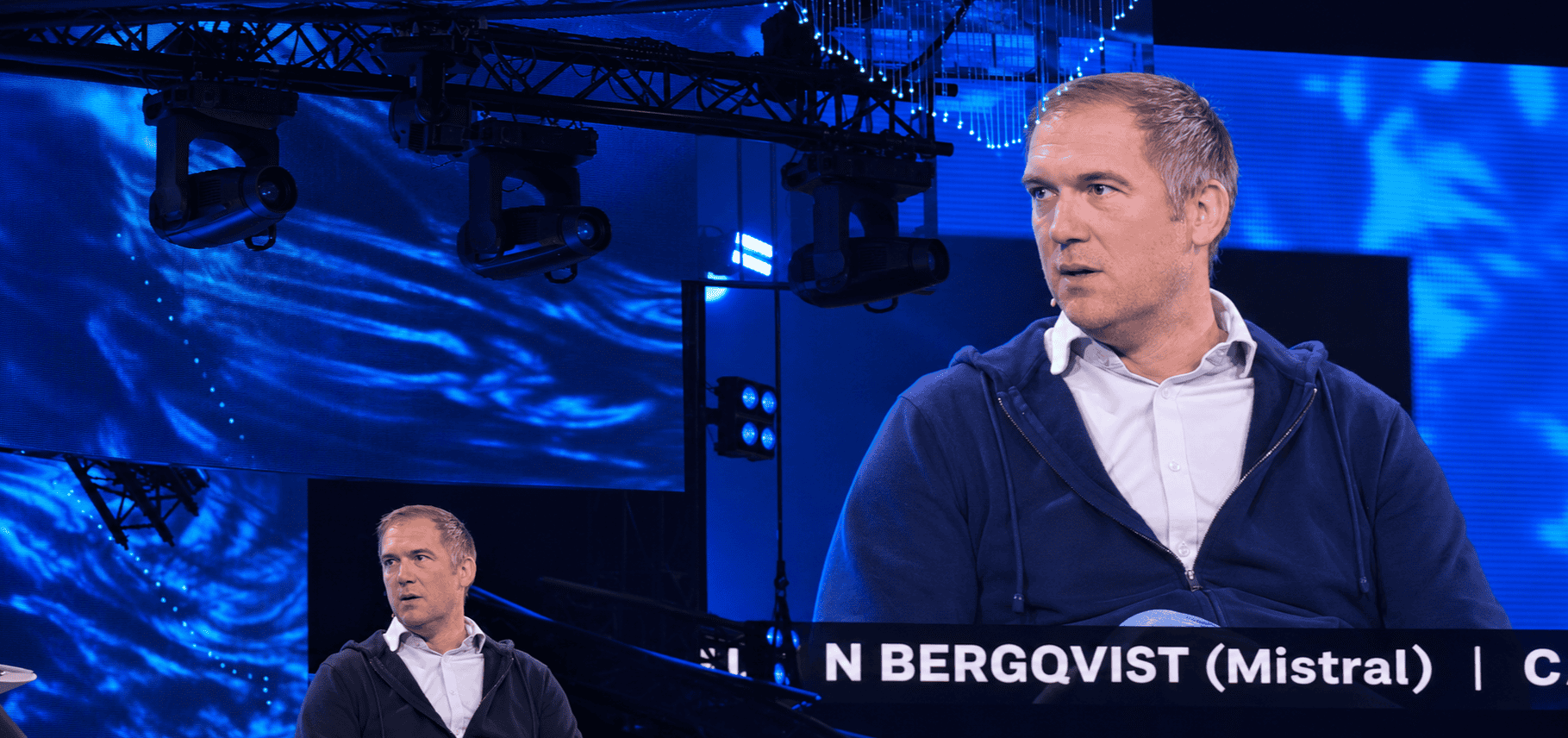
Bergqvist made the argument during a 25-minute Founder Stage conversation titled “Is the Future of AI Open Source? Who Will Lead?” His interviewer was Christian Vogel-Claussen, founder and chief executive of Alanda Capital, a London growth equity firm whose portfolio, according to his Slush biography, includes Anthropic, Mistral and Legora, a Swedish legal AI company. That gave the moderator’s firm a financial stake on both sides of the open-versus-closed question the session was built around, and Vogel-Claussen opened by noting that Anthropic would go public within hours.
Anthropic’s listing framed the conversation
The timing was not subtle. Anthropic priced its offering at $83 a share on the evening of Nov. 18, U.S. Eastern time. Its shares opened at $111.50 when trading began just before noon in New York on Nov. 19 and closed the day at $97.17, about 17 percent above the offer price. CNBC called the $81.3 billion raise the biggest initial public offering on record, ahead of SpaceX’s June listing. The National put the total at $107.3 billion once a $26 billion private placement, set to close with the offering, is included.
Mistral works at a different scale. The Paris company announced a Series D of 3 billion euros on Sept. 8 at a post-money valuation exceeding 21 billion euros. Samsung Electronics led the round, with the EQT-managed Scaleup Europe Fund and existing investor PSG Equity as co-leads. Mistral described it as the biggest equity raise any European technology company has completed, coming three years after the company launched. Deutsche Telekom disclosed its own stake in that round on the day of the session. Its T.Capital Tech Fund had invested 100 million euros, the company said, as a first step toward a partnership offering Mistral’s models to companies and public bodies in Germany.
Asked on stage when Mistral would list, Bergqvist said “there’s no plans around the date today.” Going public at some point remains the company’s mission, he said, but a company only three years old needs more time to build its business. That matches what he told Reuters in September, when he called a stock market listing an option for the company but said its timing was still up in the air.
Owning the model, by the CFO’s account
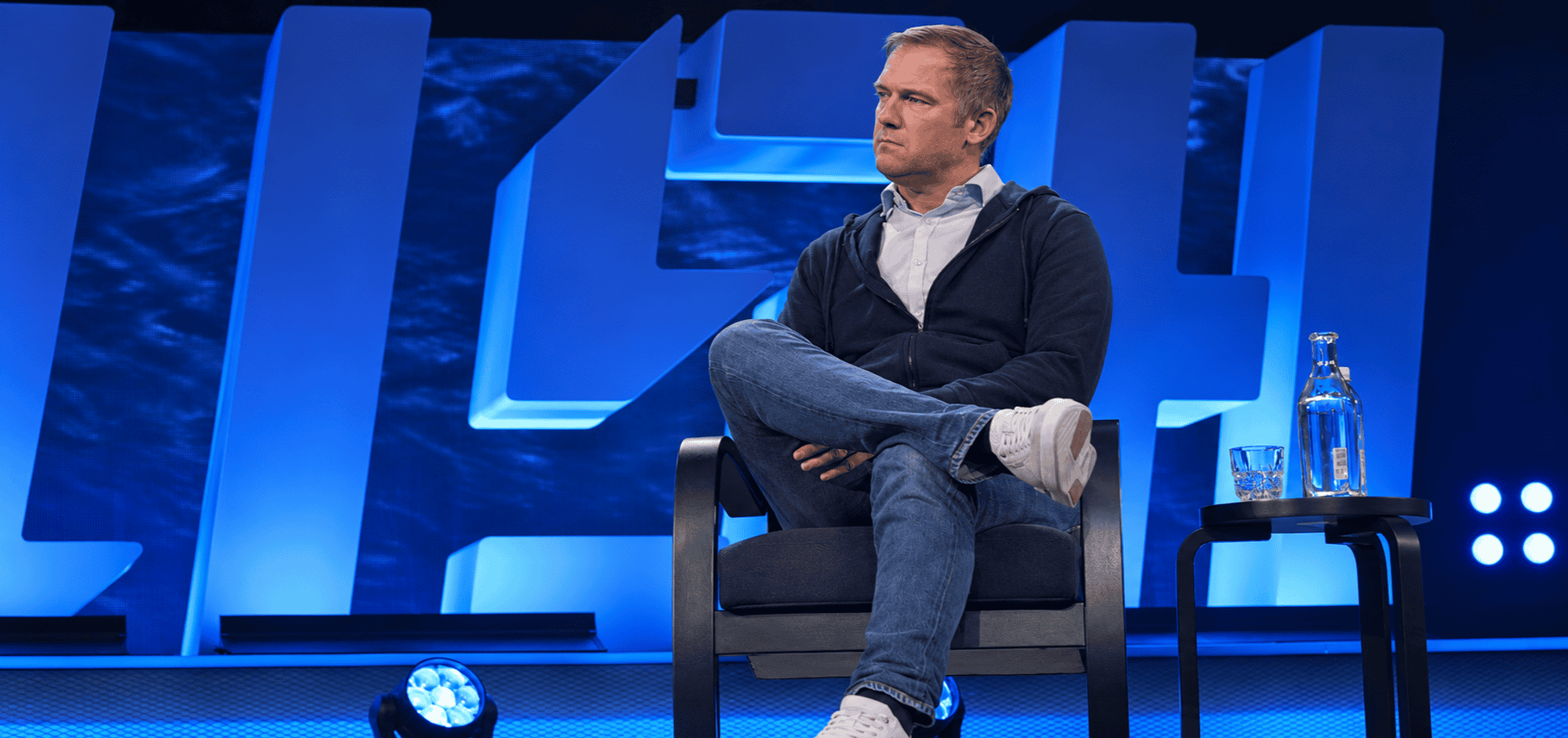
Valuation was the backdrop, but control became the subject once Vogel-Claussen turned to companies and governments that “want to own the AI rather than rent it.” Bergqvist answered in supply-chain terms. “It’s pretty common sense that you need to own and control your own intelligence as a company,” he said, and companies must also make sure they secure their own supply chain. If the worst happens, he said, a dependent business “becomes almost obsolete and cannot compete on the same terms.”
Open source is most often the answer, in his account, because the performance gap with leading closed models has narrowed. Bergqvist said today’s best open-source models can handle 99 percent of the use cases a company has, at lower cost and with tighter control, without a company uploading its most confidential data into a cloud “black box.” The figure is his own and was offered without a benchmark, from the finance chief of a company that sells open models. He added that in large enterprises the outcome depends on deployment and customization for a specific use case as well as on the model’s capability. A company that optimizes only the model, he said, gains no edge over a rival running the same one.
A vocabulary point matters for anyone carrying that argument into a contract review. Bergqvist spoke of open source, while Mistral’s own Series D announcement describes its models as “open-weight.” The Open Source Initiative, which maintains the Open Source AI Definition, says the two terms are often used interchangeably even though open-source AI models offer benefits that an open-weight release does not. In practice, “owning” an open-weight model means controlling where and how it runs under the terms of its license, not holding title to the model itself.
Why Mistral wants its own compute
Control, in Bergqvist’s account, extends below the model to the computing capacity it runs on. He called compute both the enabler and the bottleneck of the industry, with a large imbalance between supply and demand. Mistral needed to own that part of its supply chain, he said, for its own model training, for certainty of access and to lower training costs it could pass on to customers. He also argued that Europe should not let all of its AI infrastructure be taken up by U.S. or Chinese hyperscalers with balance sheets large enough to lock up capacity for roughly five years.
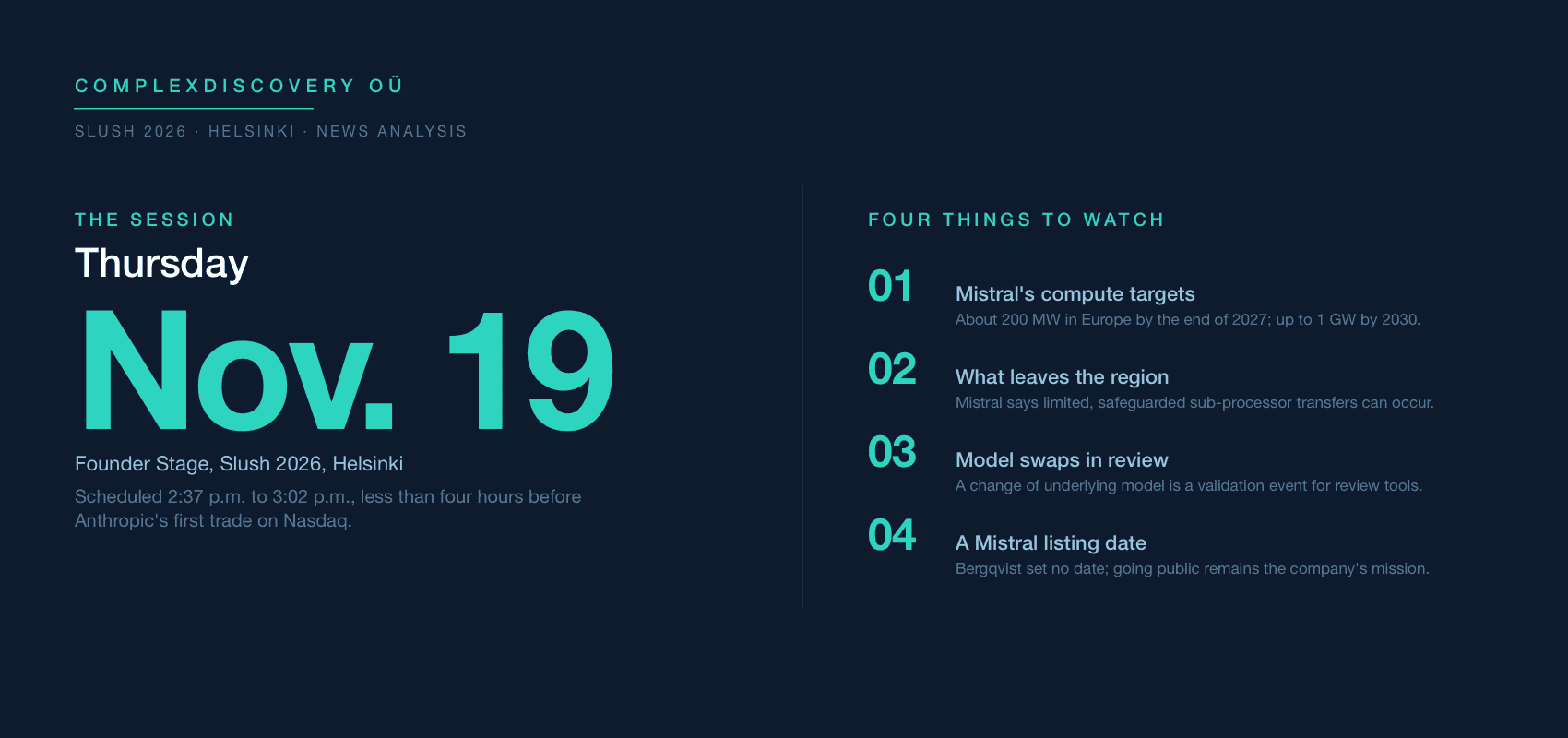
The build-out behind that argument is on the record, and it leans on lenders and partners. In March, Mistral raised $830 million in debt from seven banks for a 44-megawatt data center at Bruyères-le-Châtel, south of Paris, financing that DatacenterDynamics said was for the purchase of 13,800 Nvidia GB300 chips for the site. Euronews reported in September that Mistral has one facility running outside Paris and another under construction in Sweden, a project Mistral announced with EcoDataCenter in February for that company’s Borlänge site. Mistral had said in March that it aims to deploy 200 megawatts across Europe by 2027, and by late May it had set a one-gigawatt goal for 2030. On Aug. 11 it restated both targets and tied them to multiyear purchase commitments from ASML, Amadeus, Capgemini, Caisse des Dépôts and CMA CGM. Mistral calls those forward commitments European Compute Units, which customers can spend on its compute products once the capacity is built. Microsoft agreed in July to spend billions of dollars on Mistral’s European computing infrastructure, according to Reuters, though it did not join the Series D.
That Microsoft deal complicates the sovereignty story. European Business Magazine pointed out that Microsoft will consume part of the new capacity, which places a U.S. hyperscaler among the anchor customers of a build-out that Mistral presents as securing Europe’s AI sovereignty. Finnish President Alexander Stubb made a related point at the Slush opening session a day earlier, saying no country, the United States and China included, is fully technologically sovereign, though Europe is more dependent.
The capital gap is just as stark. Mistral Chief Executive Arthur Mensch told a French parliamentary inquiry in May that building one gigawatt of capacity takes about $50 billion of investment over five years. Atomico’s State of European Tech 2026 report, released at Slush on Nov. 18, put the United States at just over 72 percent of global AI compute capacity and Europe at about 7 percent. Atomico based that share on AI chips delivered between 2022 and mid-2026, expressed in Nvidia H100 equivalents, a measure that tracks where chips landed rather than who owns or runs them.
On stage, Bergqvist acknowledged that Europe has ground to make up on compute. He said all of Mistral’s contracts are profitable because the company is sales-led. That claim is his own, and the session offered no figures to support it. Model making, he said, is the part Mistral must subsidize because of compute costs and capital spending. Much of that spending can be financed, he said, though some equity is still required. He put the U.S. ambition at somewhere between 100 and 150 gigawatts, “who knows in the end,” and said whoever holds the most compute will be best placed to keep building and innovating.
Capital, talent and the case for an early CFO
Money alone will not close that gap, he argued. “Capital in itself is not a strategy,” Bergqvist said, citing companies that raised heavily, deployed it inefficiently and failed. Europe’s advantages, in his telling, are its industrial base and its talent pool, including some of the best people now working for American companies, whom he counted as European because they are based in Europe and come from there. He urged European companies to work together more. Mistral pays well for talent, he said, and in some months has hired the equivalent of as much as 10 percent of its entire company.
Asked when founders should hire a finance chief, Bergqvist started from cash: companies “go bust because they can’t pay their bills.” He said founders should bring in a CFO early and look for a good capital allocator who questions where the company invests. Many companies fail, he said, because they assume the next raise will go as smoothly as the first and leave too little time to plan it. He then turned to Spotify’s April 2018 direct listing on the New York Stock Exchange, which he worked on as part of Spotify’s finance leadership. Spotify chose that route, he said, because it did not need to raise capital and wanted to communicate with the whole market rather than through underwriters, a choice that did not make him popular with bankers.
What legal, security and governance teams can take from it
Strip out the financing advice, and the session’s sharpest point for practitioners was the one Bergqvist framed as common sense: dependence on a few model providers is a supply-chain risk. The year has already supplied an example he did not mention. On June 12, the U.S. Commerce Department ordered Anthropic to suspend access to its Claude Fable 5 and Mythos 5 models by any foreign national, inside or outside the United States. Anthropic said complying meant switching off both models for every customer, since it could not separate users by nationality in real time.
Mythos 5, which had been available only to partners in Project Glasswing, Anthropic’s cybersecurity initiative, came back first, for a set of U.S. organizations, after government approval on June 26. The department lifted the directive on June 30, and Fable 5, the version Anthropic had released to the public only days before the order, returned globally on July 1. For nearly three weeks, then, access to Anthropic’s newest public model depended on a government order outside any customer’s control.
That episode suggests a practical checklist. Information governance teams should ask every AI vendor which model sits underneath its product, where inference runs and whether the contract allows a substitute model if the original becomes unavailable. Mistral, for its part, introduced regional endpoints in August that let customers choose Europe or the United States for inference. Mistral says inference stays in the chosen region “subject to limited, safeguarded transfers to sub-processors that may occur outside that region,” and that kind of qualification is exactly what the vendor questions should bring to the surface. Teams running eDiscovery and investigations should treat a model change as a validation event, because results validated on one model are not automatically validated on its replacement.
Self-hosting is not free of risk either. Running open-weight models on infrastructure an organization controls can keep confidential data out of a model provider’s cloud, but it moves patching, access control, logging and incident response onto the deploying organization’s security team. Bergqvist’s “right model for the right use case” point, including his warning against paying a “10X premium” for mundane tasks, also argues for tiering AI use by sensitivity and cost rather than sending every document through the most expensive system.
The session was scheduled to end at 3:02 p.m. in Helsinki, less than four hours before Anthropic’s first trade in New York. By Nasdaq’s 4 p.m. close, 11 p.m. in Helsinki, Anthropic’s shares stood 17 percent above their offer price. Mistral’s finance chief, by then, had asked for more time and argued that owning the model and the compute beneath it is how a company, or a continent, keeps control. If owning the model has become a supply-chain decision, who in your organization signs off on which model is allowed to touch the evidence?
News sources
- Statement on the US government directive to suspend access to Fable 5 and Mythos 5 (Anthropic)
- Redeploying Fable 5 (Anthropic)
- In-region inference, open models, and new European infrastructure for sovereign AI (Mistral AI)
- Mistral raises €3B to make sovereign, open-weight AI the technology frontier (Mistral AI)
- Mistral AI and EcoDataCenter Partner to Build AI-focused Data Center in Sweden (EcoDataCenter via Mynewsdesk)
- Deutsche Telekom backs Mistral with €100 million investment to lay groundwork for sovereign AI partnership (Deutsche Telekom via EuropaWire)
- Compte rendu de réunion n° 42: Commission d’enquête sur les dépendances structurelles et les vulnérabilités systémiques dans le secteur du numérique et les risques pour l’indépendance de la France (Assemblée nationale)
- Speakers (Slush)
- The AI Era Arcs Toward Openness (Open Source Initiative)
- Anthropic blocks all customers’ access to Fable 5 and Mythos 5 (Engadget)
- Legal Considerations Related to the Anthropic “Export Controls Directive” (Just Security)
- US lifts restrictions on Anthropic’s powerful AI models Fable and Mythos (Al Jazeera)
- Anthropic IPO takeaways: ANT debuts with $1.8 trillion market cap in landmark moment for AI (CNBC)
- Anthropic shares close 17 percent above IPO price after volatile Nasdaq debut (The National)
- Anthropic IPO Live: ANT’s First Day of Trading, Updated Step by Step (Stock Titan)
- French AI company Mistral hits $24 billion valuation in funding round (Reuters via Euronext)
- Deutsche Telekom is investing about $110 million in French AI startup Mistral AI (Quartz)
- Mistral AI raises record €3 billion in Samsung-led funding round (Euronews)
- Mistral raises €3B as sovereign AI becomes big business (TechCrunch)
- Mistral AI raises $830M in debt to set up a data center near Paris (TechCrunch)
- Mistral raises €3bn in Series D led by Samsung Electronics (DatacenterDynamics)
- Mistral secures $830M from seven banks to build its own AI data centre (The Next Web)
- Five of Europe’s biggest companies just bought compute Mistral has not built (The Next Web)
- ASML, Amadeus and others commit to backing Mistral’s data centre buildout (Sifted)
- Mistral AI vise une capacité de calcul d’un gigawatt à l’horizon 2030 (Maddyness)
- Mistral Targets 1GW of European Compute by 2030 (European Business Magazine)
- Spotify Case Study: Structuring and Executing a Direct Listing (Harvard Law School Forum on Corporate Governance)
- Johan Bergqvist (MarketScreener)
- Christian Vogel-Claussen (Informa Connect)
- Why Legora isn’t building its own model (Sifted)
- Atomico report projects a decade high in European founders and a halved share of global capital (ComplexDiscovery)
- Stubb tells Slush that Finland’s AI bet runs through data centers, quantum and clean power (ComplexDiscovery)
- Slush 2026 brings a smaller, sharper bet on European startups to Helsinki (ComplexDiscovery)

Assisted by GAI and LLM Technologies
Additional reading
- Välimäki and Donahue tell DECOI x Borderland founders to test in Ukraine and plug into NATO’s data layer
- Days before Slush, an attack on Estonian drone maker Threod raises the stakes for defense tech
- Before the Abu Dhabi talks, a claimed Rosstat leak and hacked alert apps test what can be confirmed
- Spoofed nuclear alert caps four days of Ukraine war assessments that separate claims from evidence
- Kyiv says Starshield speeds are back, but who capped them is still disputed
- Diesel license, Starshield cap and intelligence warnings strain US support for Ukraine
- Drones hit two Yandex data centers, and a Kremlin decree sets terms for state management
- A cell tower near Lyman and Russia’s fight over its own war record
- How a general’s walk across a bridge tested Putin’s claim to Svyatohirsk
- Germany names Russia for the Leipzig drone, and keeps most of its evidence out of view
- Estonia scrambled jets over a drone no official has identified
- Russia leans on drones and dissent-proofing as fuel crisis bites
- Senate passes Graham sanctions act, shifting Russia pressure from policy to statute
Source: ComplexDiscovery OÜ
ComplexDiscovery’s mission is to enable clarity for complex decisions by providing independent, data‑driven reporting, research, and commentary that make digital risk, legal technology, and regulatory change more legible for practitioners, policymakers, and business leaders.