

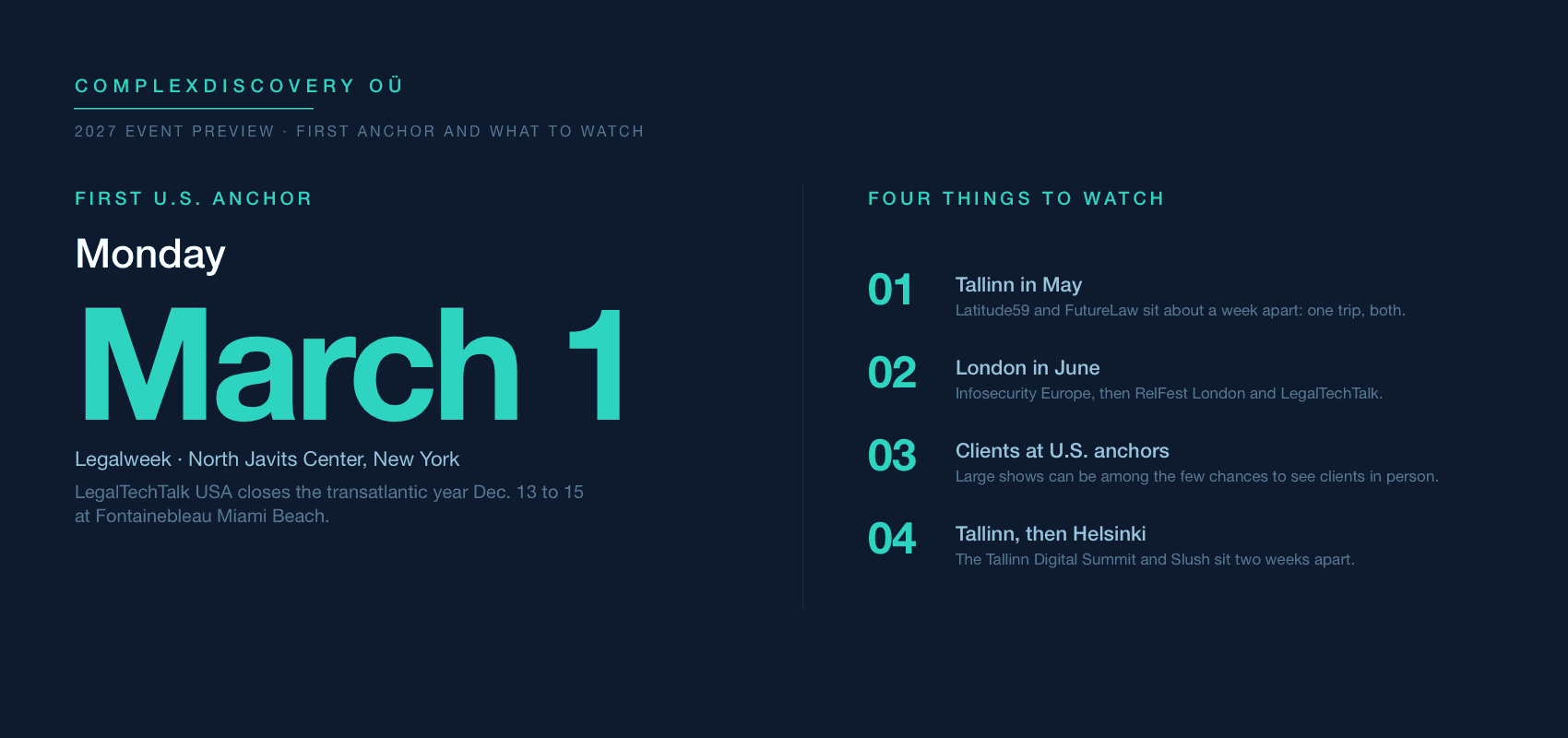
Editor’s Note: Organizers have begun setting the 2027 conference calendar for cybersecurity, information governance and eDiscovery professionals, with Legalweek in New York on March 1 to 3 and the first U.S. edition of London’s LegalTechTalk at Fontainebleau Miami Beach on Dec. 13 to 15. This preview narrows over 100 events to a short list centered on Tallinn, Helsinki, Dublin and London, plus those two U.S. anchors, and revisits what 2026 coverage of eight European gatherings showed.
Why it matters: event choices shape which regulators, investors and clients a team hears from early. The preview argues that Nordic-Baltic investment trends and technology trajectories belong in market diligence and business development, because innovation from these hubs is shaping markets and policy across Europe. Smaller venues, such as the invitation-only Tallinn Digital Summit, can offer closer access to the people writing data and AI rules, while large U.S. shows can be among the few chances each year to see existing clients in person.
Disclosure: ComplexDiscovery OÜ’s editor and managing director, Rob Robinson, also serves as chief marketing officer of HaystackID. The views expressed are ComplexDiscovery’s and do not necessarily reflect those of HaystackID.
Content Assessment: The 2027 event horizon: Europe's smaller rooms and the transatlantic legal tech calendar
Information - 93%
Insight - 94%
Relevance - 91%
Objectivity - 90%
Authority - 93%
92%
Excellent
A short percentage-based assessment of the qualitative benefit expressed as a percentage of positive reception of the recent article from ComplexDiscovery OÜ titled, "The 2027 event horizon: Europe's smaller rooms and the transatlantic legal tech calendar."
News Analysis – Events Beat
The 2027 event horizon: Europe’s smaller rooms and the transatlantic legal tech calendar
ComplexDiscovery Staff
Slush, the Helsinki startup event its organizers call Europe’s largest gathering of venture capital, did something few conferences advertise in 2026: it set out to get smaller on purpose. When Slush named Noora Saksa chief executive on Jan. 27, it said the November event would cut its audience by 10 percent to better serve the early-stage startups at its core.
For cybersecurity, information governance and eDiscovery professionals now planning 2027 travel, that choice works as a planning rule. A useful calendar pairs the anchor shows where existing clients gather with smaller rooms built to keep signal from turning into noise, and many of those rooms sit in Europe’s smaller capitals rather than on its largest exhibit floors.
The 2027 event calendar compiled for this preview from organizer announcements, as of Nov. 23, 2026, lists over 100 conferences, running from the Congressional Investigations Forum in Washington on Jan. 20 to LegalTechTalk USA in Miami Beach in December. The full list appears at the end of this article; the analysis narrows it to Europe’s events in Tallinn, Helsinki, London and Dublin, plus two U.S. anchors: Legalweek in New York and the first LegalTechTalk USA. The selection reflects a view formed across a year of reporting from these venues: Nordic-Baltic investment trends and technology trajectories belong in market diligence and business development, not on the sidelines. The innovation coming out of these hubs is shaping markets and policy across Europe.

Why Nordic-Baltic trends belong in market diligence
The policy half of that view rests on this publication’s June review of seven European events across four cities, which spanned late 2025 and the first half of 2026. The review described sovereignty moving from policy rhetoric into concrete obligations and pointed to defense technology data provenance, regulatory sandboxes, authentication of synthetic evidence and retention of off-channel messages. Those items were a mix of new requirements, proposals and recommendations made from conference stages, so not all of them bind anyone yet. The review also argued that small states such as Estonia, Finland and Ireland are setting rules that larger markets may later adopt.
For a U.S. legal team, those developments can reach daily work quickly. An exemption under Estonia’s planned sandbox framework, a regulator’s priorities in Dublin or a procurement threshold discussed in Helsinki can shape where data sits, which vendor may process it and what an authority may later request. Practitioners who track those developments early can adjust data maps, vendor contracts and preservation protocols while the choices are still inexpensive, instead of reacting once an obligation arrives in a client alert.
The market half shows up in investment flows. Latitude59, Estonia’s flagship startup conference, markets Tallinn as a gateway to the New Nordics, a region its organizers describe as having the most unicorns per capita in Europe. The startups those investors back in 2027 are the review platforms, AI tools and security vendors that legal and compliance teams may be asked to evaluate a year or two later. Watching the pitch stage is a practical form of early vendor due diligence.
Tallinn and Helsinki anchor the New Nordics calendar
Tallinn holds three of the European events on this short list. Latitude59 returns to Kultuurikatel, a former power plant on the city’s waterfront, on May 19 through 21, 2027, according to its organizers. FutureLaw, the legal innovation conference that filled the Port of Tallinn cruise terminal on May 14 and 15, 2026, is set for May 27 and 28, 2027. The 10th Tallinn Digital Summit, the annual forum hosted by the prime minister of Estonia, is set for Nov. 3 and 4.
The summit shows most clearly why format matters. Its 2026 edition was built as an invitation-only forum for political, business, financial, digital and defense leaders, held while Estonia chaired both the Nordic-Baltic Eight and the Digital Nations group. In a room designed that way, a compliance officer or legal technologist hears ministers and agency heads frame policy before it is written down, often in sessions small enough to allow a follow-up conversation afterward.
Helsinki closes the European short list. Slush’s 2026 main event ran Nov. 18 and 19 at Messukeskus, the Helsinki Expo and Convention Centre, with Investor Day and a founders’ program on Nov. 17. Slush 2027 is set for Nov. 17 and 18. Alongside the main event in 2026, the Finnish Business Angels Network and Borderland, an Eastern Finland testing network, organized the DECOI x Borderland summit. It offered something a large hall cannot: a single day in which generals, defense founders and angel investors discussed the same readiness thresholds in one room.
The pairing of these cities also simplifies logistics. Latitude59 and FutureLaw fall about a week apart in May, and the Tallinn Digital Summit and Slush sit two weeks apart in November. A team planning around either month can cover both capitals in one trip, using the ferry connections between Helsinki and Tallinn that Latitude59’s organizers promote to visitors.
Dublin and London carry the governance conversation
From the Baltic, the governance thread runs west to Ireland. Dublin Tech Summit, which held its 10th edition at the Royal Dublin Society on May 27 and 28, 2026, is listed for May 26 and 27, 2027, the week after Latitude59, according to event listings that cite the organizer. Dublin’s role as the regional base for Europe, the Middle East and Africa at some of the largest global technology companies makes the summit a governance venue as much as a technology show. In 2026, William Fry’s Barry Scannell told its main stage that Ireland acts as the world’s de facto AI regulator, and the panel then spent the session on the compliance costs behind that role.
London concentrates the legal technology side of the European year in June. LegalTechTalk returns on June 16 and 17, 2027, to the InterContinental London, The O2, according to the event’s own pages, after organizers reported over 5,500 attendees and over 400 speakers across eight stages for the 2026 edition. RelFest London, Relativity’s two-day event for its community in Europe, the Middle East and Africa, is set for June 14 and 15, the same week. A week earlier, organizers list Infosecurity Europe for June 8 through 10 and Legal Geek Growth for June 9. Later in the year, Legal Geek returns to London in October, and Legal Innovators UK is listed for Nov. 2 and 3.
London’s value is density, and so is its risk. Two weeks that stack Infosecurity Europe, RelFest London and LegalTechTalk reward teams that book meetings before arrival and choose sessions by the decision they need to make, not by the brand on the stage.
Legalweek and LegalTechTalk USA frame the transatlantic year
Across the Atlantic, the U.S. calendar opens earlier than it did in 2026. Legalweek moves to March 1 through 3, 2027, at the North Javits Center in New York, according to its organizer, Centellic, the trading name of ALM Global; the 2026 edition ran March 9 through 12. The event’s page anticipates about 10,000 legal professionals, which would keep it among the largest rooms on the U.S. legal technology calendar.
The newer U.S. anchor arrives at year-end. On June 17, 2026, LegalTechTalk announced LegalTechTalk USA, its first event outside Europe, set for Miami in December 2027, with 55 founding launch partners and 72 confirmed speakers at the time of the announcement. Bradley Collins, LegalTechTalk’s co-founder and chief executive, presented Miami as a meeting point for legal leaders from the United States, Latin America and other regions. In July, the events company Hyve Group announced that it had acquired LegalTechTalk and would support the U.S. launch. The event’s site now lists Dec. 13 through 15, 2027, at Fontainebleau Miami Beach.
Together, the two U.S. events bracket the year and test the European argument from the other side. A London-born format is betting that conversations built in Europe will travel to American and Latin American audiences. Professionals who attend LegalTechTalk in both London and Miami Beach can compare how the same providers frame AI, privacy and data governance for clients on each side of the Atlantic.
Beyond Europe: Why the full calendar still matters
That comparison depends on being in both rooms. Since the pandemic, a handful of conferences each year has become, for many legal technology and cybersecurity professionals, one of the main places where clients, providers and peers still meet face to face. That is a working assumption drawn from this publication’s reporting, not a measured finding, and the industry research supports a narrower point. Freeman, an event-services company, said in its review of 2025 that face-to-face remains the most trusted marketing channel. Cvent, which sells event software, surveyed 1,067 full-time marketers in the United States and United Kingdom with a hand in their companies’ events programs for its 2026 Event-Led Growth Report. It reported that 72 percent of marketers say deals close faster when prospects attend events, without stating whether that share covers the full sample, and the report discusses owned, sponsored and partner events as well as virtual formats.
The value is not only in new business. In a post on B2B event strategy, Forrester said the largest and most mature organizations in its research were notably more likely to use events to strengthen existing customer relationships and identify expansion opportunities. Bizzabo, another event-software provider, says events are increasingly measured on pipeline influence, deal velocity and customer retention. For a provider or a law firm, skipping Legalweek, ILTACON, RelFest Chicago or the IAPP Global Summit can mean giving up one of the few chances in a year to see an existing client in person. That is why the full calendar of over 100 events, U.S. anchors included, runs alongside this European short list.
Budgets push the other way. Forrester, describing the 2026 event market, said budgets are constrained and competition for attendees has intensified. That squeeze is the practical reason to plan the year as a whole: the anchor shows that keep existing relationships warm, plus a few smaller European rooms where the next rules and vendors first appear.
Smaller rooms, closer access to decision-makers
Those smaller rooms earn their place for a different reason. Legalweek’s exhibit hall shows much of the U.S. market in one building, but the 2026 record suggests that the emerging venues offered something the largest shows struggle to provide: time with the people who set rules and allocate capital. FutureLaw described its 2026 audience as about 500 practitioners, technologists and policymakers. At DECOI x Borderland, the commander of the Finnish Army, Lt. Gen. Pasi Välimäki, shared a keynote stage with Christopher Donahue, a retired U.S. Army general, before an audience of early-stage defense founders, and Välimäki said both were offering personal opinions rather than official positions.
The practical lesson is to treat these events as listening posts with an agenda. Before attending, write down two or three questions that a regulator, investor or procurement official in the room could answer, and request meetings through the matchmaking tools that Slush and LegalTechTalk both promote. Afterward, record which themes repeated across venues, because a concern raised in Tallinn in May and again in London in June is worth tracking toward U.S. clients before it reaches them.
What the 2026 circuit showed
Those repeated themes ran through this publication’s 2026 coverage tied to eight European gatherings. FutureLaw opened in Tallinn on May 14 by asking who governs the governors, and its second day attached costs to that framing, from the future of the billable hour to what legal teams should build next. Latitude59 opened with Estonia presenting a planned sandbox framework for legal exemptions and closed with sessions on AI sovereignty, a driverless vehicle permit and up to 450,000 euros in syndicated investment commitments across three startups.
In Dublin, coverage moved from Ireland’s regulatory weight to a forensic problem, as deepfakes forced a reckoning over whether digital evidence presented in disputes and investigations can still be trusted. London’s June week produced two eDiscovery stories. At RelFest London, Relativity bet that legal teams will query their data conversationally, with citations, rather than only search it. During LegalTechTalk week, the story was off-channel communications enforcement crossing the Atlantic, told through HaystackID’s launch of a mobile-messaging compliance tool timed to the London event.
November returned the circuit to the Baltic and the Nordics. The ninth Tallinn Digital Summit opened Nov. 5 on who keeps control of AI systems that act on their own and closed Nov. 6 on whether people can still check what those systems do. In Helsinki on Nov. 17, Donahue urged DECOI x Borderland founders to test their technology in Ukraine and set out NATO’s data requirements. He said NATO will help companies at lower technology readiness levels, the nine-step scale used to rate a technology’s maturity, but cares about levels 7 to 9. Välimäki said the army engages from level 7 upward and pointed founders toward Arctic Strike 26. A day later, Finnish President Alexander Stubb used a fireside session after the Slush 2026 opening show to frame artificial intelligence around national, economic and social security.
Read in sequence, those reports show a single argument about control of data, models and defenses gaining specificity as it moved from Tallinn to London and back to Helsinki. Slush set out to trim its crowd to make that kind of signal easier to hear, and the same test applies to every invitation on the 2027 calendar. When your team builds its travel plan, which rooms will keep you close to the clients you serve, which will put you in front of the people writing next year’s rules, and which will only add to the noise?
Disclosure: ComplexDiscovery OÜ’s editor and managing director, Rob Robinson, also serves as chief marketing officer of HaystackID. HaystackID is a founding launch partner of LegalTechTalk USA and lists Legalweek 2027 and LegalTechTalk 2027 among its planned events. It also appears in two of the 2026 stories cited here: its mobile-messaging compliance launch during LegalTechTalk week and the Dublin deepfake coverage, which featured two of its executives. ComplexDiscovery OÜ covered Latitude59 on press credentials and has no media partnership with the event. ComplexDiscovery OÜ is a private limited company registered in Estonia, and two of its staff members are e-residents of Estonia. The views expressed are ComplexDiscovery’s and do not necessarily reflect those of HaystackID.
If your organization has eDiscovery-related events you would like added, amended, or corrected, please click here to provide the appropriate updates.
- Event Name
- Date (Month/Dates)
- Website (URL For More Information)
- Event Scheduling Changes (If Applicable)
News sources
Updated: November 2026
- Slush 2026 (Slush, Jan. 27, 2026)
- Slush Impact Report Series: Slush Startup Report 2026 (Slush)
- Event Info (Slush)
- Where the boldest minds (Latitude59)
- Benchmark Legal Conference (FutureLaw)
- How to Thrive in the Agentic Era? (Tallinn Digital Summit, International Centre for Defence and Security)
- Pitch at DECOI × Borderland 2026 (Finnish Business Angels Network and Borderland)
- Dublin Tech Summit (Dublin.ie)
- Dublin Tech Summit (Business & Finance, April 20, 2026)
- RelFest London (Relativity)
- Infosecurity Europe (Infosecurity Europe)
- LEGAL GEEK GROWTH 2027 (Legal Geek)
- THE HOME OF LEGAL INNOVATION (Legal Geek)
- Event profile: Dublin Tech Summit (Dealroom)
- Europe’s Event for Legal Transformation (LegalTechTalk)
- Legalweek New York 2027 (Legalweek (Centellic))
- Legal Week New York (Clocate)
- LegalTechTalk to launch in the USA (Legal IT Insider)
- Press Release: LegalTechTalk USA launches in Miami (LegalTechTalk USA)
- Hyve enters Legal SuperVertical with acquisition of LegalTechTalk (Hyve Group, July 2026)
- Freeman Trends Report: Highlights of 2025 and a look ahead to 2026 (Freeman)
- The 2026 Event-Led Growth Report (Cvent)
- The Events Industry’s Top Marketing Statistics, Trends, and Benchmarks for 2026 (Bizzabo)
- How Leading Organizations Are Rethinking B2B Event Strategy (Forrester)
- The Next Era Of B2B Events: Eight Data-Backed Shifts Defining 2026 (Forrester)
- Nine months across Europe’s tech-sovereignty arc, from Tallinn to London (ComplexDiscovery)
- FutureLaw 2026 opens in Tallinn with a sharp question: who governs the governors? (ComplexDiscovery)
- FutureLaw 2026 closes: hard truths, the billable hour, and what gets built next (ComplexDiscovery)
- Estonia opens Latitude59 with sandbox framework for legal exemptions (ComplexDiscovery)
- Latitude59 final day in Tallinn: AI sovereignty, a driverless permit and €450,000 to three startups (ComplexDiscovery)
- Ireland’s AI regulator role gets a hard look at Dublin Tech Summit (ComplexDiscovery)
- When you can’t trust the evidence: deepfakes force a forensic reckoning in Dublin (ComplexDiscovery)
- Relativity bets legal teams will talk to their data, not just search it (ComplexDiscovery)
- Europe’s off-channel reckoning: HaystackID bets COMET on a messaging crackdown crossing the Atlantic (ComplexDiscovery)
- Tallinn Digital Summit opens on who holds the rope in the agentic era (ComplexDiscovery)
- Tallinn Digital Summit closes on whether humans can still check what AI does (ComplexDiscovery)
- Välimäki and Donahue tell DECOI x Borderland founders to test in Ukraine and plug into NATO’s data layer (ComplexDiscovery)
- Slush 2026 brings a smaller, sharper bet on European startups to Helsinki (ComplexDiscovery)
- Stubb tells Slush that Finland’s AI bet runs through data centers, quantum and clean power (ComplexDiscovery)












Assisted by GAI and LLM Technologies
Additional Reading:
- The 2026 Event Horizon: Early Outlook for eDiscovery, AI, and European Innovation
- From Legalweek to ILTACON: 2025’s Early eDiscovery-Related Event Listing
- Stay Ahead in 2024: A Concise List of eDiscovery Events
- The New Office Meeting? A Running Listing of eDiscovery Events in 2023
- Moving Forward? A Running Listing of eDiscovery Events in 2022
- Here We Go Again? A Running Listing of eDiscovery Events in 2021
- COVIDancellations? A Running Listing of eDiscovery Event Updates
- An Early Start: A Working List of 2020 eDiscovery Events
- A Running Start: The Short List of 2018 eDiscovery Events
- A Short List of 2017 eDiscovery Events
Source: ComplexDiscovery OÜ

ComplexDiscovery’s mission is to enable clarity for complex decisions by providing independent, data‑driven reporting, research, and commentary that make digital risk, legal technology, and regulatory change more legible for practitioners, policymakers, and business leaders.