

Editor’s Note: Almog Koren, founder and chief executive of DogBase, a startup building an AI platform for the training, health and operations of working dogs, spoke with ComplexDiscovery on Nov. 19, 2026, the second day of Slush in Helsinki, which bills itself as the world’s largest venture capital gathering. Before the interview, Peter Vesterbacka, one of Slush’s founders, introduced himself after noticing Koren’s dog, Echo, and suggested Koren contact him after the event. Koren runs DogBase’s European side from Tallinn, Estonia, and DogBase was one of three winners of the Latitude59 pitch competition there in May 2026. He said 85 to 90 percent of its customers are in the U.S., from search-and-rescue handlers to police K-9 units, and described per-dog pricing, U.S. hosting on Google Cloud and walled-off explosive-detection training data.
For cybersecurity, information governance and eDiscovery professionals, the story matters because police K-9 records can end up in court: a co-founder of PackTrack, a competing records system, has warned handlers to expect subpoenas for them. Watch for a large enterprise contract DogBase is finalizing, native iOS and Android apps due for full release around the turn of the year and kennel-monitoring hardware the company is developing.
Content Assessment: Search dogs, subpoenas and software: DogBase at Slush 2026
Information - 94%
Insight - 96%
Relevance - 90%
Objectivity - 91%
Authority - 95%
93%
Excellent
A short percentage-based assessment of the qualitative benefit expressed as a percentage of positive reception of the recent article from ComplexDiscovery OÜ titled, "Search dogs, subpoenas and software: DogBase at Slush 2026."
News Analysis – Startup Beat
Search dogs, subpoenas and AI: DogBase at Slush 2026
ComplexDiscovery Staff
When a well-trained search dog suddenly works badly, trainers tend to blame the heat, the cold, a skipped meal or their own bad mood, according to Almog Koren. On the second day of Slush in Helsinki, the founder of DogBase argued that a dog’s own training records can show what those guesses miss.
Koren, the founder and chief executive of DogBase, spoke with ComplexDiscovery whose interviewers included Lynn Robinson on Nov. 19, 2026. Slush ran Nov. 18 to 19 at Messukeskus, the Helsinki Expo and Convention Centre. He described DogBase as an AI operating system for working dogs, a category he drew wide enough to cover police, military, search-and-rescue, service, therapy, conservation, private-security and dog-sport animals. Koren runs the company’s European side from Tallinn, Estonia. In May 2026, DogBase was one of three winners of the pitch competition at Latitude59, the Tallinn startup conference, whose organizers described it as an Estonian AI startup. That places DogBase among the startups of the “New Nordics,” the label Latitude59, Silicon Vikings and other regional organizers use for the combined Nordic and Baltic startup scene. Its customers sit mostly across the Atlantic, though: Koren said 85 to 90 percent are in the U.S.
That geography also explains why Koren came to Helsinki. He said events like Slush are not where DogBase meets its customers. His message to investors there was that working dogs are a large, untapped market still run largely on pen and paper, and he said he wants partners driven by the mission. Slush offers that audience at scale. The not-for-profit event, which began in 2008 as a 250-person gathering, bills itself as the planet’s most founder-focused event and the world’s largest venture capital gathering. For 2026, it advertised 12,000-plus attendees, 200-plus speakers, 600-plus side events and over 20,000 meetings, and it said 76 percent of attendees were startups or investors. Its planning figures called for 5,800 startups and 3,300 investors, after organizers cut the audience by 10 percent to concentrate on early-stage companies. ComplexDiscovery covered Slush on press credentials for the second consecutive year.
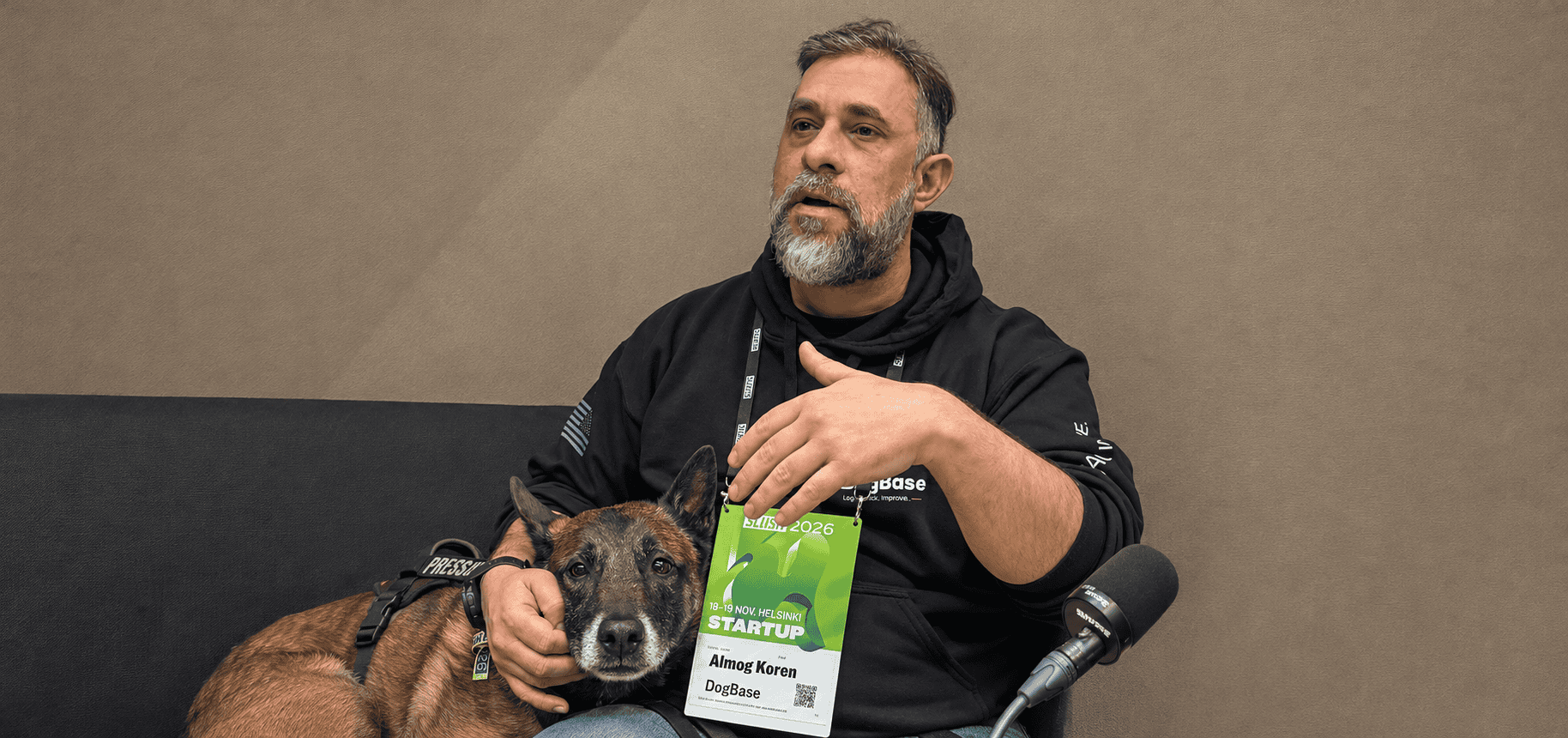
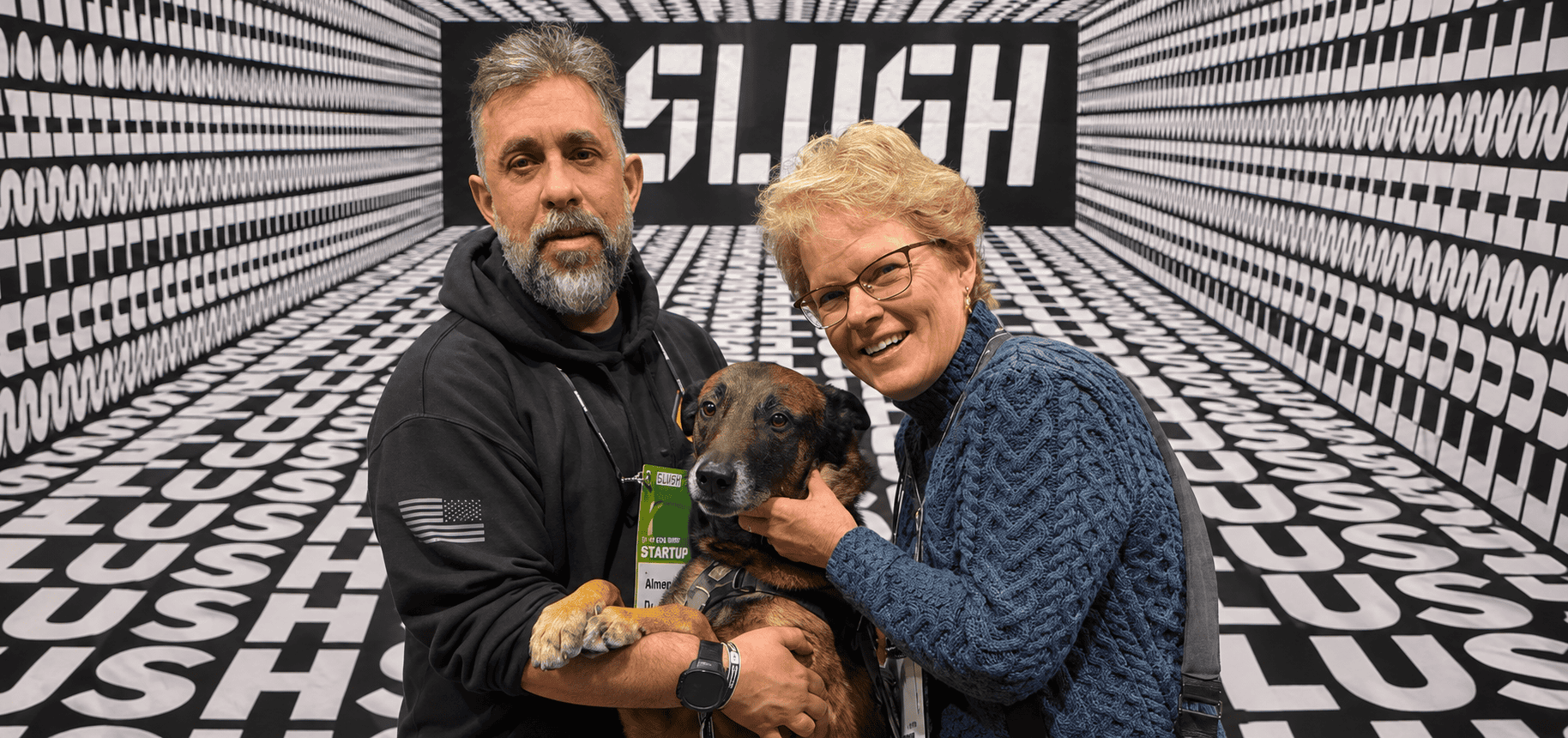
Those figures describe the room, and an encounter shortly before the interview showed how it works. While Koren waited with Echo in the Slush media area for his conversation with ComplexDiscovery, Peter Vesterbacka noticed the dog and introduced himself. Vesterbacka is one of Slush’s founders and the former “Mighty Eagle” of Rovio, the company behind Angry Birds. He told Koren he had invested in a few projects involving dogs and wanted to know more about DogBase, and he suggested that Koren contact him after the event to talk further. It was an introduction rather than a deal, but it shows why founders travel to events like Slush: a chance meeting in the right place can open a door that no scheduled pitch had opened.

From dialysis to a training app
Long before Helsinki, DogBase began with a personal history Koren described openly. Koren, who grew up in Las Vegas, is a military veteran and a software engineer. While living in Australia, he said, he learned his kidneys were failing, and he later went on dialysis and returned to Israel for a transplant. During that process he took in Echo, a purebred Belgian Malinois puppy, and began training him as a service dog. A little later, Koren received a kidney from a living donor through Matnat Chaim, whose name is Hebrew for “Gift of Life,” a Jerusalem nonprofit that encourages living kidney donation and connects donors with patients who need a transplant. Echo, Koren said, grew bored with service work, so the pair moved into volunteer search and rescue. Koren tied that choice to a sense of responsibility after receiving an organ from a living person.
Echo, now 7, is trained in air-scent work, the search for missing people who are still alive, and Koren said his own focus is searching rubble. That training is where the idea for DogBase took shape. Koren said his trainer, who was working with about 10 dogs, kept records with pen and paper and often could not recall what the team had covered the week before. So Koren wrote a small logging app for himself and shared it in Facebook groups for search-and-rescue and canine handlers, where other handlers asked to use it. One early contact, he said, came from the U.K. military, which funded a prototype and access to it for a specialized unit. DogBase later joined the inaugural Techstars Tech Central Sydney Accelerator, according to the class announcement Techstars published in July 2023.
What the software records and what it infers
The prototype has since grown into a platform that Koren said covers training logs, health records, scheduling, certifications, team communication and compliance paperwork. Units once kept much of that on paper and in WhatsApp threads, he said. He framed its analytics around three areas. The first is repetition, since dog training builds the same command at rising difficulty, and the software shows whether a team can advance or is stalling. The second is the problem from the opening, which Koren called “trainer’s blind”: a well-trained dog’s unexplained poor performance. By looking across six months of sessions rather than one week, he said, the software can show whether those lapses recur more often than a handler thinks. It can also show whether they cluster around conditions such as weather. The third is welfare: avoiding overtraining and work in excessive heat, keeping health records current and logging injuries, which Koren said search dogs, Echo included, pick up routinely.
Koren said DogBase offers recommendations rather than instructions, leaving training decisions to the handler and trainer. Its current AI features include training summaries and recaps. They also include a one-click history of a dog’s training and outcomes, which he said the company modeled on the record booklet the military keeps for each dog. Behind those features, he said, sit three kinds of data. The first is a customer’s own dog and unit records. The second is outside data on breeds, veterinary history and diet that the company gathered from open sources or built itself. The third is data pooled across the user base after identifying details are removed. He said the company moves cautiously on AI because police, military and search units have standards to meet and need the information they receive to be accurate.
Who controls a working dog’s data
That caution extends to the data itself, which is where DogBase’s story meets the concerns of records and information governance professionals. Koren said no official rules specifically govern data about working dogs, so DogBase treats it the way it would treat data about people. His reasoning is that many police forces regard their dogs as members of the unit. Record keeping for military dogs is one area with written rules: Army Regulation 190-12 governs the Army’s working dog program. A 2018 Defense Department inspector general report on the Army’s tactical explosive detection dogs found that the Army had not used the DoD Working Dog Management System. Both that regulation and a joint military instruction require the system.
Explosive-detection training gets particular care at DogBase, Koren said, because the compounds a unit trains on and its training methods are closely held. He said that data is walled off for the unit that owns it and that DogBase does not sell customer data. After the interview, Koren added that the pooled data behind DogBase’s AI features is stripped of identifying details, and that data a unit marks as restricted, including explosive-detection training, is excluded from it. DogBase hosts its data on Google Cloud in the U.S., a point its GetApp directory listing also makes. Koren said that setup meets the requirements of military, police and government customers, though ComplexDiscovery did not review any certification. He also said nearly every unit asks about its AI and data policies.
Those questions carry weight because police dog records have a life in court. Jeff Barrett, a co-founder of the PackTrack K-9 records system and co-author of “Canines in the Courtroom,” warned in a July 2024 Police Magazine article that handlers should expect subpoenas for their K-9 records. PackTrack’s app listing pitches its records as data that can prove a dog’s reliability in court. Koren named PackTrack as a competitor in the police market and described DogBase as a broader, all-in-one system. He said DogBase moved into police work after starting with search and rescue alone. Court records drew DogBase’s first customers too, he said. Those search-and-rescue handlers had to keep records for compliance and U.S. court purposes, and they wanted to log a session in five or 10 minutes instead of filling a paper logbook. Units weighing any K-9 records platform should ask where records are hosted and who can see sensitive training detail. They should also ask whether pooled data is stripped of identifiers and whether records export in a form counsel can produce. DogBase’s GetApp listing says its compliance records export as PDF, Excel or CSV files.
Pricing built around the dog, not the user
Those records are priced by the dog rather than by the person reading them. Koren said an individual handler can use about 90 percent of the platform for $12 a month per dog. DogBase charges by the dog, he said, so trainers and second handlers can see a dog’s records without paying for extra seats. Nonprofit search teams get every feature at a discounted price, he said, and DogBase’s GetApp listing says nonprofit pricing is available for search-and-rescue and volunteer teams. Plans start with a 30-day free trial, which Koren said requires no credit card.
Customers range from single handlers with one dog to a police department with 10 dogs and search-and-rescue teams that each field 30 to 40 dogs, Koren said. He put enterprise deal sizes at $50,000 to $100,000 a year and said the company has one or two customers at that level. DogBase is finalizing a large enterprise contract, Koren said, with the paperwork still being completed. The company itself is small, made up of Koren, a co-founder and two or three others, he said. Its reach is wider: DogBase’s website says teams in 15-plus countries use the platform across 15-plus working-dog disciplines, and that it has tracked over 525,000 minutes of training.
Kennel cameras, a Texas office and fundraising plans
Koren’s near-term plans run from software to hardware. He said native iOS and Android apps are in testing, with a full release planned around the turn of the year, and that most handlers use DogBase in a mobile browser today. DogBase is also developing a plug-in camera system for kennels, vehicles and training centers that reads temperature and airflow and sends alerts to a handler’s phone. The system also monitors a dog’s breathing, a feature Koren said took a year and a half to build. He said the company will test the hardware with users before a wider release.
He also wants to open an office in Texas and hire a sales team there, citing the state’s working-dog community and potential grants, after weighing Florida and Las Vegas as alternatives. On funding, Koren said DogBase is sustainable and working toward profitability, but is open to the right partners. A round would likely be about $1 million or above, he said, and could be smaller for an investor who brings strategic help. His preference is an angel syndicate of $500,000 to $700,000, and he tied the raise to a goal of reaching profitability. Growth so far has come through word of mouth and speaking invitations, he said, including the World Police Summit in Dubai and the search-and-rescue event SARCON. DogBase’s press page lists other invitations as well, from a Frontex conference in Krakow, Poland, to New York’s 2026 Technical Rescue Conference.
The armadillo that showed up in the data
The use Koren said he least expected surfaced in the company’s own data. A user in Argentina built a custom training template named Pink Armadillo. The unusual name caught the team’s attention, he said. Koren contacted the user and learned she was a conservation handler training a detection dog to search for the pink fairy armadillo. DogBase later interviewed her for its website, he said. The site’s interview with Mariella Superina, a researcher with Argentina’s CONICET science agency in Mendoza, lists her as a handler at FIAA Argentina. In it, Superina describes a search in which her dog, Roy, gave an indication, and she says the team may have found its first pink fairy armadillo.
The pink fairy armadillo is a burrowing species found only in central Argentina, according to conservation researchers, and grows up to 6 inches long, according to the World Wildlife Fund. The dog, Koren said, is meant to smell the animal from above ground and lie down to mark the spot without disturbing it. Those researchers also report that the species is listed as Data Deficient by the International Union for Conservation of Nature, a category for species without enough information to assess their risk.
The unexplained bad day that opened this story and the search for an armadillo underground end up in the same kind of record. Koren’s bet is that the record can tell a handler something the handler could not see alone. For professionals who manage records that may one day be produced in litigation, the open question is familiar: when a working dog’s training log becomes evidence, who decided what it would capture?

News sources
- Slush 2026 (Slush, homepage)
- Slush 2026 (Slush, About page)
- Slush 2026 (Slush newsroom, Jan. 27, 2026)
- Peter Vesterbacka (European Innovation Council)
- Peter Vesterbacka: Ta in hundratusen utländska studerande (Yle)
- Start-upmission to Slush Helsinki 2026 (Netherlands Enterprise Agency)
- Slush 2026: Europe’s Leading Startup Event (Dublin Chamber)
- Slush (MyHelsinki)
- Latitude59 Pitch Competition Awards €450,000 to Startups from Estonia, Finland and Lithuania (Latitude59)
- Inaugural Techstars Tech Central Sydney Accelerator powered by the NSW Government Announces Class of 2023 (Techstars)
- Startups confirmed for Techstars accelerator in Sydney (NSW Government)
- The Army’s Tactical Explosive Detection Dog Disposition Process from 2011 to 2014 (U.S. Department of Defense Office of Inspector General)
- DogBase: K9 Training & Operations Management Software (DogBase)
- Press Releases (DogBase)
- Interview with Mariella Superina, Handler at FIAA Argentina (DogBase)
- COVID-19 death of Israeli kidney nonprofit founder spurs record number of donors (The Times of Israel)
- Matnat Chaim (Matnat Chaim via IsraelGives)
- DogBase 2026 Pricing, Features, Reviews & Alternatives (GetApp)
- PackTrack App (Canine Development Group Inc. via Apple App Store)
- How to Improve K9 Record Keeping (Police Magazine)
- Investigadores mendocinos usan perros rastreadores para proteger la fauna y prevenir enfermedades (Cadena 3)
- Meet the pink fairy armadillo (World Wildlife Fund)
- Conservation of an Unknown and Elusive Species the Pink Fairy Armadillo: Citizen Science, Genetic Diversity and Population Dynamics (Rufford Foundation)
- Venture Nordics Program: Europe’s top investor program (MyHelsinki)
- May Newsletter (Silicon Vikings)
- Slush 2026 brings a smaller, sharper bet on European startups to Helsinki (ComplexDiscovery)
- Seven startups from four nations compete for Latitude59’s nearly half-million-euro investment prize (ComplexDiscovery)

Assisted by GAI and LLM Technologies
Additional reading
- Mistral’s CFO tells Slush companies need to own and control their AI as Anthropic heads to Nasdaq
- Välimäki and Donahue tell DECOI x Borderland founders to test in Ukraine and plug into NATO’s data layer
- Days before Slush, an attack on Estonian drone maker Threod raises the stakes for defense tech
- Before the Abu Dhabi talks, a claimed Rosstat leak and hacked alert apps test what can be confirmed
- Spoofed nuclear alert caps four days of Ukraine war assessments that separate claims from evidence
- Kyiv says Starshield speeds are back, but who capped them is still disputed
- Diesel license, Starshield cap and intelligence warnings strain US support for Ukraine
- Drones hit two Yandex data centers, and a Kremlin decree sets terms for state management
- A cell tower near Lyman and Russia’s fight over its own war record
- How a general’s walk across a bridge tested Putin’s claim to Svyatohirsk
- Germany names Russia for the Leipzig drone, and keeps most of its evidence out of view
- Estonia scrambled jets over a drone no official has identified
- Russia leans on drones and dissent-proofing as fuel crisis bites
- Senate passes Graham sanctions act, shifting Russia pressure from policy to statute
Source: ComplexDiscovery OÜ

ComplexDiscovery’s mission is to enable clarity for complex decisions by providing independent, data‑driven reporting, research, and commentary that make digital risk, legal technology, and regulatory change more legible for practitioners, policymakers, and business leaders.