Editor’s Note: Three Russian Kh-101 cruise missiles came down in southeastern Poland on Nov. 20, 2026, according to preliminary findings Polish prosecutors first released Nov. 22, during what the Institute for the Study of War (ISW), a Washington think tank, called Russia’s largest missile and drone strike on Ukraine that month. Polish Prime Minister Donald Tusk said it appeared to be an intentional Russian provocation; Moscow had no immediate comment. NATO authorized the forward deployment of an AWACS surveillance aircraft on Nov. 23, and another Russian drone briefly entered Polish airspace that night. Over the next three days, a Russian drone crossed into Moldova, drones that Finland’s military said were likely Ukrainian struck the U.S.-sanctioned Russian cargo ship Sparta II in the Gulf of Finland, and Ukrainian President Volodymyr Zelenskyy said Ukrainian sea drones sank the Russian corvette Merkury in Benghazi, Libya. German media reported that Western intelligence services believe Russia could launch a nuclear-armed satellite within weeks; the Kremlin dismissed the report.
For cybersecurity, information governance and eDiscovery professionals, war risk now reaches shared airspace, Baltic shipping lanes and, potentially, the satellites behind navigation and communications. Watch for further NATO air defense steps, Baltic shipping guidance and any confirmed satellite launch.
Content Assessment: Russia's war presses on NATO's edges from Poland to the Gulf of Finland
Information - 93%
Insight - 94%
Relevance - 93%
Objectivity - 95%
Authority - 96%
94%
Excellent
A short percentage-based assessment of the qualitative benefit expressed as a percentage of positive reception of the recent article from ComplexDiscovery OÜ titled, "Russia's war presses on NATO's edges from Poland to the Gulf of Finland."
News Analysis – Geopolitics Beat
Russia’s war presses on NATO’s edges from Poland to the Gulf of Finland
ComplexDiscovery Staff
Three Russian cruise missiles came down in Poland on Nov. 20, Polish prosecutors’ preliminary findings show, during what the Institute for the Study of War (ISW) called Russia’s largest missile and drone strike this month. Over the following three days, the war’s effects reached Moldovan airspace, the Gulf of Finland and a Libyan harbor, and unconfirmed German reporting raised the prospect of a nuclear-armed Russian satellite in orbit.
None of those places is a front line. ISW’s daily assessments for Nov. 20 through Nov. 23, read alongside reporting from Reuters, The Associated Press and German broadcasters, show the war’s pressure landing again on NATO airspace and shared shipping lanes. The satellites that commercial networks depend on are now part of the conversation too. That makes the four days worth close study for anyone responsible for security, continuity or records in organizations with European exposure.
Missiles fall in southeastern Poland
Polish officials first counted two missiles and a jet-powered drone. Defense Minister Władysław Kosiniak-Kamysz said on Nov. 20 that Russia’s overnight attack had sent them onto Polish territory, Al Jazeera reported. The missiles landed near Nowy Lipowiec and Rudnik nad Sanem and the third object, initially counted as a drone, near Mołodycz, all in the country’s southeast, and no injuries were immediately reported. Two days later, prosecutors in Lublin said preliminary examinations with weapons specialists had found Kh-101 cruise missile debris at all three sites, from missiles built in the fourth quarter of 2026 at a plant in Dubna, in the Moscow region. They repeated the finding in a Nov. 23 summary of the investigation.
The overnight strike that sent the missiles west was large. Russia launched 27 ballistic missiles, 84 cruise missiles and 404 drones on the night of Nov. 19 to 20, ISW reported, citing President Volodymyr Zelenskyy and Ukraine’s air force, and Zelenskyy said at least eight civilians were killed. Strikes on the power grid pushed all three of Ukraine’s operating nuclear plants to cut output and triggered emergency outages in 11 regions, First Deputy Energy Minister Artem Nekrasov said, according to AP.
Back in Poland, AP reported that one missile is believed to have come down about 35 kilometers from a two-week multinational exercise that began Nov. 9 to prepare European troops for a possible postwar deployment to Ukraine. ISW identified that missile as the one near Rudnik nad Sanem and dated the exercise Nov. 9 to Nov. 22.
Prime Minister Donald Tusk said it appeared that “we are dealing with an intentional provocation” by Russia, likely timed to the exercise, and NATO Secretary-General Mark Rutte called the incursion a grave violation of Polish airspace, according to AP. Moscow had no immediate comment.
Tusk’s reading of the timing matched ISW’s. The exercise was run by the Multinational Force-Ukraine, the military arm of the Coalition of the Willing, a 35-nation group backing Ukraine; the force has secured military commitments from 24 nations, according to Britain’s Defense Ministry. ISW assessed that the Kremlin timed the violations to the exercise to deter the coalition’s support for Ukraine and test NATO’s responses. The think tank, which openly advocates Western support for Kyiv, recommended that NATO members and Ukraine pursue air defense arrangements so allied air defenses can fire on Russian missiles and drones threatening NATO territory before they leave Ukrainian airspace.
Poland’s own response ran through the alliance. ISW reported that Poland asked NATO for more troops and air defenses but did not invoke Article 4, the alliance’s provision for emergency consultations among members, and Kosiniak-Kamysz asked specifically for more AWACS surveillance aircraft and F-35 fighters. On Nov. 23, NATO ambassadors met in the North Atlantic Council. Afterward, alliance spokesperson Allison Hart said NATO’s top commander in Europe had authorized the forward deployment of one AWACS aircraft, Anadolu Agency reported; its account did not address the request for fighters. Late that night, Poland’s Armed Forces Operational Command said another Russian drone had briefly violated Polish airspace. Commanders authorized shooting it down but held fire after it turned east, judging that firing risked harm to civilians and damage on the ground, ABC News reported.
Moldova’s quieter count
Poland drew the headlines. Moldova absorbed the routine version of the same problem. Two unidentified drones, which ISW assessed were likely Russian strike drones involved in strikes on Ukraine, crossed into Moldovan airspace on Nov. 20 before turning back, ISW reported, and Moldova’s Defense Ministry logged two unauthorized overflights that day. A Russian jet-powered drone then entered twice on Nov. 21, according to ISW’s account of Moldovan Defense Ministry reporting. It first crossed at 11:20 a.m. local time toward the village of Purcari and left Moldovan airspace for the last time at 11:32 a.m.
Those crossings added to a long ledger. Moldova’s Defense Ministry put the total at 84 aerial incidents in 2026 and 121 since 2022 in a report covering the week of Nov. 14 to Nov. 20, the state news agency Moldpres reported. The 10 incidents that week included four unauthorized overflights, four drones that exploded on the ground and two finds of drone fragments. ISW assessed that the Kremlin is trying to normalize increasingly frequent Russian drone incursions into European airspace.
Gulf of Finland becomes a strike zone
The pattern ran north as well as west when drones struck the Sparta II, a 121-meter Russian-flagged cargo ship sailing from St. Petersburg to Kaliningrad, on Nov. 21. Finland’s Defense Forces said the ship was hit in international waters west of Russia’s Gogland Island and that Ukraine was the likely attacker, Reuters reported, and Ukraine made no official comment. Reuters reported, citing the U.S. Treasury Department, that the vessel is subject to U.S. sanctions and is linked to Oboronlogistika, a company whose own website says it provides logistics services for Russia’s Defense Ministry.
Estonia’s Police and Border Guard Board placed the strikes inside Estonia’s exclusive economic zone, in lanes open to vessels of all flags, ISW reported. That account fits Finland’s: an exclusive economic zone gives a coastal state rights over resources, but it is not that state’s territorial sea, and foreign ships may pass through it freely. The burning ship drifted into Finnish waters, its 16 crew members were evacuated, and crews from Finland, Russia and Estonia fought the fire before a Russian rescue vessel began towing it out on Nov. 22. The ship and its crew reached St. Petersburg on Nov. 23, Leningrad region Gov. Alexander Drozdenko said, and the Kremlin that day accused Ukraine of terrorist activity in the Baltic Sea, Reuters reported.
It was not the first such strike in those waters this month. Ukraine’s Security Service said it struck the Russian missile ship Naro-Fominsk in the Gulf of Finland on Nov. 11, the Saudi Gazette reported, citing the BBC. A senior Finnish official told the Finnish broadcaster Yle that Finland detected an attack near Gogland that day. Ilya Timtchenko, a fellow at the Center for European Policy Analysis, told Al Jazeera that the Nov. 11 attack was thought to be Ukraine’s first on a Russian ship in Baltic waters open to civilian traffic. Finnish Defense Minister Antti Häkkänen said Helsinki had raised it with Kyiv.
That gives the eastern gulf, a narrow, heavily trafficked waterway between two NATO members, at least two drone strikes on Russian vessels within 10 days. Logistics and risk teams with Baltic exposure should confirm how their carriers and insurers now treat the eastern gulf, and compliance teams should note that a sanctioned, defense-linked operator was moving cargo through the same lanes as commercial traffic.
From Benghazi to orbit
The farthest reach came from the Mediterranean. Zelenskyy said on Nov. 23 that seven Ukrainian-made naval drones sank the Russian corvette Merkury in the port of Benghazi, Libya, early on Nov. 22 and destroyed a Ka-27 helicopter aboard it, according to CNBC and ABC News. Satellite imagery published on Nov. 22 showed most of the corvette capsized and sunk, ISW reported. Zelenskyy said the operation also struck the Russian cargo ship Angara off the Libyan coast, and Ukraine’s Security Service said a mothership at sea had deployed the drones, The War Zone reported. Libyan officials aligned with the eastern-based Libyan National Army had earlier put the number of attacking sea drones at six, ISW reported.
Libya’s eastern-based government condemned the attack as a violation of the country’s sovereignty, and the United Nations mission in Libya urged an independent inquiry, RFE/RL reported. The Kremlin left comment to the Defense Ministry. ISW, which had reported on Nov. 22 that local footage showed the Ascalon being hit, added a correction to that assessment after Ukrainian officials named the Angara. The two ships are nearly identical and sailed in the same convoy, ISW said, and it remains unclear whether the Ascalon was also struck.
That correction is a small lesson for information governance teams. Ship names, drone counts and strike locations in this story shifted across official, analyst and open-source accounts within 48 hours, and a Kremlin-affiliated Russian milblogger put the number of attacking drones at 12 to 14, ISW reported. Any organization preserving such reporting for sanctions, insurance or legal purposes should capture each version with its source and time rather than overwriting the record with the latest one.
A separate report pushed the risk picture off the planet entirely. German broadcasters WDR and NDR and the newspaper Süddeutsche Zeitung reported on Nov. 23 that Russia could launch a satellite carrying a nuclear warhead, called Sputnik-S, in the coming weeks. That is the assessment of Western intelligence services and militaries, including Germany’s Bundeswehr and its BND foreign intelligence service, according to t-online and other German outlets citing the reporting. Warnings exchanged among some NATO intelligence services in early November put a possible launch within 60 days, and the Bundeswehr’s space command considers December possible, those outlets reported. Moscow rejected the report on Nov. 23: Kremlin spokesman Dmitry Peskov said it was hardly worth taking seriously, and Russia’s embassy in Berlin called it unfounded insinuations, The Moscow Times reported. None of the reporting cited a government publicly confirming the launch plans.
ISW warned that detonating a nuclear device in space could knock out navigation, communications and other satellite services across a wide area. The two treaties it cited bar different acts. The 1967 Outer Space Treaty prohibits placing nuclear weapons in orbit, and the 1963 Partial Nuclear Test Ban Treaty prohibits nuclear explosions in space. Russia, as the Soviet Union’s legal successor, is a party to both. For continuity planners, the report is a reason to test how operations, timestamps and evidence chains hold up if satellite navigation or communications degrade, whether or not a launch ever occurs.
Kremlin messaging aims at Article 5
Moscow’s words over the same four days pointed at the same alliance. Deputy Foreign Minister Sergei Ryabkov said on Nov. 20 that Russia could not accept even quasi-membership in NATO for Ukraine, AP and ISW reported. That came after U.S. envoy Jared Kushner told European leaders that Washington believed Moscow was at ease with NATO-style guarantees for Ukraine after the war, according to AP. Foreign Minister Sergey Lavrov went further in a Nov. 20 interview for Our Baptism: The Patriarch, a documentary project for state broadcaster Channel One. “Southeastern Ukraine and much of central Ukraine, including Kiev, are undoubtedly historically Russian lands,” he said, according to the Russian Foreign Ministry’s English transcript.
On Nov. 23, Mikhail Khodarenok, a retired colonel and military columnist for Gazeta.ru, which ISW describes as a Russian state media outlet, argued that Article 5, NATO’s collective defense clause, binds allies to little beyond reassuring words. If an enemy attacked Estonia or Norway, he wrote, Washington might stay out of direct combat and limit itself to supplying weapons. ISW assessed that Russian state media may be exploiting the debate over security guarantees for Ukraine to cast doubt on Article 5 as a promise to existing members, the Baltic states above all.
Security Council Deputy Chairman Dmitry Medvedev published an article in the Moscow Journal of International Law the same day, ISW reported. He wrote that Russian nuclear policy gives Moscow the right, and in certain cases an obligation, to use every means at its disposal, nuclear weapons included, to protect national security, according to ISW and the state news agency TASS. He added that Moscow had not yet found nuclear use directly necessary. ISW described Medvedev as a regular messenger for top-down Kremlin nuclear threats and judged that Ukrainian long-range strikes inside Russia have not raised the odds of Russian nuclear use.
The ground war continued beneath the signaling. On Nov. 21, Zelenskyy proposed temporary local ceasefires to evacuate civilians from 15 named settlements along or near the Dnipro River in occupied Kherson and Zaporizhzhia oblasts, ISW reported. That request followed an earlier list Ukraine had given the United States, and the model is a short local ceasefire that let civilians leave the occupied town of Oleshky at the end of October. ISW reported on Nov. 23 that the Kremlin was still ignoring Ukraine’s Dnipro ceasefire proposals. Kremlin spokesman Dmitry Peskov said on Nov. 23 that a separate Russian proposal for Kostyantynivka, first raised by President Vladimir Putin on Nov. 12, remains relevant, ISW reported. ISW assessed that a Dnipro ceasefire is feasible because the river gives the front a stable line and a natural barrier between the two sides’ positions. A Kostyantynivka ceasefire is not, ISW said, because Russian and Ukrainian positions there are intermixed.
Shared spaces on a wider map
On the ground, ISW recorded movement in both directions. A Ukrainian regiment disclosed on Nov. 20 that Operation Bear Trap had recaptured 204 square kilometers and 14 settlements north and northeast of Velykyi Burluk in Kharkiv Oblast over recent months, ISW reported. Russian forces recently gained ground southeast of Dobropillya and southeast of Kupyansk, ISW said. Zelenskyy said Russia used about 2,700 long-range drones, nearly 1,460 glide bombs and 165 missiles against 20 oblasts in the week ending about Nov. 22, according to ISW.
Neither the Polish airspace violations nor the Baltic strikes were new in kind. Russian drones crossed into Poland in large numbers in September 2025, ISW noted, and Ukraine’s Security Service claimed the Nov. 11 strike in the same gulf where the Sparta II burned. What the four days showed was how many shared spaces the war now reaches, or threatens, at once. Russian missiles came down on a NATO member’s soil near an allied exercise, and a Russian drone crossed into the same airspace three days later. Drones struck Russian vessels in waters bordered by Finland and Estonia, where Finland’s military judged Ukraine the likely attacker, and in and near a Libyan port, where Ukraine claimed the strikes. German reporting also raised the unconfirmed prospect, which Moscow dismissed, of a nuclear-armed satellite in the orbit that commercial networks share.
The missiles that came down in southeastern Poland on Nov. 20 hit no battlefield, only the territory of a NATO member, and that is the point security and governance teams can take from Nov. 20 through Nov. 23. Risk registers built around the front line in Ukraine may need to cover the airspace and sea lanes the war keeps reaching, and the satellites it could reach next. If your continuity plan assumes those shared spaces stay neutral, when did you last test that assumption?
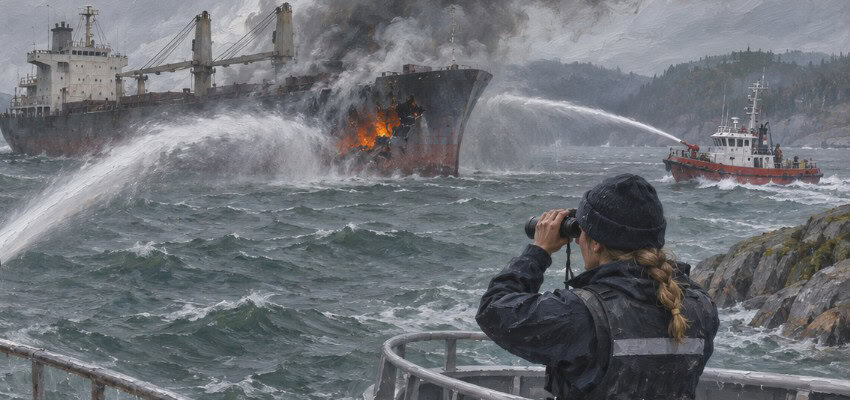
AI-generated editorial illustration of firefighting efforts around a damaged cargo ship in a northern gulf, evoking the article’s discussion of maritime risk in the Gulf of Finland. It does not depict the actual Sparta II incident.
ComplexDiscovery’s mission is to enable clarity for complex decisions by providing independent, data‑driven reporting, research, and commentary that make digital risk, legal technology, and regulatory change more legible for practitioners, policymakers, and business leaders.
Have a Request?
If you have information or offering requests that you would like to ask us about, please let us know, and we will make our response to you a priority.
ComplexDiscovery OÜ is an independent digital publication and research organization based in Tallinn, Estonia. ComplexDiscovery covers cybersecurity, data privacy, regulatory compliance, and eDiscovery, with reporting that connects legal and business technology developments—including high-growth startup trends—to international business, policy, and global security dynamics. Focusing on technology and risk issues shaped by cross-border regulation and geopolitical complexity, ComplexDiscovery delivers editorial coverage, original analysis, and curated briefings for a global audience of legal, compliance, security, and technology professionals. Learn more at ComplexDiscovery.com.
Generative Artificial Intelligence and Large Language Model Use
ComplexDiscovery OÜ recognizes the value of GAI and LLM tools in streamlining content creation processes and enhancing the overall quality of its research, writing, and editing efforts. To this end, ComplexDiscovery OÜ regularly employs GAI tools, including ChatGPT, Claude, Gemini, Grammarly, Midjourney, and Perplexity, to assist, augment, and accelerate the development and publication of both new and revised content in posts and pages published (initiated in late 2022).