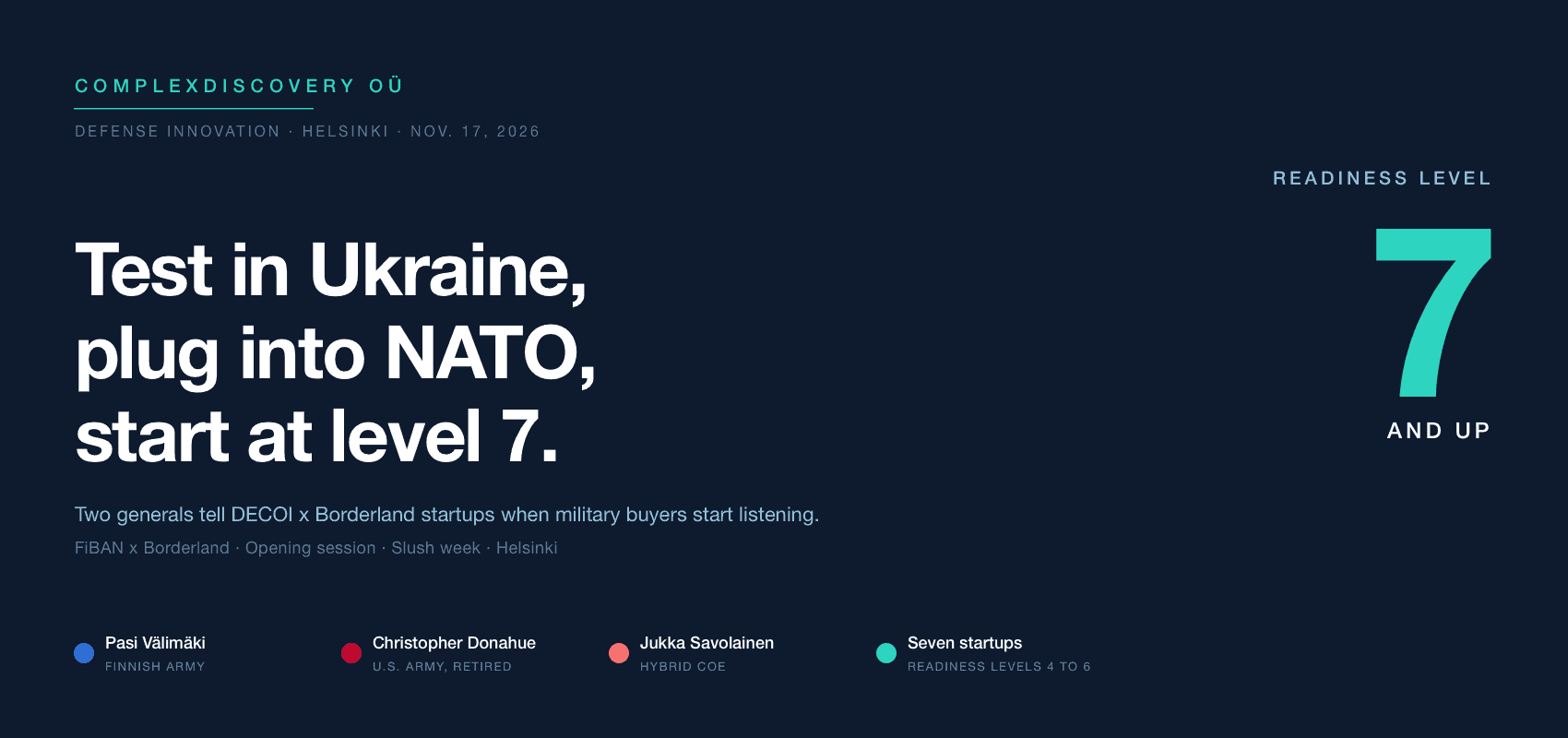
Editor’s Note: Two generals told early-stage defense startups at DECOI x Borderland, a one-day defense startup and investor summit in Helsinki, on Nov. 17, 2026, that military buyers start paying attention once technology reaches level 7 on the nine-step technology readiness scale, the point where a prototype has been demonstrated in an operational environment. Lt. Gen. Pasi Välimäki, commander of the Finnish Army, said development risk belongs to the company because he spends taxpayers’ money. Retired U.S. Army Gen. Christopher Donahue, who relinquished command of U.S. Army Europe and Africa in July, said NATO will help companies at lower levels but cares about levels 7 to 9. He urged startups to test their technology in Ukraine and said vendors must plug their data into the shared systems behind NATO’s Eastern Flank Deterrence Initiative, the alliance’s land forces concept for 2030. Välimäki said both were giving personal opinions, not official positions.
Their joint keynote followed seven three-minute pitches from startups at levels 4 to 6 at the summit, which the Finnish Business Angels Network organized with Borderland, an Eastern Finland testing network. It preceded a keynote on hybrid threats, meaning hostile activity kept below the threshold of open war, from Jukka Savolainen of the Helsinki-based European Centre of Excellence for Countering Hybrid Threats.
For cybersecurity, information governance and eDiscovery professionals, the generals’ requirements amount to data integration and records obligations: a vendor’s sensor output has to translate into national mission command systems and move over shared cloud infrastructure, and field testing in Ukraine can generate cross-border records that companies may later need to document, preserve and, in a dispute, produce.
Content Assessment: Välimäki and Donahue tell DECOI x Borderland founders to test in Ukraine and plug into NATO's data layer
Information - 93%
Insight - 92%
Relevance - 94%
Objectivity - 91%
Authority - 93%
93%
Excellent
A short percentage-based assessment of the qualitative benefit expressed as a percentage of positive reception of the recent article from ComplexDiscovery OÜ titled, "Välimäki and Donahue tell DECOI x Borderland founders to test in Ukraine and plug into NATO's data layer."
News Analysis – Geopolitics Beat
Välimäki and Donahue tell DECOI x Borderland founders to test in Ukraine and plug into NATO’s data layer
ComplexDiscovery Staff
Minutes after seven early-stage defense startups pitched in Helsinki on Tuesday, a retired U.S. Army general told the room that NATO will help companies below readiness level 7 but cares only about technology at 7 and above.
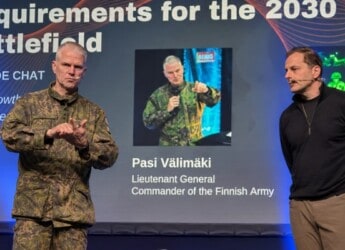
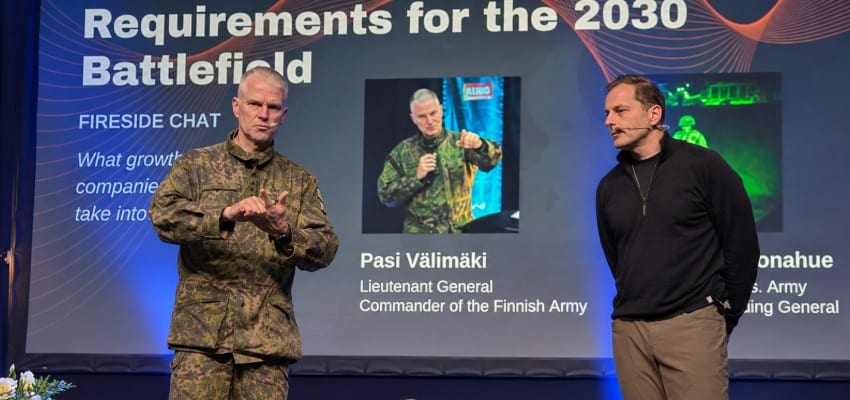
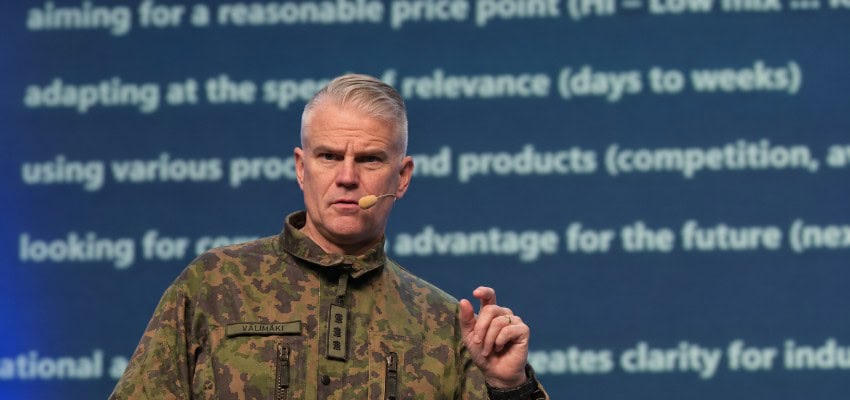
That general, Christopher Donahue, shared the keynote stage at DECOI x Borderland with Lt. Gen. Pasi Välimäki, commander of the Finnish Army, and Välimäki put the same point in budget terms. He said he spends taxpayers’ money, so the risk of developing a product belongs to the company, and the army engages from technology readiness level (TRL) 7 upward. On the nine-step scale the European Commission uses for research funding, TRL 7 means a system prototype demonstrated in an operational environment, and TRL 9 means an actual system proven in operations. Välimäki said both generals were giving personal opinions rather than official positions.
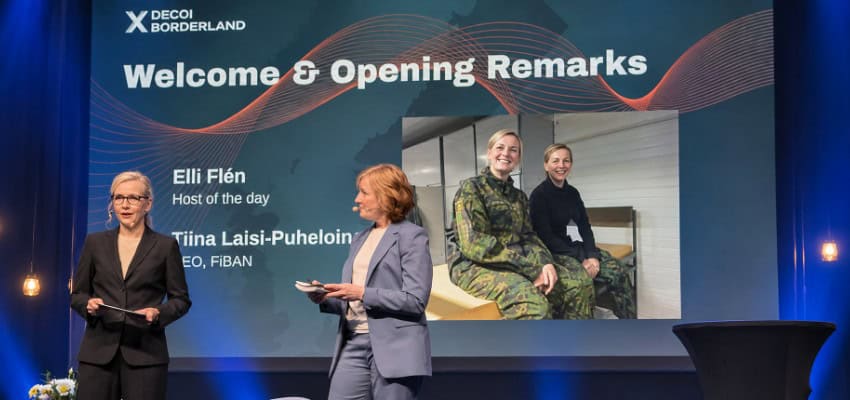
The exchange set the tone at DECOI x Borderland, a one-day defense and dual-use summit held the day before the Slush startup conference, which ComplexDiscovery is also covering. The Finnish Business Angels Network (FiBAN) organized it with Borderland, an Eastern Finland testing and innovation network. This report covers the summit’s opening session, which ComplexDiscovery attended: the welcome and partner remarks, a round of startup pitches, the joint NATO land forces keynote and a keynote on hybrid threats.
The summit matters because of who sat in the room at once. The hosts billed it as the largest defense startup and investor event in Northern Europe, and it put the people who fund, test and buy early-stage defense technology on one stage. Angel investors and venture funds sat alongside Eastern Finland’s border-testing network, the Finnish Army, a former NATO land commander and European Commission officials describing new startup funding. In ComplexDiscovery’s analysis, that mix is why the generals’ readiness message carries weight, because it tells founders and investors when military buyers start paying attention and therefore where the private funding gap sits.
A question from a general started the program
DECOI itself traces back to a conversation FiBAN Chief Executive Tiina Laisi-Puheloinen described from the stage. About three years ago, she said, Gen. Janne Jaakkola, now commander of the Finnish Defence Forces, asked her where defense startups could go for money. She told him there was nowhere, and DECOI, the Defence Ecosystem of Innovators that FiBAN founded in 2023, grew out of that answer. Its aim is to connect defense startups with angel investors and defense-focused venture funds that rarely get access to the sector. This year DECOI joined forces with Borderland for the first time; FiBAN describes Borderland as led by the cities of Eastern Finland and as a test environment for digital border security technology in Arctic conditions.
Demand outran the room. The hosts said the event capped attendance at 500 and turned away about 300 more people, and they suggested the organizers would need a bigger venue next year. Host Elli Flen, a communications consultant with Losvik & Flen, moderated the program, which ran the day before Slush opened its main program on Nov. 18 and 19 at the Helsinki Expo and Convention Centre.
Partners used the opening remarks to describe the money and programs around the stage. Harri Tallinn, a partner at Civitta, spoke for EUDIS Matchmaking, one of the summit’s three key partners alongside Patria and Borderland. Civitta said in 2025 it was leading the program for the European Commission’s EU Defence Innovation Scheme, an instrument of the European Defence Fund. Tallinn described a EUDIS-branded defense accelerator now recruiting its fourth cohort, plus recent field-testing events in Germany and Romania where he said mentors from Ukraine’s armed forces took part.
Mikko Järvilehto, Startup Joensuu ecosystem lead at Business Joensuu, speaking for Borderland, said the network spans five Eastern Finland regions with a planned investment pipeline of 11 billion euros. He counted 20 research and innovation organizations employing about 8,000 people, roughly 400 startups and about 40 million euros dedicated to startup funds. He acknowledged that the region has yet to produce a defense or dual-use unicorn. Its testing work did reach NATO this year: Finland hosted NATO Innovation Range events led by Allied Command Transformation from June 1 to 10, 2026, in Riihimäki, Joensuu, Oulu and Turku. The Ministry of Defence authorized the Digital Defence Ecosystem and Defence Innovation Network Finland (DEFINE) to organize them with Borderland Europe, the initiative that the summit’s partner listing says Joensuu hosts, and three regional business development organizations.
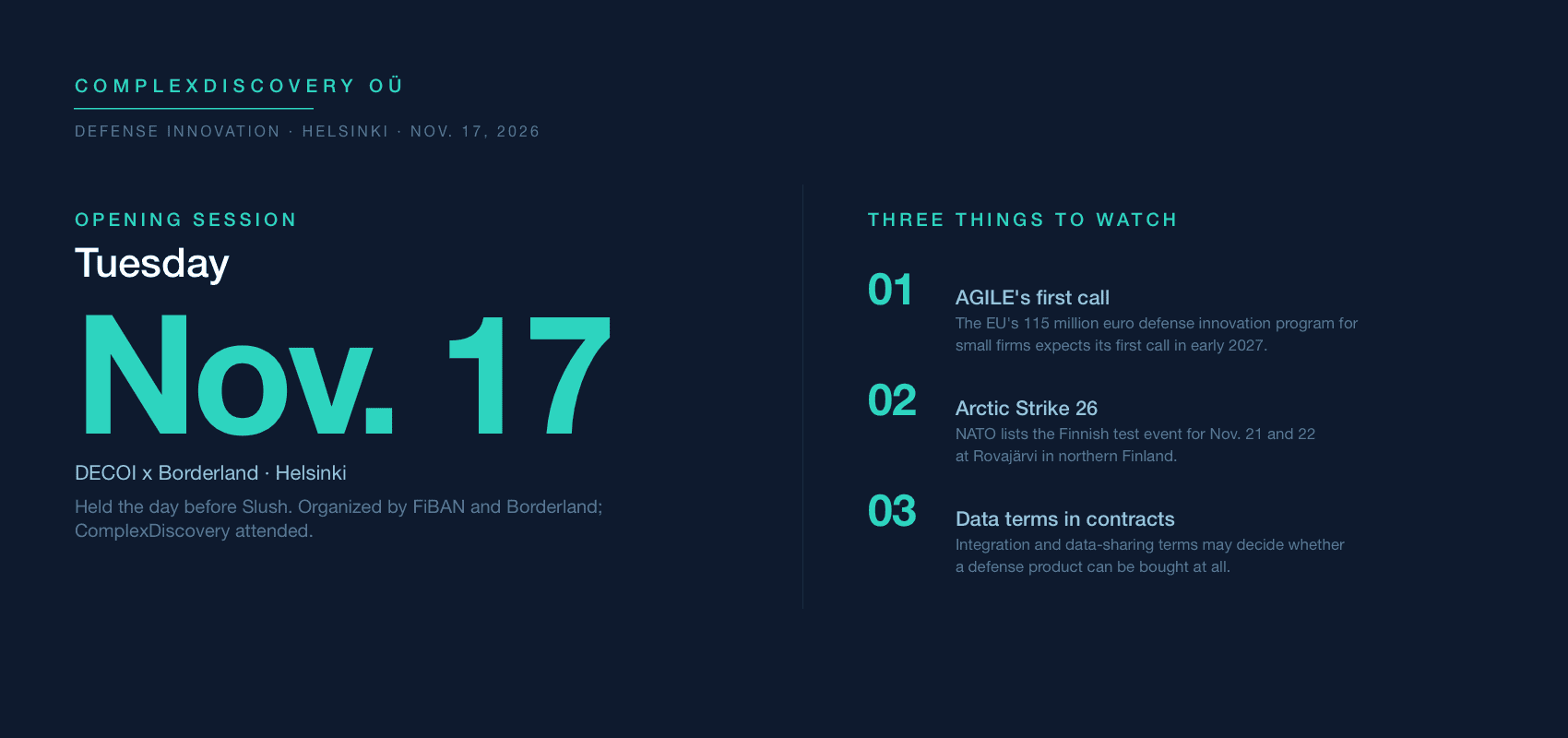
Business Finland Director General Lassi Noponen said defense sat largely outside the agency’s funding scope not long ago and now ranks among its most important strategic priorities, with a new program due early next year. He argued that every euro Europe spends on defense is also someone’s revenue, and that Europe’s problem is turning existing technology into competitive companies rather than a shortage of technology. Dinka Dinkova, a Commission deputy head of unit introduced for its Directorate-General for Defence Industry and Space, listed the European Defence Fund, EUDIS and a new rapid-innovation program for startups and scale-ups due within months. The commission, she said, wants such companies to raise money and stay in Europe. That program is AGILE, a 115 million euro instrument the Commission proposed in March 2026. The European Parliament approved it on Oct. 6 and the Council of the EU adopted it on Oct. 12. Regulation (EU) 2026/2387 was published in the EU’s Official Journal on Nov. 3, and the first call for proposals is expected in early 2027.
Seven startups, three minutes each
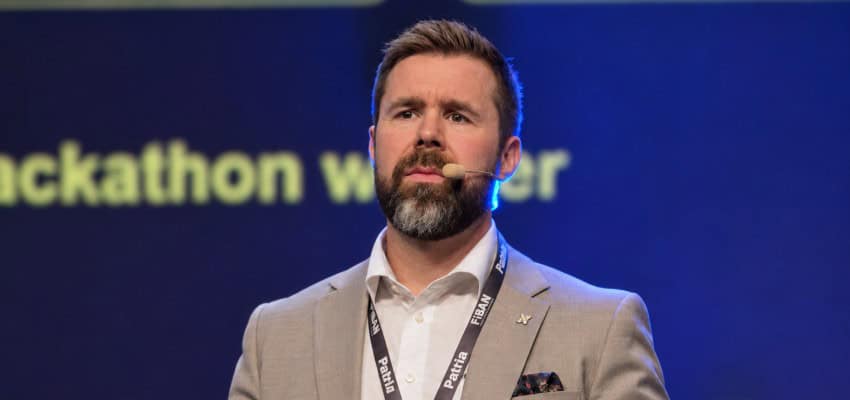
FiBAN’s pitch coordinator then explained the competition. This session covered companies at TRL 4 to 6, which on the Commission’s scale runs from a technology validated in a lab to one demonstrated in a relevant environment. Each founder had exactly three minutes, with no questions, and the audience voted by phone. The coordinator said FiBAN, EUDIS Matchmaking and selected accelerators combined nominated companies with an open application process, narrowing a field of over 100 companies to the summit’s finalists. FiBAN says the companies selected to pitch also get Slush 2026 tickets.
The seven pitches, as the founders presented them, ranged from sensors to supply chains. IRIDESENSE, a French company, pitched a spectral lidar that maps terrain without satellite navigation and also reads what objects are made of, and its chief executive said the company is raising an equity round to manufacture a second-generation sensor. Tiepoint, a Norwegian drone operator, described a drone-agnostic autonomy layer, trained through reinforcement learning, that takes over the final interception once an operator confirms a target. It plans validation in Ukraine from the first quarter of next year and is raising 10 million euros. Soron Systems presented camera-based navigation for drones and ground vehicles where satellite signals are jammed, and ran out of its three minutes mid-explanation.
Arqus co-founder and chief executive Marnix Meersman said his company builds laser and electronic defenses to protect satellites from hostile spacecraft and to dazzle drones on the ground, and that the company has three co-founders and a team of 10. Aiko Bernehed, alteva’s co-founder and chief executive, pitched ultralight batteries built on a European materials supply chain. Bernehed said flight tests in Ukraine doubled a drone’s range against a reference battery and that the company is raising 10 million euros. NaturAI, whose roots are in analyzing natural soundscapes, pitched acoustic AI for detecting low-flying drones. Its edge, the company said, is filtering out the animal and other background noise that causes false alarms. Last came 3P Defence, with an autonomous platform meant to detect, track and defeat small drones in the final seconds before impact. Its presenter placed the system at TRL 6, with a goal of TRL 7 within 12 months.
Ukraine as the reference point
Välimäki opened the keynote by telling the growth companies to treat Ukraine as their benchmark. Once the fighting ends, he said, Ukraine’s defense industry becomes their competition, because it already works at scale, in mass, with a mix of high- and low-cost systems and without locking itself to single vendors. He described industry as effectively a fourth branch of the armed forces, next to land, air and maritime, and said the urgency does not end when the firing stops, because that is when armies rebuild.
He then gave the room a procurement timeline as proof. The Finnish Army signed a contract with one company in June, trained its first people in July and received the equipment in October. Two weeks later the systems were flying, with final acceptance due by year end and use with reservists to follow next year. Every supplier still faces a fixed checklist with no skipped steps, he said, but the checklist can take three months as easily as a year. He pointed companies toward Arctic Strike 26, a test event he said the army planned with U.S. and Nordic partners, and said that a company that succeeds there will get the army’s attention. NATO’s events calendar lists Arctic Strike 26 for Nov. 21 and 22 at Rovajärvi in northern Finland as the Finnish Defence Forces’ main national test event.
Donahue’s four components are a data requirement
Donahue, whom the host introduced as most recently commanding general of U.S. Army Europe and Africa and commander of NATO’s Allied Land Command, relinquished the Army command in July and has since retired; the host also noted that he was the last American soldier to leave Afghanistan, in August 2021. He opened with a warning that armies never fight the last war, so watching Ukraine is necessary but not sufficient. The Eastern Flank Deterrence Initiative (EFDI), he said, is how NATO intends its land forces to be ready for 2030, and he credited Finland, and Välimäki by name, with pushing that work faster than any other nation.
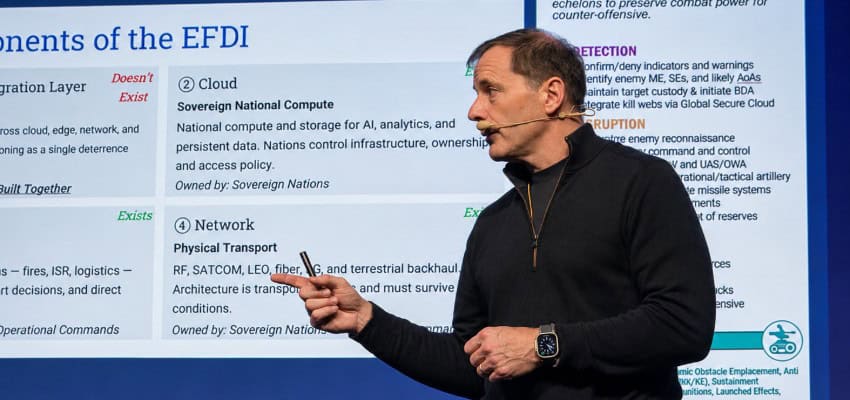
Each element of what EFDI asks of a vendor, as he set it out, came back to data. A product has to plug into a warfighting integration layer still under development, which he said is built on open-source code so that any system can connect to it. It has to feed national mission command systems, which means a sensor’s output must translate into those systems, and it needs cloud infrastructure and the transport to move that data. Hardware at the edge will keep changing, he said, which is why companies have to iterate quickly.
NATO’s own descriptions match that framing. The U.S. Army calls EFDI the transformational warfighting concept behind NATO’s deterrence posture, and Allied Land Command said in June that an EFDI data backbone would be built into a Layered Counter UAS Initiative (LCI-X) accelerator run by Allied Command Transformation. The route in, Donahue said, is Task Force X, where companies compete to show their equipment fits the initiative and can then enter the process through which NATO clears it for purchase. He said that work would take place in the north. NATO’s events calendar also files Arctic Strike, the test event Välimäki named, under its Task Force X Eastern Flank Deterrence Line banner as a test of drones, counter-drone systems and unmanned ground vehicles.
On readiness, Donahue was blunt: NATO will help companies at TRL 1 to 6, he said, but it cares about TRL 7 to 9. Asked how a startup could get there faster, his first answer was to take the technology to Ukraine and test it against the force NATO aims to deter, and his second was to engage NATO directly. He listed what he tests for: soldiers have to want to use the system, it has to scale, and it has to adapt and integrate as software changes on a battlefield that never stays still. He named four capabilities whose importance he said he still underestimates despite knowing it: autonomy, artificial intelligence, scale, and adaptability paired with integration. Systems built without them, he said, will not matter on the next battlefield.
With a few minutes left, Välimäki opened the floor for questions. He said the Finnish Army changed its reputation with startups by doing its homework: building a body of knowledge, testing with experienced people and using Ukraine as a reference point for unmanned and command systems. He said Finland will not create a separate drone force and will integrate drones into existing units, because Finnish terrain changes how systems used in Ukraine perform. Donahue agreed, arguing that a separate drone force cannot maneuver with the rest of an army and that mirroring Russia’s fires-based force would copy the wrong model.
Hybrid threats and the long view
The bridge from battlefield to the home front came from the host. Introducing the next speaker, Flen listed recent disruptions in Europe, among them supermarket freezers that stopped cooling and mass bomb threats against schools. While political leaders insist Europe is not at war, she said, it is not fully at peace either. ComplexDiscovery reported on Nov. 3 on attacks on refrigeration controllers across Europe, incidents that landed on ordinary businesses rather than on military targets.
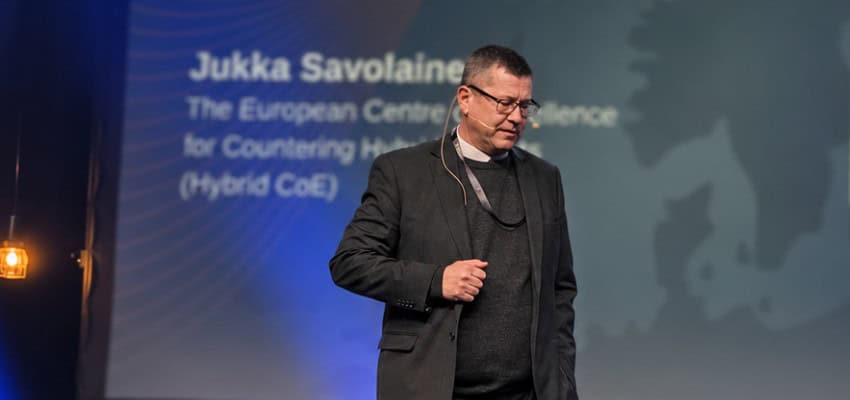
Jukka Savolainen directs the community of interest on vulnerabilities and resilience at the European Centre of Excellence for Countering Hybrid Threats (Hybrid CoE), which serves 35 participating states along with the European Union and NATO. Savolainen said the Helsinki center was founded in 2017 to combine European Union and NATO understanding of how Russia took Crimea while staying below the thresholds that trigger resistance. He described a three-step scale of hybrid influencing, hybrid operations and hybrid warfare, and pointed to a new report with the Commission’s Joint Research Centre that shifts emphasis toward hybrid warfare as the step before open war. EU Defence and Space Commissioner Andrius Kubilius launched that report, the third hybrid threats report prepared by the Joint Research Centre and Hybrid CoE, in October.
Most of his talk was a strategic reading of adversaries, offered as his own analysis. He described Russian doctrinal writing as casting Russia as a civilization-state that must absorb Ukraine, said China shares Russia’s rejection of democratic standards, and argued that recent Western air campaigns exposed weaknesses in Russian- and Chinese-made air defenses. He cited the 2024 Nobel memorial prize in economic sciences, awarded for research linking prosperity to inclusive institutions, as evidence that democracies hold the long-term advantage. He closed by arguing that Europe should keep using hybrid warfare as a label, saying that dropping it would serve Russia’s narrative, because individual incidents can rarely be attributed with certainty even when the broader campaign is clear.
Why the session matters to data professionals
For cybersecurity, information governance and eDiscovery professionals, the session’s clearest message came in Donahue’s component list, and in ComplexDiscovery’s analysis that list is a data-governance requirement in military form. A vendor that wants into EFDI must show how its data enters shared systems, crosses national mission command and moves through cloud infrastructure, which raises the same questions of data standards, access and retention that govern any shared platform. Several of the pitches were, at their core, data products: a lidar that reads materials, acoustic AI that classifies sound and navigation software that builds its own maps.
Practitioners advising defense and dual-use companies can take three points from the session. Integration and data-sharing terms deserve early legal and governance review, because by Donahue’s account they decide whether a product can be bought at all. Testing in Ukraine, which Donahue urged on stage and the host said both generals have recommended publicly, can create field records and cross-border data flows that companies may need to document, preserve and, in a dispute, produce. And Savolainen’s hybrid-threat frame reaches past defense contractors to any organization running connected infrastructure, as the freezer attacks showed.
Who controls the systems, and the data inside them, is also the question that links the session back to Tallinn. At the ninth Tallinn Digital Summit on Nov. 5 and 6, which ComplexDiscovery covered for a third consecutive year, the second morning turned on who controls the AI systems Europe depends on. DECOI x Borderland asked a version of that question about defense technology: whose systems a vendor’s data has to flow into, and who decides when a young company is ready to be heard.
If military buyers wait for readiness level 7, who funds the companies still at 4, and who governs the data they generate on the way up?
News sources
- DECOI x Borderland 2026 | FiBAN (Finnish Business Angels Network)
- European Commission Launches First Call to Accelerate European Defence Innovation and Matchmaking (European Commission)
- Regulation on establishing the Programme for agile and rapid defence innovation (AGILE): adoption of the legislative act (Council of the European Union)
- EU adopts AGILE: €115 million for defence innovation in small firms (EUR-Lex Official Journal via Lovguiden)
- Defence: EU Council approves the AGILE programme (Eunews)
- Horizon 2020 Work Programme 2014-2015 General Annexes: G. Technology readiness levels (TRL) (European Commission)
- Minister of Defence Antti Häkkänen: Finland will host a series of NATO Innovation Range events (Finnish Government)
- Arctic Strike 26 (NATO)
- Arctic Strike 2026: TFX EFDL (NATO)
- US Army Europe and Africa leads NATO integration and readiness efforts in Sword 26 (U.S. Army)
- NATO Allies Advance Data Sharing Efforts at Vilnius Exercise (NATO Allied Land Command via GlobalSecurity.org)
- About us (European Centre of Excellence for Countering Hybrid Threats)
- Contacts (European Centre of Excellence for Countering Hybrid Threats)
- Hybrid warfare (European Centre of Excellence for Countering Hybrid Threats)
- Kubilius: Rusland angriber Europas forsvarsvilje med hybride angreb (European Commission Press Corner via Lovguiden)
- European Commission Launches First Call to Accelerate European Defence Innovation and Matchmaking (Civitta)
- NATO put technologies to the test at the Innovation Range event: Millog enabled shared situational awareness (Millog)
- OuluZone quickly provided a realistic testing environment for NATO’s LCI-X Crucible 2-26 (BusinessOulu)
- Harri Tallinn (Civitta)
- Slush (MyHelsinki)
- Army’s top general in Europe set to retire next week (Breaking Defense)
- Kyiv military chief salutes outgoing US Army commander as war rages in Ukraine (Army Times)
- AGILE: EU’s new €115 million funding instrument for rapid defence innovation (Vinge)
- NATO corps chiefs set 2026 focus on year of execution (UK Defence Journal)
- IAV 2026: Joint air-ground integration, deep battle and lessons learned from Ukraine are leading Finnish Army reshaping (European Defence Review)
- Arqus Aerospace (private company) (Nordic 9)
- Alteva raises €1.7M for battery development (Dealroom)
- Tiepoint AS (Interspill)
- Defrost and Disrupt | An Assessment of Europe’s Refrigeration Attacks (SentinelOne)
- France ties October supermarket fridge sabotage to Iran’s IRGC and seeks arrest warrants (ComplexDiscovery)
- Tallinn Digital Summit 2026 puts the agentic state to the test (ComplexDiscovery)
- Tallinn Digital Summit’s second morning asks who controls the AI Europe runs on (ComplexDiscovery)

Assisted by GAI and LLM Technologies
Additional reading
- Days before Slush, an attack on Estonian drone maker Threod raises the stakes for defense tech
- Before the Abu Dhabi talks, a claimed Rosstat leak and hacked alert apps test what can be confirmed
- Spoofed nuclear alert caps four days of Ukraine war assessments that separate claims from evidence
- Kyiv says Starshield speeds are back, but who capped them is still disputed
- Diesel license, Starshield cap and intelligence warnings strain US support for Ukraine
- Drones hit two Yandex data centers, and a Kremlin decree sets terms for state management
- A cell tower near Lyman and Russia’s fight over its own war record
- How a general’s walk across a bridge tested Putin’s claim to Svyatohirsk
- Germany names Russia for the Leipzig drone, and keeps most of its evidence out of view
- Estonia scrambled jets over a drone no official has identified
- Russia leans on drones and dissent-proofing as fuel crisis bites
- Senate passes Graham sanctions act, shifting Russia pressure from policy to statute
Source: ComplexDiscovery OÜ

ComplexDiscovery’s mission is to enable clarity for complex decisions by providing independent, data‑driven reporting, research, and commentary that make digital risk, legal technology, and regulatory change more legible for practitioners, policymakers, and business leaders.