

Editor’s Note: Estonia is positioning regulatory experimentation as a competitive instrument by building a sandbox framework that can grant companies real legal exemptions, rather than guidance on how to comply with existing rules. Reported from the opening of Latitude59 in Tallinn, this article examines how Estonia, Japan, Canada, platform companies, investors, and founders are approaching regulated innovation in sectors where current statutes often lag behind emerging technologies.
For cybersecurity, data privacy, regulatory compliance, and eDiscovery professionals, the stake is immediate: when exemptions accelerate testing for AI-driven products, autonomous systems, drone logistics, and health-adjacent delivery platforms, they also accelerate the creation of sensitive data, audit trails, governance obligations, and future discovery exposure. The central question is no longer whether regulators can keep pace with innovation, but whether organizations can document, secure, and defensibly explain what happens inside the experiment before the law catches up.
Content Assessment: Estonia opens Latitude59 with sandbox framework for legal exemptions
Information - 93%
Insight - 92%
Relevance - 90%
Objectivity - 92%
Authority - 91%
92%
Excellent
A short percentage-based assessment of the qualitative benefit expressed as a percentage of positive reception of the recent article from ComplexDiscovery OÜ titled, "Estonia opens Latitude59 with sandbox framework for legal exemptions."
Industry News – Investment Beat
Estonia opens Latitude59 with sandbox framework for legal exemptions
ComplexDiscovery Staff
Estonia is building a framework to issue companies real legal exemptions from current law — not compliance advice — so they can test products today’s statutes do not allow. That model opened Latitude59 on Wednesday at Kultuurikatel, where Estonian, Japanese and Canadian policymakers met with founders, investors and delivery platforms to compare regulatory sandbox programs in motion in Tokyo and Tallinn.
The morning belonged to the official opening event, Thinking in Billions, co-organized by Latitude59, the Estonian Ministry of Economic Affairs and Communications, and Accelerate Estonia, a governmental innovation lab under the ministry whose CEO Olari Püvi moderated the Japan-Estonia segment on stage. The day moved through two keynotes, a fireside dialogue between Estonia and Japan, a foreign-policy address from Canada, and two panel discussions on regulated markets — Bolt and Wolt discussing over-the-counter pharmacy delivery, and three founders and an investor in dialogue about how to enter markets that have no rules yet.
A framework built on legal exceptions, not consulting
Erkki Keldo, the minister of economic affairs and industry of Estonia, opened with a description of how Estonia plans to differ from the many regulatory sandboxes already operating globally. “In most places, regulation is a barrier, but in Estonia we are turning it into our competitive advantage,” he said. Most existing sandboxes, Keldo said, deliver compliance consulting — help in meeting current rules. Estonia, he said, is building something different: a system designed to issue real legal exemptions so a company can run an experiment the current statute does not allow.

Sigrid Rajalo, deputy secretary general for economy and innovation at the Estonian Ministry of Economic Affairs and Communications, walked through the design. “We are not offering compliance consultancy. We are offering actual exceptions in legislative order,” she said. The framework runs through three layers: a horizontal regulation defining what an experimentation project is, sector-specific regulations attaching to permitting processes, and individual agreements between a company and its sector regulator. Companies enter at a single point, and the state coordinates exemptions across ministries from there.
Rajalo also surfaced the cultural barrier the framework is designed to remove. “The biggest obstacle to innovation is not a lack of ideas, but the fear of making mistakes,” Rajalo said in a Latitude59 statement on the opening event. “Through a testing environment, we are creating a clear and safe way for companies and the state to test complex technologies and solutions with high potential impact.”
Accelerate Estonia, the innovation arm running the framework, says companies participating in Estonian regulatory sandboxes could raise close to €1.7 billion over 10 years — roughly €220 million above what equivalent firms would raise outside the framework. The same analysis says sandbox participants are 50 percent more likely to attract investment than peers, and that five of Estonia’s top 20 startups by capital raised needed at least some regulatory change to operate. Those five companies have raised over €2.5 billion in combined investment, according to Accelerate Estonia.
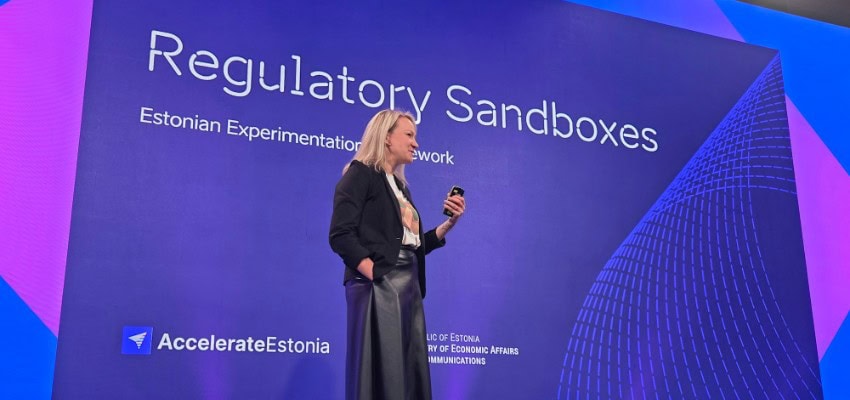
Japan and Estonia compare sandbox notes
Takeshi Kito, co-founder and CEO of GFTN Japan and a committee member on the Government of Japan’s Regulatory Sandbox, said Japan launched its national program in 2018 under the Cabinet Secretariat — placing it under the prime minister’s office so it could cut across ministries. “New technologies and new business models often cannot be classified and defined with the existing regulatory frameworks,” Kito said. The program ran on a three-year temporary basis and became permanent in 2021.
The Cabinet Secretariat’s English-language portal records 33 projects involving 152 entities certified under the Regulatory Sandbox between June 2018 and March 2025, across mobility, finance, healthcare, IoT, and real estate. On stage, Kito cited two examples he had worked through: a rule change that opened drone operations to commercial uses, and a sandbox finding that pushed Japan’s paper-only real estate transactions online during COVID-19.
In a Latitude59 statement on the opening event, Kito framed the Estonia-Japan partnership as the day’s opening proposition. “In particular, Japan and Estonia share regulatory sandboxes built on highly similar concepts and missions. In the short term, I hope we can exchange insights and sandbox outcomes,” Kito said. “Looking ahead, I look forward to exploring collaborations that foster billion-scale emerging industries not only through mutually compatible regulatory frameworks, but also through the exchange of talent and ecosystem integration.”

Canada arrives with a foreign-policy pitch
Anita Anand, Canada’s minister of foreign affairs, spoke after the Japan-Estonia fireside and tied digital governance to a broader trade and security discussion. “When the world changes around you, we have to adapt and we have to grow together,” Anand said. “Canada has prospered because it is a multilateral nation, because we believe in international cooperation and coordination, including in cybersecurity and digital governance.”
Anand said Canadian merchandise exports to Estonia reached almost $30 million last year, with imports totaling almost $200 million, and that Canada is pursuing a doubling of non-US trade over the next 10 years. Anand also pointed to the planned 2026 opening of KESKUS International Estonian Centre in downtown Toronto — a centre for the Estonian diaspora — and confirmed Canada will continue working with Estonia, Latvia, and Lithuania through the 3+1 cooperation format. The visit was her first to Estonia, she said.

Bolt and Wolt push for over-the-counter delivery
Two delivery platforms used the next panel to discuss why platforms entering health-adjacent verticals — specifically over-the-counter medicine delivery in Estonia — need regulators willing to move at a different pace, and how a deeper dialogue between platforms and the state could get them there.
Triin Toimetaja, strategy and operations manager at Bolt, said the company sees room for closer cooperation with the state. “Bolt sees great potential in closer cooperation between platforms and the public sector to jointly design solutions, update outdated rules and ensure that the regulatory environment keeps pace with people’s real needs,” Toimetaja said in a Latitude59 statement on the opening event.
Irina Kuzina, sub-regional head of key account management at Wolt, said Wolt already runs over-the-counter delivery across the Nordics and the wider Baltic region — but not yet in Estonia. The company’s discipline, she said, is to “start from compliance, from regulations, safeguards, and not from the speed and expansion.” Aggressive growth pitches into healthcare, she said, lose regulators on first contact.
Both panelists discussed the demographic case for moving faster. Toimetaja said single-adult households in Europe are up about 19% (updated) percent in recent decades; about one in five of those households is now headed by a single parent and about one in three by a person over 65 living alone, she said — populations less able to reach a pharmacy when sick. Toimetaja’s figures, presented from the stage, are attributed to her and were not independently verified by external data sources. An audience show of hands on stage indicated that fewer than 10 attendees had ever used a pharmacy delivery service. The need exists, Toimetaja said; the rule does not.

Investors say price the risk, then take it
Leo Ringer, founding partner at Form Ventures, said his fund built its thesis on backing startups in complex regulated markets. “Estonia has long led the way when it comes to regulatory innovation, not least through Accelerate Estonia, and it’s great to discuss the opportunities and challenges here at Latitude59,” Ringer said in a Latitude59 statement on the opening event. On stage, Ringer added that early-stage investors should price regulatory timelines into capital plans and warned founders to raise enough runway to outlast the regulator. “The worst thing that can happen is you get to within two months of that final approval and then you’re out of cash,” he said.
Julian Glaab, CEO and co-founder of Bliq, the Berlin-based driverless-vehicle company, said his team had raised €35 million predominantly from US investors and that Bliq received an Estonian permit the previous week to operate vehicles with no driver in the seat on public roads. To Glaab’s knowledge, no other European company holds an equivalent permit at this moment, he said. Doron Appelboim, co-founder and CTO of Aerolane, described certifying a configuration not contemplated by any current regulator: two airplanes connected by a cable, one towing the other for cargo. “You have to get an anchor in some existing regulations and you got to be safer than the regulator,” Appelboim said.

The closing question: careers versus innovation
The day closed with a public-sector panel that flipped the usual framing. Tõnis Tänav, PhD, deputy secretary general for innovation and strategy at the Estonian Ministry of Regional Affairs and Agriculture, put a question to his peers in the audience.
“I really haven’t seen that anyone loses their job in the public sector because of being too innovative,” Tänav said in a Latitude59 statement on the opening event. “However, the current risk and reward system really does not incentivize the public sector enough to force them to take great leaps. Maybe it should be the other way, losing your job for not being innovative enough?”
For cybersecurity, information governance and eDiscovery practitioners, the stakes in that question come into view fastest in regulated workflows. Sandboxes that grant real legal exemptions — rather than consulting on compliance — change the timing of when AI-driven products, autonomous-vehicle fleets, drone logistics and platform-delivered healthcare enter the regulated economy. They also change the timing of when those products begin generating discoverable records, audit trails and litigation exposure. Estonia’s bet is that exempting the experiment produces better rules, faster, than waiting for the rules to catch up.
That bet returns the day to where it started. Estonia opened Latitude59 by committing to build a framework that issues real legal exemptions to companies testing products today’s statutes do not allow. The harder question for the audiences that sit between cybersecurity, information governance and eDiscovery comes after the experiment is approved: when the rule arrives months later, who keeps the record of what the company actually tested, and on whose customers?
News sources
- Latitude59: Future technologies need more flexible rules (Thinking in Billions (Latitude59 press release))
- Program – Thinking in Billions (Thinking in Billions)
- Speakers – Thinking in Billions (Thinking in Billions)
- About – Thinking in Billions (Thinking in Billions)
- Experimentation framework (Accelerate Estonia)
- Regulatory Sandbox (Cabinet Secretariat, Government of Japan)
- Latitude59 | Startup & Tech Event (Latitude59)
- KESKUS International Estonian Centre | Toronto (KESKUS International Estonian Centre)





Assisted by GAI and LLM Technologies
Additional Reading
- Seven startups from four nations compete for Latitude59’s nearly half-million-euro investment prize
- Big tech, defense and climate to share the main stage at Latitude59 2026
- Latitude59 pitch competition draws 465 startups from 53 countries as prize pool grows to €400,000
- Baltic and Nordic Angel Networks Pool €300,000 for Latitude59 Pitch Competition as Cross-Border Startup Investing Deepens
- Latitude59 Opens Pitch Applications as Investors Raise the Bar on Operational Readiness
Source: ComplexDiscovery OÜ

ComplexDiscovery’s mission is to enable clarity for complex decisions by providing independent, data‑driven reporting, research, and commentary that make digital risk, legal technology, and regulatory change more legible for practitioners, policymakers, and business leaders.