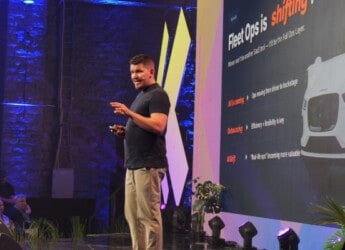

Editor’s Note: Tallinn is stepping into the spotlight as Latitude59 2026 tests Estonia’s claim as the Capital of the New Nordics, bringing founders, investors, policy leaders, and global technology firms together May 20-22 at Kultuurikatel. Under the theme The Global Village Experiment, the conference frames cross-border collaboration as more than a regional ambition; it positions the Nordic-Baltic corridor as a working model for climate innovation, defense technology, AI adoption, and startup-driven economic growth.
For cybersecurity, data privacy, regulatory compliance, and eDiscovery professionals, the program offers several signals worth tracking. Google Cloud’s planned AI agents workshop in the Baltics points to the growing importance of enterprise security defaults in agentic AI. Defense-tech sessions and the Ukrainian delegation bring cyber resilience, operational technology risk, and supply-chain exposure into sharper focus. Tallinn’s proximity to the NATO Cooperative Cyber Defence Centre of Excellence adds further context, reinforcing why Estonia remains a consequential meeting point for technology, governance, and security.
Latitude59’s broader relevance extends beyond Europe. With recent activity in Nairobi, Singapore, Cape Town, and Johannesburg, the event is positioning Tallinn as a bridge between the New Nordics and startup ecosystems across Africa and Asia. For practitioners watching the convergence of AI, cyber, defense, and regulatory strategy, Latitude59 2026 offers a useful preview of where emerging technology markets, policy priorities, and security expectations may be heading next.
Content Assessment: Big tech, defense and climate to share the main stage at Latitude59 2026
Information - 93%
Insight - 92%
Relevance - 90%
Objectivity - 93%
Authority - 93%
92%
Excellent
A short percentage-based assessment of the qualitative benefit expressed as a percentage of positive reception of the recent article from ComplexDiscovery OÜ titled, "Big tech, defense and climate to share the main stage at Latitude59 2026."
Industry News – Investment Beat
Big tech, defense and climate to share the main stage at Latitude59 2026
ComplexDiscovery Staff
Latitude59 pitch competition winners have raised over €20 million in follow-on investment over the past three years — a track record the conference’s 14th edition will try to extend, May 20-22 in Tallinn, with founders, investors, and policy figures arriving from over 70 countries.
Organizers are casting Latitude59 as the front door to what they call the New Nordics — a stretch of Nordic and Baltic markets that share digital infrastructure, an export-led mindset, and growing ambitions in climate and defense technology — and the 2026 main theme, The Global Village Experiment, frames the week as a test of whether ecosystems produce more value when they collide than when they operate inside national borders.
The framing is itself a positioning claim, not a settled status. Helsinki’s Slush, the founder-focused event scheduled for November, drew 6,000 startups and 3,500 investors at its 2025 edition, and Lisbon’s Web Summit hit 71,386 attendees in 2025 — the established peer venues Latitude59 implicitly competes against. The pitch from Tallinn is that proximity, pace, and the dense Baltic-Nordic deal corridor are different goods than the larger conferences are selling.
“Latitude59 is bringing international startup communities to Tallinn and creating a practical environment where real problems are solved, and tangible outcomes are achieved,” said Kai Isand, head of program for the conference, in a statement released by organizers. The aim, Isand said, is to “bring different experiences and ways of thinking together, sparking meaningful collisions.” The gathering will run at Kultuurikatel, the former power station turned creative campus that has hosted the event for years.
The program leans into topics organizers say require collective thinking — climate technology and defense technology among them — alongside specialized sessions and interactive formats designed to encourage practical exchange rather than passive listening. The stated philosophical anchor is the balance between humanity and technology, a frame that runs through main-stage sessions, workshops, and side events.
On the program
For the first time, Latitude59 will host a two-day Builders Lab where 10 selected teams and individuals will present software solutions to companies including Google, Project Europe, and Bilt and receive feedback from industry experts. The audience is meant to participate rather than observe, with organizers structuring the format so attendees pick up ideas they can apply to their own projects. The Builders Lab sits alongside the long-running pitch and podcast stages where the next generation of founders gets airtime, and Bliq will showcase the teledriving technology it has deployed in Estonia through its partnership with Tallinn-based Elmo. Teledriving keeps a human operator in the loop via a remote connection rather than handing full control to autonomous systems — a distinction that matters for readers tracking the evolution of mobility tech.
The track record behind that €20 million figure traces to specific names. The 2025 pitch winner, Luna Robotics, a Lithuanian defense-tech startup, closed a €1.08 million round in October 2025 with Coinvest Capital, Plug & Play EMEA Ventures, and international business angels — a representative post-stage outcome of the kind the competition is built around.
Finland’s Aalto University is bringing deep tech into focus with a stage discussion preceded by workshops for Estonian and Finnish startups and investors. Those conversations continue across the event and are explicitly designed to build bridges between New Nordics markets that share early-stage capital, talent flows, and regulatory rhythms. A separate New Nordics area, hosted by the Ministry of Foreign Affairs of Estonia, will showcase the regional positioning that underpins the entire week.
Global technology firms anchor the showcase. Google Cloud, Meta, Mastercard, and Amazon Web Services will all be on the ground in Tallinn, with Google Cloud organizing what organizers describe as the first AI agents workshop in the Baltics. Google Cloud will also feature Axel Toybetman, a former rapper now working at the company, on a main-stage talk about his journey from music and graffiti to a tech career. The big-tech presence reinforces the event’s pitch that what happens on the Tallinn stage matters to founders, governments, and enterprise buyers alike.
International delegations from Italy, Valencia, Austria, the United Kingdom, Ukraine, South Korea, and Canada will round out the international footprint. The Ukrainian delegation, in particular, brings cyber and defense-tech credentials forged through wartime conditions, and Tallinn’s startup week sits a short distance from the NATO Cooperative Cyber Defence Centre of Excellence, which authored the Tallinn Manual and runs the annual Locked Shields exercise from this same city. Latitude59’s program is not built around cybersecurity, but the proximity to that institutional backbone gives the convention a flavor most European startup weeks lack.
Estonia’s underlying pitch is that scale is not the constraint. The country claims 865 startups per million people, by its own count, and Invest in Estonia data places it at the front of European unicorn density at about 7.7 unicorns per million inhabitants — ahead of Luxembourg’s 3.1, the United Kingdom’s 1.6, and Germany’s 0.6. Estonia counts 10 unicorn companies, including Skype, Wise, Bolt, and Veriff, and the country’s e-Residency program and X-Road data infrastructure are the quiet backbone of why founders keep coming to Tallinn. Independent analysts back parts of that pitch. Copenhagen-based venture firm byFounders publishes an annual Shape of New Nordics report tracking deal flow across the Nordic-Baltic corridor, and Estonia has drawn 40 to 50 foreign funds actively scouting defense-tech and deep-tech investments, according to Nordic Fintech Magazine.
What practitioners should track
For cybersecurity, information governance, and eDiscovery professionals reading this preview, the audience-relevant items inside the broader program are the AI agents workshop (where the security defaults major cloud providers are pushing tend to become industry baselines), the defense-tech sessions (where supply-chain and operational-technology exposures naturally surface), and the side events around the Ukrainian delegation (where battle-tested cyber operators are reachable in person). The Global Village Experiment frame is broader than any single audience read, but each of those items lands inside it.
Beyond Europe
Last year, the organizers extended the Latitude59 brand outside Estonia with a two-day conference in Nairobi (Dec. 3-5, 2025), side events in Singapore, and two events in South Africa (Cape Town on Nov. 12 and Johannesburg on Nov. 14, 2025). Data current as of May 2026 confirms the Kenya edition drew about 2,500 participants from 50 countries. The 2026 ambition, organizers say, is to deepen those bridges between the New Nordics and startup communities in Africa and Asia, putting Tallinn at the center of a global village that runs farther than any earlier edition tried to reach.
What is the New Nordics moment most worth bringing back from Tallinn this year — the cross-ecosystem deal flow, the agentic AI defaults set on stage, or the talent and partnership corridors connecting Europe to Africa and Asia?
ComplexDiscovery OÜ — covering cybersecurity, information governance and eDiscovery for a global professional audience — will have staff on-site at Latitude59 2026 in Tallinn, May 20-22.
News sources
- Latitude59 — Startup & Tech Event, Tallinn, May 20-22 (Latitude59)
- Kicking Off Latitude59 2026 Tallinn: The Global Village Experiment (Latitude59)
- Latitude59 Pitch Competition Winners Secured Over €20 Million in Investments (Latitude59)
- byFounders Launches the Shape of New Nordics 2024 Report, Powered by Crunchbase (Crunchbase)
- Estonia’s Startup Sector Is Entering a New Era (Nordic Fintech Magazine)
- About Us — NATO Cooperative Cyber Defence Centre of Excellence (CCDCOE)
- Estonia Leads Europe in Startups, Unicorns and Investments Per Capita (Invest in Estonia)
- Latitude59 Returns to Kenya in 2025: Three Days with 3,000+ Innovators, Founders & Investors (Latitude59)
- World’s First Public Remote-Driven Taxi Service Launches in Tallinn (Elmo Remote)
- Slush — Helsinki, Nov 18-19 (Slush)
- Web Summit – The best tech conference in Europe | November 9-12, 2026 (Web Summit)
- Defense Technology Startup Luna Robotics Receives Over €1 Million Investment (Coinvest Capital)





Assisted by GAI and LLM Technologies
Additional Reading
- Latitude59 pitch competition draws 465 startups from 53 countries as prize pool grows to €400,000
- Baltic and Nordic Angel Networks Pool €300,000 for Latitude59 Pitch Competition as Cross-Border Startup Investing Deepens
- Latitude59 Opens Pitch Applications as Investors Raise the Bar on Operational Readiness
- The M&A Risk of Confusing Market Velocity with Marketing Capability
- From Principles to Practice: Embedding Human Rights in AI Governance
- Government AI Readiness Index 2025: Eastern Europe’s Quiet Rise
- Trump’s AI Executive Order Reshapes State-Federal Power in Tech Regulation
- From Brand Guidelines to Brand Guardrails: Leadership’s New AI Responsibility
- The Agentic State: A Global Framework for Secure and Accountable AI-Powered Government
- Cyberocracy and the Efficiency Paradox: Why Democratic Design is the Smartest AI Strategy for Government
- The European Union’s Strategic AI Shift: Fostering Sovereignty and Innovation
Source: ComplexDiscovery OÜ

ComplexDiscovery’s mission is to enable clarity for complex decisions by providing independent, data‑driven reporting, research, and commentary that make digital risk, legal technology, and regulatory change more legible for practitioners, policymakers, and business leaders.