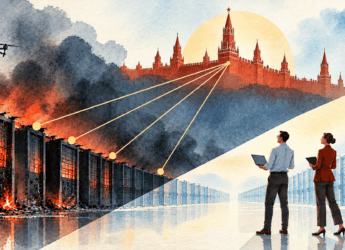

Editor’s Note: Ukrainian drone strikes near Moscow exposed more than gaps in Russia’s air defenses; they revealed how quickly kinetic disruption, supply-chain risk, cyber operations, and state narrative control can converge into a single operational picture. Grounded in the Institute for the Study of War’s May 17, 2026, Russian Offensive Campaign Assessment, this analysis gives cybersecurity, data privacy, regulatory compliance, and eDiscovery professionals a timely case study in evidence suppression, open-source intelligence constraints, sanctioned technology supply chains, and the growing role of AI-assisted threat activity. The targeting of microelectronics and energy infrastructure, coupled with Moscow’s restrictions on publishing strike-related imagery, underscores a practical governance concern: when authoritative channels distort or minimize events, organizations must rely on resilient evidence pipelines, independent verification, and risk models that can withstand politically managed information environments. The article is especially relevant for leaders monitoring adversary cyber programs, export-control exposure, digital evidence preservation, and geopolitical risk in regions where access to reliable data may narrow without warning.
Content Assessment: The night Ukrainian drones exposed gaps in Moscow’s defenses and state TV gave it 60 seconds
Information - 93%
Insight - 93%
Relevance - 92%
Objectivity - 91%
Authority - 92%
92%
Excellent
A short percentage-based assessment of the qualitative benefit expressed as a percentage of positive reception of the recent article from ComplexDiscovery OÜ titled, "The night Ukrainian drones exposed gaps in Moscow’s defenses and state TV gave it 60 seconds."
Industry News – Geopolitics Beat
The night Ukrainian drones exposed gaps in Moscow’s defenses and state TV gave it 60 seconds
ComplexDiscovery Staff
Ukrainian drones struck four Russian defense industrial and oil targets in Moscow City and Moscow Oblast overnight on May 16 to 17. Russian state television gave the operation about a minute of airtime.
The Institute for the Study of War’s May 17, 2026, update of its Russian Offensive Campaign Assessment series — the foundational analytical source for the reporting that follows — synthesizes Ukrainian official claims, Russian official statements, Russian milblogger commentary, independent Russian monitoring, and geolocated open-source imagery from the strike series. For cybersecurity, information governance, and eDiscovery professionals, the gap between the kinetic event and the state-controlled retelling is where this analysis lives. The strikes hit the Angstrem semiconductor plant — designated on the U.S. Treasury Office of Foreign Assets Control’s Specially Designated Nationals list — the Moscow Oil Refinery, and two oil pumping stations on the capital’s energy ring. Three of Russia’s largest state-owned broadcasters — Perviy Kanal, Rossiya-1, and NTV — devoted roughly one minute each to coverage, according to independent Russian monitoring outlet Agentstvo, whose count the assessment relayed. Some Russian ultranationalist milbloggers, working from the same open-source Telegram feeds Western analysts use, called for tactical nuclear retaliation.
When drones exposed gaps in Moscow’s defenses
The most consequential hit, for readers of this publication, was a sanctioned microelectronics plant. The Angstrem Semiconductor Plant in the Elma Technopark in Zelenograd, northwest of Moscow City, produces microelectronics that feed Russian high-precision weapons programs and is designated on the U.S. Treasury Office of Foreign Assets Control (OFAC) Specially Designated Nationals (SDN) list. The Ukrainian General Staff and the Security Service of Ukraine (SBU) announced the strike on May 17; a Ukrainian Unmanned Systems Forces unit said it also hit the technopark itself; Russian opposition channel Astra published footage of the subsequent fire alongside a geolocated image showing a smoke plume at the plant.
The Moscow energy ring absorbed the rest of the operation. The SBU reported strikes on the Moscow Oil Refinery in Kapotnya Raion, the Volodarsk oil pumping station southeast of Moscow City, and the Solnechnogorsk pumping station near Durykino — the last producing a large fire visible in geolocated video. Moscow City Mayor Sergei Sobyanin acknowledged the refinery hit while trying to confine the public damage assessment to a checkpoint; Moscow Oblast Governor Andrei Vorobyov acknowledged drone hits on infrastructure and residential damage. Sobyanin claimed Russian air defenses downed over 120 drones over the capital across May 16 and 17 — a figure that hangs awkwardly next to the audible explosions, the geolocated smoke plumes, and the runway fire at Sheremetyevo International Airport that diverted 51 flights overnight, the Russian Transportation Ministry reported.
Ukrainian-developed long-range drones — the RS-1, FP-1, and BARS-SM — carried the operation, according to the Ukrainian General Staff. The verdict Russian milbloggers themselves landed on was harsher than any Ukrainian boast: in the milbloggers’ assessment, Russia has not built the air-defense architecture to protect its own capital, and the federal apparatus is now openly downplaying that fact.
The Kremlin’s narrative-control machinery
Russian Ministry of Foreign Affairs Spokesperson Maria Zakharova criticized the strikes for their alleged civilian impact and quietly omitted the defense industrial and oil targets entirely. Kremlin Spokesperson Dmitry Peskov, asked by reporters about “powerful bombs” used by a “nuclear power state,” answered: Russia “cannot be threatened as a nuclear power and its very existence cannot be threatened.” Peskov did not address the kinetic events themselves. Agentstvo’s count — about a minute each on Perviy Kanal, Rossiya-1, and NTV, focused on civilian implications and a vague reference to Russian “retaliatory strikes” whose nature was not specified — completes the federal-broadcast layer.
The pattern is familiar to readers who tracked the preceding day’s reporting. Russian Chief of the General Staff Army General Valery Gerasimov spent the May 16 briefing cycle telling Russian President Vladimir Putin that Russian forces were advancing west of Kupyansk — territory they have not taken — in claims Russian milbloggers themselves derisively call “beautiful reports.” Ukrainian Joint Forces Group Spokesperson Colonel Viktor Trehubov reinforced the point on May 17, telling reporters that repeated false Russian claims of seizing Kupyansk are now forcing Russian forces to keep attacking the town “for informational effects.” The federal communications layer and the military-command layer are now running on the same kind of corrupted feedback — and the milblogger community, which has built Russia’s only functioning open-source feedback loop, sees the cost. Milbloggers spent May 17 calling for a multi-echeloned and unified air defense network around Moscow, an early-warning system, and, in several quarters, retaliatory tactical nuclear strikes; they dismissed Peskov and Zakharova as inadequate and called Russian mobile-internet shutdowns useless at slowing Ukrainian strikes.
For information-governance practitioners, the divergence between the federal communications layer and the milblogger layer is the lesson. A state can suppress its own kinetic event from its own broadcasters and lose internal credibility at the same time. The cost is paid in adversary cyber-targeting choices, in domestic recruitment, and in the inputs senior leaders rely on for operational planning.
Striking Russia’s microelectronics core
Angstrem deserves a closer look from cybersecurity and supply-chain leaders specifically. The plant supplies microelectronics for Russian high-precision weapons and carries an active OFAC SDN designation tied to its military-industrial supply role. The Elma Technopark in which Angstrem operates hosts a cluster of microelectronics, optical, robotics, information-technology, and scientific-research firms that move dual-use components into Russian defense manufacturing. Practitioners building export-control programs or third-party-risk frameworks should treat Zelenograd as a critical concentration point for Russian military microelectronics whose disruption will route components through new and likely opaque channels. Counter-diversion screening on Eurasian distributors and shell entities should be retuned now, not after the first downstream incident report.
The Belbek military airfield strike in occupied Sevastopol the same day, also announced by the SBU, hit exactly the categories of electronics that move first in any modern air campaign. Air-defense systems took the brunt — a Pantsir-S2 system and a hangar housing the radar for an S-400 system. Command-and-control infrastructure followed: an Orion drone control system, a Forpost ground-based unmanned aerial vehicle control system, a ground-to-air data transmission system, and a control tower. NASA’s Fire Information for Resource Management System (FIRMS) data showed a heat anomaly at Belbek, and Sevastopol occupation governor Mikhail Razvozhaev acknowledged the strikes. Ukrainian Unmanned Systems Forces commander Major Robert “Magyar” Brovdi added a separate Black Sea Fleet communications-node hit near occupied Myrne and a strike on a Project 10410 Svetlyak-class Russian Federal Security Service Border Service patrol ship near Kaspiysk in Dagestan, roughly 1,000 kilometers from the front. Brovdi said long-range drones in the Myrne operation launched eight unguided air-launched rockets carrying 60-kilogram warheads at ranges up to 500 kilometers.
How CERT-UA and the Moscow ban fit in
The Moscow anti-terrorism commission instituted a citywide ban on May 13 that prohibits government bodies, emergency services, journalists, and citizens from publishing photos, videos, or detailed accounts of drone-strike aftermath without prior authorization. Fines run from 3,000 to 5,000 rubles (approximately $38 to $64 at current rates) for individuals up to 200,000 rubles (approximately $2,500) for legal entities, the Kyiv Independent and Asia Plus reported, and similar restrictions already apply across about 30 Russian regions as of late 2025. The order is, in effect, a real-time criminalization of open-source intelligence — exactly the kind of evidence the May 16 to 17 strike series generated.
Beneath the kinetic and information layers, the cyber war continues. Ukraine’s Computer Emergency Response Team, CERT-UA, has documented a steady shift in Russian-linked threat-actor tradecraft over the past year. CERT-UA reporting summarized by The Record in October 2025 found Russian-linked actor UAC-0219 using AI-generated PowerShell scripts in the Wrecksteel malware family; CERT-UA reporting summarized in cybersecurity trade press through early 2026 documented additional groups, including UAC-0227, using SVG image attachments carrying embedded HTML and JavaScript to deliver AMATERA and STRELA infostealers against local-government and critical-infrastructure targets. CERT-UA has also flagged a separate campaign in which attackers impersonate the agency itself in phishing emails — a social-engineering loop that exploits the trust Ukrainian defenders have built in their own incident-response brand. Ukrainian Ministry of Defense advisor on defense technology and electronic warfare Serhiy “Flash” Beskrestnov added on May 17 that Russian forces may have resumed using Belarusian telecommunications infrastructure to deploy Shahed radio control points as signal relays during Russian strikes on Kyiv on May 13 and 14, after Ukrainian countermeasures had blocked that tactic late in winter 2025-2026.
What practitioners should watch next
The May 17 picture is layered. A Ukrainian force struck the microelectronics nodes that feed Russian high-precision weapons. A Russian government criminalized open documentation of the strikes. A Kremlin communications apparatus appears to have understated the kinetic event to its own population. A Russian milblogger community provided the only functioning feedback loop, called for tactical nuclear retaliation, and was ignored. An adversary cyber program continued to use AI-generated malware and impersonate Ukraine’s own defenders, with operations relayed through Belarusian telecommunications infrastructure. Each layer reinforces the others. Each carries a governance lesson that travels outside the Ukraine theater: communications channels controlled by political incentive cease to function as data, supply-chain risk concentrates in a few choke points, real-time information bans force verification onto narrower channels, and AI-assisted tradecraft is now baseline rather than novelty. Boards reviewing geopolitical risk briefings this quarter should ask whether their own organizations have built feedback loops that will report the truth when the truth is unwelcome, and whether their digital-evidence pipelines can survive a comparable crackdown in a future operating region.
If a Russian state communications apparatus can give a coordinated multi-target strike on its own capital about a minute of airtime, what assurance can any analyst have that the operational picture inside other adversary states — including those running offensive cyber programs against Western targets — is not being similarly downsized for public consumption?
News sources
- Russian Offensive Campaign Assessment, May 17, 2026 (Institute for the Study of War)
- Russian Offensive Campaign Assessment, May 16, 2026 (Critical Threats / Institute for the Study of War)
- OFAC Specially Designated Nationals (SDN) List entry: Joint Stock Company Angstrem (Entity ID 39158) (U.S. Treasury Office of Foreign Assets Control)
- Ukraine war latest: Drone strike reportedly hits major Russian fertilizer plant linked to explosives production (The Kyiv Independent)
- Moscow Authorities Restrict Publication of Photos and Videos of Aftermath of Drone Strikes (US News & World Report)
- Russian hackers turn to AI as old tactics fail, Ukrainian CERT says (The Record from Recorded Future News)
- Drones Hit Elma-Zelenograd Technopark 30 km from Moscow (Militarnyi)

Assisted by GAI and LLM Technologies
Additional reading
- From warning to funding: Russia’s expanding media machine and the risk signals ahead
- Invisible by design: NATO’s 2026 cognitive warfare paper and the crisis of discovery
- When Your Legal Tech Vendor Gets Breached: DocketWise Incident Exposes 116,666 Immigration Records and a Profession’s Blind Spot
- The DOJ’s Cyber FCA Playbook Is Working as Enforcement Triples and Shows No Signs of Slowing
- FTC’s OkCupid Action Reframes AI Training Data as a Consumer Protection Issue
- White House AI Framework Signals New Compliance Stakes for Legal, Cybersecurity, and eDiscovery
- The Gatekeeper’s Key: How the Conformity Assessment Unlocks the EU AI Market
Source: ComplexDiscovery OÜ

ComplexDiscovery’s mission is to enable clarity for complex decisions by providing independent, data‑driven reporting, research, and commentary that make digital risk, legal technology, and regulatory change more legible for practitioners, policymakers, and business leaders.