
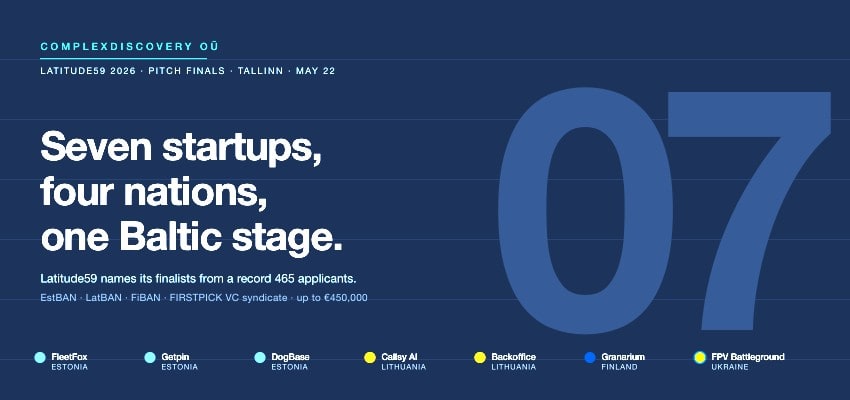
Editor’s Note: Tallinn becomes the gateway to the New Nordics this week, and the seven startups taking the Latitude59 main stage May 22 will show what Baltic-Nordic angel investors call the defining pillars of European early-stage tech in 2026. The class spans defense, energy and workforce automation, and the finalists will vie for a syndicate of up to €450,000 pooled by EstBAN, LatBAN, FiBAN and FIRSTPICK VC.
For cybersecurity, information governance and eDiscovery professionals, the cohort is a leading indicator for emerging risk and compliance work. AI workforce agents raise questions about training-data provenance, customer-data handling and model governance. Mainstreaming of dual-use defense tech reflects a broader European funding surge that tightens supply-chain attribution and export-control review for vendors selling across NATO and EU jurisdictions. Estonia’s role as host keeps the country in view as a reference case for the cross-border data flows being shaped across the New Nordics.
Watch the Bold stage May 22 to see which categories Baltic-Nordic angel networks favor most.
Content Assessment: Seven startups from four nations to vie for nearly half-million-euro investment prize at Latitude59 pitch finals
Information - 93%
Insight - 94%
Relevance - 91%
Objectivity - 91%
Authority - 93%
92%
Excellent
A short percentage-based assessment of the qualitative benefit expressed as a percentage of positive reception of the recent article from ComplexDiscovery OÜ titled, "Seven startups from four nations compete for Latitude59’s nearly half-million-euro investment prize."
Industry News – Investment Beat
Seven startups from four nations compete for Latitude59’s nearly half-million-euro investment prize
ComplexDiscovery Staff
A Ukrainian drone-combat simulator, a Finnish supercapacitor company and a Lithuanian AI sales agent will share a stage this week. Seven companies were chosen from 465 applicants. The finalists will compete for an investment prize of up to nearly half a million euros.
That contest — the Latitude59 pitch final — runs May 22 on the Bold stage at Kultuurikatel in Tallinn, and the seven finalists named by organizers last week reflect what Baltic and Nordic angel investors call the defining shape of European early-stage tech in 2026: defense and security applications, energy resilience and workforce automation.
How the prize pool came together
Latitude59 said the finalists were selected from 465 applicants, the highest number in the competition’s history. This year’s pool drew startups from 53 countries on five continents, according to the organizer’s earlier disclosure.
The syndicated prize round pools commitments from four investor groups. The Estonian Business Angels Network (EstBAN) is contributing up to €200,000. The Latvian Business Angels Network (LatBAN) is adding up to €100,000. Lithuania-based venture capital fund FIRSTPICK VC is committing up to €150,000. The Finnish Business Angels Network (FiBAN) is joining the syndicate to represent Nordic investors; Latitude59 did not disclose FiBAN’s amount in the finalists announcement. The disclosed commitments total up to €450,000, with the organizer describing the headline prize as “an investment of nearly half a million euros.” The disclosed €450,000 total represents a 50 percent increase from Latitude59’s earlier 2026 announcement of up to €300,000 from EstBAN, LatBAN and FiBAN, reflecting the later inclusion of FIRSTPICK VC’s up-to-€150,000 commitment in the May 14 finalist announcement. Both figures describe announced syndicate capacity rather than audited disbursed capital.
Past Latitude59 pitch winners have collectively raised over €20 million in follow-on investment across the last three years, according to organizer disclosures. The 2025 cohort included Estonian green-energy developer MarkeDroid, Latvian construction startup Adventum Tech and Lithuanian defense-tech company Luna Robotics, with Luna Robotics closing a €1.08 million round in October 2025, according to public reporting.
Who the seven finalists are
Three Estonian companies sit alongside two Lithuanian entries, one Finnish entry and one Ukrainian entry on the May 22 stage. According to Latitude59’s product descriptions, the Estonian finalists are FleetFox, a fleet-management product aimed at European operators; Getpin, a tool helping local businesses surface in AI-driven search and discovery; and DogBase, an AI training and performance product for working-dog teams. The Lithuanian finalists are Callsy AI, which sells an AI agent that handles outbound sales, activation and support calls, and Backoffice, a workforce-management product targeting restaurant operators. Finland is represented by Granarium, a company developing renewable supercapacitors for grid-stabilization use. Ukraine’s entry is FPV Battleground, a combat-focused first-person-view drone training simulator developed by the Ukrainian studio BAZU LLC. According to dev.ua, FPV Battleground has also presented at TechChill’s Founders Battle pitch competition in Riga.
Voices from the investor syndicate
Krista Meinarde, Latitude59’s head of startup and investor relations, said the spread of business categories defines this year’s class. “The teams that have made it to the finals are working across remarkably different fields, which makes the final competition on Latitude59’s main stage especially exciting,” Meinarde said.
Jana Budkovskaja, an EstBAN board member and a partner at BSV Ventures who is co-leading the EstBAN syndicate for the competition, said the application pool tracked clear global patterns. Defense, energy and workforce optimization came through as dominant themes, she said. “Reviewing the applications sometimes feels like reading science fiction, except these stories come with business models, and AI agents and drones are already part of our everyday reality,” Budkovskaja said. “Alongside rapid technological advancement, we’re also seeing compelling ideas focused on health and wellbeing.”
Emils Kragis, LatBAN’s managing director, said the judging difficulty was a marker of overall quality. “New technology is enabling solutions we wouldn’t have imagined a few years ago. But what excited me most was seeing how many of these teams are built around founders who have already been in the trenches. Experience matters,” Kragis said.
Defense tech moves out of the wings
Budkovskaja’s reference to drones as “part of our everyday reality” lands most directly on Ukraine’s entry. FPV Battleground is the only Ukrainian finalist and the most overtly dual-use product in the field. The simulator, which sells a civilian version on Steam for $10 and supplies free keys to military users, had logged about 10,000 paid downloads as of March 2026, according to dev.ua reporting that cited Steam platform data. The product was released in Early Access at the end of November 2024. Ukrainian-developed drone simulators have drawn growing investor interest as Western defense ministries look for low-cost training products that mirror current frontline conditions.
The Latitude59 finalist slot lands in the middle of a European defense-tech funding surge. European defense, security and resilience startups raised a record $8.7 billion in 2025, up 55 percent year over year, according to Vestbee analysis citing Dealroom funding data. Brussels has matched the private capital: the European Investment Fund committed €50 million to Join Capital Fund III under the InvestEU Defence Equity Facility in March 2026, and the European Commission adopted a €1 billion European Defence Fund annual work program in December 2025. FPV Battleground’s appearance alongside investors representing four national angel networks signals that defense-adjacent tech is part of mainstream early-stage consideration, not a separate vertical.
Beyond the headline prize
Beyond the syndicated prize, event partners contributing additional awards include TalentHub, SEB, Knowzilla, Widen Legal, Amazon Web Services and Google Cloud, according to Latitude59. Organizers said attendees from over 70 countries are expected at this year’s event, which carries the theme “The Global Village Experiment” — what Latitude59 describes as a test of whether the most valuable connections happen, in its phrasing, “when ecosystems collide.” Latitude59 2026, the 14th edition of the event, runs May 20-22; last year, organizers expanded into Africa with a two-day conference in Nairobi and side events in South Africa, alongside the Tallinn flagship.
Three things to watch May 22
Three threads worth tracking beyond the headline winner: how the panel weighs dual-use defense products against pure commercial software, with FPV Battleground tested against Callsy AI and Backoffice; whether Granarium’s grid-stability story draws backing in a year of heightened European interest in critical infrastructure resilience; and whether the syndicate’s growth within the 2026 cycle — from an up-to-€300,000 initial commitment by EstBAN, LatBAN and FiBAN to an up-to-€450,000 total once FIRSTPICK VC was added on May 14 — signals bigger Baltic-Nordic angel checks for early-stage rounds ahead.
For cybersecurity, information governance and eDiscovery professionals, the finalist mix carries practical signal beyond Tallinn. AI workforce agents like Callsy AI raise familiar questions about training-data provenance and customer-data handling. The renewed European appetite for dual-use defense products tightens supply-chain attribution and export-control review for vendors selling across NATO and EU jurisdictions. And Estonia — which Invest in Estonia and the country’s e-Residency program describe as Europe’s leader in unicorns per capita with about 865 startups per million residents as of 2025 — keeps the country in view as a reference case for the cross-border data flows the New Nordics region is shaping.
A Ukrainian drone-combat simulator, a Finnish supercapacitor company and a Lithuanian AI sales agent open this story sharing one stage. By May 22, one of them — or one of the four other finalists — will leave with a syndicate of up to €450,000. Which of these categories will Baltic-Nordic angel networks back hardest over the next 18 months, and what does that tell cybersecurity, governance and discovery professionals about where European early-stage tech is heading next?
News sources
- Startups from Estonia, Finland, Lithuania and Ukraine Reach the Finals of Latitude59’s Pitch Competition (Latitude59)
- Latitude59 Pitch Competition Draws 465 Applicants From Five Continents (Latitude59)
- Latitude59 Pitch Competition Winners Secured Over €20 Million in Investments (Latitude59)
- Ukrainians created a combat FPV drone simulator that was purchased 10,000 times on Steam (dev.ua)
- Europe’s defence and resilience startups hit $8.7B in 2025. Here are top deals so far in 2026 (Vestbee)
- EIF Commits €50 million via the InvestEU Defence Equity Facility to Join Capital Fund III for European Deeptech and Dual-use (European Investment Fund)
- New Nordics Angel Investors Back Latitude59 Pitch Competition with up to €300,000 (EstBAN)
- Estonia leads Europe in startups, unicorns and investments per capita (Invest in Estonia)





Assisted by GAI and LLM Technologies
Additional Reading
- Big tech, defense and climate to share the main stage at Latitude59 2026
- Latitude59 pitch competition draws 465 startups from 53 countries as prize pool grows to €400,000
- Baltic and Nordic Angel Networks Pool €300,000 for Latitude59 Pitch Competition as Cross-Border Startup Investing Deepens
- Latitude59 Opens Pitch Applications as Investors Raise the Bar on Operational Readiness
- The M&A Risk of Confusing Market Velocity with Marketing Capability
- From Principles to Practice: Embedding Human Rights in AI Governance
- Government AI Readiness Index 2025: Eastern Europe’s Quiet Rise
- Trump’s AI Executive Order Reshapes State-Federal Power in Tech Regulation
- From Brand Guidelines to Brand Guardrails: Leadership’s New AI Responsibility
- The Agentic State: A Global Framework for Secure and Accountable AI-Powered Government
- Cyberocracy and the Efficiency Paradox: Why Democratic Design is the Smartest AI Strategy for Government
- The European Union’s Strategic AI Shift: Fostering Sovereignty and Innovation
Source: ComplexDiscovery OÜ

ComplexDiscovery’s mission is to enable clarity for complex decisions by providing independent, data‑driven reporting, research, and commentary that make digital risk, legal technology, and regulatory change more legible for practitioners, policymakers, and business leaders.