
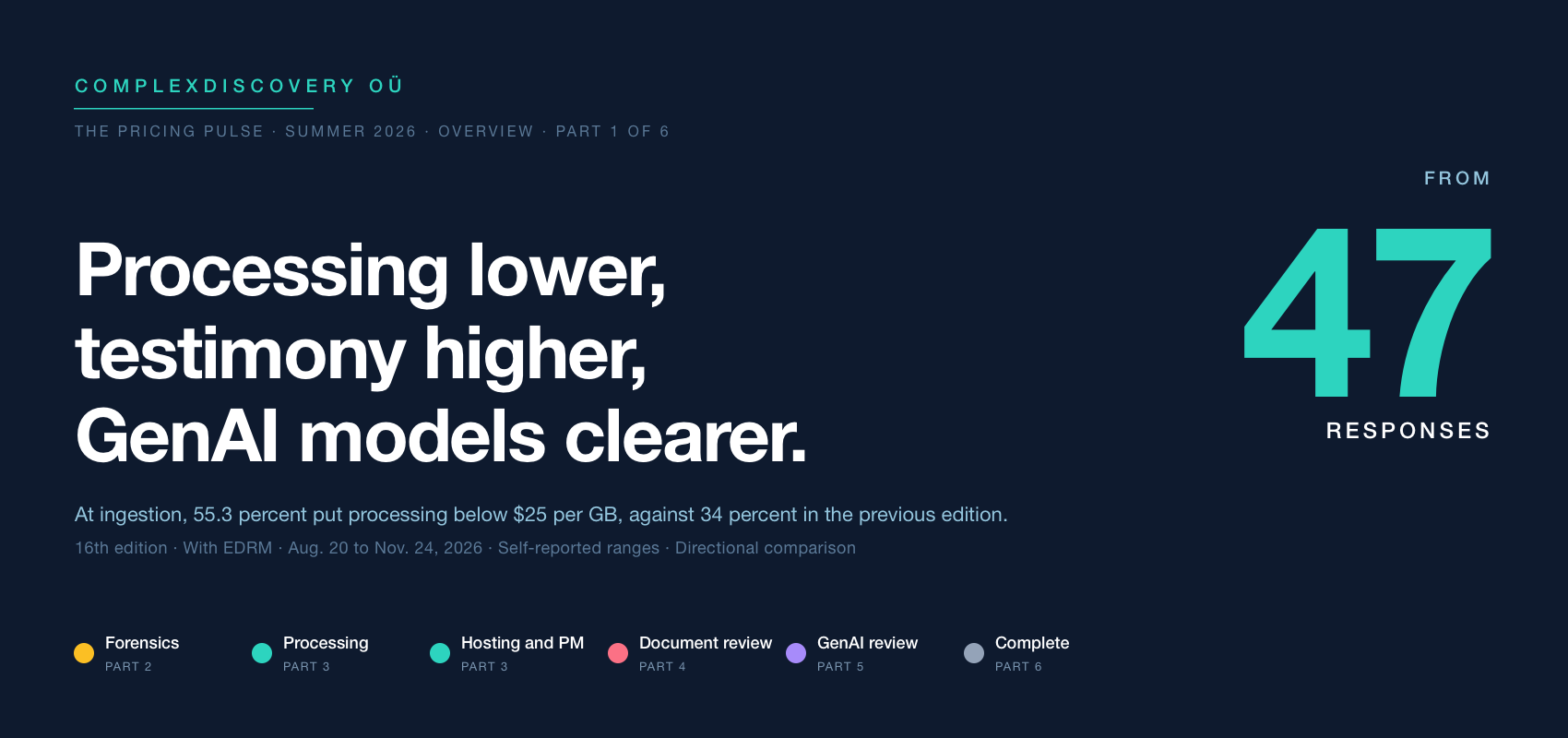
Editor’s Note: The Summer 2026 eDiscovery Pricing Survey, the 16th edition of the semiannual survey ComplexDiscovery OÜ conducts with the Electronic Discovery Reference Model (EDRM), drew 47 responses from Aug. 20 to Nov. 24, 2026. Those responses placed data processing and hosting in lower price bands, and expert testimony and project management in higher ones, than the 53 responses in the previous edition, Winter 2026, gathered from December 2025 through February 2026. At ingestion, 55.3 percent of Summer responses put processing below $25 per gigabyte, against 34 percent in the previous edition, while 42.6 percent put expert witness testimony above $550 per hour, against 26.4 percent. On generative AI (GenAI) review, 6.4 percent called their primary pricing model unknown or not applicable, down from 17 percent, though more chose do not know or not applicable on the per-document price.
Both editions are small, separate samples of self-reported ranges, so the shifts are directional. For cybersecurity, information governance and eDiscovery professionals, results point to processing and hosting as places to test quotes, and testimony and project management hours as places to recheck budgets.
This overview opens a six-part series. Installments on forensics, infrastructure, document review and GenAI review follow, then a complete analysis.
Disclosure: Rob Robinson is founder and managing editor of ComplexDiscovery OÜ, which designs, runs and publishes this survey, and is chief marketing officer of HaystackID, an eDiscovery provider whose forensic, processing, hosting, review and GenAI-assisted review services fall within the categories the survey measures. ComplexDiscovery OÜ conducts the survey in partnership with EDRM, is an EDRM Guardian Partner, and Robinson sits on EDRM’s Global Advisory Council. Respondents include people affiliated with ComplexDiscovery OÜ, EDRM and HaystackID.
Content Assessment: Summer 2026 eDiscovery Pricing Survey puts processing lower and expert testimony higher
Information - 96%
Insight - 95%
Relevance - 95%
Objectivity - 96%
Authority - 97%
96%
Excellent
A short percentage-based assessment of the qualitative benefit expressed as a percentage of positive reception of the recent article from ComplexDiscovery OÜ titled, "Summer 2026 eDiscovery Pricing Survey puts processing lower and expert testimony higher."
News Analysis – Research Beat
Summer 2026 eDiscovery Pricing Survey puts processing lower and expert testimony higher
ComplexDiscovery Staff
Ask eDiscovery practitioners what it costs to process a gigabyte of data and what an expert charges to testify about it, and the Summer 2026 eDiscovery Pricing Survey sends their answers in opposite directions.
In the 47 responses ComplexDiscovery OÜ collected between Aug. 20 and Nov. 24, 2026, 55.3 percent put processing at ingestion below $25 per gigabyte and 42.6 percent put forensic expert testimony above $550 per hour. The previous edition, Winter 2026, fielded from December 2025 through February 2026, had put those shares at 34 percent and 26.4 percent.
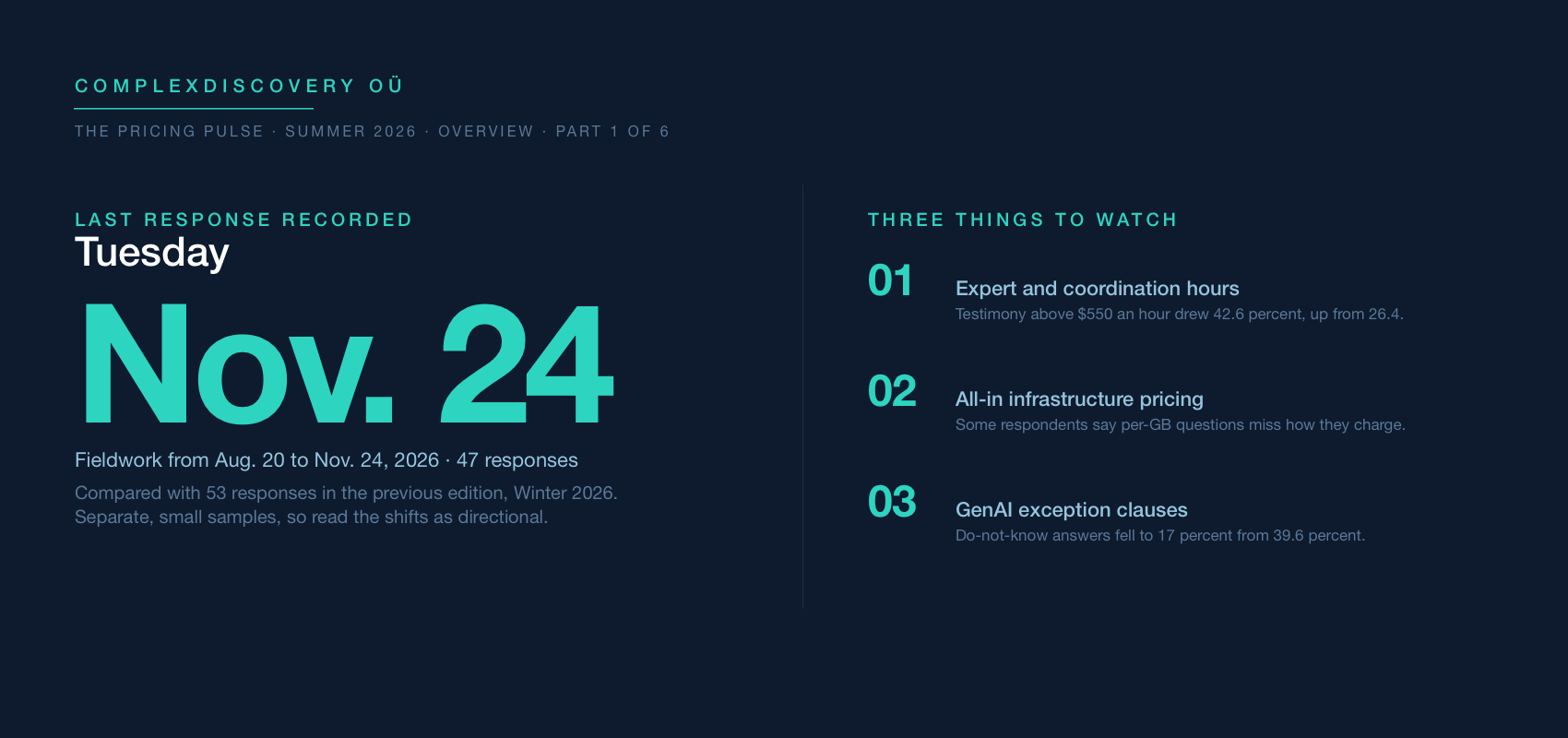
That split runs through much of the data. Answers for infrastructure work that software performs drifted toward the lower price bands, while answers for several services that people perform, from testimony to project management, drifted up. On generative AI (GenAI) review, fewer responses chose the do-not-know or not-applicable option on how the work is priced and how its exceptions are handled, though the questions asking for a specific GenAI price moved the other way.
This overview opens a six-part series on the Summer 2026 results, the 16th edition of the survey, which ComplexDiscovery OÜ conducts twice a year in partnership with the Electronic Discovery Reference Model (EDRM). Four installments follow on forensic collection and testimony; data processing, hosting and project management; document review; and GenAI-assisted review, before a complete analysis brings the full data set together. How far any of these patterns travels depends first on who supplied them.
pricing-pulse-summer-2026-overview-chart-1-split
Who answered the Summer 2026 survey
Law firms supplied the largest share of the 47 responses, at 23, or 48.9 percent. Software and services providers followed with 10 (21.3 percent), then consultancies with seven (14.9 percent), media, research and educational organizations with four (8.5 percent) and corporations with three (6.4 percent). In nearly three in four responses, 72.3 percent, the respondent described a primary function in legal or litigation support. In all, 89.4 percent named the United States as the primary place they conduct eDiscovery business, with the rest split among Asia and the Asia Pacific region, the United Kingdom and Canada.
The questions shape the answers as much as the profile does. The survey’s 25 questions, 22 on pricing and three on respondent profile, use preset answer categories, including price ranges, rather than open numeric entry. Every pricing answer is a practitioner’s self-report, of prevailing prices or of the respondent’s own arrangements, rather than a verified invoice. Each percentage in this series uses all 47 responses as its base, including do-not-know and not-applicable answers. A figure such as 42.6 percent therefore describes a share of all submissions, not only of those that came from buyers of the service, and it is on that base that the clearest movement on the software side appears.
Where respondents placed infrastructure prices
Processing produced the widest swing among the infrastructure measures. At ingestion, 26 responses (55.3 percent) placed the per-gigabyte charge below $25, against 34 percent in the previous edition. At the completion of processing, 28 responses (59.6 percent) chose the lowest band, below $100 per gigabyte, up from 37.7 percent, and no Summer response selected the top band above $150, which 9.4 percent had chosen in the previous edition.
Hosting followed the same direction with smaller steps. Monthly hosting without analytics drew a below-$10-per-gigabyte answer from 63.8 percent, against 54.7 percent in the prior edition, and hosting with analytics drew a below-$15 answer from 55.3 percent, against 43.4 percent. User licensing went the other way on structure, with alternative pricing models falling to 23.4 percent of responses from 34 percent while the $50-to-$100 monthly band held near 40 percent.
Some respondents questioned whether per-gigabyte questions still describe how this work is sold. One wrote that the organization has an all-in hosting cost and does not charge a per-gigabyte fee for processing, promotions or production, and said that appears to be a growing trend. Another asked for a “$0.00 or No Fee” option on the processing and user fee questions. Those comments echo a concern the previous edition recorded, when a respondent said the two processing questions may conflate all-in and staged billing, and the Summer questionnaire kept the same two questions. While respondents debated how to bill the software side, their answers on work delivered by individual professionals moved the other way.
Expert labor moved the other way
The testifying expert from the opening is the clearest case. Expert witness testimony drew an above-$550-per-hour answer from 20 responses, or 42.6 percent, compared with 26.4 percent in the previous edition. Project management support drew an above-$200-per-hour answer from the same number, 20 responses, up from 26.4 percent, leaving that top band roughly even with the $100-to-$200 range, which fell to 40.4 percent from 52.8 percent.
Forensic analysis and reporting held its anchor while its floor thinned. The $350-to-$550 hourly band drew 55.3 percent, close to the prior edition’s 54.7 percent, but answers below $350 fell to 12.8 percent from 30.2 percent. Collection itself stayed near its earlier level, with 55.3 percent placing on-site collection at $250 to $350 per hour and 61.7 percent placing remote collection in the same band, against 56.6 percent for both in the prior edition. Per-device collection was the exception, as the share choosing the above-$350 band fell to 38.3 percent for both computers and mobile devices, from roughly half in the previous edition.
Human document review showed a similar lift at the top of the per-document scale. For on-site managed review, the above-$1-per-document band drew 31.9 percent, up from 22.6 percent, and now sits roughly even with the 50-cent-to-$1 band at 29.8 percent. Hourly rates for review attorneys did not show that lift. On-site review above $40 per hour drew 48.9 percent, near the prior edition’s 45.3 percent, while remote review concentrated in the $25-to-$40 band at 51.1 percent, up from 41.5 percent. The previous edition’s analysis treated human per-document rates as the baseline for judging GenAI-assisted review pricing, which is where the Summer answers turn next.
GenAI answers grew more specific on pricing structure
On GenAI, the clearest change came in the questions about pricing structure. Only three responses (6.4 percent) called the primary pricing model for GenAI-assisted review unknown or not applicable, against 17 percent in the previous edition. Per-document pricing led narrowly, with 16 responses (34 percent), one ahead of hybrid models at 15 (31.9 percent), after the two tied in the prior edition at 28.3 percent each. Per-gigabyte pricing drew 17 percent, and a single response named per-token billing.
Exception handling, the question of how pricing accounts for documents that fail to process or require special handling, showed the same shift. The share choosing the do-not-know or not-applicable option fell to 17 percent from 39.6 percent. The most common answer became “depends on the specific issue encountered,” at 29.8 percent, followed by manual review at standard rates at 21.3 percent and inclusion in the base price at 14.9 percent. For outcome-based pricing, the do-not-know or not-applicable share fell to 61.7 percent from 79.2 percent, and custom agreements tied to project goals rose to 21.3 percent from 9.4 percent.
The questions asking for a GenAI price did not follow that pattern. Do-not-know or not-applicable answers rose to 38.3 percent from 35.8 percent on the per-document price and to 68.1 percent from 64.2 percent on the per-gigabyte price. Among responses that named a per-document price, the most frequently selected range was one band lower than in the previous edition. That range, 11 to 25 cents, was chosen in 10 of the 47 responses (21.3 percent), about a third of the 29 that named a price. The prior edition’s most common price range had been 26 to 50 cents, and the margin is narrow, since eight Summer responses (17 percent) still chose it.
pricing-pulse-summer-2026-overview-chart-2-genai
One feature of the questionnaire shapes how those follow-up figures read. Every submission includes an answer to the per-document, per-gigabyte and outcome-based questions, whatever model the respondent named as primary. Only two responses named outcome-based pricing as the primary model, yet 18 described how outcome-based pricing is structured, 10 of them from responses that named hybrid models. The survey does not show whether those answers describe arrangements respondents use directly, components of hybrid pricing or terms they have seen elsewhere. Each of these GenAI shifts, like those on the infrastructure and expert sides, also carries the same limit.
Reading the edition-to-edition comparison with care
The Summer 2026 and Winter 2026 editions are separate samples rather than a matched panel, and both are small. Winter 2026 collected 53 responses and Summer collected 47. With samples of that size, a swing of 10 percentage points can come from who answered rather than from how prices moved, and even the roughly 20-point shifts in processing are best read as a direction rather than a measurement.
The respondent mix also changed. Corporations supplied 6.4 percent of Summer responses, down from 15.1 percent, while law firms rose to 48.9 percent from 43.4 percent and consultancies to 14.9 percent from 9.4 percent. Software and services providers slipped to 21.3 percent from 24.5 percent, and media, research and educational organizations edged to 8.5 percent from 7.5 percent. Respondents choose their own segment, and a sample that tilts toward buyers or toward sellers can move answers on its own, so this analysis reports unweighted counts.
pricing-pulse-summer-2026-overview-chart-3-respondents
Other limits come from the questions themselves. One respondent said the review questions did not mention offshore first-line review and so answered for domestic U.S. review, adding, “The offshore option would have dramatically changed my answers.” Another said the pricing questions do not represent that organization’s models and do not account for exchange rates. A third named token-based pricing for AI as the unknown factor and asked whether, when and how it will change. Read with those limits, the results still give buyers and providers a place to start.
What practitioners can do with the numbers
The split between software and people works as a practical sorting rule. Infrastructure line items, processing and hosting above all, are where respondents most often reported the lowest price bands, which makes them the natural place to test a renewal quote or ask whether an all-in rate would cost less. Testimony and project management are where the top band grew, so matter budgets built on earlier assumptions about those hourly rates are worth checking against current quotes.
That split also reaches teams outside litigation. Security and investigations groups that buy forensic collection for incident response can use the $250-to-$350 collection band as a survey reference range, though the survey does not separate incident-response work from litigation collection. The analysis and testimony that can follow a serious incident are where Summer answers moved upward.
GenAI review is becoming a category practitioners describe through its pricing structure and contract terms, even as many still do not give a specific price. With the most common exception-handling answer being that treatment depends on the specific issue encountered, the contract language that defines how each kind of exception is billed can decide much of what a GenAI engagement costs. The installments that follow take each service area in turn, with the question-level data behind every figure here.
The gigabyte and the testifying expert from the opening sit at opposite ends of the same matter budget, and between editions the answers about them moved apart. Between them sits GenAI exception handling, the pricing for documents that fail to process or require special handling, which respondents now most often say depends on the issue encountered. If those directions hold, the negotiation over an eDiscovery bill may turn less on what a gigabyte costs and more on the hours and handoffs that still belong to a person. Which line in your next engagement letter is built for that?
News sources
- Rob Robinson and Holley Robinson, ComplexDiscovery OÜ, “Summer 2026 eDiscovery Pricing Survey,” November 2026
- A Complete Analysis of the Winter 2026 eDiscovery Pricing Survey (ComplexDiscovery OÜ)
- The Pricing Pulse: Forensic Collection, Examination, and Testimony Insights from the Winter 2026 eDiscovery Pricing Survey (ComplexDiscovery OÜ)
- The Pricing Pulse: Data Processing, Hosting, and Project Management Insights from the Winter 2026 eDiscovery Pricing Survey (ComplexDiscovery OÜ)
- The Pricing Pulse: Document Review Insights from the Winter 2026 eDiscovery Pricing Survey (ComplexDiscovery OÜ)
- The Pricing Pulse: Generative AI-Assisted Review Insights from the Winter 2026 eDiscovery Pricing Survey (ComplexDiscovery OÜ)
- ComplexDiscovery OÜ Launches Winter 2026 eDiscovery Pricing Survey, Seeking Clarity in a Maturing GenAI Market (ComplexDiscovery OÜ)
- ComplexDiscovery OÜ and EDRM Release Complete Analysis of the Winter 2026 eDiscovery Pricing Survey (EDRM)

Assisted by GAI and LLM Technologies
Additional reading
- The 2027 event horizon: Europe’s smaller rooms and the transatlantic legal tech calendar
- Complete look: ComplexDiscovery OÜ’s 2025 to 2030 eDiscovery market size mashup
- Is the Chatham House Rule outdated? An Oxford-style tutorial for event reporting
- Does marketing drive revenue? An Oxford-style tutorial for eDiscovery and legal tech
Source: ComplexDiscovery OÜ

ComplexDiscovery’s mission is to enable clarity for complex decisions by providing independent, data‑driven reporting, research, and commentary that make digital risk, legal technology, and regulatory change more legible for practitioners, policymakers, and business leaders.