
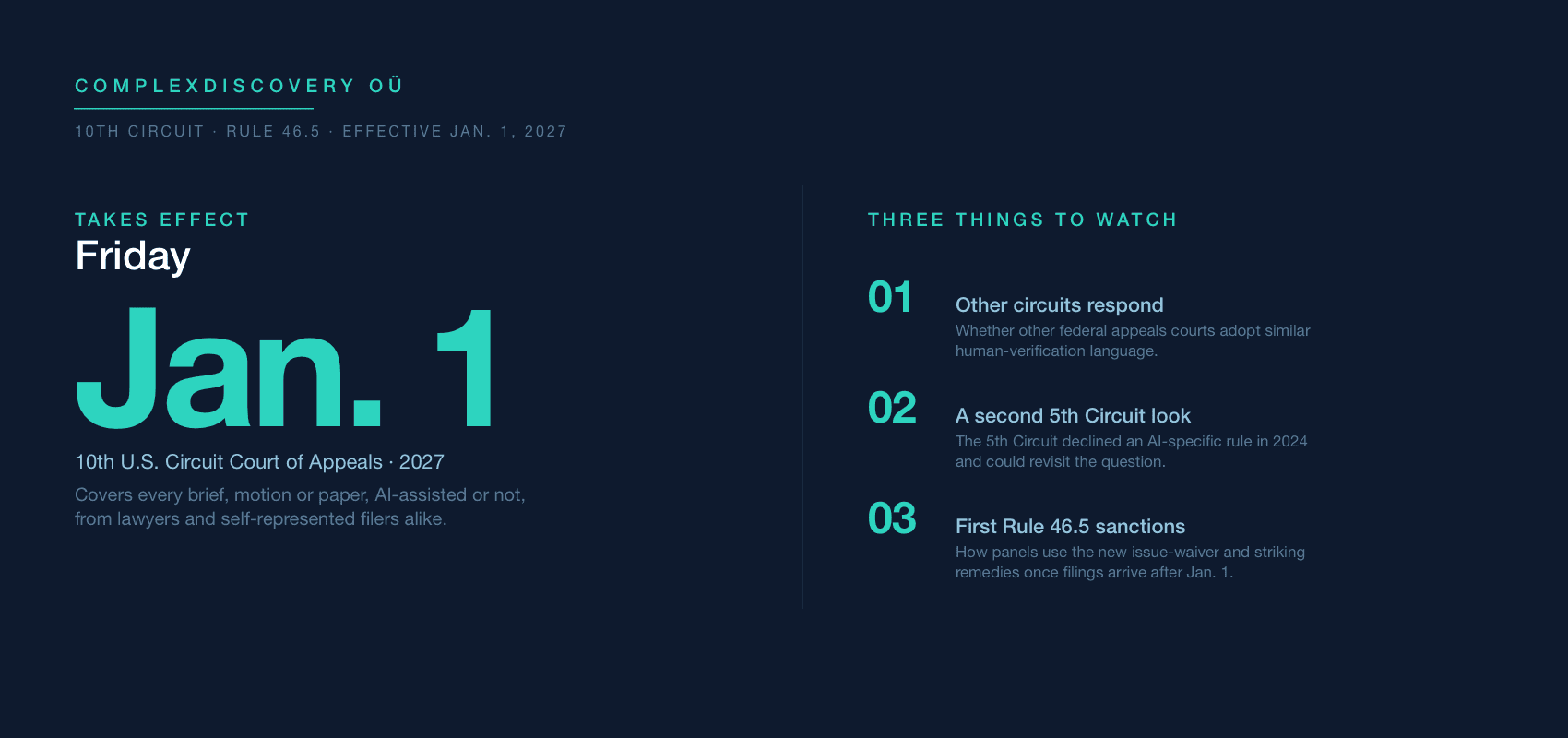
Editor’s Note: The 10th U.S. Circuit Court of Appeals, which hears federal appeals from Colorado, Kansas, New Mexico, Oklahoma, Utah and Wyoming, posted final rules on Nov. 20 that take effect Jan. 1, 2027. From that date, revised Tenth Circuit Rule 46.5 makes presenting any brief, motion or other paper a certification that a human reviewed it before filing and independently verified that every cited authority exists, that quotations and citations are accurate, that each authority supports the proposition it is cited for and that the paper complies with relevant rules and ethical obligations. The September draft applied the check only to documents prepared with generative artificial intelligence; after public comment, the court extended it to every filing by lawyers and self-represented parties, AI or not. As of Nov. 27, the court’s notice and rules page gave no reason for the change. The court also added two sanctions, deeming an issue waived and striking a filing, to existing options.
For cybersecurity, information governance and eDiscovery professionals, citation checking becomes a representation every filer makes. Watch whether other federal appeals courts follow and whether the 5th Circuit, which declined an AI-specific rule in 2024, revisits it.
Content Assessment: Tenth Circuit Rule 46.5 makes every filer vouch for human citation checks starting Jan. 1
Information - 93%
Insight - 93%
Relevance - 94%
Objectivity - 92%
Authority - 93%
93%
Excellent
A short percentage-based assessment of the qualitative benefit expressed as a percentage of positive reception of the recent article from ComplexDiscovery OÜ titled, "Tenth Circuit Rule 46.5 makes every filer vouch for human citation checks starting Jan. 1."
News Analysis – eDiscovery and Information Governance Beat
Tenth Circuit Rule 46.5 makes every filer vouch for human citation checks starting Jan. 1
ComplexDiscovery Staff
Rashonna Moore cited 11 cases the 10th U.S. Circuit Court of Appeals could not find, and the court dismissed her appeal as a sanction, in the alternative to affirming it on the merits. Starting Jan. 1, 2027, a version of the check her brief lacked becomes a representation every filer in the circuit makes.
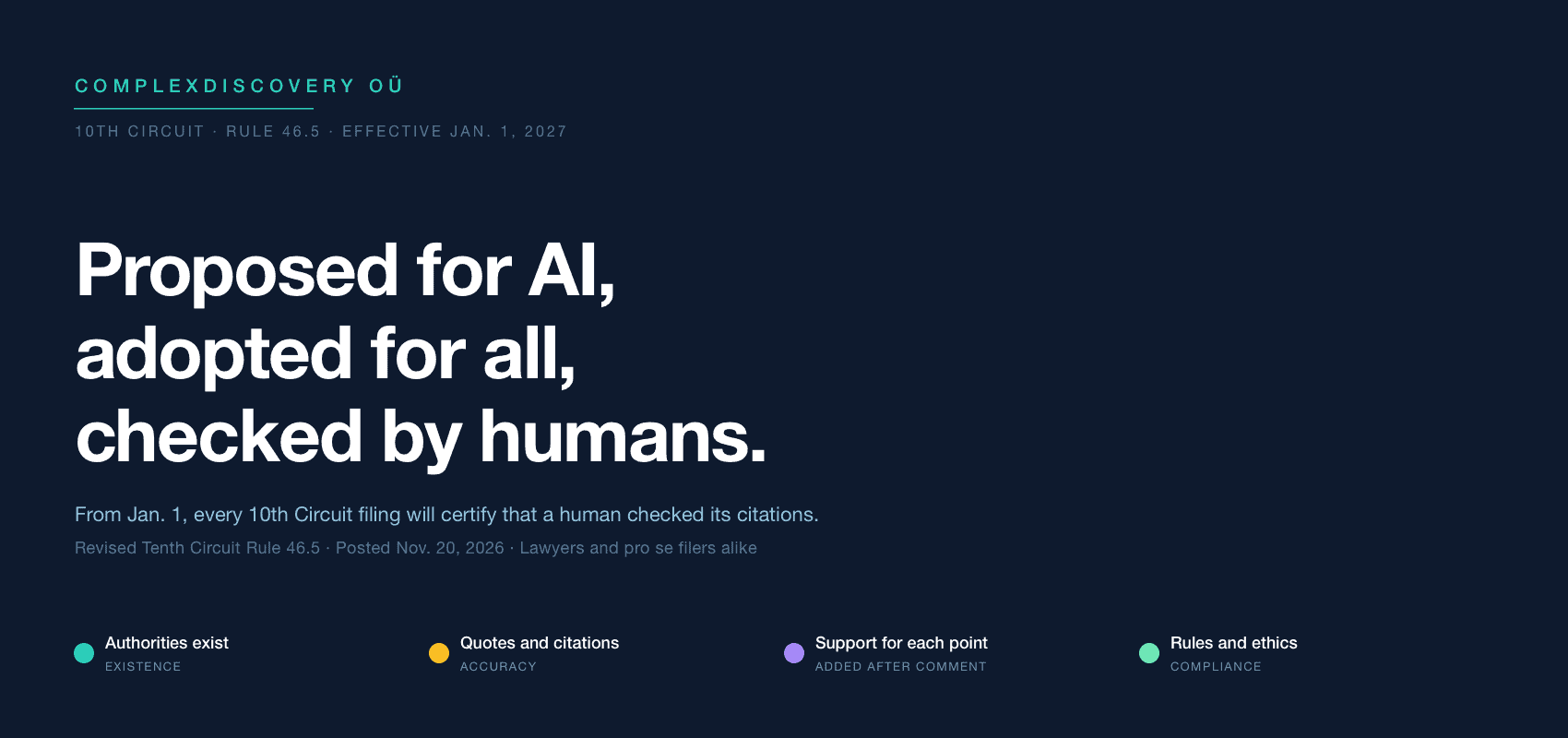
The court posted its final 2027 rules on Friday, Nov. 20, and revised Tenth Circuit Rule 46.5 reaches further than the version it proposed in September. From that date, presenting any brief, motion or other paper will certify that a human reviewed it before filing. That reviewer must have independently verified that every cited authority exists, that quotations and citations are accurate, that each authority supports its proposition and that the paper complies with relevant rules and ethical obligations.
What the court proposed, and what it adopted
The 10th Circuit hears federal appeals from Colorado, Kansas, New Mexico, Oklahoma, Utah and Wyoming, so the change reaches every lawyer and self-represented party who files there. The court’s Nov. 20 notice said the 2027 Federal Rules of Appellate Procedure take effect Dec. 1, 2026, and the 2027 Tenth Circuit Rules take effect Jan. 1, 2027.
The change began with a Sept. 18 memorandum from Clerk of Court Christopher M. Wolpert, which invited public comment through Oct. 18. The memo said the revisions to subsections (B) and (C) of Rule 46.5 are “intended to address the increased use of generative artificial intelligence by both lawyers and pro se litigants.” The wording itself appeared in a full redline of the rules that the court posted with the memo.
That redline describes a narrower rule than the one the court adopted. As proposed, new paragraph (B)(4) reached only “any document prepared with the assistance of generative artificial intelligence,” and it asked the reviewer to verify “the accuracy of all quotations, citations, and legal analysis.” A post-comment redline now on the court’s rules page shows the AI-only trigger struck, along with the words “citations, and legal analysis” in the accuracy clause.
In their place, the court applied the check to every brief, motion or paper and added a requirement that each cited authority support the proposition for which it is cited. It also added a closing sentence stating that the certifications “have the same force and effect regardless of whether the brief, motion or paper was prepared with the assistance of artificial intelligence.” A brief drafted entirely by hand therefore carries the same representation as one drafted with a chatbot. As of Nov. 27, neither the court’s Nov. 20 notice nor its rules page, which still links the September memo as its summary of the changes, explains why the court widened the rule after the comment period.
The difference between the two versions has already blurred in early coverage. The ABA Journal described the rule on Nov. 25 as requiring “mandatory human review of all court filings that use artificial intelligence,” a description that fits the September proposal rather than the adopted text. The National Law Journal reported that the rule makes the 10th Circuit the first federal appeals court with a rule aimed at AI in briefs, according to a summary by eDiscovery Today publisher Doug Austin.
The new certification, element by element
Before this change, Rule 46.5(B) already worked much like Federal Rule of Civil Procedure 11, with certifications triggered whenever an attorney or unrepresented party signed, filed, submitted or later advocated a paper. Each certification was made “to the best of the person’s knowledge, information, and belief, formed after an inquiry reasonable under the circumstances.” Under the 2026 version, the filer certified that the paper had no improper purpose, that its issues were warranted by law or a nonfrivolous argument for changing it, and that its factual contentions were supported in the record.
The 2027 rule keeps those three representations and adds a fourth. Under new paragraph (B)(4), a human must have reviewed the paper before filing and independently verified four things. The first two are “the existence of all cited authorities” and “the accuracy of all quotations and citations.” The other two are “that each cited authority supports the proposition for which it is cited” and “the document’s compliance with all relevant rules and ethical obligations.” The knowledge-and-inquiry qualifier in the subsection’s opening clause still governs all four representations, the new one included.
The text settles one practical question. Nothing in Rule 46.5 calls for a separate signed certificate, because the representation attaches to the act of presenting the paper, whether by signature, filing, submission or later advocacy. Other questions stay open: the rule does not say whether the verifying human must be the signer, and it does not say what record of verification a filer should keep.
The third verification element, which the court added after the comment period, goes further than confirming that a case exists. A real case cited for a holding it does not contain fails the requirement that each authority support its proposition. On the text, then, a reviewer who confirmed only that citations resolve to real opinions has not done everything (B)(4) describes. How the court will apply that element to a paraphrase that bends a holding, rather than inventing one, is a question the rule leaves to future cases.
What is new in the sanctions list, and what is not
When a certification proves false, the court turns to subsection (C), and there the ABA Journal’s account blurred what is new. It listed five of the rule’s six sanctions as what the court can do starting next year. It did not separate the two new ones from the rest, and a comparison of the 2026 and 2027 rule books shows that most of the list is not new. The 2026 version of Rule 46.5(C) already let the court, on its own initiative or at a party’s request, sanction the signer, a represented party or both. The listed sanctions were dismissal or affirmance of the appeal, monetary sanctions, disciplinary proceedings under the court’s Plan for Attorney Disciplinary Enforcement, and an order to pay the other side’s reasonable expenses, including attorney’s fees.
The 2027 version adds two remedies at the top of the list: waiver of the affected issue and striking of a noncompliant document. It also changes “including” to “including but not limited to,” which indicates that the six listed sanctions are examples rather than limits on what the court may order. Austin’s eDiscovery Today post identified waiver and striking as the two new sanctions, which is the more accurate account of the change. Unlike the certification itself, the sanctions changes appeared in the September redline and came through the comment period unchanged.
The represented-party language deserves attention from in-house counsel. Because the court may sanction “a represented party,” a client whose outside counsel files an unchecked brief falls within the rule’s reach, as it did under the prior text.
How the court was already handling fabricated citations
The rule puts in writing expectations that the court’s panels had already been enforcing case by case. In an unpublished per curiam order and judgment filed Dec. 3, 2025, in Moore’s case against the City of Del City, the court found that she had cited 11 cases it could not locate on Westlaw. It also found two real cases that did not reasonably support the propositions she cited them for. The panel affirmed on the merits and, in the alternative, dismissed the appeal as a sanction. It ordered that each of her future filings with the court disclose, under penalty of perjury, whether she used a generative AI tool and confirm that every case citation points to a real case.
The Moore panel did not invoke Rule 46.5. It relied on the court’s inherent power to sanction and on its power to dismiss an appeal when an appellant fails to follow the appellate rules. The fabricated citations, the panel found, breached the requirement in Federal Rule of Appellate Procedure 28(a)(8)(A) that a brief cite supporting authority. The panel also cautioned self-represented and counseled litigants that it may, in a given case, dismiss an appeal outright without reaching the merits, and that money sanctions or an order covering the other side’s fees may also fit.
Two months later, in a case Kusmin L. Amarsingh brought against Frontier Airlines, an order and judgment entered by Circuit Judge Harris L. Hartz sanctioned Amarsingh, an attorney representing herself, under Federal Rule of Appellate Procedure 38. The panel affirmed the dismissal of her claims on the merits and concluded that dismissing the appeal as a sanction was not warranted. Citing her candor, her remorse and the novelty of lawyer AI use at the time of her January 2025 misconduct, it tailored the sanctions it chose instead. Those were a $1,000 payment to Frontier and transmission of the decision to the attorney-disciplinary authority in Maryland.
Both decisions are nonprecedential under Tenth Circuit Rule 32.1, though they may be cited for persuasive value.
The pro se question and the hallucination record
Moore filed without a lawyer, and the memo’s reference to pro se litigants matches the wider record. The AI Hallucination Cases database is maintained by researcher Damien Charlotin, who also markets an automated reference checker built on it. As of Nov. 27, 2026, it listed 2,387 “legal decisions in cases where generative AI produced hallucinated content,” mostly from courts but also from tribunals and arbitral bodies. The database flags 26 of them as cases where AI use was alleged but not confirmed. Of the total, 1,351 involved pro se litigants and 968 involved lawyers, about 57 percent and 41 percent. The database counts decisions addressing hallucinated material, not every fabricated citation ever filed.
A ComplexDiscovery tally of the database’s downloadable records, taken Nov. 27, found 15 decisions from Dec. 3, 2025, through Oct. 28, 2026, that the records attribute to the 10th Circuit itself rather than to district courts in its territory. None of the 15 is flagged as alleged AI use. Eleven of those involved pro se litigants and four involved lawyers, with Amarsingh counted among the lawyers because she is an attorney even though she represented herself.
Holding self-represented filers to the same certification raises an access-to-justice tension the rule does not resolve, because a pro se litigant can satisfy the human-review element only by doing the checking personally or finding someone who will. The sanctions are discretionary, since the court “may” impose them, and the Moore and Amarsingh panels both calibrated their penalties to the filer’s circumstances.
A rule the 5th Circuit declined
Whether a standing rule adds anything to the inherent power and appellate rules those panels used is a question the 5th Circuit answered the other way. In November 2023 the 5th U.S. Circuit Court of Appeals proposed amending Fifth Circuit Rule 32.3 and its certificate of compliance. Filers would have certified either that no generative AI program was used or that a human had checked any generated text for accuracy and approved it. The court posted its answer in June 2024, as Bloomberg Law and King & Spalding reported at the time. Having considered the proposal and the comments, it said, it would not adopt a special rule on AI in drafting briefs “at this time.” The notice reminded parties and counsel of their duties under Federal Rule of Appellate Procedure 46(b)(1)(B) and warned that “I used AI” will not excuse an otherwise sanctionable offense. Commenters had argued that existing rules already required lawyers to check their filings, according to accounts by Bloomberg Law and eDiscovery Today.
The 10th Circuit started closer to the 5th Circuit than its final rule suggests, since its September draft also tied the human check to AI use. The adopted text moved away from that premise, and it avoids the disclosure question the 5th Circuit proposal raised by requiring no statement about whether AI was used, only a representation that a human checked the work.
What practitioners should do before Jan. 1
Firms with 10th Circuit matters should treat (B)(4) as a four-item checklist. A defensible practice records who verified each authority, against what source and when, and it covers quotations and pinpoint citations as well as case names. Keeping that record with the matter file gives the signer something to point to if a citation is later questioned, although the rule itself imposes no retention requirement.
Automated citation checkers can support that work, but the text describes verification by “a human,” so on the text a tool’s pass report does not by itself match the representation the signer makes. Supervising attorneys should also decide whether the signer or a designated reviewer performs the check, since the rule requires a human reviewer without saying which one.
Timing deserves a look as well. The certification attaches when a paper is presented, including when it is later advocated, and the rule does not say how that applies to a brief filed in 2026 and argued in 2027. The compiled rule book also carries two apparent holdovers. Rule 1.5 in the 2027 compilation still states that the local rules are effective Jan. 1, 2025. Section 3.4 of the disciplinary plan still cites Rule 46.5(C)(4) when it excludes fee-award proceedings from the plan, though fee awards now sit at (C)(6) and (C)(4) covers monetary sanctions, so practitioners should cite the 2027 numbering.
Moore’s order required one litigant to disclose AI use and verify her citations under penalty of perjury, and the court’s September draft tied the human check to AI use. The final rule asks no question about AI at all and keeps the verification, for every filer, starting with the first filing of 2027. Will other circuits, and the 5th Circuit on a second look, follow the 10th Circuit’s tool-neutral model, or does the hallucination record still suggest that existing duties are enough?
News Sources
- 2027 FRAP and Local Rules Published (U.S. Court of Appeals for the Tenth Circuit)
- Federal Rules of Appellate Procedure Effective December 1, 2026 And Tenth Circuit Rules Effective January 1, 2027 (U.S. Court of Appeals for the Tenth Circuit)
- Federal Rules of Appellate Procedure Effective December 1, 2025 And Tenth Circuit Rules Effective January 1, 2026 (U.S. Court of Appeals for the Tenth Circuit)
- Memorandum: 2027 Revisions to the Tenth Circuit Rule Changes (Tenth Circuit Clerk of Court)
- Public Comment Period Open for Revisions to the 2027 Tenth Circuit Rules (U.S. Court of Appeals for the Tenth Circuit)
- Full Redline of 2027 Rules (U.S. Court of Appeals for the Tenth Circuit)
- 2027 FRAP and Local Rules REDLINE (U.S. Court of Appeals for the Tenth Circuit)
- Moore v. City of Del City, No. 25-6002, Order and Judgment (U.S. Court of Appeals for the Tenth Circuit)
- Amarsingh v. Frontier Airlines, Inc., No. 24-1391, Order and Judgment (U.S. Court of Appeals for the Tenth Circuit)
- Court Decision on Proposed Rule (U.S. Court of Appeals for the Fifth Circuit)
- Notice of Proposed Amendment to 5th Cir. R. 32.3 (U.S. Court of Appeals for the Fifth Circuit)
- U.S. Court of Appeals for the Tenth Circuit: Circuit Composition (Federal Judicial Center)
- AI Hallucination Cases Database: Damien Charlotin (Damien Charlotin)
- 10th Circuit addresses AI hallucinations with new human fact-check rule (ABA Journal)
- Fifth Circuit Won’t Adopt AI Rule After Attorney Pushback (Bloomberg Law via Bloomberg Government)
- The Tenth Circuit Adopted Certification Rule for Human Review of Filings: Artificial Intelligence Trends (eDiscovery Today)
- U.S. Fifth Circuit Decides Against Its Proposed Rule Amendment on AI Use in Legal Filings (King & Spalding)





Assisted by GAI and LLM Technologies
Additional reading
- Brooklyn jury convicts Huawei of trade-secret conspiracy and Iran sanctions crimes but rejects racketeering
- Signal turns on screenshot blocking to limit operating-system AI access to its chats
- Oregon and Virginia sue SpaceX over what Grok’s makers said about safety
- Commerce makes overseas data centers answer for who rents their advanced chips
- Johnson Controls agrees to pay $5 million over alleged security plan gaps in federal contracts
- Officials tie FAA ground stop to contractor router work, not hackers, but the specific fault is still undetermined
Source: ComplexDiscovery OÜ

ComplexDiscovery’s mission is to enable clarity for complex decisions by providing independent, data‑driven reporting, research, and commentary that make digital risk, legal technology, and regulatory change more legible for practitioners, policymakers, and business leaders.