Editor’s Note: The Summer 2026 eDiscovery Pricing Survey, the 16th edition of the semiannual survey ComplexDiscovery OÜ conducts with the Electronic Discovery Reference Model (EDRM), drew 47 responses from Aug. 20 to Nov. 24, 2026. On forensic expert witness testimony, 42.6 percent of responses placed the hourly rate above $550, making that top band the most common answer. In the previous edition, Winter 2026, which drew 53 responses, the top band drew 26.4 percent and the $350-to-$550 band led at 47.2 percent. Hourly collection held near its earlier level, while the share placing per-device collection above $350 fell to 38.3 percent from roughly half, and examination answers below $350 fell to 12.8 percent from 30.2 percent.
Both editions are small, separate samples of self-reported price ranges, so the shifts are directional. For eDiscovery, cybersecurity and investigations professionals, the results suggest building forensic rate schedules that cover collection, examination and testimony at the outset, because the later stages are where answers moved up.
This is the second article in a six-part series. Installments on processing and hosting, document review and generative AI review follow, then a complete analysis.
Disclosure: Rob Robinson is founder and managing editor of ComplexDiscovery OÜ, which designs, runs and publishes this survey, and is chief marketing officer of HaystackID, an eDiscovery provider whose forensic, processing, hosting, review and GenAI-assisted review services fall within the categories the survey measures. ComplexDiscovery OÜ conducts the survey in partnership with EDRM, is an EDRM Guardian Partner, and Robinson sits on EDRM’s Global Advisory Council. Respondents include people affiliated with ComplexDiscovery OÜ, EDRM and HaystackID.
Content Assessment: Summer 2026 eDiscovery Pricing Survey moves forensic testimony answers to the top rate band
Information - 94%
Insight - 95%
Relevance - 94%
Objectivity - 93%
Authority - 96%
94%
Excellent
A short percentage-based assessment of the qualitative benefit expressed as a percentage of positive reception of the recent article from ComplexDiscovery OÜ titled, "Summer 2026 eDiscovery Pricing Survey moves forensic testimony answers to the top rate band."
News Analysis – Research Beat
Summer 2026 eDiscovery Pricing Survey moves forensic testimony answers to the top rate band
ComplexDiscovery Staff
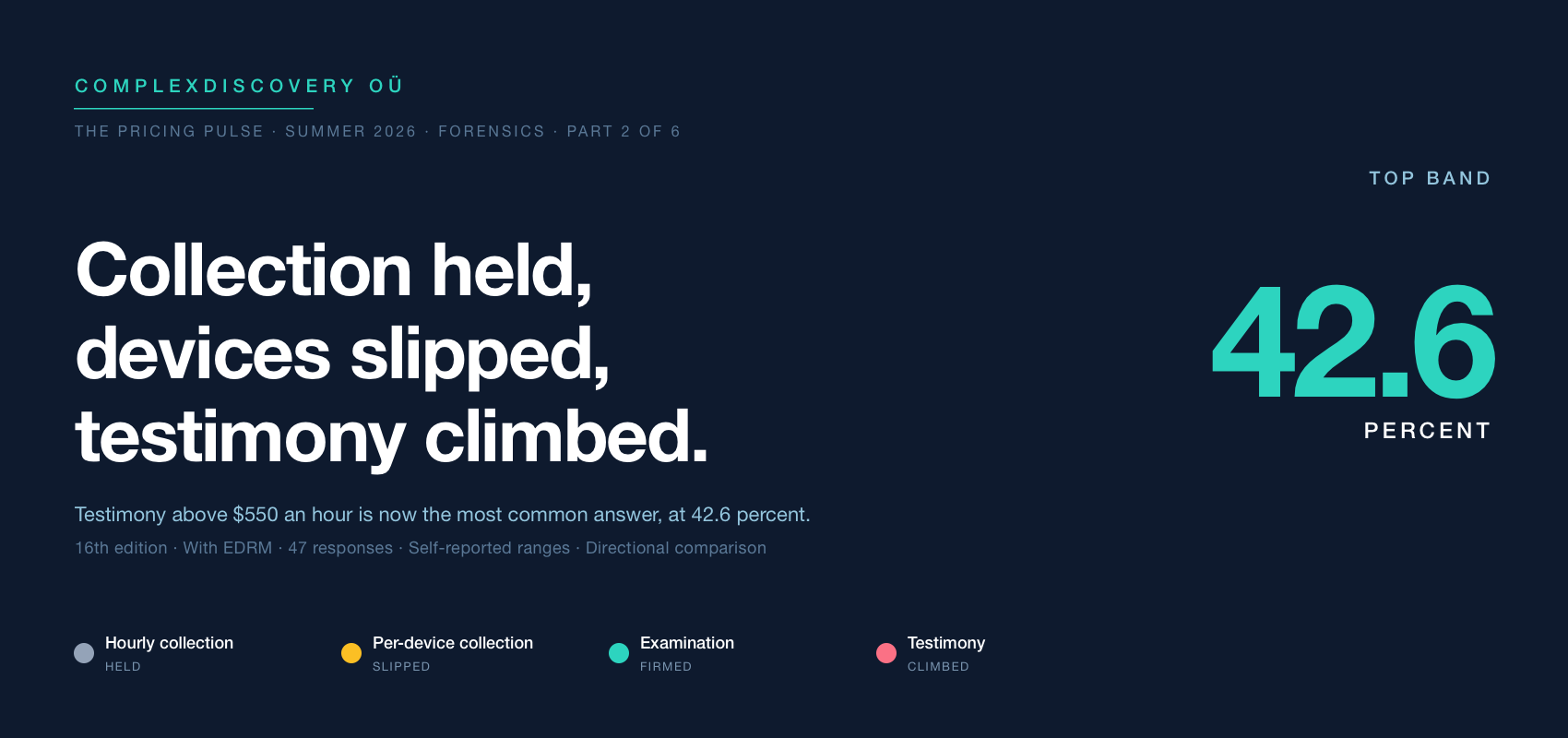
The most common answer for what a forensic expert charges to testify is now the top rate band in the Summer 2026 eDiscovery Pricing Survey: above $550 an hour.
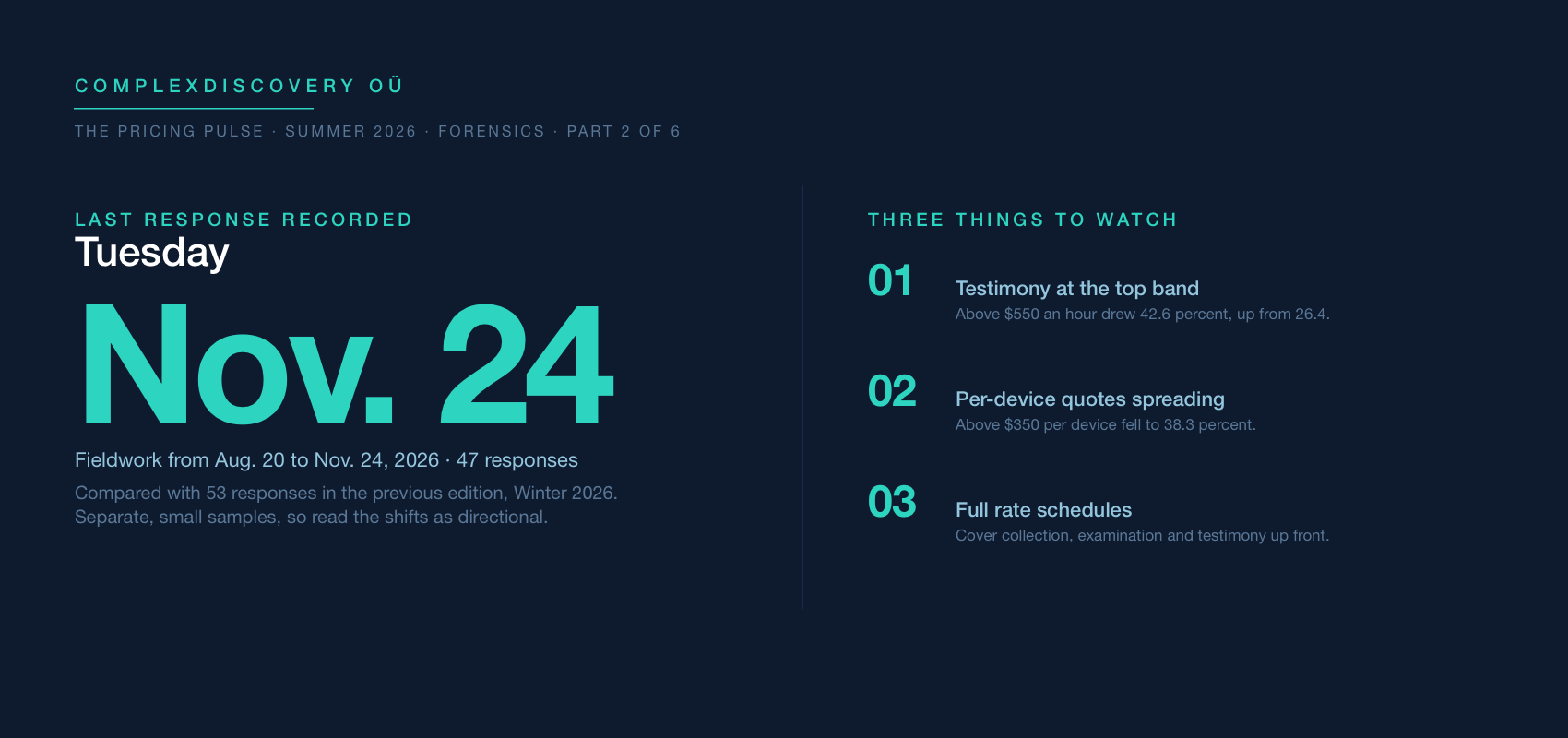
That band drew 20 of 47 responses, or 42.6 percent, in the survey ComplexDiscovery OÜ conducted with the Electronic Discovery Reference Model between Aug. 20 and Nov. 24, 2026. In the previous edition, Winter 2026, fielded from December 2025 through February 2026, the most common testimony answer had been $350 to $550 an hour, at 47.2 percent, with the top band at 26.4 percent.
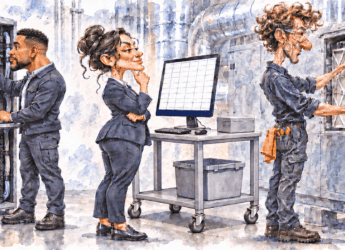
Testimony sits at the far end of a sequence that runs from collecting data off a laptop or phone, through analyzing what the data shows, to defending that analysis under oath. Across that sequence, the Summer answers shifted along a clear gradient. Hourly collection held near its previous level, per-device collection answers moved down, the floor under forensic analysis thinned, and testimony moved up. The closer the work sits to the courtroom, the further the Summer answers moved toward higher bands.
This article is the second in a six-part series on the Summer 2026 results, the 16th edition of the survey. An overview opened the series, and installments on data processing, hosting and project management; document review; and generative AI review follow before a complete analysis brings the full data set together. The forensic questions are the first six in the survey, and they begin with collection, the first step in that sequence.
pricing-pulse-summer-2026-forensics-chart-1-sequence-updated
How the forensic questions were answered
Every figure here uses all 47 responses as its base, including do-not-know and alternative-pricing answers. Each question offered preset price ranges, and every answer is a practitioner’s self-report of prevailing prices rather than a verified invoice. Law firms supplied 48.9 percent of responses and software and services providers 21.3 percent, and 89.4 percent of responses named the United States as the primary place the respondent conducts eDiscovery business. The previous edition drew 53 responses, and the two editions are separate samples rather than a matched panel, so the comparisons that follow describe direction rather than precise movement. Hourly collection, the first step, shows the least of it.
Hourly collection held its anchor
On-site collection by a forensic examiner drew a $250-to-$350-per-hour answer from 26 responses (55.3 percent), close to the 56.6 percent the band drew in the previous edition. The above-$350 band slipped to 17 percent from 20.8 percent, and the below-$250 band held near its earlier level at 6.4 percent, against 5.7 percent.
Remote collection concentrated further in the same band. In all, 29 responses (61.7 percent) placed remote collection at $250 to $350 an hour, up from 56.6 percent, and 19.1 percent placed it below $250, against 18.9 percent in the previous edition. No Summer response chose the above-$350 band for remote work, which 5.7 percent had chosen before, and alternative pricing models fell to 2.1 percent from 7.5 percent. The on-site premium the previous edition described therefore persists: 17 percent of Summer responses put on-site collection above $350 an hour, while none did so for remote collection.
Uncertainty rose at this stage too, with do-not-know answers reaching 17 percent for both on-site and remote collection, against 13.2 percent and 11.3 percent in the previous edition. The rates themselves held steadier than the work priced by the device.
Per-device collection answers moved down
Per-device pricing was the premium tier in the previous edition, with roughly half of responses placing both computer and mobile collection above $350 per device. In Summer, that share fell to 38.3 percent for both, 18 responses each, against 50.9 percent for desktops and laptops and 49.1 percent for mobile devices.
The answers spread into the lower bands. For desktop and laptop collection, the $250-to-$350 band rose to 25.5 percent from 18.9 percent, and the below-$250 band to 12.8 percent from 11.3 percent. For mobile devices, the $250-to-$350 band held near its earlier level at 23.4 percent, against 24.5 percent, while below-$250 answers rose to 10.6 percent from 9.4 percent and alternative models to 10.6 percent from 7.5 percent. Do-not-know answers on mobile collection also rose, to 17 percent from 9.4 percent.
The top band still drew the largest single share for both device types, so the most common answer did not change, but fewer responses placed per-device work there than in the previous edition. The next stage, examining what the collected data shows, moved the other way.
Examination firmed as its floor thinned
Investigation, analysis and report generation by a forensic examiner held its anchor band, and the $350-to-$550 hourly range drew 26 responses (55.3 percent), against 54.7 percent in the previous edition. Below that band, the change was sharper: answers under $350 fell to 12.8 percent from 30.2 percent. Above it, 8.5 percent of responses put examination above $550 an hour, against 5.7 percent.
Do-not-know answers on examination rose to 17 percent from 9.4 percent, and alternative pricing drew 6.4 percent, against none in the previous edition. Read together, fewer responses placed examination at the low end, and the share placing it at $350 or above rose to 63.8 percent from 60.4 percent. The steepest move came one step later, when the examiner takes the stand.
Testimony moved to the top band
Expert witness testimony, which the survey defines as in-person and written testimony support by a forensic examiner, produced the largest shift among the six forensic questions. The above-$550-per-hour band rose to 42.6 percent from 26.4 percent, while the $350-to-$550 band, the most common answer in the previous edition, fell to 25.5 percent from 47.2 percent. The top band, which drew about a quarter of responses in the previous edition, became the most common answer in Summer.
Below $350, testimony drew 8.5 percent, against 5.7 percent, and 4.3 percent of Summer responses chose an alternative pricing model, against none in the previous edition. Do-not-know answers held high at 19.1 percent, against 20.8 percent, the largest do-not-know share among the forensic questions in both editions; the previous edition suggested that testimony engagements are less frequent than collections or examinations. Because the survey’s top band has no upper limit, the results show how many responses placed testimony above $550 an hour, not how far above it those rates run.
pricing-pulse-summer-2026-forensics-chart-2-testimony
Reading the forensic results with care
Two features of the data limit how far these shifts can be read. The samples are small and separate, so a swing of 10 percentage points can come from who answered rather than how prices moved. The testimony shift, about 16 points in the top band and about 22 points in the middle band, is among the larger moves in the survey, while most collection changes fall within a few points.
The respondent mix also changed between editions. Corporations supplied only 6.4 percent of Summer responses, against 15.1 percent in the previous edition, and law firms rose to 48.9 percent from 43.4 percent. Respondents choose their own segment, and a sample with more law firms and fewer corporations can move answers on its own, without any change in what forensic work actually costs. With those limits stated, the pattern still offers practical guidance.
What buyers and providers can do with the results
The gradient matters most at the start of a matter, when forensic budgets are set. Hourly collection, and remote collection above all, showed the strongest concentration in a single band, which gives estimators a clear survey reference point for that stage. Per-device answers spread across more bands, so device quotes are worth comparing rather than assuming a single going rate. Examination and testimony are where the Summer answers sat highest, so estimates built on earlier assumptions about analysis and testimony rates are worth checking against current quotes.
Security and investigations teams face the same sequence after an incident. Collection from affected systems, analysis of what happened and, if the matter reaches litigation or a regulator, testimony about the findings follow the same order. The survey does not separate incident-response work from litigation work, so its bands serve as reference ranges rather than incident budgets. A rate schedule agreed at engagement, covering collection, examination and testimony rather than collection alone, helps keep the later and higher-priced stages from arriving as a surprise.
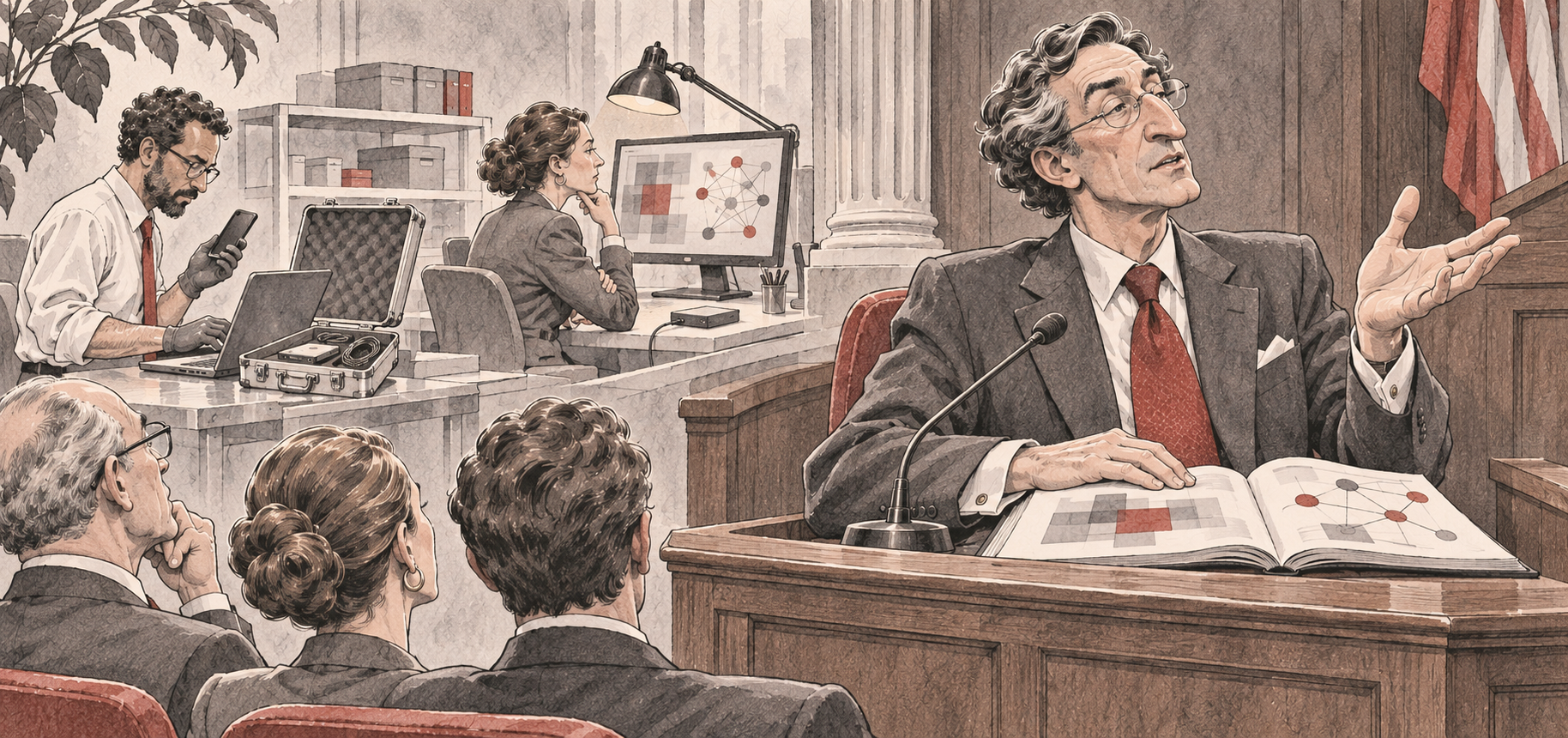
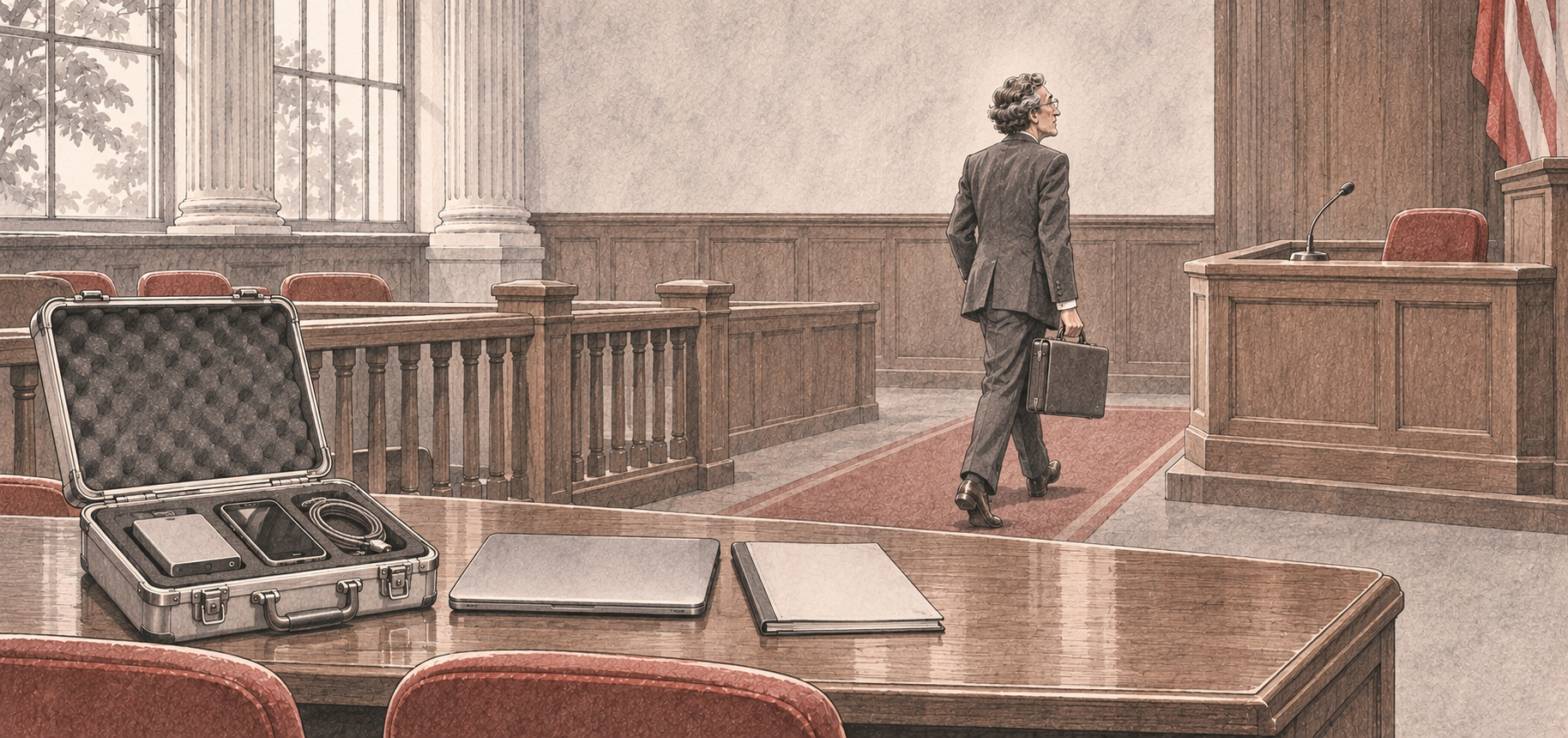
The testifying expert from the opening sits at the end of that sequence, and in Summer 2026 the most common answer for that hour moved to the survey’s top band. Because that band has no ceiling, collection can be estimated from a survey range while testimony needs its own quote. When your next forensic engagement is scoped, does its rate schedule reach all the way to the witness stand?
In this series: The Summer 2026 eDiscovery Pricing Survey
- Overview, background and executive summary
- Forensic collection, examination and testimony (you are here)
- Data processing, hosting and project management (coming soon)
- Document review (coming soon)
- Generative AI-assisted review (coming soon)
- Complete analysis (coming soon)
Conducted by ComplexDiscovery OÜ in partnership with EDRM.
News sources
- Rob Robinson and Holley Robinson, ComplexDiscovery OÜ, “Summer 2026 eDiscovery Pricing Survey,” November 2026
- The Pricing Pulse: Forensic Collection, Examination, and Testimony Insights from the Winter 2026 eDiscovery Pricing Survey (ComplexDiscovery OÜ)
- A Complete Analysis of the Winter 2026 eDiscovery Pricing Survey (ComplexDiscovery OÜ)
- ComplexDiscovery OÜ and EDRM Release Complete Analysis of the Winter 2026 eDiscovery Pricing Survey (EDRM)
- ComplexDiscovery OÜ Launches Winter 2026 eDiscovery Pricing Survey, Seeking Clarity in a Maturing GenAI Market (ComplexDiscovery OÜ)
- Summer 2026 eDiscovery Pricing Survey puts processing lower and expert testimony higher (ComplexDiscovery OÜ)

Assisted by GAI and LLM Technologies
Additional reading
- The 2027 event horizon: Europe’s smaller rooms and the transatlantic legal tech calendar
- Complete look: ComplexDiscovery OÜ’s 2025 to 2030 eDiscovery market size mashup
- Is the Chatham House Rule outdated? An Oxford-style tutorial for event reporting
- Does marketing drive revenue? An Oxford-style tutorial for eDiscovery and legal tech
Source: ComplexDiscovery OÜ
ComplexDiscovery’s mission is to enable clarity for complex decisions by providing independent, data‑driven reporting, research, and commentary that make digital risk, legal technology, and regulatory change more legible for practitioners, policymakers, and business leaders.