Editor’s Note: Recent drone incursions in allied airspace, an Estonian missile-defense startup pitching itself as the next missile house of Europe and President Alar Karis’s remarks on AI, education, and skills as one of the key questions of the time defined Latitude59 2026’s opening morning. Day One Bold Stage moved fast from welcome remarks by Latitude59 Chief Executive Liisi Org and Karis into operating-model conversations with Plural’s Taavet Hinrikus and Pierre-Dimitri Gore-Coty, an industrial briefing with Frankenburg Technologies founder Kusti Salm, a defense procurement conversation between NATO DIANA’s Kadri Tammai and Lendurai’s Siim Maivel, and a lean-capital playbook from WiPower veteran Dr. Rahul Razdan. For cybersecurity, information governance, regulatory compliance and eDiscovery teams, this is not a startup story. It is a resilience supply-chain story. The dual-use technology, missile-defense manufacturing capacity and procurement-reform mechanics on display in Tallinn will land directly inside European compliance regimes, cross-border data-flow obligations and dispute pipelines that follow defense contracting.
Content Assessment: Bold Stage opens Latitude59 2026 with AI, missiles and the New Nordics bet
Information - 93%
Insight - 94%
Relevance - 92%
Objectivity - 94%
Authority - 95%
94%
Excellent
A short percentage-based assessment of the qualitative benefit expressed as a percentage of positive reception of the recent article from ComplexDiscovery OÜ titled, "Bold Stage opens Latitude59 2026 with AI, missiles and the New Nordics bet."
Industry News – Investment Beat
Bold Stage opens Latitude59 2026 with AI, missiles and the New Nordics bet
ComplexDiscovery Staff
Latitude59 2026 opened Thursday in Tallinn with a missile-defense startup laying claim to becoming Europe’s next missile house, a head of state framing education and AI skills as one of the central questions of the time and panelists naming recent drone incursions in allied airspace as the backdrop for their work. The New Nordics are no longer pitching themselves as a regional curiosity. They are pitching themselves as a working model for how small democracies build companies, defend borders and govern technology under pressure.
The 14th edition of the conference opened at Kultuurikatel with 3,000 participants from 70 countries, 140 speakers and delegations from across the Baltic and Nordic capitals. The Bold Stage’s Day One morning block ran from welcome remarks through four extended sessions on European ambition, missile defense, the NATO innovation pipeline and deep-tech startups built outside the dominant hubs. For cybersecurity, information governance and eDiscovery professionals, the morning amounted to a tour of the resilience stack the region intends to sell to the rest of Europe.
Care, code and the opening floor
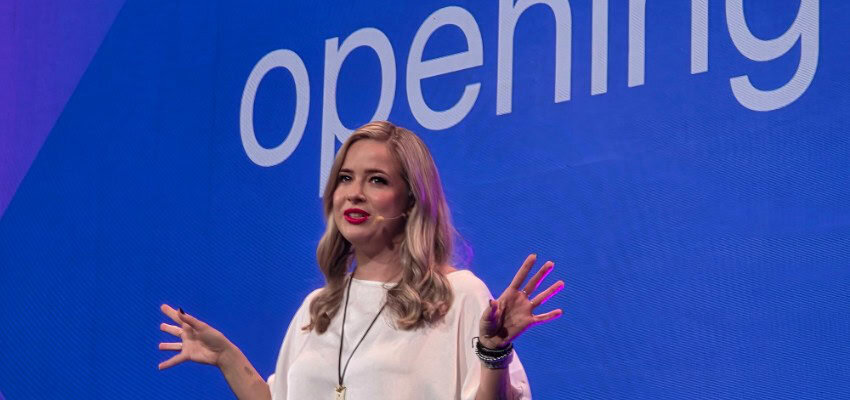
Latitude59 Chief Executive Liisi Org opened the conference with a line that framed the day. “Computers can code and only humans can care,” Org said, sketching a year she called economically challenging for startups and the broader ecosystem. Org introduced the New Nordics area developed with Estonia’s Ministry of Foreign Affairs, then handed the stage to the Builders Lab agenda and to the after-program of pitches and meetings that runs through May 22.
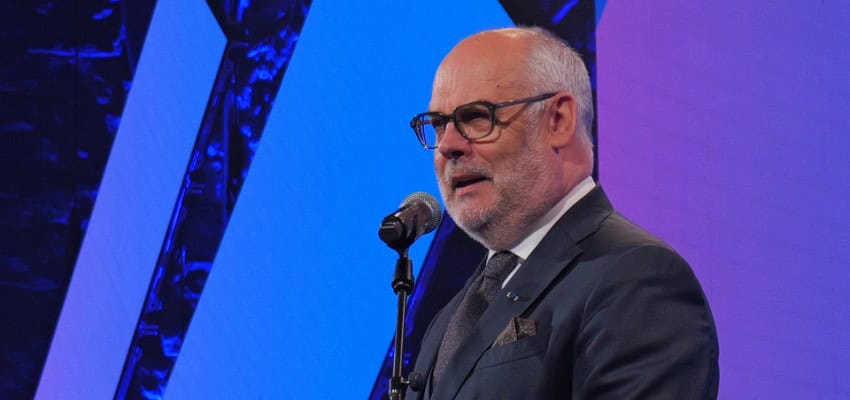
President Alar Karis followed with an address on what AI is doing to work and education. “If we want society to benefit fully from artificial intelligence, we need to talk more about the skills people must develop so that AI makes us smarter rather than simply replacing us,” Karis said, calling education “one of the key questions of our time.” He compared AI to electricity, called it a general-purpose technology that gives smaller companies access to capabilities that were once reserved for the largest organizations, and pointed to AI Leap, the national education initiative Estonia is building with OpenAI and Google to put AI tools and AI literacy into the hands of upper-secondary students and teachers. Reading, analytical thinking, mathematics and human collaboration, Karis said, remain the foundation. Narrow technical skills built around a single machine, he warned, are the ones most at risk.
Hardware, defensibility and the new European thesis
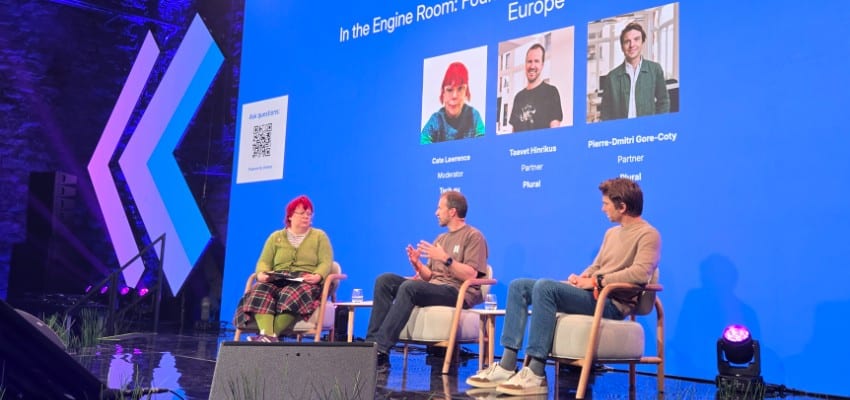
The first panel pulled the camera back to the company level. Tech.eu Senior Journalist Cate Lawrence interviewed Plural partners Taavet Hinrikus, the Wise and Skype co-founder, and Pierre-Dimitri Gore-Coty, the former Uber Eats global delivery lead who joined Plural in 2025. The session set the tone for the morning’s strategic frame, the New Nordics as a launchpad for category-defining companies rather than a regional sideshow.
Gore-Coty argued that two things had changed since his early Uber years. Headcount is no longer a proxy for seriousness, and the era of cheap capital that rewarded growth at any cost is gone. “There’s a wider spectrum of productivity across companies, which means it’s an opportunity to differentiate faster than ever,” he said. Investors will reward defensibility, not size for its own sake.
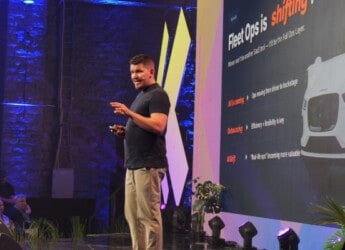
Hinrikus said Plural is steering away from pure software bets toward hardware, robotics and deep tech. “If you’re building pure software, it’s probably a pretty bad idea to do that,” Hinrikus said, citing the speed at which frontier AI models are eating into application-layer differentiation. He pointed to defensible categories that resist commodification — regulated medical software, proprietary data flywheels, hardware that benefits from machine learning-accelerated simulation. He also pointed, with a Tallinn audience in mind, to defense. Plural has backed hypersonic missile work and Frankenburg Technologies, the missile-defense startup that would headline the next session.
The missile economy comes to the Bold Stage
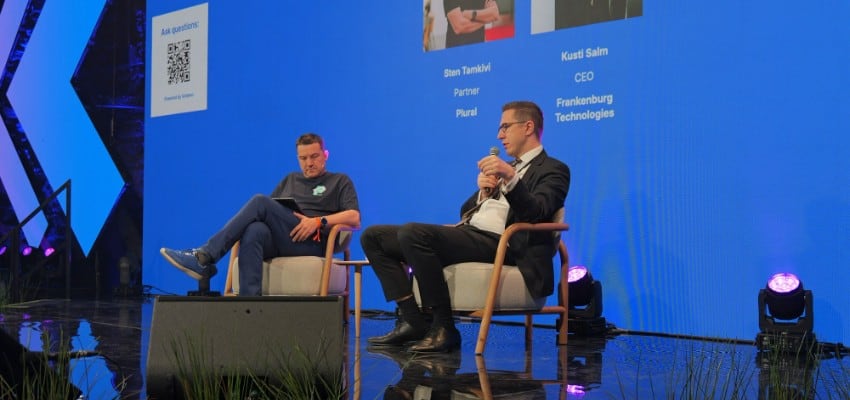
Plural partner Sten Tamkivi welcomed Frankenburg Technologies founder Kusti Salm, the former permanent secretary of Estonia’s Ministry of Defense, to the stage for what was, in effect, an industrial briefing dressed as a fireside chat. Salm described Frankenburg’s strategy in blunt terms. “We’re building the next missile house of Europe and then the missile house of the world,” he said.
Frankenburg delivered its first guided missile in 30 months, against an industry average closer to 30 years, Salm said, in the very-short-range air-defense category and at a price point he put at roughly 20 times below comparable systems. The company plans to push production volumes to hundreds and eventually thousands of times above current European baselines. Salm sized the European addressable market at 15 billion euros to 17 billion euros, with the global market larger and growing at an annual rate he estimated at 20 percent to 25 percent.
Salm’s reading of the threat was equally direct. Russian use of Iranian-style Shahed attack drones, which he tracked at roughly 100 a month when sustained strikes on Ukraine began in the third quarter of 2022, now averages about 400 a day. He warned that the next inflection point is tactical ballistic missiles, citing production of the Iskander system rising from about 50 a year before the war to 60 a month, with a trajectory he projected toward 10,000 units by 2030.
The pitch landed because Salm refused to treat any of it as abstract. Pressed by Tamkivi — who told the room there is “no such thing as a passive peace in Ukraine” and that “Russia must lose” — Salm said Frankenburg’s mission outlives the current war. Russia, Iran and others have built attack-side capabilities orders of magnitude beyond Europe’s defensive inventory, he said, and closing that gap is the work of the decade. Frankenburg, Salm said, is by design a pan-European company with operations in Estonia, Latvia, Germany and the United Kingdom. The era of national defense champions, in his telling, is over.
NATO DIANA, denied environments and the procurement question
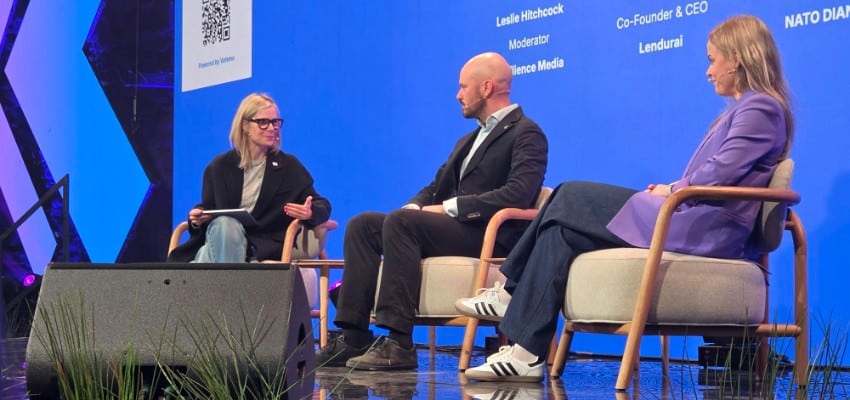
Resilience Media co-founder Leslie Hitchcock moderated the morning’s third session on the new defense economy, with Lendurai Chief Executive Siim Maivel and NATO DIANA Regional Director Kadri Tammai. Hitchcock framed the conversation around recent drone incursions affecting Nordic and Baltic countries, including one she said had occurred a day and a half earlier, and the panel traced the operational reality of building autonomous systems for a region where war is no longer theoretical.
Maivel, who came to defense from data science roles at Bolt and the autonomous-vehicle sector, described Lendurai’s two foundational bets. Unmanned systems are reshaping how war fighters operate, and those systems need software that lets a single operator command many platforms across GPS- and radio-denied environments. The first version of the company’s product shipped six months after founding, Maivel said, and the team continues to test directly with Ukrainian operators rather than through the long feedback loops typical of legacy defense procurement.
Tammai laid out the DIANA model in equally operational terms. The accelerator scouts technologies from across the alliance’s 32 nations against specific capability needs and connects validated startups to procurement officers who can place real contracts. “We can turn around from the initial contact by a nation to a contract being placed to a company within four weeks,” Tammai said. She called the legacy assumption that defense procurement must run on multi-year cycles a luxury the alliance cannot afford and described the next DIANA challenge round as opening June 1.
Both panelists pushed back on the idea that money was the limiting factor. Capital exists, Tammai said, but too much of it is sitting unspent because investors are defense-curious rather than defense-committed. Maivel offered a sharper warning to founders. Overselling in defense breaks reputations that are difficult to rebuild, and the customer base is small enough that one failed deployment can end a company.
Building deep tech outside Silicon Valley
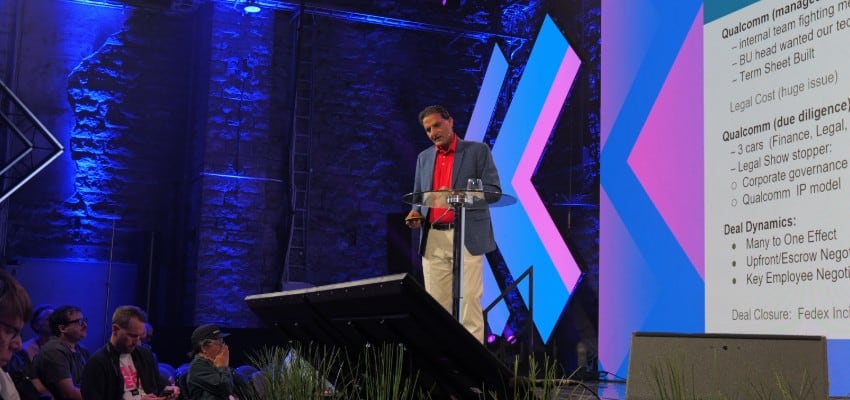
The morning closed with Dr. Rahul Razdan, a microprocessor designer turned serial founder who walked the room through the story of WiPower, the University of Florida spinout he led to acquisition by Qualcomm. The piece slotted into the morning’s larger thesis. If small ecosystems want to build category-defining companies, they need a different operating model than the one Silicon Valley exports.
Razdan’s argument was that culture, not capital, is what makes hub geographies different. In Silicon Valley, peers nudge founders into starting companies. Outside the hubs, peers tell them good luck and back away. Customers and investors carry the same skepticism. The answer, he said, is to invert the cost structure. WiPower raised about $700,000 to reach exit, used an equity-weighted compensation model that limited cash burn, charged tire-kicking partners $5,000 apiece to engage with the company and asked customers to prepay product. The lean model gave the team optionality at the negotiating table. When Qualcomm came in with a competing internal program, WiPower had enough strategic depth in the wireless-power market to close on terms it could live with.
The Estonia connection was not incidental. Razdan said he has built a research collaboration with TalTech and pointed to the same dynamic Salm had named earlier. Small ecosystems where everyone wants you to succeed can compound advantages that the bigger hubs no longer offer.
Why the morning matters for the resilience audience
Stitched together, the Bold Stage’s first morning was a coherent argument. Europe’s small democracies are betting that defensibility, manufacturing speed, alliance-scale procurement reform and a culture that supports founder ambition will let them build companies of consequence in the categories that matter most to the next decade — defense, deep tech, regulated software and hardware-augmented AI. For information governance and compliance professionals, the implication is that the resilience supply chain is acquiring real industrial weight. For cybersecurity practitioners, the message is that the systems being built in Tallinn, Riga and Helsinki are the systems that will defend European networks, borders and skies in the next decade. And for eDiscovery teams, the implication is the slower one. A region putting over 800 startup representatives in a single venue, with hundreds of those building dual-use technology, will generate the disputes, the procurement records and the cross-border data flows that follow.
The conference continues through May 22, with the pitch competition final and its near-half-million-euro prize taking the main stage at 2 p.m. local time. Whose strategy from the Bold Stage’s opening morning — Hinrikus on hardware, Salm on missiles, Tammai on procurement or Razdan on lean capital formation — will look most prescient when Latitude59 returns in 2027?
News sources
- Program | Latitude59 (Latitude59)
- Estonian missile defence startup Frankenburg Technologies raises €30M (Tech.eu)
- Lendurai secures €5.57M for autonomous UAV solutions in GPS-denied environments (Tech.eu)
- NATO DIANA Regional Hub opens in Tallinn (ERR News)
- AI Leap 2025: Estonia sets the standard for AI in education (e-Estonia)
- Plural’s newest partner: Uber veteran Pierre-Dimitri Gore-Coty (Plural)
- Resilience Media secured seed funding to build the voice of NATO’s defence tech sector (Tech.eu)
- WiPower (Wikipedia)





Assisted by GAI and LLM Technologies
Additional Reading
- Estonia opens Latitude59 with sandbox framework for legal exemptions
- Seven startups from four nations compete for Latitude59’s nearly half-million-euro investment prize
- Big tech, defense and climate to share the main stage at Latitude59 2026
- Latitude59 pitch competition draws 465 startups from 53 countries as prize pool grows to €400,000
- Baltic and Nordic Angel Networks Pool €300,000 for Latitude59 Pitch Competition as Cross-Border Startup Investing Deepens
- Latitude59 Opens Pitch Applications as Investors Raise the Bar on Operational Readiness
Source: ComplexDiscovery OÜ
ComplexDiscovery’s mission is to enable clarity for complex decisions by providing independent, data‑driven reporting, research, and commentary that make digital risk, legal technology, and regulatory change more legible for practitioners, policymakers, and business leaders.