
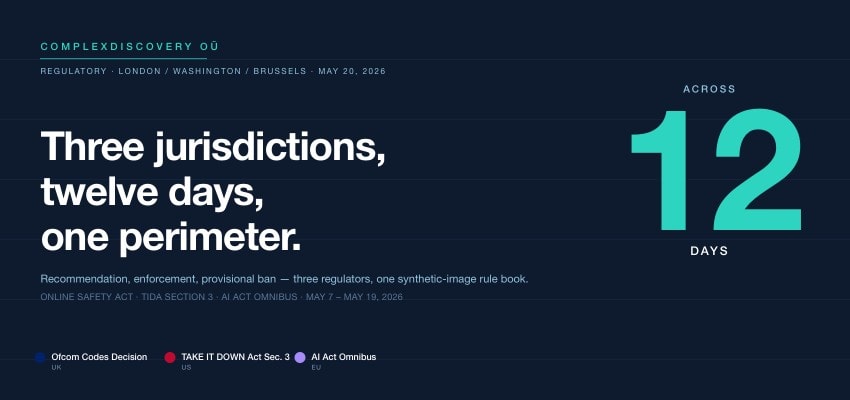
Editor’s Note: Three regulators on two continents tightened the synthetic-image rule book inside two weeks, and the operating environment for any platform that touches user-generated imagery shifted with them. The U.S. FTC’s TAKE IT DOWN Act enforcement, the UK Ofcom strengthened codes decision published May 18, and the EU AI Act Omnibus provisional deal reached May 7 now form a three-jurisdiction stack — with different mechanics, similar outcomes, and a U.S. 48-hour clock that is in force today alongside parallel UK and EU obligations still moving toward formal adoption.
For cybersecurity, information governance, and eDiscovery practitioners, the work begins at the moment a takedown request lands and continues through preservation, vendor diligence, and the procurement renewals that will hard-code these obligations into next year’s SLAs. The forward indicators worth watching are the first FTC complaint volumes through the new TakeItDown portal, the autumn timing on Ofcom’s codes, and how the EU Commission interprets “reasonable safety measures” for general-purpose image models once the Omnibus is formally adopted. Readers should treat this article as a compliance map for the second half of 2026 and revisit it after the EU’s December 2 compliance date settles.
Content Assessment: Three jurisdictions, two weeks: How the synthetic-image takedown clock just got faster
Information - 93%
Insight - 92%
Relevance - 94%
Objectivity - 92%
Authority - 91%
92%
Excellent
A short percentage-based assessment of the qualitative benefit expressed as a percentage of positive reception of the recent article from ComplexDiscovery OÜ titled, "Three jurisdictions, two weeks: How the synthetic-image takedown clock just got faster."
Industry News – Data Privacy and Protection Beat
Three jurisdictions, two weeks: How the synthetic-image takedown clock just got faster
ComplexDiscovery Staff
Britain’s Ofcom on May 18 recommended that certain tech platforms use hash-matching technology to detect non-consensual intimate images and AI-generated deepfakes — the third leg of a transatlantic regulatory perimeter built across 12 days.
The U.S. Federal Trade Commission began enforcing the TAKE IT DOWN Act the next day under a 48-hour removal clock. Twelve days before the FTC went live, EU negotiators reached a provisional agreement to ban AI systems used to create non-consensual intimate depictions of identifiable people and AI-assisted child sexual abuse material. The political work behind each measure took longer, but for platforms the perimeter took its operational shape across the 12-day window between May 7 and May 19. The synthetic-image regulatory stack is no longer a forecast — it is the operating environment cybersecurity, information governance, and eDiscovery teams will work inside for the rest of 2026.
How the perimeter closed in 12 days
Ofcom published the announcement on May 18, 2026, saying it would update its codes of practice under the Online Safety Act to recommend that certain service providers use “hash matching” technology to detect non-consensual intimate images, or NCII. The regulator said the change reflects the “urgent need to better protect women and girls online,” according to its press release. The amended codes are expected to take effect this autumn pending action from the UK Parliament.
The Ofcom code update is one of two related UK actions, and the distinction matters. The hash-matching recommendation sits inside Ofcom’s strengthened codes under the existing Online Safety Act. The 48-hour takedown clock, by contrast, lives in companion legislation that Prime Minister Keir Starmer announced in February — a bill that Parliament has yet to enact, but that would treat nudification tools as unlawful and expose services that fail to act to enforcement by Ofcom. In a February opinion piece, Starmer called the issue “a national emergency” and said victims “have been left to fight alone — chasing takedown of harmful content site to site, reporting the same material again and again, only to see it reappear elsewhere hours later.” He added: “We are putting tech companies on notice.”
Across the Atlantic, the FTC opened its enforcement window the next day. The agency began enforcing Section 3 of the TAKE IT DOWN Act, which requires covered platforms to provide a removal-request mechanism and to remove validly reported intimate images, plus known identical copies, within 48 hours of a valid request. The FTC also launched TakeItDown.ftc.gov, a complaint portal for victims who report platform non-compliance.
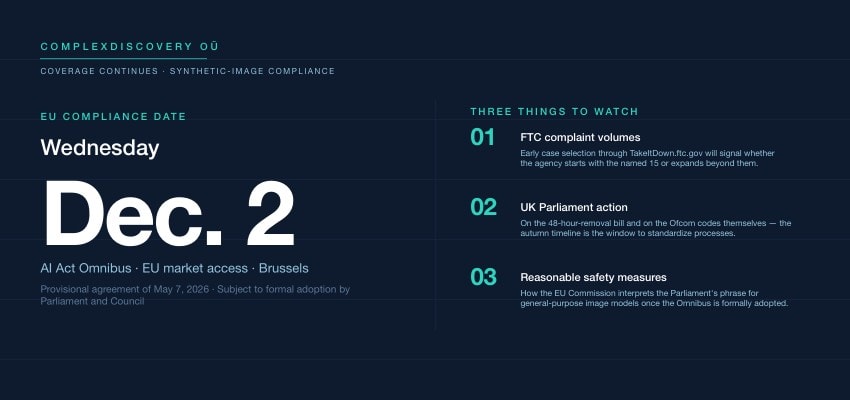
The third leg sits in Brussels. On May 7, 2026, European Parliament and Council negotiators reached a provisional deal on the AI Act Omnibus that would ban AI systems generating non-consensual intimate depictions of identifiable people and child sexual abuse material. Subject to formal adoption by both Parliament and Council, companies would have until Dec. 2, 2026 to bring systems into line.
What Section 3 actually requires
The U.S. statute reaches further than headline coverage has implied. The FTC’s Section 3 obligations attach to a broad set of platforms — “social media, messaging, image or video sharing, and gaming platforms,” in the agency’s framing — and apply to real images, digitally altered images, and AI-generated deepfakes alike. Civil penalties can reach the FTC’s statutory per-violation maximum (adjusted annually).
FTC Chairman Andrew N. Ferguson sent stakeholder letters the week of May 12 to 15 named services: Alphabet, Amazon, Apple, Automattic, Bumble, Discord, Match Group, Meta, Microsoft, Pinterest, Reddit, SmugMug, Snapchat, TikTok and X. The letters reminded each company of its obligation to comply fully no later than May 19, 2026. “Thanks to First Lady Melania Trump’s dedication, the public, especially children, will have recourse against digital exploitation and extortion,” Ferguson said in the agency’s announcement. “In the age of AI, anyone can be targeted, and that becomes even more appalling if children are involved.”
The Ferguson letter list is the practical guide for U.S. multinationals trying to read the political temperature: if a company is on it, it is on notice.
Brussels picks up the AI thread
The EU’s approach sits a step earlier in the supply chain. Where the FTC and Ofcom focus on takedown of content already posted, the Omnibus targets the AI systems that generate it. Negotiators agreed to ban placing on the EU market AI systems whose purpose is creating non-consensual intimate material, placing them on the EU market without reasonable safety measures to prevent such creation, and deploying them for that purpose. Subject to formal adoption by Parliament and Council, companies would have until Dec. 2, 2026 to bring systems into compliance.
The prohibition was added during negotiations after a late-2025 and early-2026 surge of nudified images generated through xAI’s Grok chatbot, which The Record reported spread millions of non-consensual images of women and children worldwide. Co-rapporteur Michael McNamara, an Irish MEP for Renew Europe on the Civil Liberties, Justice and Home Affairs committee, said in the Parliament’s announcement that the deal gives Europe “the tools to act if providers do not address AI systems that compromise fundamental rights or human dignity.” Co-rapporteur Arba Kokalari, a Swedish MEP for the European People’s Party, said the agreement showed “that politics can move just as quickly as technology.”
Where the takedown clocks diverge
The three jurisdictions converge on outcome and diverge on tempo. The U.S. Section 3 standard is 48 hours from a valid request, in force today. The UK’s two-day clock sits in legislation Parliament has yet to enact, and would pair the removal duty with a regulator that can block services that fail to comply and with criminal exposure for nudification-tool operators that the U.S. statute does not impose. The EU rule, once formally adopted, would operate as a market-access prohibition for nudifier systems: those systems would not be allowed to be sold or deployed inside the EU after Dec. 2, 2026.
For platforms that serve all three markets, the binding constraint is the strictest standard applied jurisdiction-by-jurisdiction. A U.S. multinational running an image-generation feature in Europe will need an EU-grade prohibition stance, an Ofcom-grade detection program, and an FTC-grade removal workflow, all at once.
Procurement, preservation, and vendor diligence
Procurement teams renewing image-moderation contracts this quarter should bake jurisdiction-specific service levels into the SLA. A 48-hour clock is operationally different from a “best efforts” commitment, and the financial exposure under the FTC’s per-violation penalty math compounds quickly when a victim files a single batch of related takedown requests that go unanswered. Service-level language should specify hash-match coverage, the appeal-resolution clock, and the supplier’s posture on cross-border data handling between the United States, the UK, and the EU.
Information governance teams should treat each takedown event as a record with downstream value. Request metadata, the hash that matched, the moderator decision, and the appeal trail are all relevant if a victim later sues, if a wrongly suppressed user contests removal, or if the FTC asks why the agency portal received a complaint. UK GDPR analyses are due on perceptual-hashing programs that touch biometric-template data, and trust-and-safety teams will be building hash databases at speed — counsel should map what gets preserved, for how long, and under whose lawful basis.
For eDiscovery teams, the takedown record is the future evidence. Class-action plaintiffs in NCII suits, employer-employee harassment matters, defamation actions against perpetrators, and criminal prosecutions of nudification-tool operators will all seek the same artifacts: the request log, the hash-match record, the originator metadata, the moderator decision trail, and the appeal record. eDiscovery teams should expect preservation-versus-deletion conflicts when content slated for 48-hour removal is also subject to litigation hold, and should prepare Rule 26-style production maps that survive a 48-hour deletion. Vendor risk teams should diligence trust-and-safety suppliers on false-positive rates, hash-database security, and supply-chain exposure — particularly any tooling that touches biometric data subject to UK GDPR or to Illinois BIPA-style state regimes in the United States.
Indicators worth tracking next
Three forward indicators will tell platforms how aggressive the enforcement curve gets. First, watch the first FTC complaint volumes through the TakeItDown.ftc.gov portal — early case selection will signal whether the agency starts with the named 15 or expands beyond them. Second, track Parliament action on the UK 48-hour-removal bill and on the Ofcom codes themselves; the autumn timeline gives industry a narrow window to standardize processes. Third, watch how the EU Commission interprets the Parliament’s phrase “reasonable safety measures to prevent such creation” for general-purpose models with image-generation capability — that language is the loophole or the noose, depending on the implementing acts.
How will your organization reconcile a 48-hour UK clock, a 48-hour U.S. clock, and a December EU market-access deadline before the next renewal cycle closes?
News sources
- UK regulator to require tech firms to tackle deepfakes, non-consensual intimate images (The Record from Recorded Future News)
- Platforms should use detection technology to stop spread of illegal intimate images online under strengthened Ofcom Codes (Ofcom)
- FTC Begins Enforcing the TAKE IT DOWN Act (Federal Trade Commission)
- Complying With the Take It Down Act (Federal Trade Commission)
- AI Act: deal on simplification measures, ban on “nudifier” apps (European Parliament)
- EU AI Act Omnibus Deal Reached: Postponed Deadlines, Watermarking Compromise, and the Nudification Prohibition (William Fry)
- May 19 Deadline for TAKE IT DOWN Act Compliance: Is Your Company Prepared? (Wiley Rein LLP)

Assisted by GAI and LLM Technologies
Additional reading
- FTC sets May 19 enforcement clock for the Take It Down Act, with $53,088 per violation on the table
- The Data Sovereignty Vise: Two Governments, One Compliance Trap, No Safe Harbor
- The EU’s E-Evidence Framework Goes Live in August and Most of Europe Isn’t Ready
- We Wanted Smarter Legal Tech, but Instead Got an Expensive Dependency
- The AI Sanction Wave: $145K in Q1 Penalties Signals Courts Have Lost Patience with GenAI Filing Failures
- FTC’s OkCupid Action Reframes AI Training Data as a Consumer Protection Issue
- White House AI Framework Signals New Compliance Stakes for Legal, Cybersecurity, and eDiscovery
- The Gatekeeper’s Key: How the Conformity Assessment Unlocks the EU AI Market
Source: ComplexDiscovery OÜ
ComplexDiscovery’s mission is to enable clarity for complex decisions by providing independent, data‑driven reporting, research, and commentary that make digital risk, legal technology, and regulatory change more legible for practitioners, policymakers, and business leaders.