
Editor’s Note: Helsinki’s European Centre of Excellence for Countering Hybrid Threats (Hybrid CoE) published a paper Oct. 15, 2026, arguing artificial intelligence structurally alters hybrid threats, which it describes as deniable, multi-tool campaigns against democracies, while their logic stays the same. Its authors are Tinna Þuríður Sigurðardóttir of the Central Bank of Iceland and Martin Cvetko of the NATO Cooperative Cyber Defence Centre of Excellence in Tallinn. The paper says responsibility for its views rests with the authors.
It sorts AI’s effects into three groups: generating and amplifying content, probing and exploiting systems, and sensing and targeting. Read against its sources, the evidence for two of those groups shows costs falling and access widening sooner than results attributable to AI. Security firm VulnCheck found 14 of 1,061 vulnerabilities attributed to AI-assisted discovery confirmed as exploited.
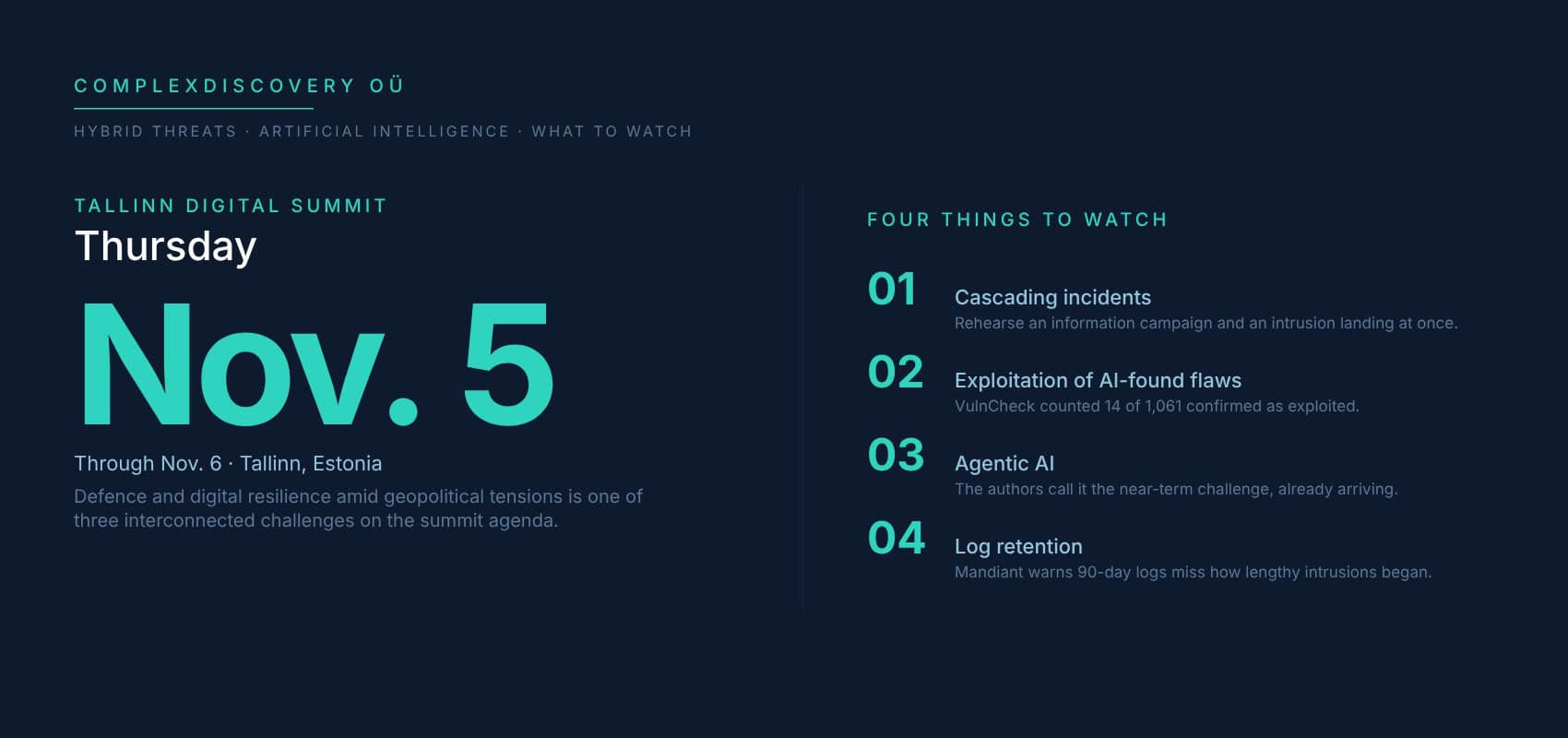
Security, records and legal teams may want to rehearse a disinformation campaign and an intrusion arriving together. Estonia’s Tallinn Digital Summit, Nov. 5 and 6, will take up hybrid threats.
Content Assessment: AI changes the economics of hybrid threats but not their logic, Helsinki paper argues
Information - 93%
Insight - 92%
Relevance - 92%
Objectivity - 94%
Authority - 92%
93%
Excellent
A short percentage-based assessment of the qualitative benefit expressed as a percentage of positive reception of the recent article from ComplexDiscovery OÜ titled, "AI changes the economics of hybrid threats but not their logic, Helsinki paper argues."
News Analysis – Cybersecurity Beat
AI changes the economics of hybrid threats but not their logic, Helsinki paper argues
ComplexDiscovery OÜ Staff
A paper published Oct. 15 by Helsinki’s European Centre of Excellence for Countering Hybrid Threats argues that artificial intelligence structurally alters existing hybrid threats while leaving their underlying logic intact.
The evidence it gathers tells a more cautious story. In two of the paper’s three capability clusters, AI is visibly lowering costs and widening access, while the results the paper can attribute to AI remain modest or anticipatory.
The paper, Hybrid CoE Strategic Analysis 36, also has a Tallinn connection. Its authors are Tinna Þuríður Sigurðardóttir and Martin Cvetko. Sigurðardóttir, a cyber specialist in the Central Bank of Iceland’s Financial Stability Department, was Iceland’s secondee and a senior analyst at the Helsinki center, known as Hybrid CoE, from 2024 to 2026. Cvetko, a senior military specialist from the Slovenian Armed Forces, is a strategy researcher at the NATO Cooperative Cyber Defence Centre of Excellence (CCDCOE) in Tallinn, where he coordinates Cyber Intelligence Research. The paper states that responsibility for its views rests with the authors, which makes it a Hybrid CoE publication with a CCDCOE co-author rather than a joint position of the two institutions.
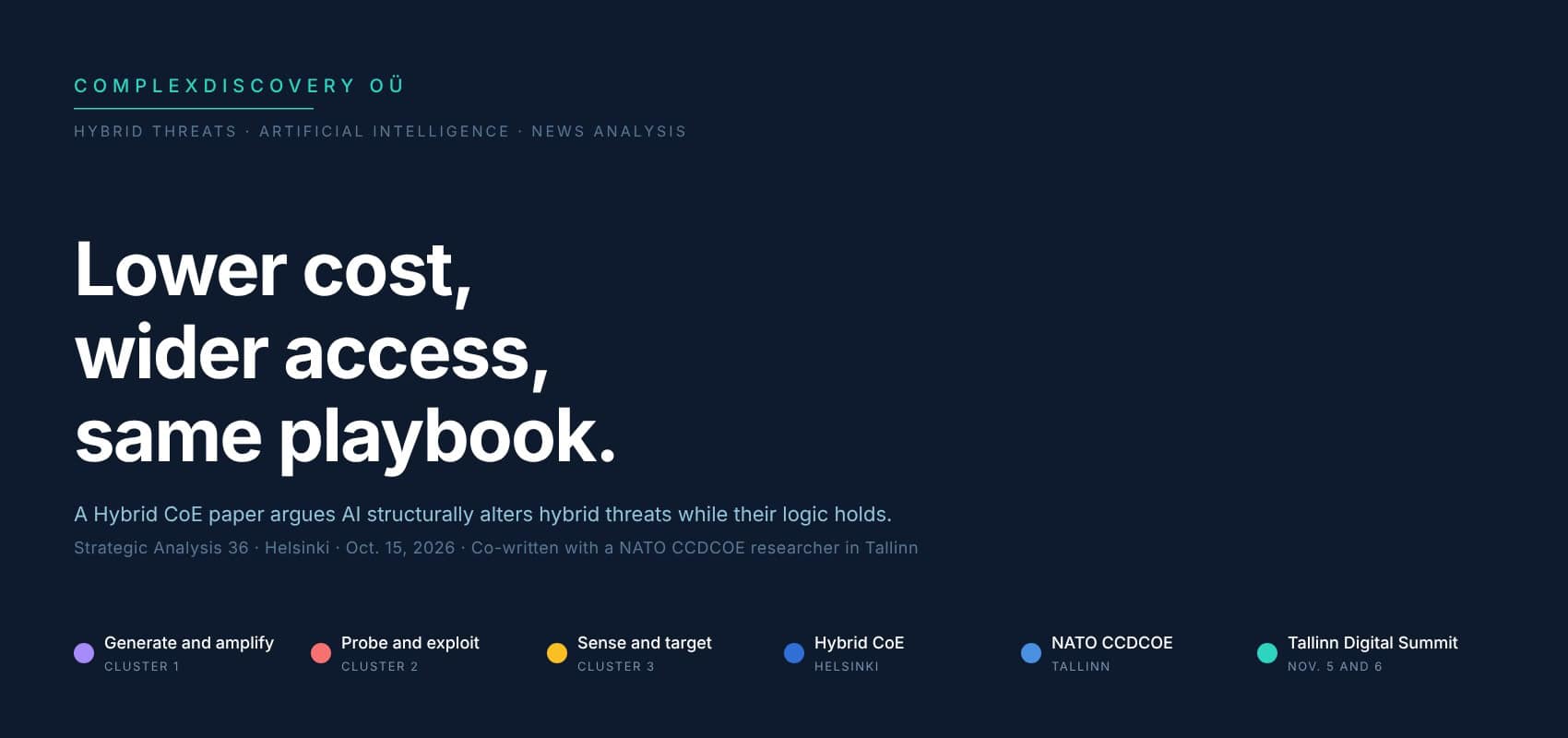
Three clusters drawn from the existing playbook
Hybrid CoE describes itself as “an autonomous network-based international expert organization” serving its 35 participating states, the European Union and NATO. The paper describes hybrid threats as deniable campaigns against democracies that mix many tools and methods. To analyze them, the authors borrow a tool the center developed with the European Commission’s Joint Research Centre. That tool, the Comprehensive Resilience Ecosystem (CORE) model, divides society into civic, governance and services spaces, spread across local, national and international levels and 13 domains.
Against that map, the authors sort AI’s effects into three capability clusters. Shaping societal perception covers generating and amplifying content, penetrating digital systems covers probing and exploiting them, and directing effort covers sensing and targeting. The authors present the clusters “as illustrations rather than as a defined taxonomy of AI capabilities,” a caveat worth keeping, because a tidy three-part frame invites readers to treat it as a classification scheme.
Persuasion at scale, impact still in question
The first cluster draws on a familiar run of cases from the war in Ukraine. A deepfake of Ukrainian President Volodymyr Zelenskyy telling his soldiers to give up appeared in March 2022 and was quickly exposed. By November 2023, three fabricated videos of Valerii Zaluzhnyi, then Ukraine’s commander in chief, were harder to spot. Other operations after 2022 went after smaller audiences, including a fabricated video call in which, the Digital Forensic Research Lab (DFRLab) found, doctored footage of former President Petro Poroshenko led International Legion members to agree with inflammatory remarks about Zelenskyy.
Persuasive power alone does not explain the concern, judging by a Scientific Reports meta-analysis the paper cites, in which Lukas Hölbling, Sebastian Maier and Stefan Feuerriegel pooled seven studies and 17,422 participants. Its abstract reports that the overall gap in persuasiveness between large language models and humans did not reach statistical significance, with wide variation across studies. The paper places the machines’ edge in the sheer number of personalized messages they can produce.
Volume, by the paper’s own account, has not yet become demonstrated effect. The authors call their assessment of this cluster anticipatory, describing the affected spaces as “exposed rather than currently degraded,” and they argue that reach, rather than content quality or quantity, decides the damage. DFRLab reached a similar judgment in a July 2024 case study the paper cites, covering events through April 2024: AI could not yet outperform older tactics such as amplifying existing footage out of context.
Exploits arrive before patches
The second cluster carries the paper’s hardest numbers, and most of them come from security vendors that sell products in this market. Citing Mandiant’s M-Trends 2026 report, which draws on the company’s 2025 investigations, the authors put the mean time to exploit vulnerabilities at an estimated minus seven days, against 63 days in 2018. CERT-EU, the cybersecurity service for European Union institutions, draws the same comparison, and Mandiant reads the negative figure as exploitation routinely starting before a patch ships.
In its M-Trends 2026 summary, Mandiant does not attribute that speed to AI. The company wrote that it does “not consider 2025 to be the year where breaches were the direct result of AI,” and it traced most successful intrusions to basic human and systemic failures.
Other signals point to AI more directly. Google Threat Intelligence Group reported in May 2026 that it had, for the first time, found an attacker wielding a zero-day exploit it believes was built with AI. The actor was criminal and had planned a mass exploitation event that Google’s own discovery may have prevented. Actors linked to China and North Korea, the group added, showed particular interest in AI-assisted vulnerability research.
CERT-EU framed the shift in April 2026 as one of access rather than novelty, acknowledging that state-linked groups have long out-resourced most defenders in vulnerability research. “What AI does is change who else can credibly operate at that tempo,” the team wrote. It put typical enterprise patch cycles at 30 to 60 days.
The paper’s own case study for this cluster, the Chinese state-sponsored actor Volt Typhoon, is a pre-AI baseline, and the authors state that “this case has not been attributed to AI.” Beyond that baseline, the paper cites VulnCheck, a vulnerability intelligence firm, whose July 2026 report combined two datasets of vulnerabilities attributed to AI-assisted discovery, 1,061 in all. Exploitation in those datasets remains limited: VulnCheck counted 14 of the 1,061, or 1.3 percent, confirmed as exploited in the wild. VulnCheck said that rate closely aligns with the overall exploitation rate it saw from January through June 2026, though it falls below rates the firm has recorded historically.
The measure tracks whether flaws found with AI were later exploited, not whether attackers used AI to exploit them. On that measure, VulnCheck called the impact so far “real but modest” and wrote that AI-assisted vulnerability discovery has been “overhyped relative to the evidence available today.” The authors reach a compatible verdict in one line: “Vulnerability discovery has industrialized; exploitation [still] has not.”
Targeting shortens the loop
The third cluster is the one where the paper points to battlefield results linked to AI, and those results rest on studies it cites. Language models can sort open-source information into usable intelligence, the authors write. Citing research on the 2020 Nagorno-Karabakh conflict, when Azerbaijan overwhelmed Armenian defenses, they write that onboard sensors and AI-augmented automatic target recognition shortened the interval between detecting military assets and striking them. In Ukraine, the paper says, both armies now field drones with differing degrees of autonomy and AI support. Because the same technology increasingly serves soldiers and civilians alike, the authors argue, effects in this cluster spill into civilian life, blurring responsibility and slowing responses.
A Kyiv case the paper cites shows how little such targeting can require, with or without AI. According to the Centre for Information Resilience report the authors rely on, a pro-Russian Telegram account called Rybar used an April 2022 Ukrainian television segment to find a repair workshop at a Kyiv armored vehicle plant. Rybar posted its coordinates April 14; two days later, Russian precision missiles all but destroyed the workshop and killed at least three civilians. The investigators could not say exactly how Rybar found the site, but they showed it could be located with several simple searches of public sources, the kind of sifting the authors say widely available language models have made easier.
Where the paper and its sources differ
Those cited reports are worth opening, because a check of the documents the paper relies on shows its summaries running looser than the originals in at least two places. The paper says the Russian Meliorator bot farm “produced 968 posts on X” before “its seizure in July 2024.” The U.S. Justice Department’s July 9, 2024, release instead announces “the seizure of two domain names and the search of 968 social media accounts.”
The paper also says Volt Typhoon “has established and maintained persistence” in U.S. communications, energy, transport and water sector networks “for at least five years.” The February 2024 advisory it cites, from U.S. agencies including the Cybersecurity and Infrastructure Security Agency, does report confirmed compromises primarily in those sectors, but it attaches the five-year span only to “indications” of footholds “within some victim IT environments.”
Neither difference cuts against the paper’s argument, since the bot farm’s scale and Volt Typhoon’s role as a pre-AI baseline both hold under the originals’ wording, but policy staff and conference audiences are likely to meet these figures secondhand. Anyone relying on them should take them from the cited originals.
Rehearsing the cascade before Tallinn
The paper’s closing sections hold both of its big claims at once. AI has altered the economics of hybrid campaigns, cutting their cost and lifting their output, the authors write, while “the nature and logic of hybrid threat operations remain the same.” Read together, the two claims fit: the playbook stays the same while the cost of running it, and the range of actors able to run it, changes. Cross-space coordination used to be a nation-state capability and is now within reach of less sophisticated actors, the authors write, and they locate the real risk in cascading effects across spaces rather than in any single cluster. Their assessment is that decision makers face a polluted information space, dormant access an adversary has already planted and compromised command capacity simultaneously.
Agentic AI sharpens that problem. In the authors’ view it is the near-term challenge and is already arriving, because systems that act continuously without real-time human direction cut both the time and the staff a campaign needs.
Their recommended response is the cross-space tabletop exercise. A viable scenario, the authors write, pairs a machine-generated information campaign with an AI-enabled intrusion into operational technology, so defenders train for cascading events rather than isolated ones; NATO and EU exercises, they add, have already attempted versions of it.
Security and legal teams can borrow that design directly. Pairing a ransomware or operational technology intrusion with a synthetic-media campaign tests whether incident response, communications, litigation hold and evidence preservation plans can run in parallel. It also tests whether anyone owns the record of what was fabricated, when it surfaced and who acted on it.
Information governance teams face a narrower question first. Mandiant’s M-Trends 2026 summary says threats such as the BRICKSTORM backdoor are “achieving dwell times of nearly 400 days.” At that length, Mandiant warns, organizations that keep logs for the standard 90 days are left “completely blind” to how an intruder got in and how far the intrusion reached. Set beside the separate U.S. agency indications of Volt Typhoon footholds lasting at least five years, retention schedules look less like a records formality and more like part of the response plan.
The timing gives the paper a ready audience. Estonia’s International Centre for Defence and Security organizes the Tallinn Digital Summit with four Estonian government bodies for Nov. 5 and 6, and the summit lists “Defence and digital resilience amid geopolitical tensions” among three interconnected challenges. Its description of that challenge names countering hybrid and cyber threats and protecting critical infrastructure. ComplexDiscovery previewed the summit’s agenda Oct. 12.
The paper’s bracketed “still” is the word that room should test. If the change the authors describe arrives as an information campaign, an intrusion and a targeting problem landing at once, are your response, communications and preservation plans written for one event or for three?
News sources
- Artificial intelligence in hybrid threat operations: How AI empowers the existing adversarial playbook (The European Centre of Excellence for Countering Hybrid Threats)
- Justice Department Leads Efforts Among Federal, International, and Private Sector Partners to Disrupt Covert Russian Government-Operated Social Media Bot Farm (U.S. Department of Justice)
- PRC State-Sponsored Actors Compromise and Maintain Persistent Access to U.S. Critical Infrastructure (Cybersecurity and Infrastructure Security Agency)
- AI is changing the economics of vulnerability discovery. Defenders should adapt now (CERT-EU)
- Tallinn Digital Summit 2026 (International Centre for Defence and Security)
- A meta-analysis of the persuasive power of large language models (Scientific Reports via PubMed Central)
- M-Trends 2026: Data, Insights, and Strategies From the Frontlines (Google Cloud)
- Adversaries Leverage AI for Vulnerability Exploitation, Augmented Operations, and Initial Access (Google Threat Intelligence Group)
- VulnCheck State of Exploitation 1H-2026 (VulnCheck)
- AI tools usage for disinformation in the war in Ukraine (Digital Forensic Research Lab)
- Killer Coordinates: How a Russian missile hit Kyiv with the help of online sleuths (Centre for Information Resilience)
- Tallinn Digital Summit 2026 puts the agentic state to the test (ComplexDiscovery)

Assisted by GAI and LLM Technologies
Additional reading
- A warned Vilnius Starlink site puts CISA’s 3-day patch clock in context
- Refrigeration hack affected about 700 French supermarkets, government says, as Danfoss interfaces stay online
- MonsterCloud indictment exposes the ransom payment a victim’s own file may not record
- Wikimedia publishes its own account of suspected OpenAI agent activity on its wikis
- Cyber Law Toolkit tests AI deception, cyber torture and peacetime cyber duties
- ENISA Threat Landscape 2026 finds DDoS leads incident counts while ransomware stays most impactful in the short term
- Cyber Resilience Act reporting starts Sept. 11 on an unfinished platform
Source: ComplexDiscovery OÜ

ComplexDiscovery’s mission is to enable clarity for complex decisions by providing independent, data‑driven reporting, research, and commentary that make digital risk, legal technology, and regulatory change more understandable for practitioners, policymakers, and business leaders.