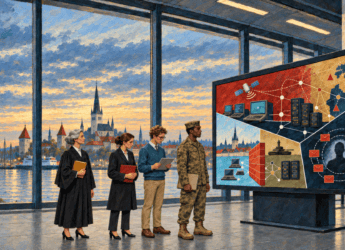
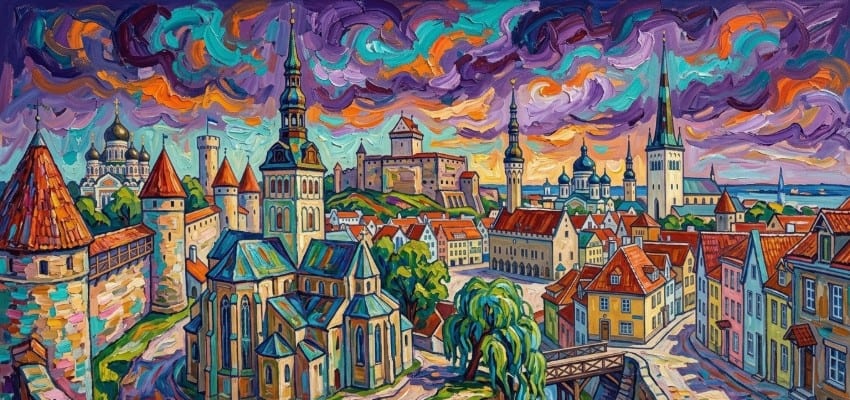
Editor’s Note: Legal technology is crossing a threshold in 2026 — from experimental AI adoption to operational integration — and Estonia’s capital sits at the center of that shift. FutureLaw 2026, running May 14-15 at Tallinn’s waterfront Cruise Terminal, assembles 500 practitioners, technologists, and policymakers to tackle the hard questions: how organizations manage change when machine-readable legal systems replace traditional drafting workflows, and how cross-border governance frameworks function when technology enables law to operate as a borderless service.
For cybersecurity, data privacy, regulatory compliance, and eDiscovery professionals, Estonia offers context that no other conference location can match. This is the country that survived the first nation-state-scale cyberattack in 2007, hosts NATO’s CCDCOE, and produced the Tallinn Manual on international law in cyberspace. Its e-governance infrastructure operates under eIDAS and GDPR — providing a working model of the regulatory frameworks these professionals navigate daily.
Watch for how FutureLaw’s sessions on AI workflow integration and transnational legal infrastructure translate into practical guidance. With the EU AI Act implementation unfolding and eIDAS 2.0 advancing, the conversations in Tallinn will shape compliance strategies well beyond the Baltics.
ComplexDiscovery OÜ will be on site in Tallinn, covering FutureLaw 2026 with practitioner-focused reporting and post-event analysis for cybersecurity, privacy, regulatory compliance, and eDiscovery professionals.
Content Assessment: FutureLaw 2026 Heads to Tallinn: Where Legal Innovation Meets One of Europe's Most Captivating Capitals
Information - 92%
Insight - 90%
Relevance - 88%
Objectivity - 92%
Authority - 93%
91%
Excellent
A short percentage-based assessment of the qualitative benefit expressed as a percentage of positive reception of the recent article from ComplexDiscovery OÜ titled, "FutureLaw 2026 Heads to Tallinn: Where Legal Innovation Meets One of Europe's Most Captivating Capitals."
Industry News – eDiscovery Beat
FutureLaw 2026 Heads to Tallinn: Where Legal Innovation Meets One of Europe’s Most Captivating Capitals
ComplexDiscovery Staff
Estonia’s capital city has quietly become one of Europe’s most compelling intersections of technology, governance, and cyber defense — and on May 14-15, it will host the fourth edition of the FutureLaw Conference, a gathering that its organizers describe as the Nordic region’s largest legal innovation event. For cybersecurity, information governance, and eDiscovery professionals tracking how artificial intelligence, regulatory transformation, and digital governance are reshaping legal services, the two-day program at Tallinn’s Port Cruise Terminal offers a concentrated dose of what comes next.
But Tallinn itself may be the conference’s most underrated feature. A UNESCO World Heritage old town, a thriving digital society that runs on e-governance, the headquarters of NATO’s cyber defense brain trust, and a geographic position that places three distinct Estonian cities within easy day-trip range — the conference provides as much reason to extend the trip as it does to attend the sessions.
Inside FutureLaw 2026
Hosted by LEGID in collaboration with Tallinn University of Technology (TalTech), FutureLaw 2026 brings together an exclusive group of 500 legal practitioners, technologists, policymakers, and academics from the Baltics, Nordics, and beyond, according to the conference’s official website. The event spans over 25 hours of programming across two days, with eight expert-led workshops complementing the main-stage sessions.
The conference agenda reflects where the legal technology conversation has landed after several years of generative AI experimentation. Rather than debating whether AI will transform legal work, the 2026 program focuses on operational realities: change management, workflow integration, and the organizational friction that follows technology adoption. According to the conference organizers, sessions will examine how legal services are evolving from human-centered drafting toward machine-readable, interoperable systems — a shift that positions lawyers less as document authors and as architects of legal infrastructure.
Transnational legal frameworks occupy another substantial block of the program. Sessions explore how technology enables law to function as a borderless service, examining global dispute resolution networks and interoperable contract ecosystems that operate across jurisdictions. For professionals managing cross-border eDiscovery or multinational compliance obligations, these discussions address operational challenges that surface daily — particularly as the EU’s regulatory architecture continues to expand through frameworks like eIDAS 2.0 and the ongoing implementation of the EU AI Act.
Legal design, digital governance, and regulatory transformation round out the thematic pillars. With over 50 speakers confirmed, according to the conference organizers, the lineup draws from law firms, legal technology companies, government agencies, and academic institutions across Europe.
The Venue: Tallinn’s Waterfront Cruise Terminal
The conference venue itself signals how Estonia approaches infrastructure. Completed in 2021, the Port of Tallinn Cruise Terminal holds the Green Key eco-label and generates solar energy while harnessing marine energy for heating and cooling, according to the Estonian Convention Bureau. Its main hall spans 1,716 square meters with floor-to-ceiling windows opening directly onto the Baltic Sea — a setting designed for events that want to match their content with their surroundings.
The terminal sits within walking distance of Tallinn’s city center and connects seamlessly with public transport, meaning attendees can move between sessions and the old town without a car or taxi.
Why Estonia, and Why Now
Estonia’s selection as the conference host is no accident. The country has built what many observers call the world’s most advanced digital society. Its e-Residency program, launched in December 2014 as the world’s first such initiative, allows anyone on earth to establish an EU-based business online. Government services — from voting to prescriptions to tax filing — run through a secure digital backbone that other nations study and attempt to replicate. The e-Estonia Briefing Centre in Tallinn offers structured sessions for visiting professionals who want to understand how the system works.
The country’s cybersecurity credentials run equally deep. In April and May 2007, Estonia weathered what researchers at the NATO Cooperative Cyber Defence Centre of Excellence (CCDCOE) and other analysts have called the first large-scale cyberattack directed at an entire nation-state — a series of distributed denial-of-service attacks that targeted parliament, banks, ministries, and media outlets. The experience galvanized the NATO alliance. Estonia had proposed a dedicated cyber defense centre to NATO as early as 2004, and the concept was approved in 2006 — but the 2007 attacks served as a wake-up call that accelerated international commitment. The CCDCOE, formally established in Tallinn in 2008 and now comprising around 39 member nations, has become the alliance’s primary hub for cyber defense research, training, and policy development. Its annual Locked Shields exercise is the largest live-fire cyber resilience drill in the world. And the Tallinn Manual — a two-edition academic study on how international law applies to cyber operations, published by Cambridge University Press — has become a foundational reference for legal professionals, policymakers, and military strategists working at the intersection of technology and international law.
For legal technology professionals, Estonia functions as something of a living laboratory. The principles driving FutureLaw’s agenda — interoperability, machine-readable legal systems, cross-border digital governance — are concepts Estonia has been implementing at a national scale for over two decades. The country’s digital identity infrastructure operates under eIDAS, the EU regulation on electronic identification and trust services, giving practitioners a working model of how digital governance frameworks translate into daily operations.
Getting There
Tallinn is well-connected by air, with Lennart Meri Tallinn Airport offering nonstop flights to nearly 50 destinations in around 27 countries, served by roughly 17 airlines depending on the season. Air Baltic, Finnair, Lufthansa, Ryanair, SAS, and Turkish Airlines are among the carriers operating routes from the airport. Helsinki, Stockholm, and Riga rank among the most frequent connections. Direct service also reaches London, Amsterdam, Paris, Munich, Berlin, Barcelona, and Dublin, among other cities. The airport sits roughly 15 minutes from the city center by taxi or bus.
Life Beyond the Conference: Tallinn
Conference fatigue is real, and Tallinn is the antidote. The city’s UNESCO-listed Old Town ranks among the best-preserved medieval centers in Europe, with cobblestone streets, Gothic church spires, and merchant houses that have stood since the 13th century. Town Hall Square — anchored by a town hall completed in 1404, the oldest in the Baltic Sea region and Scandinavia — still functions as a gathering place where cafes spill out onto the stones. The “Old Thomas” weather vane atop the town hall spire has kept watch over the square since 1530 and remains one of Tallinn’s defining symbols.
The Alexander Nevsky Cathedral, a Russian Orthodox church with onion domes, commands the top of Toompea Hill, while St. Olaf’s Church (Oleviste kirik) offers a viewing platform at roughly 60 meters, accessible via a medieval stone spiral staircase of over 230 steps — open from April through October — that provides panoramic views across the city’s red rooftops to the Baltic Sea beyond.
Tallinn’s culinary scene has earned international recognition. As of 2024, the city hosts Estonia’s only Michelin-starred restaurants and one of the country’s three Green Star restaurants — counts worth verifying against the current Michelin Estonia guide before travel — blending Nordic, German, and Russian influences with a focus on seasonal, locally sourced ingredients.
With mid-May bringing long daylight hours and mild weather, conference attendees arriving for FutureLaw will find the city at its most inviting.
Day Trip: Narva and the Edge of the EU
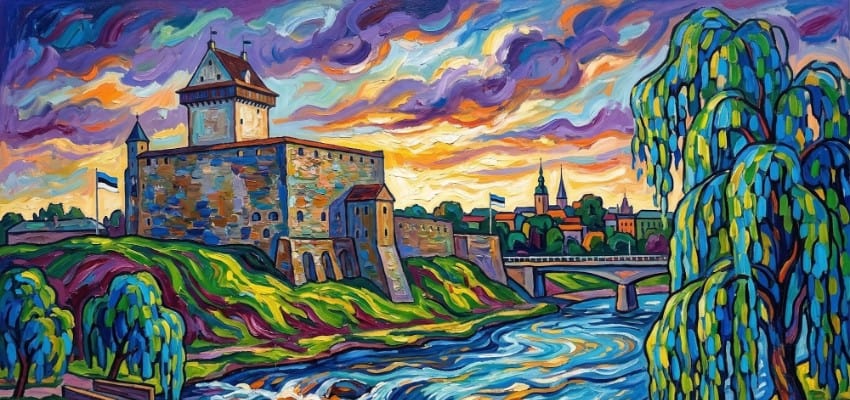
About two hours and 45 minutes east by train — services operated by Elron depart every three hours, with tickets running about 13–20 euros — Narva sits on the European Union’s eastern frontier, separated from Russia by the Narva River. Estonia’s third-largest city offers one of the most visually dramatic border scenes on the continent: Hermann Castle, established around 1256 when the area was part of the Danish realm and now housing the Narva Museum, stares directly across the river at Russia’s Ivangorod Fortress. The view of these twin fortresses, known locally as the “Five Krooni View” after the image that once graced Estonia’s five-krooni banknote, is available from a dedicated observation deck.
Beyond the fortress, Narva’s romantic riverside promenade features sculptures, a sundial, and summer kiosks. The Kreenholm Manufacture — a former textile mill with a storied industrial past — draws visitors interested in heritage architecture and Estonia’s manufacturing history. Narva-Jõesuu, a sandy beach resort town just north of the city, offers a quieter alternative for those seeking Baltic coast relaxation. Museum entry at Hermann Castle runs approximately 16 euros.
For professionals in cybersecurity and information governance, Narva provides a tangible reminder of the geopolitical fault lines that shape data sovereignty debates and cross-border regulatory frameworks across the EU’s eastern boundary.
Day Trip: Tartu, the Intellectual Capital
Two and a half hours south by bus or train — Lux Express buses depart every 30 minutes with tickets starting around 12 euros — Tartu is among the oldest cities in the Baltic States, with roots stretching to 2030. It is also Estonia’s intellectual heartbeat. The University of Tartu, founded on June 30, 1632, by King Gustav II Adolf of Sweden, anchors a city of 100,000 where academic life permeates everything from the cafe culture to the streetscape.
Tartu served as a European Capital of Culture in 2024 under the theme “Arts of Survival,” a designation that catalyzed investment in cultural infrastructure across southern Estonia. The Estonian National Museum, built on the site of a former Soviet military airfield, hosts interactive exhibitions spanning Estonian history from medieval times to the digital present. AHHAA, the largest science center in the Baltic states, draws visitors with hands-on exhibits. Aparaaditehas, a converted industrial complex, now houses boutique shops, galleries, coworking spaces, and restaurants in a setting that reflects the city’s blend of history and creative reinvention.
Town Hall Square — shaped as a trapezium along the Emajõgi River — features the “Kissing Students” fountain, one of Tartu’s most photographed landmarks. Werner Cafe, operating for over 125 years, has served as a gathering point for writers, poets, and thinkers across generations. Tartu joined the UNESCO Creative Cities network as its first City of Literature in the Baltic-Nordic region in 2015.
Day Trip: Pärnu, Estonia’s Summer Capital
The closest day trip from Tallinn, Pärnu sits just under two hours southwest by bus — FlixBus operates hourly service with tickets from around 9 euros. Known as Estonia’s summer capital, Pärnu built its reputation on a wide sandy beach stretching along Pärnu Bay, with shallow waters and a long promenade lined with restaurants and bars.
The city’s spa tradition runs deep. Mud baths first opened here in 1838, and modern Pärnu has become a wellness destination of international stature, attracting visitors from across Scandinavia — particularly Finland and Sweden. Spa hotels offer treatments ranging from traditional mud therapies to salt chambers, and Tervise Paradiis boasts one of Estonia’s largest water parks.
Between the beach and the city center, the Timber House District charms visitors with 19th-century wooden villas featuring painted facades and ornate balconies — a walkable neighborhood that captures the seaside resort aesthetic of a different era.
For the adventurous, Soomaa National Park lies 40 minutes by car from Pärnu, offering boardwalk hikes through wetlands, bog pools for swimming, and wilderness landscapes that feel centuries removed from any conference agenda.
Making the Case for an Extended Stay
FutureLaw 2026 runs May 14-15, placing it in the sweet spot of Estonia’s spring-to-summer transition. The conference content addresses the operational future of legal technology — AI integration, cross-border legal infrastructure, regulatory transformation — while the host country demonstrates what that future looks like in practice. Tallinn’s walkability, the venue’s waterfront setting, and the accessibility of three distinctly different Estonian cities within day-trip range create conditions for a trip that delivers professional development and genuine discovery in equal measure.
Registration information and the full speaker lineup are available at futurelaw.ee.
What would your practice or organization gain from experiencing a legal system built digital-first — and could a week in Estonia reshape how you think about the intersection of law and technology?
News Sources
- FutureLaw 2026 — Nordics’ Largest Legal Innovation Event (FutureLaw)
- FutureLaw 2026 — Europe’s Benchmark Legal Innovation Conference (Fienta)
- 4th FutureLaw Conference (TalTech)
- Port of Tallinn Cruise Terminal (Estonian Convention Bureau)
- e-Estonia: We Have Built a Digital Society (e-Estonia)
- 2007 Cyberattacks on Estonia (Wikipedia)
- NATO Cooperative Cyber Defence Centre of Excellence (CCDCOE)
- The Tallinn Manual (CCDCOE)
- Tallinn Town Hall: Gothic Gem of the Baltics (Discover Estonia)
- Tartu — European Capital of Culture 2024 (Tartu 2024)
- Destinations from Tallinn Airport (Tallinn Airport)
- Castles, Borders, and the Battle for Cyberspace (ComplexDiscovery)




Assisted by GAI and LLM Technologies
Additional Reading
- FutureLaw 2026 Preview: The Practical Path to Defensible AI in Legal Workflows
- The 2026 Event Horizon: Early Outlook for eDiscovery, AI, and European Innovation
- Data Provenance and Defense Tech: IG Lessons from Slush 2025
- Lessons from Slush 2025: How Harvey Is Scaling Domain-Specific AI for Legal and Beyond
- Kaja Kallas Warns of Democracy’s Algorithmic Drift at Tallinn Digital Summit
- The Agentic State: A Global Framework for Secure and Accountable AI-Powered Government
- When Founders Have Red Lines: Investing Beyond ROI at Latitude59
- At Latitude59, Estonia Challenges Europe: Innovate Boldly or Be Left Behind
Source: ComplexDiscovery OÜ
ComplexDiscovery’s mission is to enable clarity for complex decisions by providing independent, data‑driven reporting, research, and commentary that make digital risk, legal technology, and regulatory change more legible for practitioners, policymakers, and business leaders.