
Editor’s Note: Microsoft Threat Intelligence on Nov. 25 named six threat actors, including Salt Typhoon, the China-based group U.S. officials tied to breaches of at least nine U.S. telecom companies in 2024, as examples of groups adding ARTEX to their tooling. ARTEX is a framework in which AI agents plan and carry out hacking steps with little or no human involvement. Microsoft has published reports on four of the six groups’ ARTEX use but describes no Salt Typhoon campaign. Microsoft says ARTEX can reach privileged access within minutes, depending on configuration and defenses; multiple intrusions by Storm-0940, a Chinese state-aligned group, did so in under three hours. ThreatBook, the China-based company selling an enterprise edition called ARTEX Pro, says the open-source version was converted to closed source after attackers misused it and that its own platform runs only within customer-authorized test scopes.
For cybersecurity, data privacy, compliance and eDiscovery professionals, the issue is evidence: Microsoft says ARTEX detection depends on logs some organizations do not collect by default. The FBI’s Nov. 13 flash alert lists the legal industry among sectors targeted with ARTEX. Watch for any Salt Typhoon activity Microsoft publishes and any joint U.S. advisory tying named groups to ARTEX.
Content Assessment: Microsoft lists Salt Typhoon among ARTEX users but ties no campaign to it
Information - 94%
Insight - 93%
Relevance - 94%
Objectivity - 92%
Authority - 93%
93%
Excellent
This assessment rates the article’s information, insight, relevance, objectivity and authority. The analysis distinguishes Microsoft’s listing of Salt Typhoon as an ARTEX user from its documented Storm-0940 activity and explains why log retention matters for incident response and eDiscovery.
News Analysis – Cybersecurity Beat
Microsoft lists Salt Typhoon among ARTEX users but ties no campaign to it
ComplexDiscovery Staff
Microsoft Threat Intelligence on Nov. 25 named Salt Typhoon, the China-based group U.S. officials tied to the 2024 telecom breaches, among six actors it has seen adding the ARTEX agentic attack framework to their tooling. The guidance gives a detailed account of how the framework behaves and almost nothing about what Salt Typhoon has done with it.
That gap shapes how security, legal and discovery teams should read the report, because the name on the list is the headline while the evidence concerns something else. What the Nov. 25 post documents in detail is the tool, one Chinese state-aligned group it tracks as Storm-0940, and the traces both leave in logs that responders will need to keep.
Six names, two governments and an open-source tool
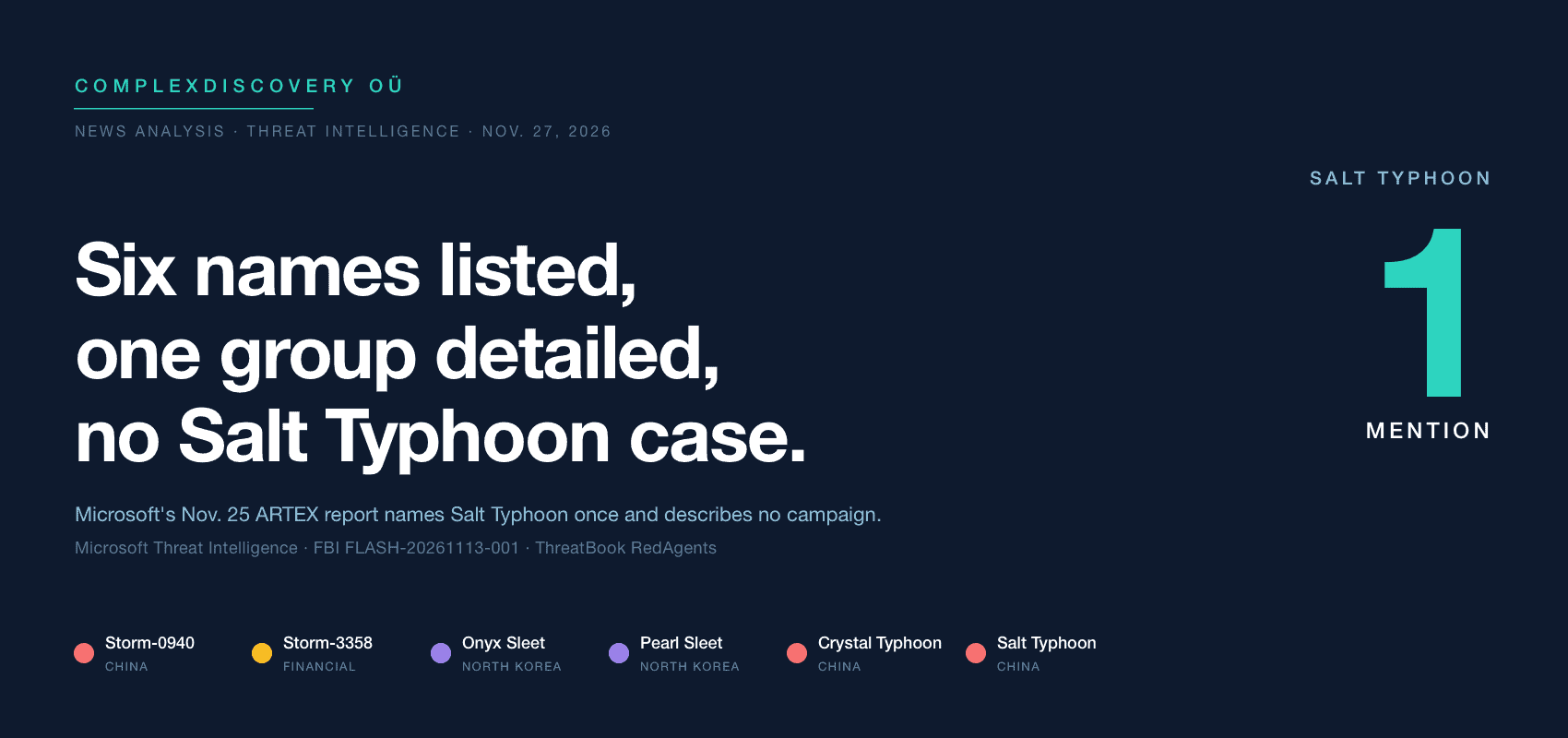
Microsoft said it has observed “both state-sponsored and financially motivated threat actors” adding ARTEX to their tooling as of November 2026. It offered Storm-0940, Storm-3358, Onyx Sleet, Pearl Sleet, Crystal Typhoon and Salt Typhoon as examples rather than a complete roster. Under Microsoft’s weather-based naming system, Typhoon marks China-based actors and Sleet marks North Korea-based actors. The company’s naming table places Onyx Sleet and Pearl Sleet in North Korea, puts Crystal Typhoon, Salt Typhoon and Storm-0940 in China, and lists Storm-3358 as financially motivated. Microsoft’s Oct. 21 report described Storm-0940 as a Chinese state-aligned group, active since 2021, that pursues data theft at organizations in many different industries. The Nov. 25 post does not sort the six by motivation itself, but a Nov. 6 Microsoft report it links describes Storm-3358 as a Cambodia-based, financially motivated cluster that mainly targets financial organizations in Southeast Asia.
Salt Typhoon appears once in the post, in that opening list. A search of the full text found no campaign, sector, victim or timeline attributed to the group, and the same holds for Crystal Typhoon. Every operational example in the document that names an actor names Storm-0940. Onyx Sleet, Pearl Sleet and Storm-3358 link to earlier Microsoft reports describing their ARTEX use, and Microsoft documented Storm-0940’s in its Oct. 21 report. Salt Typhoon and Crystal Typhoon carry no such link, and searches for this article through Nov. 27 found no Microsoft report describing either group’s ARTEX activity. The Record, which led its coverage with Salt Typhoon, wrote that U.S. agencies hold the group responsible for breaching at least nine telecom companies in 2024. Anne Neuberger, then the deputy national security adviser for cyber and emerging technology, said in December 2024 that a ninth U.S. telecom victim had been identified, according to The Associated Press.
The Record also noted that Microsoft’s report landed within hours of stories in The New York Times and Nextgov. Those outlets reported that the tool was allegedly used against systems at the CIA, the National Geospatial-Intelligence Agency and the Office of the Director of National Intelligence. Microsoft’s post does not mention those reports or those agencies, and no agency statement reviewed for this article confirmed the reported use of the tool.
From a GitHub repository to a commercial product
ARTEX began as freely available code, and its path since then matters for anyone trying to judge who can run it. Microsoft said a GitHub user called Autumn-27 published the framework in July 2026 with a Chinese-language interface and pulled the source code in October. Developers holding copies of the project kept releasing their own versions. ThreatBook, a China-based security company, announced on Oct. 16 a penetration testing platform called RedAgents that includes ARTEX Pro, an enterprise edition it describes as an extension of the open-source tool. The company said the open-source version began as a personal project of the RedAgents product lead, lacked built-in security controls and was converted to closed source on Oct. 8 after attackers misused it. ThreatBook said RedAgents operates only within testing scopes that customers authorize. Microsoft, for its part, said ThreatBook claimed ownership of ARTEX in November and started offering paid access to ARTEX Pro. Neither account establishes when a paying customer first gained access to the enterprise edition.
That history settles how the tool spread and leaves open how the named groups obtained it. Microsoft’s post does not connect ThreatBook’s commercial offering to any of the six actors, and no published report reviewed for this article shows whether state groups adopted ARTEX through the paid edition, the forks or the original code. The FBI’s Nov. 13 flash alert, FLASH-20261113-001, likewise said the framework lives on through forks, archived copies and a paid version, without naming a company.
Under the hood, Microsoft said, ARTEX runs a team of language-model agents that can carry an attack from discovery to a finished report with little or no human involvement. A goals model splits an engagement into checkable goals, and a planner agent hands out brief tasks that ARTEX calls intents. Worker agents execute those tasks using a live shell and common offensive tools, and a reporter agent then writes up each confirmed weakness. Because operators can wire the agents to almost any model, including ones stripped of their guardrails, Microsoft warned that ARTEX activity can escape any single provider’s safety controls and any single provider’s telemetry.
What “minutes” means in Microsoft’s own numbers
The most quotable line in the report is conditional. Microsoft said that, depending on the operator’s configuration and the target’s defenses, ARTEX can get from first scans to lasting, privileged access to a target within minutes. Microsoft’s measured examples track different milestones. In one, an AI agent moved from hunting GitHub for exposed client secrets to pulling data out of Azure Key Vault within five minutes, though Microsoft did not say whether that agent was ARTEX or name the actor behind it. In multiple Storm-0940 intrusions run through ARTEX, the attackers reached privileged access in under three hours from first targeting, which lines up with the FBI’s account of some intrusions getting from first targeting to privileged access inside three hours.
The report’s largest figure needs its context too. Microsoft said one Storm-0940 campaign using ARTEX produced over 151,000 failed sign-ins, with failures topping out at 2,900 a minute. Its Oct. 21 report identified that activity as an automated password-spray campaign that ran from Oct. 10 through Oct. 14 against 327 accounts at eight organizations. For that campaign, Microsoft said “no successful authentication, token issuance, Graph call, or directory change was observed.” Read that way, 151,000 is the volume of failed sign-ins Microsoft observed against those accounts, and 2,900 a minute was the peak pace, so neither number describes access to data.
Microsoft attributes none of those examples to Salt Typhoon, so applying the “minutes” estimate to the telecom intrusions would attach a speed to the group that Microsoft itself has not published.
Behavior, not signatures, is the evidence that lasts
For detection, Microsoft said the signal that holds up best, and longest, is behavioral. ARTEX fires a burst of varied requests within a short window and then either retries variations of a technique or advances to the next stage at machine speed. The company did list two user agent strings tied to the framework, artex-enrich/* and norma/*, but cautioned that operators can and do rotate user agents and source addresses to get past static rules.
On compromised servers, Microsoft described traces that existing tooling should already catch, because ARTEX does not disguise its activity by default. They include web server processes launching command shells and a string of short-lived web shells with sequentially numbered names as agents fix their own errors. Microsoft also listed quick successive reads of /etc/shadow, .env files and private keys, and new attack routes tried after containment. Its mitigation list starts with exposure: move web application firewalls to prevention mode after tuning, rate-limit requests per client and limit where web servers can send outbound traffic. It then calls for Conditional Access on every user and workload identity, with multifactor authentication required for users and, for service principals, policies that block sign-ins from unexpected locations or at elevated risk. Microsoft’s own documentation limits those workload policies to single-tenant service principals registered in an organization’s tenant, leaving out managed identities and multitenant apps from Microsoft or third parties, the category of application compromised in the ConnectWise case. Secret scanning across code and configuration files and automatic attack disruption round out the list.
Those same signals form an evidentiary record. When an intrusion compresses into hours, the request bursts, command timing and web server logs that reveal it may be the only reconstruction available. Whether they survive depends on retention settings each organization chose before the intrusion began. The same records may later be sought by regulators, insurers or opposing parties in litigation, so preserving them is a legal decision as much as a technical one.
Preservation advice Microsoft has already written
Microsoft’s earlier guidance, though written for a different incident, gives counsel a starting checklist for exactly that problem. Its Oct. 21 report was written for customers exposed to Storm-0940’s ConnectWise supply chain compromise. There, the company told those customers that deleting enterprise applications should not be their first move and that configuration and evidence should be captured before any step that cannot be undone. It also told them to hold on to sign-in and audit logs from Microsoft Entra and Microsoft Purview, along with security information and event management data, without holding back urgent containment until exports finish.
The same report carried two cautions that bear directly on breach-notification analysis. Microsoft said that finding an affected application in a tenant, or even confirming the actor signed in, does not by itself show that customer data was viewed or stolen. It also warned that a hunt that turns up nothing does not prove the actor never got in. Microsoft repeated that caution in the Nov. 25 guidance. It said ARTEX detection depends on logs some organizations do not collect by default, so an empty hunting result is no proof of safety when those logs are missing. Read together, those statements make retained logs central to any investigation, alongside whatever other evidence is available, which argues for confirming retention settings now rather than after an alert.
Legal organizations have a direct stake in that work. The FBI’s flash alert listed the legal industry among the sectors targeted with ARTEX since at least August 2026, alongside financial services, government, defense, healthcare and telecommunications. Microsoft’s Oct. 21 report separately listed legal among the industries Storm-0940 went after. The ConnectWise case also showed how a compromised third-party application with high privileges could reach downstream customer environments, a path that runs through the vendors law firms and legal service providers rely on.
What to watch after the list
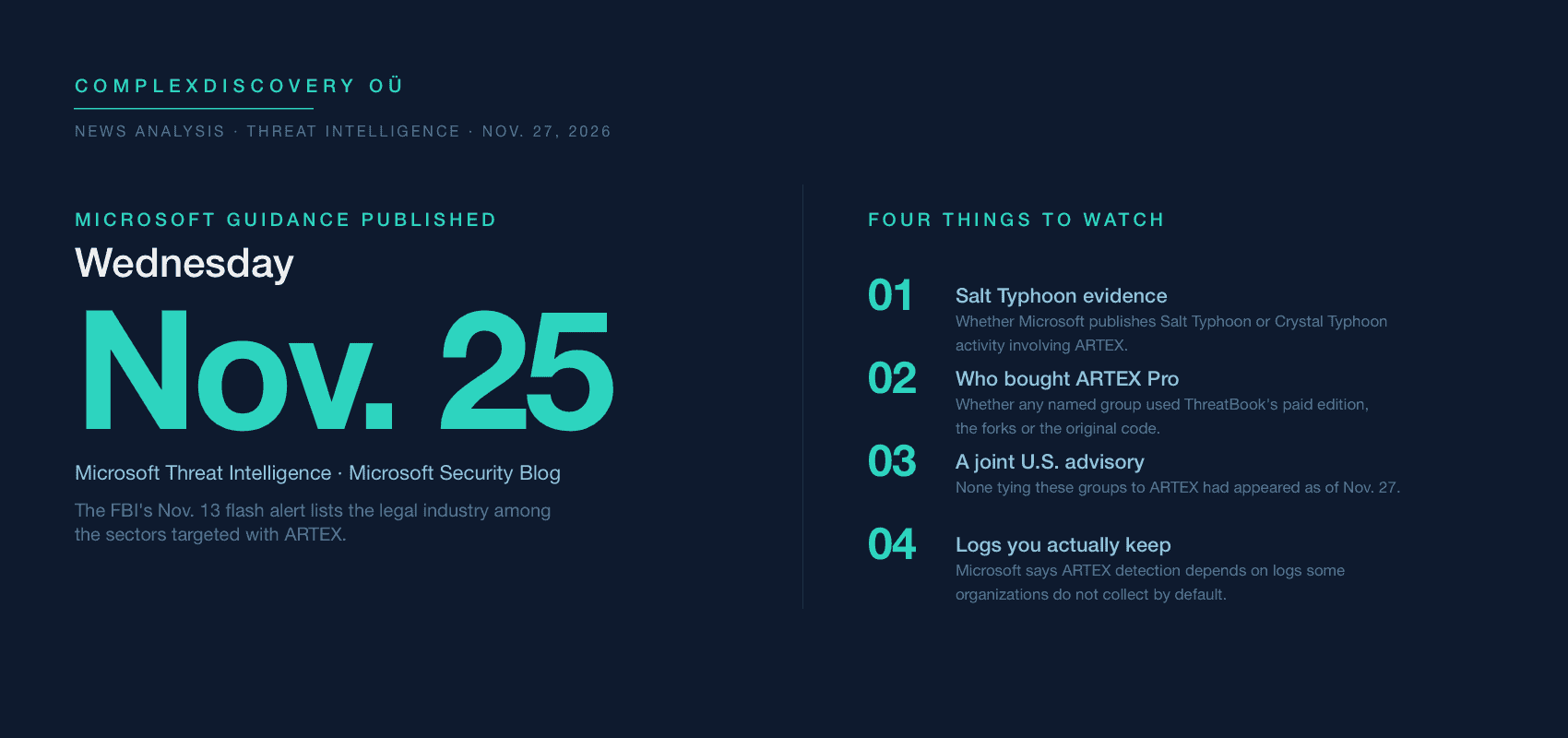
Several questions remain open as of Nov. 27. No Microsoft report reviewed for this article describes Salt Typhoon or Crystal Typhoon activity involving ARTEX, and neither ThreatBook’s announcement nor any other public document reviewed ties the commercial edition to a named state actor. The FBI’s flash alert names no co-authoring agency and, apart from a Storm-3358 campaign it sourced to Microsoft, names no threat actors. No joint U.S. advisory connecting these groups to ARTEX turned up in searches for this article. U.S. and allied agencies did issue joint guidance in August 2025 on Chinese state-sponsored activity that they said partially overlaps with industry reporting on Salt Typhoon.
Salt Typhoon’s name on Microsoft’s list is a warning about capability, not a case file. For security and legal teams, the practical response holds whichever group arrives first: shorten exposure, keep the logs that would show a machine-speed intrusion, and decide in advance who can order containment without destroying evidence. If the next ARTEX intrusion in your environment takes hours rather than weeks, will the records needed to explain it still exist when counsel asks for them?
News Sources
- What defenders need to know about ARTEX, the agentic AI framework threat actors abuse (Microsoft Threat Intelligence)
- AI-driven, large-scale nation-state campaign using ARTEX enables supply chain compromise (Microsoft Security Research and Microsoft Threat Intelligence)
- ARTEX abuse expands as cybercriminals target financial sector (Microsoft Threat Intelligence)
- Tracking AI adoption in North Korean threat actor tradecraft (Microsoft Threat Intelligence)
- How Microsoft names threat actors (Microsoft Learn)
- Microsoft Entra Conditional Access for workload identities (Microsoft Learn)
- Threat Overview of ARTEX Autonomous Penetration Testing Framework (Federal Bureau of Investigation via IC3)
- NSA and Others Provide Guidance to Counter China State-Sponsored Actors Targeting Critical Infrastructure Organizations (National Security Agency)
- ThreatBook Launches AI-Powered Pentest Aggregator, RedAgents (ThreatBook)
- Microsoft: China’s Salt Typhoon hackers are using Artex (The Record)
- FBI flash alert says Artex tool automating cyberattacks at ‘machine speed’ (The Record)
- Microsoft pins ConnectWise supply-chain attack to China-state aligned threat group (CyberScoop)
- Chinese hacking campaign hit a 9th U.S. telecom firm, White House says (The Associated Press via PBS News)
- US adds 9th telcom to list of companies hacked by Chinese-backed Salt Typhoon cyberespionage (Reuters via Yahoo)
- Artex AI Hacking Tool: Microsoft Names Chinese, North Korean State-Linked Hacker Groups (Tech Times)
- Microsoft finds 2 North Korean groups using ARTEX, a tool that alone cannot name an attacker (ComplexDiscovery)
- After the ConnectWise breach, a firm’s GDPR clock may start before its Microsoft 365 logs can answer (ComplexDiscovery)





Assisted by GAI and LLM Technologies
Additional reading
- CNIL fines Macif Vie 5 million euros over clear-text passwords and a 21-year login log
- Johnson Controls agrees to pay $5 million over alleged security plan gaps in federal contracts
- Officials tie FAA ground stop to contractor router work, not hackers, but the specific fault is still undetermined
- Notion AI chats surface in Fireworks breach, testing what zero retention covers
- France ties October supermarket fridge sabotage to Iran’s IRGC and seeks arrest warrants
- ENISA’s update advisory turns the patch pipeline into an evidence trail
- Britain’s cyber agency warns of a possible surge, and its own incident figures raise a question
- Supermarket freezer attacks reach at least six European countries, and the record linking them to US base failures stays thin
- Microsoft finds 2 North Korean groups using ARTEX, a tool that alone cannot name an attacker
- With over 40 percent of the record Binance theft frozen, getting it back becomes a legal project
- Estonia’s cyber authority saw no state-sector PHP crisis as three state institutions shut or restricted services
- AI recording spreads in Estonian health care as the regulator says the audio needs its own legal basis
Source: ComplexDiscovery OÜ

ComplexDiscovery’s mission is to enable clarity for complex decisions by providing independent, data‑driven reporting, research, and commentary that make digital risk, legal technology, and regulatory change more legible for practitioners, policymakers, and business leaders.