

Editor’s Note: The European Union Agency for Cybersecurity (ENISA) published a technical advisory on secure software update mechanisms on Nov. 4, 2026, aimed at manufacturers of products with digital elements and particularly at smaller firms. The guide maps seven steps in the life of an update, from building and signing it to recording whether it installed, and recommends controls for each. For its worked example, a smart thermostat, ENISA took inspiration from the 2025 hijacking of update traffic for the Notepad++ source code editor. The example ends with a table pairing each security claim the fictional manufacturer makes with evidence such as signing logs, update logs and rollback records. ENISA says the advisory is not legal advice, not a formal interpretation of the EU Cyber Resilience Act and not a presumption of conformity with it.
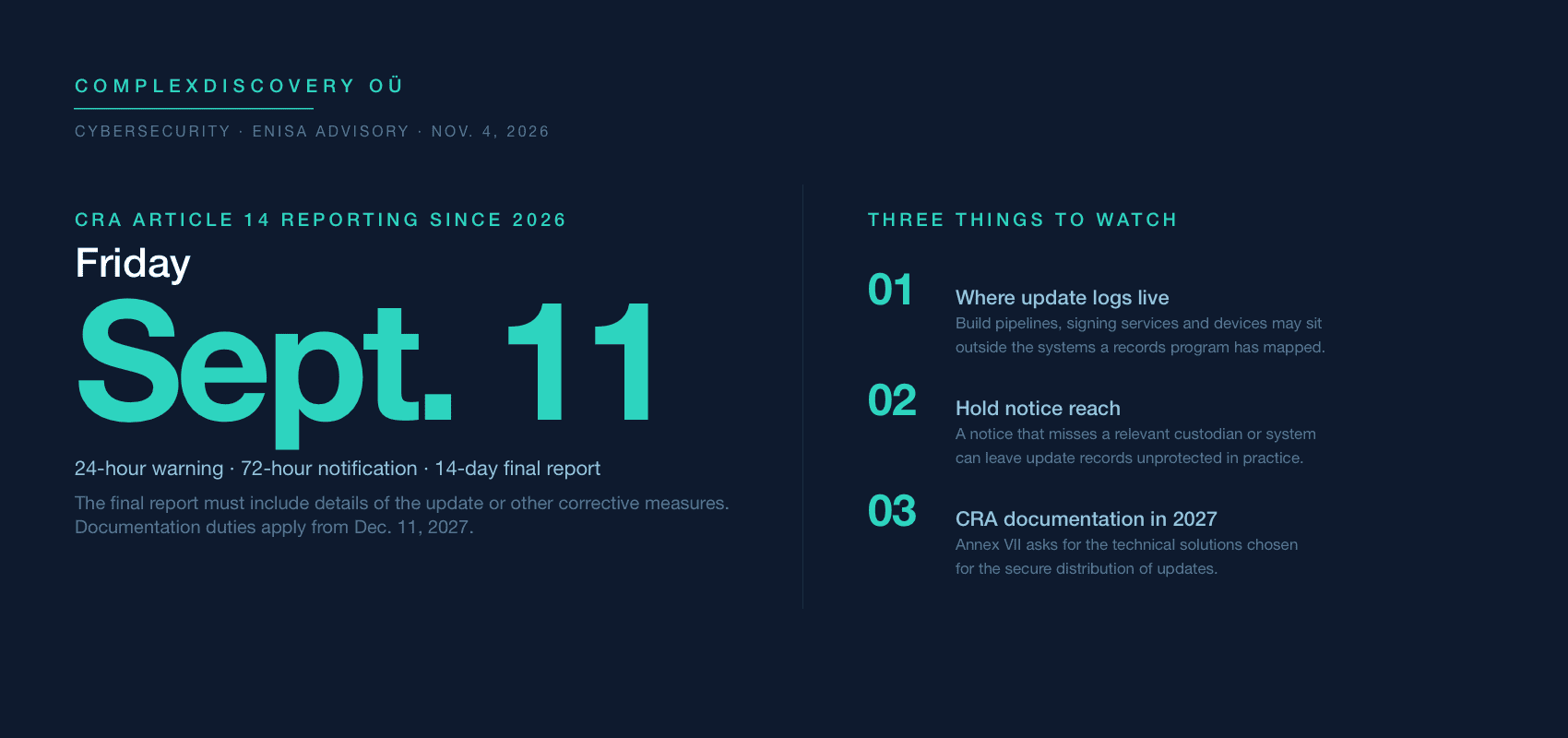
For cybersecurity, data privacy, compliance and eDiscovery professionals, many of those records sit in build pipelines, in signing services and on devices. The act’s documentation duties apply from Dec. 11, 2027, while its duty to report actively exploited vulnerabilities has applied since Sept. 11, 2026. Watch whether records programs and hold notices reach those systems before the next update incident.
Content Assessment: ENISA's update advisory turns the patch pipeline into an evidence trail
Information - 94%
Insight - 92%
Relevance - 92%
Objectivity - 93%
Authority - 92%
93%
Excellent
A short percentage-based assessment of the qualitative benefit expressed as a percentage of positive reception of the recent article from ComplexDiscovery OÜ titled, "ENISA's update advisory turns the patch pipeline into an evidence trail."
News Analysis – Cybersecurity Beat
ENISA’s update advisory turns the patch pipeline into an evidence trail
ComplexDiscovery Staff
When the Notepad++ team investigated the hijacking of its update traffic, its incident responders spent a week combing through roughly 400 gigabytes of server logs from a former host. They found signs of intrusion but no concrete indicators of compromise.
The European Union Agency for Cybersecurity (ENISA) took inspiration from that incident’s root cause and countermeasure for the worked example in a new advisory on secure update mechanisms, published Nov. 4. That example ends with a table pairing each security claim its fictional manufacturer makes with the evidence and artifacts that could support it.
The ENISA Technical Advisory on Secure Update Mechanisms is written for manufacturers of products with digital elements, particularly micro, small and medium-sized firms. ENISA states that the document is not legal advice, not a formal interpretation of the Cyber Resilience Act (CRA) and not a presumption of conformity, and that compliance remains the manufacturer’s responsibility. Its legal notice describes the publication as ENISA’s views and interpretations, intended for information purposes only, and reserves the agency’s right to change or withdraw it.
For information governance and eDiscovery teams, that table deserves the closest reading. It covers records an update pipeline produces in normal operation, when something fails and during recovery, and those records can answer questions from customers, regulators and litigants after an incident. Many of the listed artifacts live in build pipelines, in signing services and on the devices themselves, which may fall outside the systems a records program has mapped.
How ENISA defines a trustworthy update
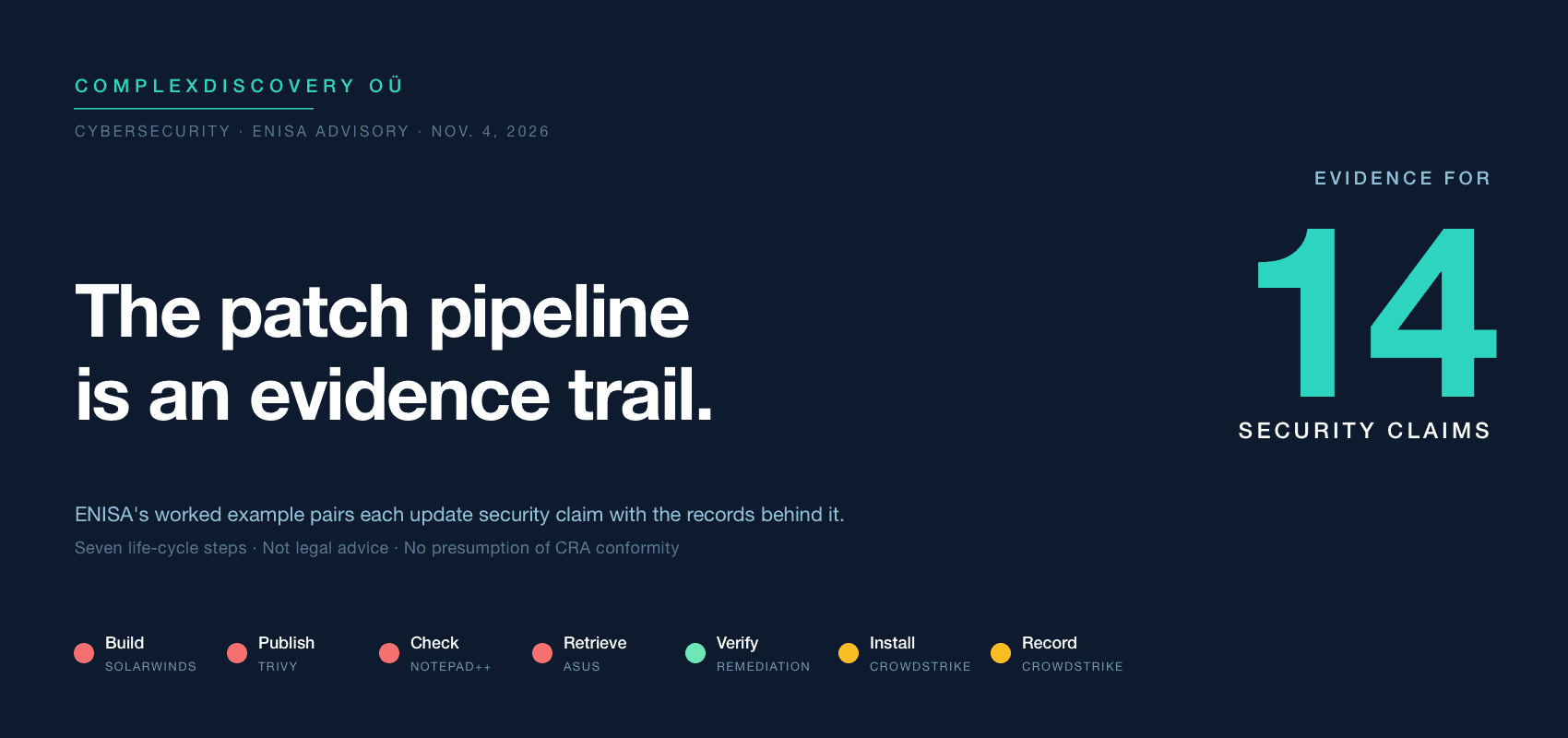
The table rests on a model ENISA lays out first. The advisory breaks the update life cycle into seven steps: build, package and establish trust; publish; check for updates; retrieve; verify; install; and record status. Its baseline trust model holds that “updates are trusted based on cryptographic verification (e.g. signatures and signed metadata) rather than because of where they are downloaded from.” Repositories, content delivery networks and other distribution intermediaries are not trusted by default.
Six of the seven steps come with a real incident, while the fifth, verification, comes with a remediation instead. ENISA cites SolarWinds for the build stage, the 2026 Trivy compromise for publication and Notepad++ for update discovery, then points to Notepad++’s later fixes for verification. The 2019 ASUS Live Update attack known as ShadowHammer illustrates retrieval. The 2024 CrowdStrike Falcon outage, which the advisory says was not malicious, illustrates installation and status recording.
The agency also explains why the timing matters. ENISA writes that “recent advances in vulnerability research, including AI-assisted tools like Anthropic’s Claude Mythos, are likely to increase the number of vulnerabilities that manufacturers need to assess, prioritise and ultimately patch through updates.” It footnotes that sentence to a May 1 report in The Record, which does not mention Mythos. That report said Ollie Whitehouse, chief technology officer of Britain’s National Cyber Security Centre, urged organizations to get ready for a “patch wave” of software updates as artificial intelligence speeds up the discovery of flaws.
What the thermostat example turns into records
More patches mean more releases, and every release leaves records behind. ENISA’s worked example follows a residential smart thermostat that receives a firmware security update through its own built-in updater, from a signed manifest through A/B firmware slots to a recovery path. The example’s last section, titled “Security claims and evidence,” lists 14 claims the manufacturer makes about that mechanism across four control stages, with example evidence and example artifacts for each.
The artifacts read like a document request. They include build logs, a software bill of materials (SBOM), continuous integration and delivery (CI/CD) records, signing logs, signature files, verification logs and freshness validation logs. The list continues with health check logs, an update log, rollback records and reprovisioning records for recovering from a compromised root key. ENISA says the list is illustrative only, not prescriptive or exhaustive, and that the evidence a real manufacturer holds will differ with its architecture, its operations and the way its product is deployed.
The advisory also asks that the records themselves be protected. Its secure logging recommendation calls for update-related logs to be protected against tampering or unauthorized access, and the example stores its update log with restricted file permissions. The threat section warns that attackers or privileged insiders may deliberately suppress logging, monitoring and reporting, and that those functions may also be missing, switched off or badly configured. For a records audience, that protection has a practical payoff, because a log shielded from alteration is easier to defend when someone later asks whether it was changed.
Where the CRA asks for related documentation
The same records matter to compliance teams. ENISA frames the advisory against the CRA’s update requirements, from timely remediation and integrity protection to secure distribution and user notification. The regulation itself requires documentation covering some of the same ground, and the clearest overlap sits in Annex VII. That annex says the technical documentation must contain, as applicable to the product, “necessary information and specifications of the vulnerability handling processes put in place by the manufacturer.” That information includes the SBOM, the coordinated vulnerability disclosure policy and “a description of the technical solutions chosen for the secure distribution of updates.” The documentation must also hold the reports from tests used to check conformity with the essential requirements.
The SBOM is the only one of ENISA’s example artifacts that the regulation names outright. The regulation never uses the word “log,” though Annex I requires products, where the manufacturer’s risk assessment makes it applicable, to record and monitor relevant internal activity, with an opt-out for the user. Nor does following the advisory create a presumption of conformity. Article 27 grants that presumption through harmonized standards whose references are published in the Official Journal, through common specifications the Commission adopts by implementing act or through a European cybersecurity certification scheme, in each case only for the requirements covered.
How far each requirement reaches depends on which part of Annex I it sits in. Under Article 13(3), the manufacturer’s cybersecurity risk assessment must say whether, and how, the Part I product requirements in point 2 apply to a given product. For the Part II vulnerability-handling duties, which include mechanisms to distribute updates securely, the text asks the assessment only to indicate how the manufacturer will apply them. Some of those duties carry their own conditions, such as automatic delivery of security updates “where applicable.”
Whatever a requirement’s reach, the CRA sets long horizons for the documentation and for the updates themselves. Under Article 13(13), manufacturers must hold the technical documentation and the EU declaration of conformity ready for market surveillance authorities for no less than 10 years from the product’s placement on the market. If the support period runs longer, that period governs. Article 13(9) separately requires each security update made available during the support period to remain available for at least 10 years after issue or for the rest of the support period, whichever is longer.
Those documentation and availability obligations apply from Dec. 11, 2027, under Article 71, but one records duty is already live. Since Sept. 11, 2026, Article 14 has required manufacturers to notify ENISA and the computer security incident response team designated as coordinator of actively exploited vulnerabilities in their products and of severe incidents affecting product security. For a vulnerability, an early warning is due within 24 hours of becoming aware and a vulnerability notification within 72 hours. A final report is due within 14 days of a corrective or mitigating measure becoming available, and each later notice is required unless an earlier one already supplied the information.
That final report must include “details about the security update or other corrective measures that have been made available to remedy the vulnerability.” As the reporting duty approached in September, ComplexDiscovery’s coverage framed the operative question as “when a manufacturer became aware,” calling it “a judgment to be evidenced rather than defined.” A manufacturer’s own record of what shipped and when is part of that evidence, alongside the record of when it learned of exploitation.
What Trivy and Notepad++ show about after-the-fact proof
The two most recent incidents in the advisory show what such a record can settle and what it cannot. Trivy’s own security advisory says that on March 19, 2026, an attacker holding compromised credentials published a malicious v0.69.4 release. The same attacker force-pushed 76 of 77 version tags in the trivy-action repository and replaced all seven tags in setup-trivy. On March 22, the advisory says, a threat actor holding compromised credentials pushed malicious v0.69.5 and v0.69.6 images to Docker Hub, which stayed exposed for about 10 hours.
The maintainers then published an exposure window for each component, with start and end times in UTC, most of them marked approximate, so users had a dated basis for deciding whether they had pulled a malicious release. The advisory also explains why some users could rule themselves out. Version 0.69.3 sat behind GitHub’s immutable releases feature, and v0.69.2 can be checked against Sigstore signatures.
On the cause, the maintainers say the credential rotation that followed a March 1 disclosure “was not atomic,” which could have let the attacker keep access and carry out the March 19 attack. ENISA’s key management recommendation calls for rotating or revoking keys promptly when compromise is suspected, and its provenance recommendation names Sigstore-based signing among the mechanisms for higher-assurance implementations.
Notepad++, a free source code editor, had less to work with. The project’s incident page, citing outside security experts, says the compromise sat at the hosting-provider level, not in Notepad++ code, and that the attackers selectively sent some targeted users’ update traffic to manifests they controlled. The page gives two dates for the end of the episode, and they measure different things. By a security expert’s reading, the attacks stopped on Nov. 10, 2025. The hosting provider’s statement says the attackers held credentials to its internal services until Dec. 2, 2025, which could have let them redirect some update traffic.
Weighing both, the maintainer estimated that the compromise ran from June through Dec. 2, 2025. Later updates to the page point to indicators of compromise shared by Rapid7, Kaspersky and the former host. The project moved its website to a new hosting provider and hardened the updater itself. Its WinGup updater began verifying the certificate and signature of the downloaded installer in v8.8.9, and v8.9.2, released Feb. 16, 2026, added verification of the signed XML that the update server returns.
For legal and governance teams, the practical lesson is to decide in advance where update records live and who keeps them. A hold notice that fails to reach a relevant custodian or system can leave records unprotected in practice. A hold over an update incident may therefore need to name sources beyond the engineering team. Those can include the CI/CD platform, the signing service, the content delivery network and a hosting provider whose logs may hold the only account of redirected traffic. Contracts with those providers can settle log access and retention before an incident rather than after one.
What the advisory leaves to manufacturers
Retention schedules and litigation holds fall outside ENISA’s advisory, which does not address either, and the guidance is open about its other limits. It says the advisory leaves aside how to build or validate the patch itself, and that it is “not intended to prescribe a single best architecture, replace established secure update frameworks or provide an exhaustive implementation model.” It describes its recommendations as consistent with The Update Framework, Uptane and NIST SP 800-40. Open-source software update ecosystems and sector-specific concerns, which it does not cover in detail, may come in future advisories.
ENISA also asks for proportion. Its recommendations are meant to be applied in light of a product’s risk profile, architecture, resources, intended use and deployment context. The final text followed a public consultation in June and July 2026 that drew 12 contributions, and ENISA says it may revise the report regularly. It joins other ENISA product-security guidance this year, including an advisory on secure use of package managers published March 10, the Secure by Design and Default Playbook published July 30 and an SBOM advisory published Oct. 22.
Notepad++ eventually got its indicators from outside researchers and its former host, after its own team’s review of roughly 400 gigabytes of logs came up without them. ENISA’s claims-and-evidence table shows what it looks like to build that record into the mechanism before anyone needs it. If a regulator, a customer or opposing counsel asked tomorrow which devices installed a given update and which key signed it, which system in your organization would answer, and whose retention schedule covers it?
News Sources
- ENISA Technical Advisory on Secure Update Mechanisms (European Union Agency for Cybersecurity)
- Regulation (EU) 2024/2847 of the European Parliament and of the Council of 23 October 2024 on horizontal cybersecurity requirements for products with digital elements and amending Regulations (EU) No 168/2013 and (EU) 2019/1020 and Directive (EU) 2020/1828 (Cyber Resilience Act) (EUR-Lex, Publications Office of the European Union)
- Corrigendum to Regulation (EU) 2024/2847 of the European Parliament and of the Council of 23 October 2024 on horizontal cybersecurity requirements for products with digital elements and amending Regulations (EU) No 168/2013 and (EU) 2019/1020 and Directive (EU) 2020/1828 (Cyber Resilience Act) (EUR-Lex, Dec. 5, 2024)
- Corrigendum to Regulation (EU) 2024/2847 of the European Parliament and of the Council of 23 October 2024 on horizontal cybersecurity requirements for products with digital elements and amending Regulations (EU) No 168/2013 and (EU) 2019/1020 and Directive (EU) 2020/1828 (Cyber Resilience Act) (EUR-Lex, July 2, 2025)
- Corrigendum to Regulation (EU) 2024/2847 of the European Parliament and of the Council of 23 October 2024 on horizontal cybersecurity requirements for products with digital elements and amending Regulations (EU) No 168/2013 and (EU) 2019/1020 and Directive (EU) 2020/1828 (Cyber Resilience Act) (EUR-Lex, Oct. 17, 2025)
- ENISA Technical Advisory for Secure Use of Package Managers (European Union Agency for Cybersecurity)
- ENISA Secure by Design and Default Playbook (European Union Agency for Cybersecurity)
- ENISA Technical Advisory for Software Bill of Materials (European Union Agency for Cybersecurity)
- Trivy ecosystem supply chain temporarily compromised (Aqua Security via GitHub)
- Notepad++ Hijacked by State-Sponsored Hackers (Notepad++)
- Notepad++ v8.9.2 release: Double-Lock Update Security (Notepad++)
- British cyber agency warns of looming ‘patch wave’ as AI speeds flaw discovery (The Record from Recorded Future News)
- Cyber Resilience Act reporting starts Sept. 11 on an unfinished platform (ComplexDiscovery)





Assisted by GAI and LLM Technologies
Additional reading
- Britain’s cyber agency warns of a possible surge, and its own incident figures raise a question
- Supermarket freezer attacks reach at least six European countries, and the record linking them to US base failures stays thin
- Microsoft finds 2 North Korean groups using ARTEX, a tool that alone cannot name an attacker
- With over 40 percent of the record Binance theft frozen, getting it back becomes a legal project
- Estonia’s cyber authority saw no state-sector PHP crisis as three state institutions shut or restricted services
- AI recording spreads in Estonian health care as the regulator says the audio needs its own legal basis
Source: ComplexDiscovery OÜ

ComplexDiscovery’s mission is to enable clarity for complex decisions by providing independent, data‑driven reporting, research, and commentary that make digital risk, legal technology, and regulatory change more legible for practitioners, policymakers, and business leaders.