

Editor’s Note: Britain’s National Cyber Security Centre (NCSC), part of GCHQ, published its Annual Review 2026 on Nov. 3. For Sept. 1, 2025, to Aug. 31, 2026, it reports 1,831 attack reports, 337 incidents supported and 80 classed as nationally significant, a tier its 2025 review defined as the upper three categories of the U.K. incident categorization model.
The new review sets no earlier figure beside the 80. The 2025 review counted 204 for the preceding year, and in April Chief Executive Richard Horne called a rate of about four a week “fairly steady.” The 2026 review neither defines the category nor says whether its method changed. Launching it, Horne warned of a real prospect of an unprecedented rise in incidents in coming months.
For cybersecurity, information governance and eDiscovery professionals, the firmer findings are shorter patch cycles, lost visibility when staff move company data to personal devices for unapproved AI tools, and unanswered questions about who keeps records of actions by Cyber Shield, a planned national network of externally built defense agents. Watch next year’s count and the liability consultation promised in the Oct. 28 U.K. budget.
Content Assessment: Britain’s cyber agency warns of a possible surge, and its own incident figures raise a question
Information - 93%
Insight - 93%
Relevance - 91%
Objectivity - 92%
Authority - 93%
92%
Excellent
A short percentage-based assessment of the qualitative benefit expressed as a percentage of positive reception of the recent article from ComplexDiscovery OÜ titled, "Britain’s cyber agency warns of a possible surge, and its own incident figures raise a question."
News Analysis – Cybersecurity Beat
Britain’s cyber agency warns of a possible surge, and its own incident figures raise a question
ComplexDiscovery Staff
Britain’s National Cyber Security Centre (NCSC) classed 80 incidents as nationally significant in the year ending Aug. 31, its annual review says, as its chief executive warned of a possible unprecedented rise in coming months.
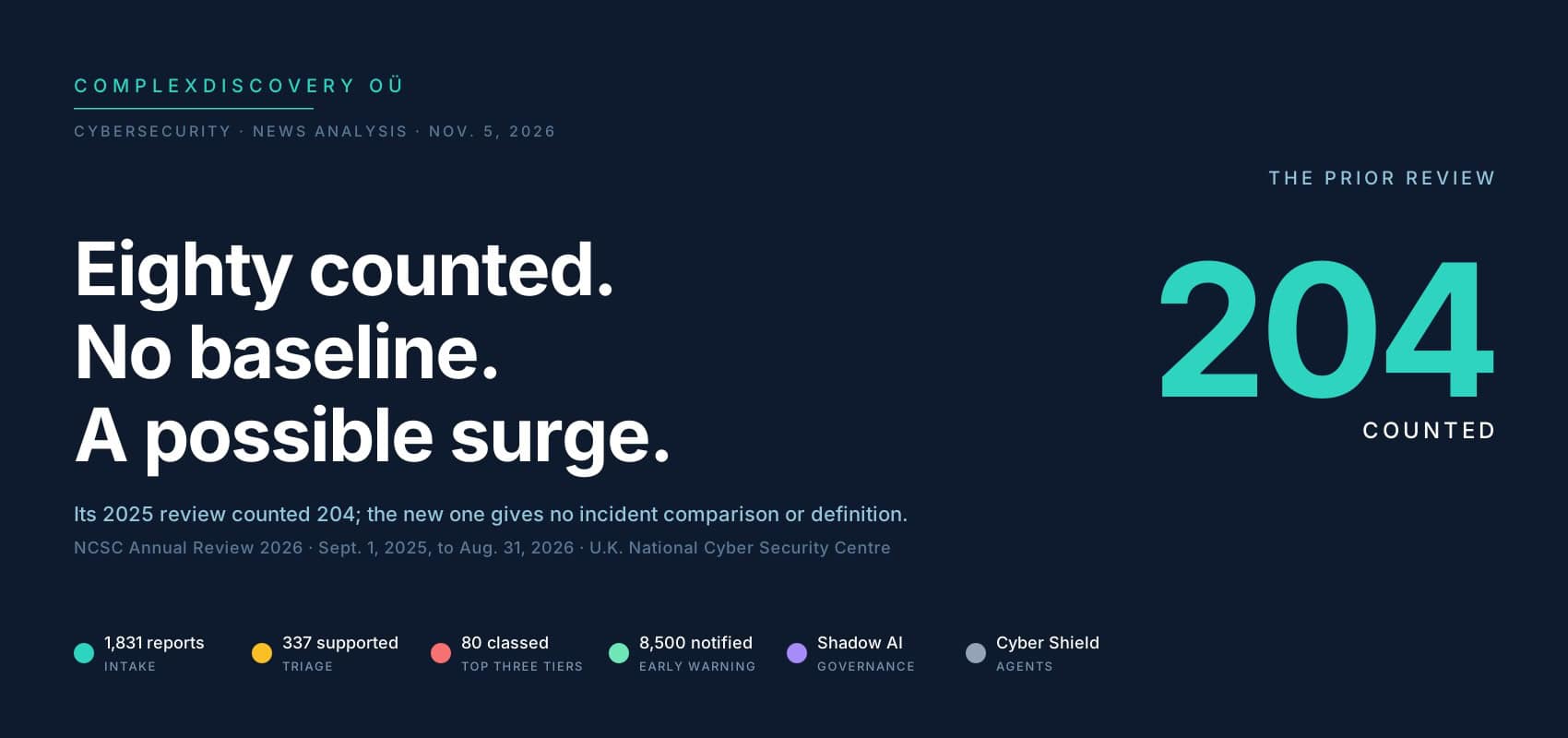
The review, published Nov. 3, sets that figure beside no earlier one. The agency’s 2025 review, covering the same September-to-August window a year before, recorded 204, so on the agency’s own published figures this year’s count is about 61 percent lower.
That comparison is not the agency’s, and it has limits a reader should weigh before repeating it. The 2025 review defined a nationally significant incident as one in the upper three categories of the NCSC and U.K. law enforcement categorization model. The 2026 review gives no definition and does not say whether the method changed. The 2025 review also warned that its data were “not a true reflection” of incidents affecting the U.K., because many businesses are not required to report a breach.
Richard Horne, the NCSC’s chief executive, sharpened the comparability question himself in April. At the CYBERUK conference in Glasgow on April 22, inside the reporting year, he recalled putting the caseload in October at “an average of four nationally significant incidents a week.” He then said “those numbers remain fairly steady.” A sustained rate of four a week, counted on the same basis, would reach 80 in about 20 weeks, and the review does not reconcile the two figures.
Inside the incident chapter’s count
The 80 itself comes from the review’s incident management chapter, which counts in three stages: the NCSC, part of the signals intelligence agency GCHQ, received 1,831 reports of cyberattacks between Sept. 1, 2025, and Aug. 31, 2026. After the reports were triaged, its Incident Management team supported 337 incidents, and 80 of those were classed as nationally significant. Through its Early Warning service, the team also notified 8,500 organizations of events indicating a suspected compromise.
Set against the 2025 review’s table, incoming reports rose about 6 percent from 1,727 incident tips, while the number of incidents needing support fell about 21 percent from 429. Nationally significant incidents made up about 24 percent of supported cases this year, against 48 percent the year before.
The review explains how it wants these numbers read. Incident reporting “does not follow a simple year-on-year trend,” it says, and earlier peaks have often traced to a handful of particularly severe incidents. It adds that Early Warning notifications likely headed off some incidents before they needed NCSC intervention. The 2025 review had tied its own rise partly to a small number of actors exploiting vulnerabilities, linking three flaws in Ivanti, Fortinet and Microsoft SharePoint products to 29 incidents. The 204 is the highest of the four years in that review’s table, but neither incident chapter says whether it reflected unusual activity or whether 2026 marks a lull.
The comparison readers do not get is specific. Across the 29 pages of the online edition, the review reports year-on-year change for services such as Cyber Essentials certifications, up 19.6 percent, and Early Warning sign-ups, up 52 percent. It reports none for incidents. The online edition also publishes no ransomware count and no sector breakdown of incidents, though the 2025 review listed the sectors that reported the most ransomware activity.
Why the forecast looks ahead, not back
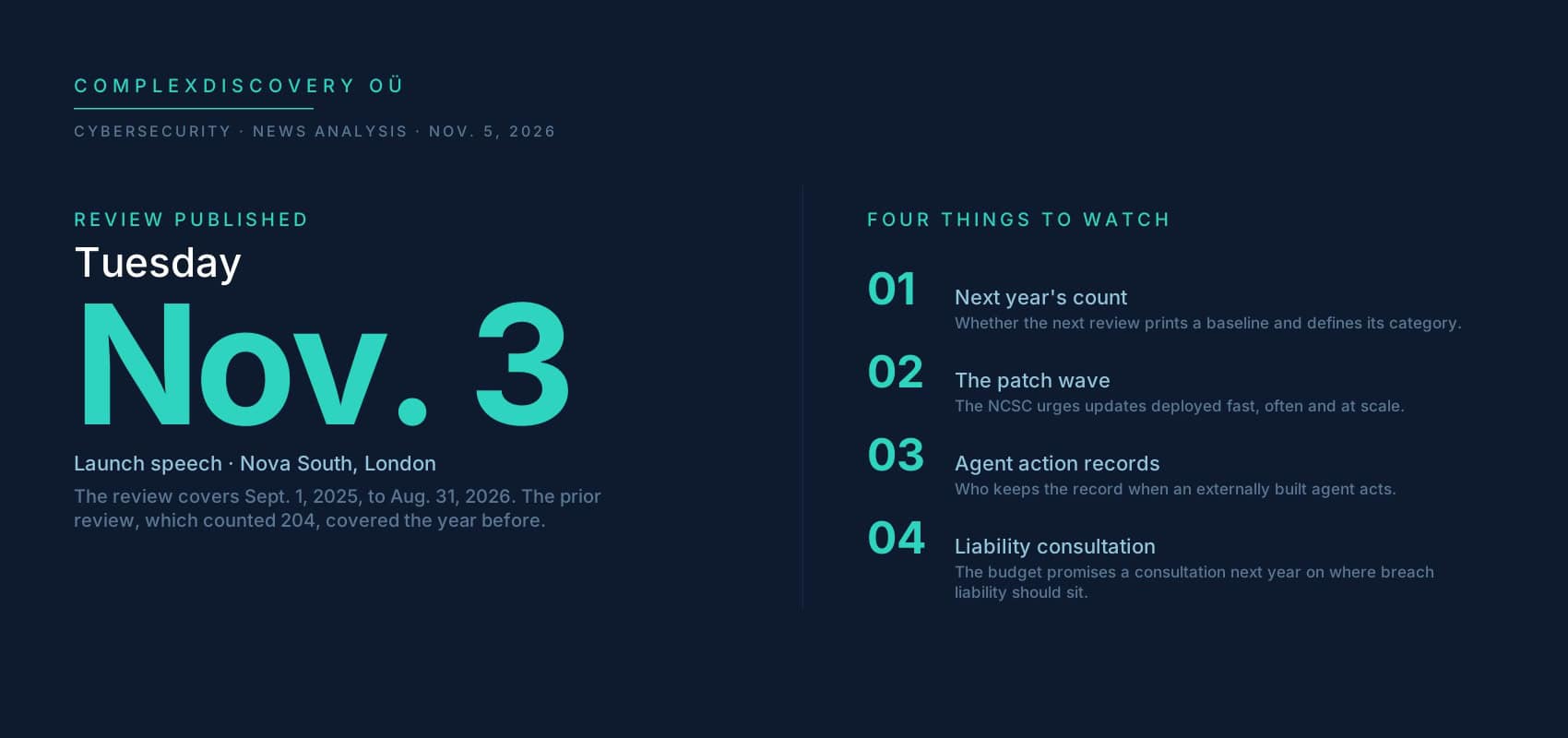
The forecast rests on old vulnerabilities that artificial intelligence (AI) makes faster to find, not on the incident line. “In the coming months, we face a real prospect of an unprecedented rise in the number of cyber incidents,” Horne said in his Nov. 3 launch speech in London. The cause, in his account, is “not because AI has invented new ways to attack us,” but because long-tolerated vulnerabilities “can now be discovered and exploited, at a scale and pace that was once unimaginable.”
A lower count and a rising forecast can both stand, because one describes the last 12 months and the other the next few. The Record, the news site of threat-intelligence company Recorded Future, reported that officials cite the surge in vulnerabilities that vendors are uncovering as evidence of the shift. Experts have yet to see a matching rise in exploitation, the outlet added.
The review’s AI chapter frames the same expectation in the graded language of intelligence assessment. It judges it almost certain that AI will act as a “force multiplier” for skilled attackers. The chapter adds that AI’s greatest effect will come from speeding up and scaling existing tactics rather than opening new attack vectors. “Human operators highly likely remain essential,” it says. Defenders highly likely face “a race to shorten patch deployment timelines,” and a widening divide between organizations able to adopt AI for defense and those unable to adapt is almost certain. The incident team itself saw attackers begin to use AI tools during the year, though it found that none of the uses it observed enabled a “novel class of attack.”
Where the 2028 date comes from
The judgment the NCSC’s own launch release led with is a dated version of one in that chapter, and where it sits in the review matters. The chapter titled “The cyber threat to the UK” judges it “highly likely that between now and 2028, AI-powered malware will have been used in a ransomware attack on UK CNI,” meaning critical national infrastructure. The same chapter judges it highly likely that by 2028 China, Russia and other states will routinely use AI in cyber operations.
A separate chapter, “The age of autonomous attack,” is also set in 2028, but it is a different kind of text. The review presents it as one plausible pessimistic future, written not to predict events but to show what inaction would cost and why present choices matter. Anyone citing the 2028 date should cite the threat chapter’s judgment, not the scenario.
Shadow AI and the records it leaves behind
Back in the AI chapter, the review’s sharpest finding for information governance teams concerns tools employees bring in themselves. It judges it highly likely that shadow AI, a term for AI tools staff use without their employer’s approval, will leave organizations open to exploitation by advanced persistent threat groups and cybercriminals. When staff shift sensitive or proprietary company data to personal devices to use such tools, the review says, organizations almost certainly lose sight of how that data is treated and who has access to it.
That is a security finding, and in ComplexDiscovery’s reading it is also a records finding. Data that leaves through a personal device and an unsanctioned tool can, in practice, slip past the retention schedule, the legal hold and the collection plan that counsel will later rely on. Practitioners can respond now by adding AI tool use to custodian interviews and hold notices, and by mapping which approved tools retain prompts and outputs.
Cyber Shield puts outside agents on a state platform
For the speed problem the forecast describes, the government’s answer mixes public money and outside code. Chancellor of the Exchequer John Healey announced £60 million for the first phase of Cyber Shield last week, the NCSC said, plus £70 million for a new National Exposure and Real-Time Vulnerability (NERV) Centre. HM Treasury’s Oct. 24 announcement of the package, which also funds an AI Cyber Security Centre of Excellence in Manchester, says the Cyber Shield money includes a £25 million challenge fund for AI and cybersecurity innovators. The Oct. 28 budget describes NERV’s purpose but not how it would differ from the NCSC’s existing scanning services, The Record reported, and an agency spokesperson declined to comment.
Cyber Shield’s chapter describes a five-year program “to build agentic detection, analysis and response,” delivered with the Department for Digital, Culture, Media and Sport (DCMS). The NCSC’s share is the core platform, intelligence and data fusion. The agents themselves “will be developed and operated by the cyber security market, the open-source community and other participants,” while DCMS leads policy, including protocols, standards and data models. The platform will feed data to agents inside U.K. organizations and draw signals back from them, and its first capability will focus on detection and blocking.
Handing defensive work to externally built agents raises a record-keeping question. A companion chapter on operational defense says agents may come to “recommend, or in some instances, take reversible action.” It adds that machine-supported response belongs alongside rehearsed playbooks, trustworthy telemetry and “clear authority to act within guardrails.” Neither that chapter nor the Cyber Shield chapter says who keeps the record of an agent’s action, for how long, or how a participating organization could produce it in an investigation or dispute. Legal and compliance teams weighing participation should put that question to vendors before an agent is installed.
Government has already run a related experiment on its own systems. Project DROMOS, launched in 2026 by the Government Cyber Coordination Centre, the AI Security Institute and other departments, began as a four-week pilot on government code repositories. It then moved into selected government environments, where participants uncovered “hundreds of potential security issues, including critical vulnerabilities.” Separately, the review credits government vulnerability management with cutting the median time to fix domain-related vulnerabilities from 50 days to eight.
Practical steps before the patch wave
Outside government, the review’s firmest advice is older than the forecast. Most successful compromises still relied on known vulnerabilities in internet-facing systems, stolen credentials and social engineering, and many state-linked incidents used flaws “for which patches are available but have not been deployed in a sufficiently timely fashion.” Security Minister Dan Jarvis wrote in his foreword that unpatched software and password compromise remain open doors that too many organizations are not taking seriously.
The NCSC is urging organizations to plan for a “patch wave,” with security updates pushed out fast, often and at scale, supply chains included. Its list of lessons from the year names logging, monitoring and incident response planning among the factors that decide outcomes. For the 8,500 organizations notified of a suspected compromise, the practical step is to record when each alert arrived and what was done, because regulators, insurers and opposing counsel are likely to ask when an organization knew.
Policy attention is also turning to where liability should sit. Building on a Law Commission consultation on product liability, the budget says the government “will consult next year on how to tackle insecure technology at source and consider where liability for cyber breaches should sit.” Which department leads and when the consultation starts remain open, The Record reported.
The 80 in this year’s review may prove to be a lull before the rise Horne warned of, the 204 may prove to have been the outlier, or the two reviews may simply be counting differently. A reader cannot tell from the review alone. When next year’s count arrives, will it come with the baseline that makes it measurable, and will your own incident logs show which side of the widening divide your organization stood on?
News Sources
- NCSC Annual Review 2026 (National Cyber Security Centre)
- NCSC Annual Review 2026 | Understanding the threat | Incident management (National Cyber Security Centre)
- NCSC Annual Review 2026 | Understanding the threat | The impact of AI on cyber threat (National Cyber Security Centre)
- NCSC Annual Review 2026 | Understanding the threat | The cyber threat to the UK (National Cyber Security Centre)
- NCSC Annual Review 2026 | Understanding the threat | The age of autonomous attack (National Cyber Security Centre)
- NCSC Annual Review 2026 | Understanding the threat | 7 things we learned (National Cyber Security Centre)
- NCSC Annual Review 2026 | Introduction | Minister of State (National Cyber Security Centre)
- NCSC Annual Review 2026 | Building strong foundations | Why ‘building strong foundations’ has never mattered more (National Cyber Security Centre)
- NCSC Annual Review 2026 | Securing the backbone of society | A moment of choice (National Cyber Security Centre)
- NCSC Annual Review 2026 | The future of cyber defence | The changing nature of operational cyber defence (National Cyber Security Centre)
- NCSC Annual Review 2026 | The future of cyber defence | Cyber Shield: Building the UK’s agentic cyber defence ecosystem (National Cyber Security Centre)
- NCSC Annual Review 2026 | The future of cyber defence | Project DROMOS (National Cyber Security Centre)
- Richard Horne’s speech at the NCSC Annual Review 2026 launch (National Cyber Security Centre)
- NCSC CEO keynote speech, CYBERUK 2026 (National Cyber Security Centre)
- Machinery of Government Changes (UK Parliament, Written Statement HLWS298)
- Chancellor unveils Britain’s ambitious plan for AI (HM Treasury)
- Cyber chief: UK facing AI-powered attacks on critical infrastructure within two years (National Cyber Security Centre)
- NCSC Annual Review 2025 | Chapter 01: Countering the cyber threat | Incident management (National Cyber Security Centre)
- UK faces ‘unprecedented rise’ in cyberattacks in coming months, warns cyber chief (The Record from Recorded Future News)
- UK to look at making software companies liable for cyber breaches (The Record from Recorded Future News)





Assisted by GAI and LLM Technologies
Additional reading
- Supermarket freezer attacks reach at least six European countries, and the record linking them to US base failures stays thin
- Microsoft finds 2 North Korean groups using ARTEX, a tool that alone cannot name an attacker
- With over 40 percent of the record Binance theft frozen, getting it back becomes a legal project
- Estonia’s cyber authority saw no state-sector PHP crisis as three state institutions shut or restricted services
- AI recording spreads in Estonian health care as the regulator says the audio needs its own legal basis
Source: ComplexDiscovery OÜ

ComplexDiscovery’s mission is to enable clarity for complex decisions by providing independent, data‑driven reporting, research, and commentary that make digital risk, legal technology, and regulatory change more legible for practitioners, policymakers, and business leaders.