
Editor’s Note: Three Estonian state institutions announced closures or restrictions of online services between Oct. 21 and Oct. 23, 2026, as two critical flaws in PHP, the server-side language behind many websites, prompted precautionary closures in several European countries. The National Archives of Estonia temporarily closed several services or restricted them to Estonian IP addresses. The Ministry of Education and Research closed a Moodle learning environment, which the University of Tartu identifies as Harno Moodle, citing only critical software vulnerabilities, and ERR reported on Oct. 23 that it had reopened. The Institute of the Estonian Language removed eight older applications from outside access. Estonia’s Information System Authority (RIA), whose Estonian-language advisory is listed as the official alert of the national incident response team, CERT-EE, said it saw no elevated crisis for the state sector and that protection for important state websites was in place.
For cybersecurity, data privacy, compliance and eDiscovery professionals, the episode shows that a national assessment did not settle whether individual systems stayed online, and why each offline decision’s threshold and timing belong in the record. Watch for the ministry’s own reopening notice and for how Estonia’s digital-resilience discussion addresses such decisions.
Content Assessment: Estonia's cyber authority saw no state-sector PHP crisis as three state institutions shut or restricted services
Information - 93%
Insight - 94%
Relevance - 90%
Objectivity - 90%
Authority - 92%
92%
Excellent
A short percentage-based assessment of the qualitative benefit expressed as a percentage of positive reception of the recent article from ComplexDiscovery OÜ titled, "Estonia's cyber authority saw no state-sector PHP crisis as three state institutions shut or restricted services."
Industry News – Cybersecurity Beat
Estonia’s cyber authority saw no state-sector PHP crisis as three state institutions shut or restricted services
ComplexDiscovery Staff
Three Estonian state institutions announced closures or restrictions of online services between Oct. 21 and Oct. 23, two citing critical PHP flaws, as the national cyber authority said it saw no elevated state-sector crisis.
The two positions are less opposed than they look. Nothing in the advisory from Estonia’s Information System Authority (RIA), or in its statements to public broadcaster ERR and the daily Postimees, told agencies to keep their services up. The advisory spoke to service providers and system administrators without saying who decides when a system goes offline, and over three days of announcements, three institutions drew three different lines.
What the Information System Authority said on Oct. 21
The flaws, tracked as CVE-2026-109618 and CVE-2026-109619, sit in PHP itself. Veikko Raasuke, an architect at the authority’s Cyber Security Centre, told ERR that the language underpins widely used site engines such as Drupal, Joomla and WordPress. Both flaws carry a severity score of 9.2 out of 10 under version 4.0 of the Common Vulnerability Scoring System. The PHP project said in its Oct. 21 advisory that they can allow unauthenticated remote code execution, shipped fixed releases (8.5.12, 8.4.27, 8.3.36 and 8.2.35) the same day, and said in its release notes that “there are no complete mitigations.”
RIA published its own advisory in Estonian on its blog on Oct. 21. The European Union’s network of national incident response teams lists that page as the official alert of CERT-EE, Estonia’s national team. The advisory told administrators to inventory every system running PHP, starting with internet-facing ones, and to consider switching off PHP’s session upload progress feature as a partial stopgap. It also told them to make sure logs were being collected and kept, and said systems that could not be updated without delay needed temporary mitigation measures. Its explicit disconnect language covered a narrower case: organizations that detect attacks against their systems should be ready to isolate them or take them off the internet temporarily.
On Oct. 21, ERR reported that RIA was not closing important websites. Raasuke told the broadcaster that protection for the important websites of the state and public sector was already in place, built nine hours before the updates were publicly released. From the standpoint of the state sector and providers of vital services, he said, the authority saw no elevated crisis. ERR also reported that RIA was not yet aware of any exploitation in Estonia, while Raasuke estimated that tens of thousands of servers in the country were susceptible.
Three institutions, three different lines
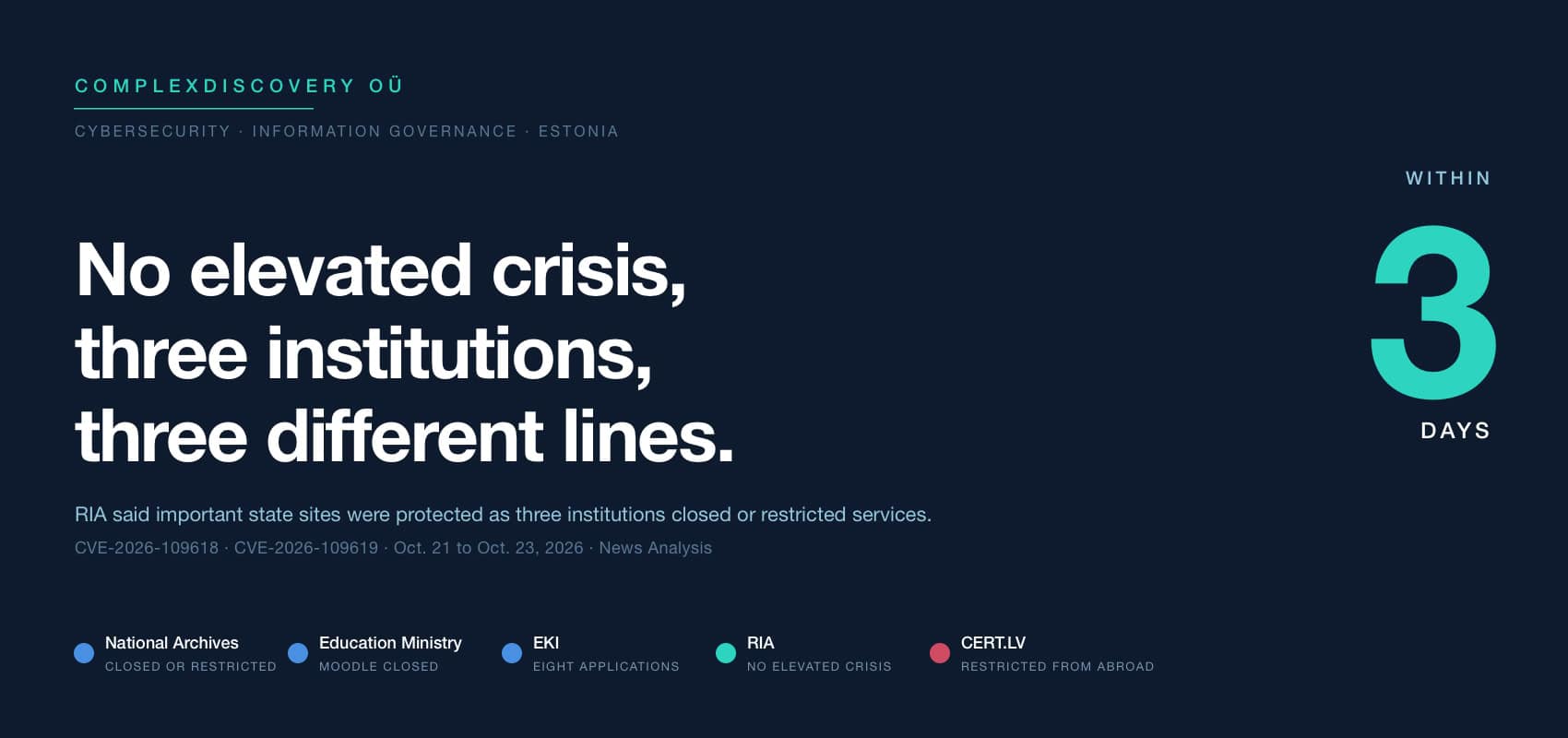
The National Archives of Estonia was the first of the three to announce a change, saying on Wednesday, Oct. 21, that it had temporarily closed several online services or restricted them to Estonian IP addresses as a precaution. “Critical security vulnerabilities have been discovered in the widely used PHP web software. We are installing security patches and will restore services as soon as possible,” the archive said, in ERR News’ English rendering.
The Ministry of Education and Research followed on Oct. 22 with a different kind of notice. Its release said the Moodle learning environment would close from that day and stay closed until required security updates were in place and confirmed to work, with a separate notice to announce the reopening. “The temporary shutdown of Moodle is a preventive measure aimed at avoiding potential data leaks, damage to the learning platform and resulting prolonged disruptions,” the ministry said, in ERR News’ translation. The release cites “critical software vulnerabilities” and names neither PHP nor either CVE, although ERR published it beside the archive’s PHP notice.
The University of Tartu clarified the scope on Oct. 23. Its notice said the ministry had announced the shutdown of “the Harno Moodle environment” and that this did not apply to the university’s own Moodle, where security patches were installed “as soon as they became available.” Harno is the Estonian Education and Youth Board, a government agency of the ministry, though the ministry’s release itself does not use the name.
The Institute of the Estonian Language (EKI) announced its restrictions on Oct. 23, in a notice that separated the applications it had patched from those that needed more work. It said it had reviewed its web applications and patched where it could. Some older applications needed more thorough attention and had been temporarily removed from the external network as a precaution, though the notice does not say when. It listed eight applications on its archive site, among them a place-name card index, a language advice service, an Estonian speech synthesizer and databases of folk songs and church hymns. The institute said the list could grow as checks continue.
The authority knew institutions were making such decisions from the first day. Postimees reported on Oct. 21 that RIA had confirmed a few Estonian institutions had decided to take websites down temporarily, and that the closures did not mean the sites had been hacked.
How Brussels and Riga framed the same choice
RIA’s attack-detection wording was not the only threshold on offer that day. The European Commission, the EU Agency for Cybersecurity (ENISA), CERT-EU, Europol’s cybercrime center and the network of national response teams issued a joint statement on Oct. 21. For organizations that cannot fix exposed systems at once, the statement said, the step was to “consider isolating exposed applications from public networks until fixes can be applied.” Set side by side, the Estonian institutions’ precautionary steps read closer to that wording than to RIA’s attack-detection sentence, though RIA’s advisory also called for temporary mitigations where updates had to wait and did not rule out preventive isolation. That is a comparison of texts, not of the institutions’ documented reasons: the ministry and EKI notices cite neither document, and neither does the archive statement ERR quoted.
Latvia, by contrast, used the same geographic tool across several state resources at once. CERT.LV, the Latvian response team, said on Oct. 21 that a decision had been taken to restrict access from abroad to several state digital resources, selectively and temporarily, possibly until Monday, Oct. 26. Its notice did not say who made the decision. In its 11 p.m. update, it counted about 6,000 potentially affected resources in Latvia, only a few hundred of them in the state sector. It reported automated exploitation attempts and said it had so far received no reports of successful attacks. The same update said restrictions on access from abroad remained for some state resources while updates were installed. Reuters reported that Finland’s state IT provider, Valtori, took government public web services offline as a precaution and that the Dutch national cyber agency took its own website offline.
What a precautionary shutdown leaves in the record
Every one of those closures gave up some availability to protect something else, and the Estonian ministry’s notice is the most explicit about what it was protecting. For information governance teams, that makes its stated reason the instructive part. A learning platform and “the data processed within it” go dark to avoid “potential data leaks,” at the cost of the availability its users rely on. The General Data Protection Regulation’s security article names both sides of that trade. Article 32 requires controllers and processors to implement security measures appropriate to the risk, including, as appropriate, “the ability to ensure the ongoing confidentiality, integrity, availability and resilience of processing systems and services.” It separately lists “the ability to restore the availability and access to personal data in a timely manner” after a physical or technical incident.
A geographic block makes a narrower trade with its own scope consequences. A service restricted to Estonian IP addresses stays reachable for connections presenting those addresses and closes to all others, a test of the connection’s apparent origin rather than of where the user actually is. The archive’s fully closed services were unavailable either way, and ERR’s reports do not say which services fell into which group; the archive’s own notice could not be retrieved for this article.
The practical lesson for security and legal teams is to record the decision as carefully as the patch. A shutdown taken before any detected attack is a judgment about risk. The record of that judgment, meaning the threshold used, who made the call, which systems it covered and when service returned, is what an auditor, regulator or opposing counsel could ask for later. RIA’s instruction to collect and keep logs matters for the same reason, because those logs can show whether a system was probed before it went dark.
Obligations that run on a clock belong in the same file. Under Article 12(3) of the GDPR, a controller must tell a person what it has done about an access request “without undue delay and in any event within one month of receipt of the request.” Two more months are available when the complexity and number of requests make them necessary, but the controller must tell the person about the extension, and why, inside the first month. The provision lists no pause for an outage, so counsel tracking access requests that touch a closed system should log the outage window as it happens, and teams managing legal holds on the same data should note it too.
What RIA’s incident-handling head said a day later
RIA’s own account of why so many owners went dark came a day later, from Taavi Kupper, who heads incident handling at the authority’s Cyber Security Centre and spoke to ERR on Oct. 22. In ERR’s summary of his view, the shutdowns worldwide were driven mainly by precaution and the installation of updates, not by attacks. Kupper said owners may have taken sites down because they did not know how to respond for their PHP version, or because updating meant restarting systems, which can take minutes to hours.
ERR cited the archive and the Moodle pause as Estonian disruptions. Kupper said Estonia is small, information moves fast and mitigations were applied immediately, though the country was not left untouched and had been lucky, in his account, that its disruptions had not involved services as critical as those hit elsewhere.
Kupper also said pre-warnings and analyses pointing to the flaws had begun arriving as early as August, and he ended the interview by saying there was no reason to panic. “This is not a crisis,” he said, in ComplexDiscovery’s translation of his Estonian remarks, adding that such events are “our new normal.”
The Moodle closure turned out to be short. ERR reported at 5:55 p.m. Estonian time on Oct. 23 that the environment, which ERR said holds study materials, had reopened the day after the ministry announced the closure. The report does not say whether the updates had been checked as the ministry promised, and the ministry’s news page carried no reopening notice when this article was prepared. Its original release also does not say which schools or users the platform serves, or whether any data was accessed before the closure.
Administrators checking their own fixes got new guidance on Oct. 23 as well. The PHP project urged them to keep session upload progress disabled until its next regular release, to guard against a further code execution path tracked as CVE-2026-115560. The project called that path unlikely, saying it requires an unusual setup in which an application switches its session serialization handler at runtime, and that applications that never do so may leave the feature on.
Why the timing matters for the Tallinn Digital Summit
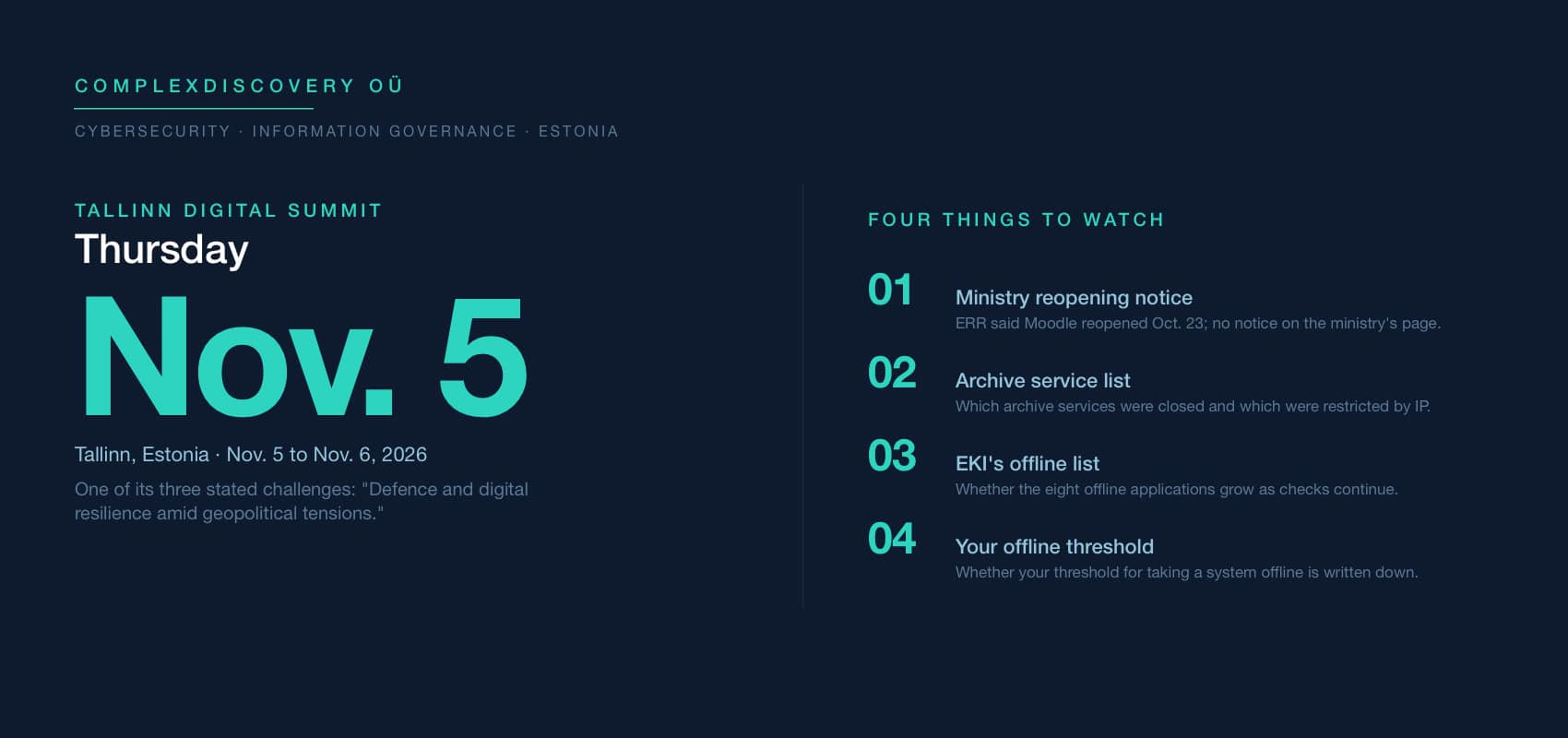
Those open threads run into the Tallinn Digital Summit, which Estonia hosts on Nov. 5 and Nov. 6, less than two weeks away, and one of its three stated challenges for 2026 is “Defence and digital resilience amid geopolitical tensions.” The International Centre for Defence and Security organizes the event with four arms of the Estonian government.
The PHP episode hands that discussion a concrete case. A national authority judged the state’s important websites protected and said so, while three institutions holding records, learning data and linguistic archives went dark or went local, and one of them was back online a day later, by ERR’s account. The authority’s incident-handling head described events like it as the new normal. If he is right, will the next advisory find each organization’s threshold for pulling a system offline already written down, or will that threshold be set in the hours after it lands?
News Sources
- Haridus- ja Teadusministeerium piirab turvariskide tõttu ajutiselt Moodle’i õpikeskkonna kasutamist (Estonian Ministry of Education and Research)
- Turvakaalutlustel on osa EKI veebirakendusi ajutiselt suletud (Institute of the Estonian Language)
- University of Tartu Moodle is operating as usual (University of Tartu)
- PHP-s tuvastati kaks kriitilist turvanõrkust: süsteemihaldajatel tuleb valmistuda turvauuenduseks (Estonian Information System Authority)
- Monitoring cyberspace and impeding incidents (Estonian Information System Authority)
- Joint statement on critical PHP vulnerabilities (European Union Agency for Cybersecurity)
- CNW/advisories/2026/CNW-2026-04_php.md at main · enisaeu/CNW (ENISA via GitHub)
- PHP: News Archive: 2026 (The PHP Group)
- PHP (The PHP Group)
- RCE via OOM corruption · Advisory · php/php-src · GitHub (PHP via GitHub)
- RCE via stale global state · Advisory · php/php-src · GitHub (PHP via GitHub)
- Saistībā ar globāli atklātām PHP ievainojamībām Latvijā ievieš preventīvus pasākumus (CERT.LV)
- Consolidated TEXT: 32016R0679: EN: 04.05.2016 (EUR-Lex)
- Tallinn Digital Summit 2026 (International Centre for Defence and Security)
- Education ministry to temporarily restrict access to Moodle platform (ERR News)
- HTM piirab turvariskide tõttu ajutiselt Moodle’i õpikeskkonna kasutamist (ERR)
- Mitu riiki sulges turvaaukude tõttu valitsusasutuste veebilehed (ERR with Reuters)
- Küberturbeekspert: PHP turvaaugud kriisi ei põhjustanud (ERR)
- Turvariski tõttu suletud õpikeskkond on taas avatud (ERR)
- Kaks kriitilist turvaauku ähvardavad veebilehti üle maailma, Eestis võeti juba kasutusele erakorralised meetmed (Postimees)
- Government websites go dark as software flaw sparks security scramble (Reuters via KFGO)





Assisted by GAI and LLM Technologies
Additional reading
- AI recording spreads in Estonian health care as the regulator says the audio needs its own legal basis
- Latitude59’s four-country push puts startup deals in front of four data-protection laws
- Tallinn Digital Summit 2026 puts the agentic state to the test
- Nine months across Europe’s tech-sovereignty arc, from Tallinn to London
- The flame and the frontier: how Estonia carries a 1919 victory into a tense 2026
- Estonia aims to be first to give AI agents official digital IDs
Source: ComplexDiscovery OÜ

ComplexDiscovery’s mission is to enable clarity for complex decisions by providing independent, data‑driven reporting, research, and commentary that make digital risk, legal technology, and regulatory change more legible for practitioners, policymakers, and business leaders.