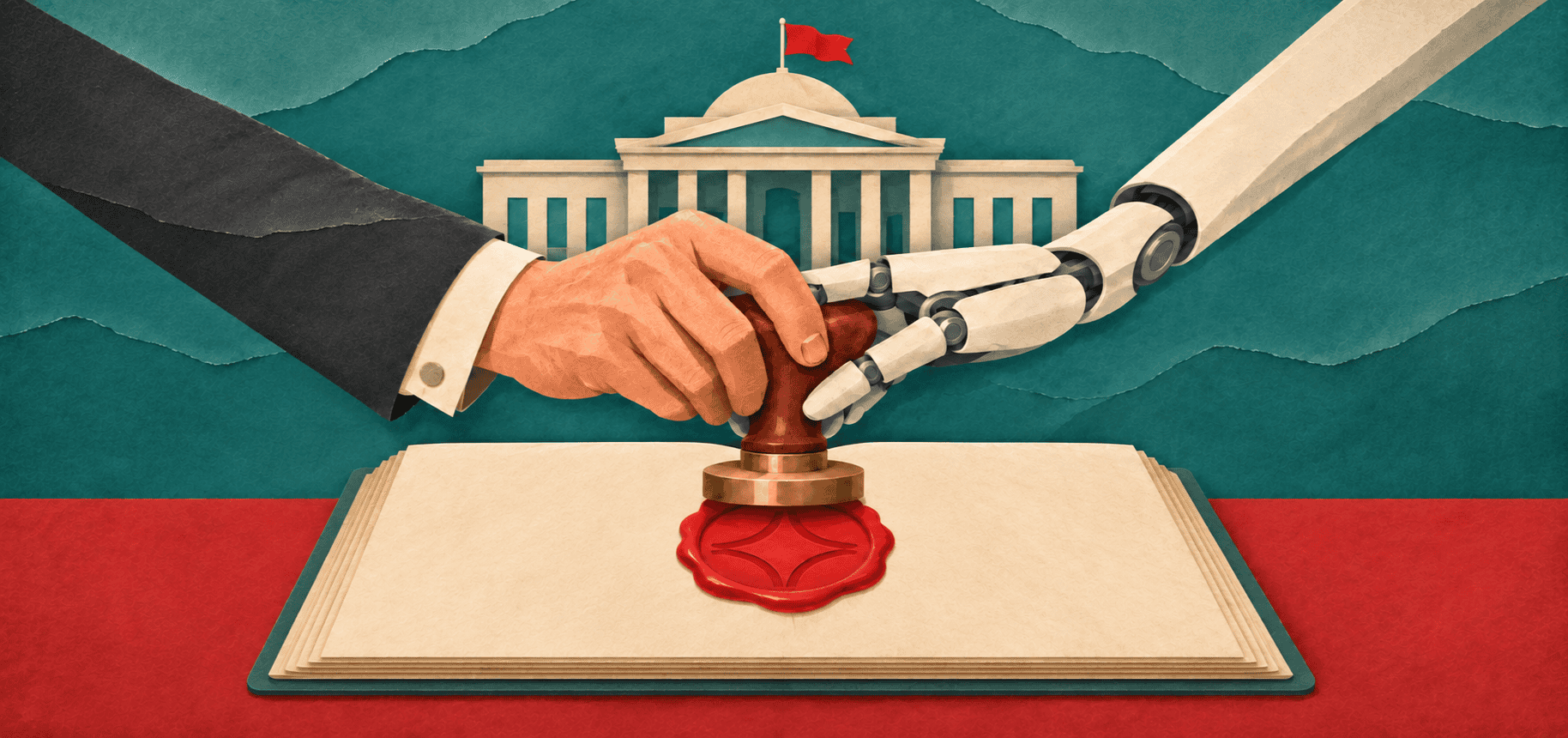
Editor’s Note: A promise, a certification or an attribution is only as strong as the record someone can produce behind it. November’s Five great reads test that line against an agency’s review instructions, an appeals court’s rules, a dating app’s download button, an AI vendor’s retention pledge and a government’s accusation.
The Federal Trade Commission has written 75 percent floors for recall and precision into instructions for technology-assisted and AI-assisted review, according to an Oct. 7 account by Arnold & Porter senior attorney Bryan M. Marra. Recall is the share of responsive documents a review finds, and precision is the share of documents marked responsive that truly are. ComplexDiscovery found no public copy of the instructions, and the agency’s public Model Second Request, its template for merger information requests, still asks for recall and precision statistics without setting a minimum.
The 10th U.S. Circuit Court of Appeals posted final rules Nov. 20, including a revised Rule 46.5 that reaches further than its September draft. From Jan. 1, 2027, presenting any brief, motion or other paper certifies, to the best of the filer’s knowledge after reasonable inquiry, that a human reviewed it before filing and independently verified four things. Under that qualifier, they are that every cited authority exists, that quotations and citations are accurate, that each authority supports the proposition for which it is cited and that the paper complies with all relevant rules and ethical obligations.
Ireland’s Data Protection Commission on Nov. 13 announced a fine of 11 million euros against MTCH Technology Services Ltd., the Match Group unit behind Tinder. The commission found that Tinder’s Download My Data tool left certain categories out without notice or supplied them only in summary form. Match Group said in a Nov. 3 Securities and Exchange Commission filing that it believes it has strong defenses and intends to appeal. The Irish Times reported Nov. 16 that MTCH has brought a High Court challenge to the fine.
Workspace software company Notion said Nov. 10 that a dataset affected by a breach at AI inference company Fireworks AI held Notion AI chat transcripts from fewer than 1 percent of its workspaces. Notion also says Fireworks retained data from the endpoints Notion used despite a contractual commitment to zero data retention, and Fireworks’ public bulletins do not address that account. Fireworks said Nov. 17 that the activity relates to two separate security incidents.
France on Nov. 9 attributed the Oct. 11 to 12 sabotage of refrigeration controllers at about 700 large French retail sites to Shahid Kaveh, which it describes as a cyber unit of Iran’s Islamic Revolutionary Guard Corps. Paris prosecutors requested international arrest warrants without announcing charges. Iran’s foreign ministry rejected the accusation as baseless and one-sided.
Industry research tracks transactions reported under the Hart-Scott-Rodino (HSR) premerger notification program. Preliminary FTC data put October 2026 at 202, up from September’s 193 but below October 2025’s 215 as fiscal 2027 began. After an FTC suit, PlayPower abandoned its purchase of rival playground maker BCI Burke. As of Nov. 9, the Justice Department’s proposed $250 million civil penalty against KKR over alleged HSR filing violations still required court approval. KKR said it strongly disagrees with the department’s characterization.
Lagniappe gathers five more reads. A Brooklyn jury convicted Huawei on 10 of 12 counts and acquitted it of racketeering conspiracy. France’s CNIL fined an insurer that Macif confirmed is Macif Vie 5 million euros over clear-text passwords. ENISA’s update advisory includes a worked example that pairs each security claim a fictional manufacturer makes with example evidence. In a ComplexDiscovery review of 10 law and immigration firm notices on California’s register for incidents dated May or August 2026, seven describe social engineering or impersonation in the firms’ own accounts. And Estonia’s data protection regulator says registering an AI agent’s code under a bill as drafted in October would not, on its own, prove the agent was authorized to perform a specific act.
Practical strategy looks at what 2026’s 16 eDiscovery deals through Oct. 29 suggest and at what email’s To, Cc and Bcc lines signal, including what a collection can miss. It also previews the 2027 event calendar’s smaller European rooms and transatlantic anchors. An Atomico report projects a decade high in European founders as Europe’s share of global venture capital stands so far this year at less than half its 2022 peak. Reid Hoffman makes his case at Slush for steering AI while testing it where it still fails.
Several of these pieces point to the same habit: deciding, before anyone asks, which record will show what actually happened, who keeps it and for how long. When a regulator, a court or a client asks next, which record will your team produce?
Content Assessment: Five great reads on cyber, data, and legal discovery for November 2026
Information - 93%
Insight - 92%
Relevance - 92%
Objectivity - 90%
Authority - 92%
92%
Excellent
A short percentage-based assessment of the qualitative benefit expressed as a percentage of positive reception of the recent article from ComplexDiscovery OÜ titled, "Five great reads on cyber, data, and legal discovery for November 2026."
Industry Newsletter
Five great reads on cyber, data, and legal discovery for November 2026
ComplexDiscovery Staff
Click on the links to read the complete article.
Numbers the template never set
FTC instructions set 75 percent recall and precision floors for TAR and AI review, law firm reports examines an Oct. 7 post by Bryan M. Marra, a senior attorney in Arnold & Porter’s Washington office. Marra described instructions he said the Federal Trade Commission issued with a civil investigative demand (CID) and a merger second request, for parties using technology-assisted review (TAR) or AI-assisted review. By his account, recall and precision must each reach at least 75 percent, with recall measured to plus or minus 3 percent at a 95 percent confidence level. By Marra’s account, AI review also requires disclosure of the tool, version, provider and underlying model, along with all prompts or review protocols given to it. Every published account of the thresholds that ComplexDiscovery located credits Marra’s post, and the post names neither investigation. The agency’s public Model Second Request, marked “Revised January 2024,” asks for recall, precision and confidence-level statistics without setting a minimum.
For counsel who expect a second request or CID, the practical step is to confirm before one arrives that the review platform can produce the metrics and artifacts the instructions list. Teams should also keep prompt revision histories and rationale exports in a form that can be logged or produced. Read more in FTC instructions set 75 percent recall and precision floors for TAR and AI review, law firm reports.
Disclosure: Rob Robinson, founder and managing editor of ComplexDiscovery OÜ, also serves as chief marketing officer of HaystackID, a provider of eDiscovery services, including AI-assisted document review. ComplexDiscovery OÜ is an EDRM Guardian Partner, and Robinson sits on EDRM’s Global Advisory Council.
Every filer becomes the checker
Tenth Circuit Rule 46.5 makes every filer vouch for human citation checks starting Jan. 1 reports on final rules that the 10th U.S. Circuit Court of Appeals posted Nov. 20. The court hears federal appeals from Colorado, Kansas, New Mexico, Oklahoma, Utah and Wyoming. From Jan. 1, 2027, presenting any brief, motion or other paper will certify, to the best of the filer’s knowledge after reasonable inquiry, that a human reviewed it before filing and independently verified four things. Under that qualifier, they are that every cited authority exists, that quotations and citations are accurate, that each authority supports the proposition for which it is cited and that the paper complies with all relevant rules and ethical obligations. The September draft reached only documents prepared with the assistance of generative AI. The adopted text applies to every filing and states that the certifications have the same force and effect whether or not AI was used. The September draft had already added waiver of the affected issue and striking of a noncompliant document to an existing sanctions list.
Rule 46.5 calls for no separate certificate, and it does not say whether the verifying human must be the signer or what record of verification a filer should keep. For firms with 10th Circuit matters, the practical step is to treat the four verification elements as a checklist. A defensible practice records who verified each authority, against what source and when, although the rule itself imposes no retention requirement. Read more in Tenth Circuit Rule 46.5 makes every filer vouch for human citation checks starting Jan. 1.
When a download stops being a copy
Tinder’s Download My Data tool draws Irish fine of 11 million euros over incomplete exports reports on a Nov. 13 announcement by Ireland’s Data Protection Commission (DPC). The DPC fined MTCH Technology Services Ltd., the Match Group unit behind the Tinder service, 11 million euros, issued a reprimand and ordered the company to make its processing compliant within three months. The self-service tool was presented as a way for users to get a copy of their personal data. The DPC found that it left certain categories out without notice or supplied them only in summary form, and its announcement says the decision centers on Article 15(3) of the General Data Protection Regulation (GDPR). The full decision is not yet public, and the DPC announcement does not identify the omitted categories. Match Group said in a Nov. 3 Securities and Exchange Commission filing that it believes it has strong defenses and intends to appeal. The Irish Courts Service’s High Court record shows MTCH issued proceedings against the DPC on Nov. 6, and The Irish Times reported Nov. 16 that MTCH has brought a High Court challenge to the 11 million euro fine.
For litigators who use data subject access requests to gather evidence early, the decision suggests a practical sequence. Request the full Article 15 response rather than accept a download alone, ask in writing whether anything was omitted or summarized and keep dated copies of what the tool produced. Read more in Tinder’s Download My Data tool draws Irish fine of 11 million euros over incomplete exports.
Zero retention, one tier down
Notion AI chats surface in Fireworks breach, testing what zero retention covers reports on Notion’s Nov. 10 statement about a breach at AI inference company Fireworks AI. Notion said a dataset affected by the breach held Notion AI chat transcripts from fewer than 1 percent of Notion workspaces, chats it had sent to Fireworks to run an administrator feature called Insights. Notion says Fireworks provided “a contractual commitment to zero data retention for our use of its platform” yet retained data from the endpoints Notion used. Fireworks’ public bulletins do not mention Notion or address that account. In a Nov. 19 TechCrunch interview, Fireworks co-founder Chenyu Zhao said Notion had used batch prediction. Fireworks said it had determined the activity relates to two separate security incidents. In the second, the company said, an attacker reached part of its production systems and account and billing information for all accounts created before Oct. 30.
The piece lays out three zero-retention promises with three scopes, among them Notion’s own enterprise promise, which is “not intended to cover” features such as chat history and Insights. For information governance and eDiscovery teams, a data map that lists the application as the home of employees’ AI chats may not show copies held by its inference provider. Organizations should know in advance which subprocessors hold AI chat content and who controls its deletion once a breach is reported. Read more in Notion AI chats surface in Fireworks breach, testing what zero retention covers.
A defrost setpoint becomes evidence
France ties October supermarket fridge sabotage to Iran’s IRGC and seeks arrest warrants reports on France’s Nov. 9 attribution of the October sabotage of refrigeration controllers at French retail sites. A report by the government’s interministerial Cyber Crisis Coordination Center (C4) attributed the Oct. 11 to 12 sabotage at about 700 large retail sites to Shahid Kaveh. The report describes Shahid Kaveh as a cyber unit of Iran’s Islamic Revolutionary Guard Corps (IRGC). According to the report, attackers reset defrost parameters to high temperatures, causing heavy merchandise losses and at least 15 fires. The Paris prosecutor’s office moved the case to investigating judges and requested international arrest warrants, citing an attack method characteristic of the unit and IP addresses pointing to terminals in Iran. No charges have been announced. Iran’s foreign ministry said on Nov. 10 that it “categorically rejects the French government’s baseless and one-sided accusations,” according to France 24 and AFP.
For victims, the prosecutors’ evidence list doubles as a preservation map, since similar traces may sit in records retailers and their contractors hold, where those records were kept. Where claims or litigation are expected, a legal hold scoped to identified custodians and systems, third-party maintainers included, should be in place before log rotation or a factory reset overwrites that history. Read more in France ties October supermarket fridge sabotage to Iran’s IRGC and seeks arrest warrants.
Industry research
October HSR reported transactions edge up to 202 as fiscal 2027 opens below last year’s pace tracks preliminary Federal Trade Commission data on transactions reported under the Hart-Scott-Rodino (HSR) Act. The agency’s Premerger Notification Office logged 202 reported transactions in October 2026, up 4.7 percent from September’s 193. That count sits 6.0 percent below October 2025’s 215, a comparison between two preliminary figures. PlayPower abandoned its acquisition of rival playground maker BCI Burke eight days after the FTC sued, with 12 state attorneys general joining the complaint. The Justice Department’s proposed $250 million civil penalty against KKR, which the department called the largest ever assessed for violating the HSR Act, was still listed as a proposed judgment as of Nov. 9 and requires court approval. KKR said it strongly disagrees with the Antitrust Division’s characterization. In the article’s analysis, productions should be built to hold up through priority review, full compliance and possible litigation. Learn more in October HSR reported transactions edge up to 202 as fiscal 2027 opens below last year’s pace.
Lagniappe
Brooklyn jury convicts Huawei of trade-secret conspiracy and Iran sanctions crimes but rejects racketeering reports that a federal jury in Brooklyn on Nov. 24 convicted Huawei Technologies Co. Ltd. on 10 of 12 counts. The convictions include conspiracy to steal trade secrets, bank and wire fraud and Iran-related violations of the International Emergency Economic Powers Act. Jurors acquitted all the companies charged with racketeering conspiracy, the count the AP called the most serious charge Huawei faced. Among the trade-secret examples the Justice Department says it proved is a nondisclosure agreement (NDA) with T-Mobile that, the department says, Huawei signed while “fully intending to violate the agreement.” Huawei said the five trade-secret disputes the government cited were civil matters resolved over the past two decades. Defense attorney Brian Heberlig called the acquittals “a vindication of the company and its good-faith compliance culture,” the AP reported, and the company has said it expects to appeal. Sentencing in the Huawei case is set for Sept. 14, 2027. For legal and compliance teams, the lesson sits in the partner file. Records of what was shared under NDAs, by whom and when, became evidence. Read more in Brooklyn jury convicts Huawei of trade-secret conspiracy and Iran sanctions crimes but rejects racketeering.
CNIL fines Macif Vie 5 million euros over clear-text passwords and a 21-year login log reports on a decision that France’s data protection authority, the Commission nationale de l’informatique et des libertés (CNIL), published Nov. 18 without naming the company. Macif confirmed to Agence Radio France that the fine was imposed on the Macif group’s life insurer, Macif Vie. The CNIL’s restricted committee found that the passwords of over 1.8 million customers were stored in clear text, 730,289 of them also in a connection-logging table. At the 2024 inspection, the logging table, despite the company’s own one-year retention policy for connection data, held data entered on Feb. 3, 2003. Macif told Agence Radio France that none of its customers’ data had been disclosed. The committee set the fine at 5 million euros, and the decision can be appealed to the Conseil d’État within two months of notification. For security and records teams, the case shows defensible disposition working as a security control. Read more in CNIL fines Macif Vie 5 million euros over clear-text passwords and a 21-year login log.
ENISA’s update advisory turns the patch pipeline into an evidence trail examines the ENISA Technical Advisory on Secure Update Mechanisms, published Nov. 4 by the European Union Agency for Cybersecurity. The advisory is written for manufacturers of products with digital elements, particularly micro, small and medium-sized firms. It breaks an update’s life into seven steps, from build, package and establish trust through record status. Its worked example ends with a table of 14 security claims paired with example evidence and artifacts such as build logs, signing logs, update logs and rollback records, a list ENISA calls illustrative only. ENISA says the advisory is not legal advice, not a formal interpretation of the EU Cyber Resilience Act (CRA) and not a presumption of conformity. For legal and governance teams, the lesson is to decide in advance where update records live. A hold over an update incident may need to name sources beyond the engineering team, such as the CI/CD platform, the signing service and the content delivery network. Read more in ENISA’s update advisory turns the patch pipeline into an evidence trail.
A cluster of law firm breach notices on California’s register points mostly to deceived staff reports that California’s attorney general lists breach notices from Baker McKenzie and Troutman Pepper Locke as reported Oct. 27 and Oct. 28. Each notice says social engineering in August gave outsiders files from the firm’s legal work. A ComplexDiscovery review of the register turned up eight more law and immigration firms with incidents dated May or August 2026. Of the 10 notices, seven describe social engineering or impersonation, one describes an intrusion into the firm’s systems and none names an attacker. Blank Rome, for example, said an attorney moved files to a Google Drive account outside the firm after being misled by a caller posing as its IT department. Under California law, notice is due within 30 calendar days of discovering or being notified of a breach. Delay is allowed when a law enforcement agency determines notice would impede a criminal investigation, or as necessary to determine the scope of the breach and restore the reasonable integrity of the data system. The register alone cannot show whether any firm met that deadline. For information governance and eDiscovery teams, finding personal data in matter files is a document review problem worth building capacity for before an incident. Read more in A cluster of law firm breach notices on California’s register points mostly to deceived staff.
Estonia’s AI agent register would link a code to a person, and state watchdogs ask what that proves reports on a two-page bill circulated in October by Liina Vahtras, Estonia’s minister of economy and industry. The bill would let Estonian citizens, listed categories of residents and holders of a valid Estonian e-resident digital ID card register a “digital identity” in a state database controlled by the Information System Authority. That identity is a permanent and unique identifier that software can use to act for them. Vahtras, who calls the registered code an “agent code,” said the change “creates no obligation for anyone.” In an Oct. 22 letter signed by Director General Pille Lehis, the Data Protection Inspectorate wrote that registering the link between an identity and a person does not prove the identity was authorized to perform a specific act. Vahtras said the ministry intends to rework the bill. This summary describes the draft as circulated in October rather than any later version. For practitioners advising clients that deploy agents, evidence of what an agent did could sit in service, platform and deployer records rather than a registry line. Read more in Estonia’s AI agent register would link a code to a person, and state watchdogs ask what that proves.
Practical strategy
Practical strategy highlights ComplexDiscovery’s writing on the business thinking behind the work: strategy, planning and the careers of the people doing it.
Reset, shift or maturation: what 2026’s 16 eDiscovery deals suggest so far reports that ComplexDiscovery’s tracker recorded 16 publicly announced eDiscovery mergers, acquisitions and investments through Oct. 29, 2026. That trails the 19 recorded by the same date in 2025, and the pace annualizes to roughly 19, which the piece calls a mechanical run rate rather than a forecast. Repario, backed by JLL Partners, acquired UnitedLex, a pairing the piece calls a platform-scale services combination. Control Risks said it will spin off its Discovery + Data Insights and Forensics lines into a standalone company backed by a Beringer Capital investment. That transaction is announced, not closed, and is expected to complete in the fourth quarter, subject to customary conditions, with closings proceeding jurisdiction by jurisdiction. For clients of acquired providers, the practical steps are to ask about integration plans, product support and hosting and to confirm change-of-control and data portability provisions before renewal. Read more in Reset, shift or maturation: what 2026’s 16 eDiscovery deals suggest so far.
Disclosure: ComplexDiscovery OÜ founder and publisher Rob Robinson serves as chief marketing officer of HaystackID, one of the companies discussed in the underlying analysis.
Hypersensitivity or hypervigilance? Reading the signals in email’s To, Cc and Bcc lines examines how an email’s address block works as a second message. It starts from RFC 5322, the Internet Engineering Task Force standards-track document that defines the email message format and says “the only difference between the three fields is how each is used.” A common working convention treats a name in To as someone expected to act and a name in Cc as someone kept informed. In a 2019 Journal of Business Ethics paper whose first author is Tessa Haesevoets of Ghent University, the studies linked putting the supervisor in Cc to lower felt trust among employees. The piece’s way past both hypersensitivity and hypervigilance is to treat a single omission as noise and a pattern as data, and to ask directly when the answer is unclear. For information governance and eDiscovery teams, the Bcc methods RFC 5322 describes leave the To and Cc recipients’ copies with no record of a blind recipient. A collection limited to their mailboxes can miss that reader entirely. Read more in Hypersensitivity or hypervigilance? Reading the signals in email’s To, Cc and Bcc lines.
The 2027 event horizon: Europe’s smaller rooms and the transatlantic legal tech calendar narrows a 2027 calendar of over 100 conferences to a short list centered on Tallinn, Helsinki, Dublin and London, plus two U.S. anchors. The calendar was compiled from organizer announcements as of Nov. 23. Legalweek, its organizer says, moves to March 1 through 3 at the North Javits Center in New York. The first LegalTechTalk USA is listed on the event’s site for Dec. 13 through 15, 2027, at Fontainebleau Miami Beach. The piece pairs the anchor shows where existing clients gather with smaller rooms such as the Tallinn Digital Summit, invitation-only in 2026 and set for Nov. 3 and 4, 2027. The piece suggests treating smaller events as listening posts. Dates, venues and formats remain subject to change, and readers should confirm details with organizers before making travel or budget decisions. Read more in The 2027 event horizon: Europe’s smaller rooms and the transatlantic legal tech calendar.
Disclosure: ComplexDiscovery OÜ’s editor and managing director, Rob Robinson, also serves as chief marketing officer of HaystackID. ComplexDiscovery OÜ is a private limited company registered in Estonia, and two of its staff members are e-residents of Estonia. The views expressed are ComplexDiscovery’s and do not necessarily reflect those of HaystackID.
Atomico report projects a decade high in European founders and a halved share of global capital reports on the State of European Tech 2026, which Atomico partner Tom Wehmeier presented Nov. 18 at Slush in Helsinki. Extrapolating from data through Sept. 30, the report projects that European tech startups will raise $81 billion in 2026, up 62 percent and second only to 2021’s $94 billion. The report puts Europe’s share of global venture investment at 9.4 percent so far this year, less than half its 20 percent peak in 2022. By the report’s forecast, about 40,000 people will start a tech company in Europe in 2026, a decade high. The piece notes that the report is a venture investor’s account of its own market and that it does not disclose how many people answered its survey. For records and eDiscovery teams, the report’s procurement counts suggest, as an inference rather than a finding the report states, how often European public-sector technology relies on U.S. vendors and products. Read more in Atomico report projects a decade high in European founders and a halved share of global capital.
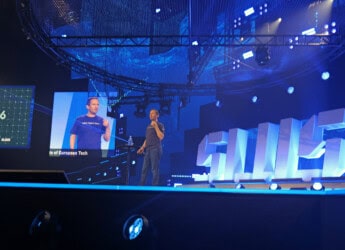
Reid Hoffman tells Slush that strategic optimism means steering AI, including where it still fails reports on the LinkedIn co-founder’s Nov. 18 conversation at Slush 2026 in Helsinki with Marko Ahtisaari, chief marketing officer of Finnish satellite company ICEYE. Hoffman said an AI-driven venture fund built today “would lose money.” He described strategic optimism as choosing the future worth building and steering toward it, rather than cheerleading. He described Manas AI, the drug discovery company he co-founded with oncologist Siddhartha Mukherjee, as using AI to generate far more candidate molecules at the start. Regulatory review, biological testing and clinical trials still have to happen, he said. His advice to keep trying AI on things “that currently don’t work” reads, in the article’s analysis, as closer to a validation protocol. For review teams, the article suggests testing new tools against matters whose privilege and relevance calls are already settled and keeping records of where results diverge. Read more in Reid Hoffman tells Slush that strategic optimism means steering AI, including where it still fails.
- Click here to view recent Five Great Reads Newsletters
- Click here to subscribe to Five Great Reads Update
November 2026 industry spotlight
Individuals and Organizations Mentioned in the November Edition Reporting
- 10th U.S. Circuit Court of Appeals: Posted final rules Nov. 20 making every filing, AI-assisted or not, certify, to the best of the filer’s knowledge after reasonable inquiry, human citation verification under revised Tenth Circuit Rule 46.5 from Jan. 1, 2027, and adding waiver and striking sanctions.
- 5th U.S. Circuit Court of Appeals: Proposed an AI certification amendment to Fifth Circuit Rule 32.3 in November 2023, then said in June 2024 it would not adopt a special AI rule “at this time.”
- Aalto University: Finnish university Hoffman mentioned, with the University of Oulu, in a thought experiment about founding an institution from scratch for the AI era.
- ABA Journal: Described the rule Nov. 25 as requiring human review of filings “that use artificial intelligence,” which fits the September proposal, and did not separate the two new sanctions from existing ones.
- Alexander Stubb: Finnish president who, in a session after the Slush 2026 opening show, framed AI as a national, economic and social security problem and promoted a nonbinding call for control of frontier AI models.
- Amazon Web Services: Supporter of Atomico’s State of European Tech 2026 publication, alongside HSBC Innovation Banking, Orrick and Slush.
- American Bar Association: Issued advisory Formal Opinion 512 in July 2024, saying lawyers using generative AI must reasonably understand tools’ capabilities and limitations or rely on others with expertise.
- Ann Donnelly: U.S. district judge who presided over the Huawei trial and ruled in June that prosecutors could use Meng Wanzhou’s 2021 statement of facts against Huawei, Reuters reported.
- Anouar El Anouni: EU spokesman who said the bloc stood ready for a “swift and united response” once member states have conferred, according to France 24.
- ANSSI: France’s national cybersecurity agency and a C4 member; its director general, Vincent Strubel, described the Danfoss and Dixell/Copeland attacks and their attribution.
- Anthropic: ENISA names its Claude Mythos as an example of AI-assisted tools among recent advances in vulnerability research that it says are likely to increase the number of vulnerabilities manufacturers need to assess, prioritize and patch, footnoting a May 1 report in The Record that does not mention Mythos.
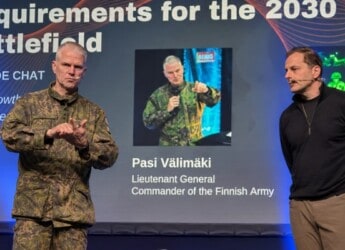
- Arctic Strike 26: Named by Lt. Gen. Pasi Välimäki at DECOI x Borderland, where he said the Finnish Army engages from readiness level 7 upward and pointed founders toward Arctic Strike 26, offering what he said were personal opinions.
- Arne Ansper: Signed Cybernetica’s Oct. 16 filing as management board member and chief technology officer; told ERR registration alone “gives us nothing” without a strong authentication or signing tool for the agent; listed as a beneficial owner.
- Arnold & Porter: Law firm whose eData Edge blog carried the Oct. 7 analysis by Bryan M. Marra describing the FTC’s reported recall, precision and AI disclosure instructions.
- ASUS: Its 2019 Live Update attack, known as ShadowHammer, illustrates the retrieval step in ENISA’s seven-step update life cycle.
- Atomico: London-headquartered venture firm that released its State of European Tech 2026 report at Slush on Nov. 18, projecting $81 billion in 2026 European startup funding and putting Europe’s share of global venture investment at 9.4 percent.
- Ats Albre: President of ITL who told ERR the government’s course is right but responsibility is “not yet sufficiently clear,” citing an agent filing data with Statistics Estonia as an example.
- Baker McKenzie: Its notice, reported Oct. 27 on California’s register, says an attacker used social engineering on two users Aug. 14 and Aug. 17 and obtained a limited number of files.
- Barry Scannell: Of William Fry, he told the 2026 Dublin Tech Summit main stage that Ireland acts as the world’s de facto AI regulator; the panel then spent the session on the compliance costs behind that role.
- BCI Burke: Rival playground manufacturer whose acquisition by PlayPower the FTC sued to block Oct. 19, alleging loss of head-to-head competition; PlayPower later abandoned the deal.
- Bending Spoons: Went public on Nasdaq in July 2026 at an $18 billion valuation, by Atomico’s report count, amid thin European exit value.
- Beringer Capital: Investor backing the new standalone company into which Control Risks said it will spin off its Discovery + Data Insights and Forensics lines; the transaction is announced, not closed.
- Beth M. Hammack: Federal Open Market Committee member who dissented from the Oct. 28 hold at 3.75 percent to 4 percent, preferring a quarter-point increase.
- Bizzabo: An event-software provider that says events are increasingly measured on pipeline influence, deal velocity and customer retention.
- Blacklane: Berlin chauffeur service the report lists as a $1.1 billion Uber acquisition; Uber’s filing puts the completed price at $554 million, below the report’s $1 billion threshold.
- Blank Rome: Said a caller posing as its IT department on May 21 misled an attorney into moving files to an outside Google Drive account; its notice names no attacker.
- Borderland: An Eastern Finland testing network that co-organized the DECOI x Borderland summit with the Finnish Business Angels Network alongside Slush 2026.
- BotDojo: AI-native startup acquired by Mitratech, a legal and compliance software provider, in a deal announced Sept. 28, 2026.
- Bradley Collins: LegalTechTalk’s co-founder and chief executive, who presented Miami as a meeting point for legal leaders from the United States, Latin America and other regions.
- Brian Heberlig: Huawei defense attorney who called the racketeering and obstruction acquittals “a vindication of the company and its good-faith compliance culture,” the AP reported, and argued much material was already public.
- Bryan M. Marra: Senior attorney in Arnold & Porter’s Washington office whose Oct. 7 eData Edge post is credited by every published account of the FTC’s reported TAR and AI review thresholds that ComplexDiscovery located.
- Bureau of Economic Analysis: Its advance estimate put third-quarter 2026 real GDP growth at a 3.4 percent annual rate; it also reported PCE inflation and a $105.0 billion September trade deficit.
- ByFounders: Firm of partner Sara Rywe, who in the Atomico report read the drop in first rounds as the market settling but said rising round sizes and valuations feel like “heading straight back into bubble territory.”
- Byrne Wallace Shields: Law firm whose analysis is cited for the April 2026 High Court ruling in LinkedIn’s DPC appeal on which provisions govern challenges to fines and infringement findings.
- California attorney general: Keeps the public breach register, which does not define its reported date and lists the 10 law and immigration firm notices; separately partnered with the Justice Department’s Antitrust Division on cement and asphalt consent decrees, the division said Oct. 29.
- Canopy: Data breach response software company whose acquisition by Epiq was announced Sept. 25; its AI-assisted review platform is set to be integrated into Epiq’s cyber incident response offerings.
- Carrefour: Retail group named by the C4 among the mainly large retailers victimized in the October refrigeration controller sabotage.
- Casino: Retail group named by the C4 among the mainly large retailers victimized in the October refrigeration controller sabotage.
- CE Global Partners: Harbor’s June 2026 transaction, one of Harbor’s two tracker entries for the year as of Oct. 29.
- Centellic: Legalweek’s organizer and the trading name of ALM Global, cited for Legalweek’s move to March 1 through 3, 2027, at the North Javits Center in New York.
- Centre for Cybersecurity Belgium: Belgian body whose spokesperson told The Record on Nov. 2 that it was not known who was behind the attack and that it may never be possible to identify them.
- Cerebras Systems Inc.: Named party in James v. Cerebras Systems Inc., where a stipulated ESI order requires model identity, prompt disclosure, prompt-change redlines and recall and precision reporting, and lets proprietary prompts be withheld if logged with particularity and offered for attorneys’-eyes-only inspection.
- Charlie Hebdo: Its online shop was defaced in January 2023 with theft of database information, an operation the C4 report assigns to Shahid Shoostari.
- Christopher Donahue: A retired U.S. Army general who, at DECOI x Borderland, urged founders to test technology in Ukraine and set out NATO’s data requirements, speaking in what Välimäki said were personal opinions rather than official positions.
- Christopher M. Wolpert: 10th Circuit clerk of court whose Sept. 18 memorandum invited comment through Oct. 18 on Rule 46.5 revisions “intended to address the increased use of generative artificial intelligence.”
- Cintas: Proposed $5.5 billion acquirer of UniFirst that certified substantial FTC second request compliance Oct. 2, agreed not to close before Dec. 11 absent an earlier FTC closing notice and still expects a 2026 close.
- Cisco: Its router source code, which the Justice Department says was identified as the “crown jewel” of Cisco technology, was copied by Huawei, and Huawei engineers referred to Cisco as “ocsic” in the code, the department said; Heberlig said Huawei recalled routers it had sold in the United States, the AP reported.
- City of Del City: Party in Rashonna Moore’s 10th Circuit case, decided by an unpublished Dec. 3, 2025, order requiring her future filings to disclose AI use under penalty of perjury.
- CNEX: U.S. technology company that, the Justice Department says, would not work with Huawei directly, and through which a university researcher hired by Huawei gave Huawei confidential information and direct access to CNEX hardware, the department said.
- CNIL restricted committee: Body that imposes the CNIL’s sanctions; it adopted deliberation SAN-2026-016 on Nov. 12, finding breaches of GDPR Article 32 and Article 5(1)(e), and set the fine at 5 million euros.
- Cogentrix: Company that, with Vistra, decided on its own to sell a gas-fired plant in Rumford, Maine, the DOJ said Oct. 30, adding that it would continue to monitor the sale.
- Columbia University: Home of colleagues on the 2007 paper with Ryan Rowe and Salvatore Stolfo that inferred social hierarchy from email communication patterns in the Enron archive.
- COMCYBER: The French military’s cyber command, listed as a member of the interministerial Cyber Crisis Coordination Center that produced the attribution report.
- Commission nationale de l’informatique et des libertés: France’s data protection authority, which on Nov. 18, 2026, published a decision fining Macif Vie 5 million euros under the GDPR without naming the company.
- Congressional Investigations Forum: Washington event on Jan. 20, 2027, that opens the over-100-conference 2027 calendar compiled for the preview from organizer announcements as of Nov. 23, 2026.
- Conseil d’État: France’s highest administrative court, to which the Macif Vie decision states it can be appealed within two months of notification; Macif’s statement to Agence Radio France did not say whether it would appeal.
- Consilio: Announced its acquisition of icourts, an Australian eDiscovery specialist, on Sept. 1, extending its Asia-Pacific footprint.
- Control Risks: Said Oct. 15 it will spin off Discovery + Data Insights and Forensics into a Beringer Capital-backed standalone company; announced, not closed, with completion expected in the fourth quarter, subject to customary conditions.
- Coopérative U: Retail group named by the C4 among the mainly large retailers victimized in the October refrigeration controller sabotage.
- Council of the EU: Agreed its Digital Omnibus negotiating mandate on Oct. 21 and its EU Inc position on Oct. 23, 2026; as of Nov. 11, its press-release listing showed no new cyber-sanctions decision after France’s attribution of the supermarket fridge sabotage to an IRGC unit.
- Court of Justice of the European Union: Held in May 2023 (Case C-487/21) that a GDPR copy means “a faithful and intelligible reproduction of all those data”; the Macif Vie decision cites its Deutsche Wohnen and ILVA rulings, and in ILVA it held that the whole undertaking’s turnover sets a GDPR fine’s ceiling.
- CourtLink: Its acquisition by LexisNexis, recorded in November 2001, is the first entry in ComplexDiscovery’s eDiscovery deal tracking, which documented 625 events as of Oct. 29.
- CRIF: Consultancy that tells clients how creditworthy people are; in Case C-487/21 an applicant who asked it for his data received, in summary form, a list of what it held.
- CrowdStrike: Its 2024 Falcon outage, which ENISA’s advisory says was not malicious, illustrates the installation and status recording steps of the update life cycle.
- Cuatrecasas: Law firm whose summary is cited for the Council of the EU’s Oct. 21, 2026, Digital Omnibus mandate on abusive access requests.
- Cvent: Event software seller that surveyed 1,067 full-time U.S. and U.K. marketers involved in their companies’ events programs for its 2026 Event-Led Growth Report and reported that 72 percent of marketers say deals close faster when prospects attend events, without stating whether that share covers the full sample.
- Cyber Crisis Coordination Center: French interministerial body (C4) whose five-page report, CERTFR-2026-CTI-009, attributes the October sabotage to Shahid Kaveh, presenting its case as a body of converging indicators.
- CyberAveng3rs: One of the hacktivist personas through which Shahid Kaveh is mainly known, per the French C4 report; a U.S. advisory spells it CyberAv3ngers, also known as the Shahid Kaveh Group.
- CyberbanNews: Propaganda outlet tied to Shahid Kaveh that relayed the October attack from Oct. 13, according to the C4 report.
- Cybernetica: IT company whose Oct. 16 filing said passing Estonia’s digital identity bill as drafted would be dangerous and that the draft could be read to let software act on the identifier alone; it markets authentication and digital-signing services.
- Cybersecurity and Infrastructure Security Agency: Co-issued the Nov. 5 U.S. fact sheet urging operators to harden refrigeration controllers without naming an actor, and hosts joint advisory AA26-097A on Iranian-affiliated controller targeting.
- Dale Sunderland: One of the three commissioners for data protection who took the DPC decision fining MTCH 11 million euros over Tinder’s access tool.
- Damien Charlotin: Researcher who maintains the AI Hallucination Cases database, listing 2,387 decisions as of Nov. 27, 2026, and also markets an automated reference checker built on it.
- Danfoss: Controller brand the Paris prosecutor named as targeted; Strubel said the roughly 700 sites ran Danfoss controllers reached through direct internet connections and weak passwords.
- Daniel Guarnera: FTC Bureau of Competition director who said the PlayPower deal would have cut major competitors from five to four and given PlayPower’s owners control of over 30 percent of the relevant market.
- Data Protection Commission: Ireland’s regulator, which announced Nov. 13 an 11 million euro fine and reprimand against MTCH, finding Tinder’s Download My Data tool breached GDPR Article 15(3), and ordered compliance within three months.
- Data Protection Inspectorate: Wrote Oct. 22 that registering an identity’s link to a person does not prove authorization for a specific act or that the act matched the person’s will.
- David De Cremer: Then a Cambridge Judge professor who led the email-trust studies, according to the school; he said including supervisors “can make employees suspicious” and that the findings point to managers setting rules on when superiors belong on an email.
- David Moran: Chief executive of Repario who said in its UnitedLex acquisition announcement that the combined company aims to move clients to case strategy sooner, with AI they can defend.
- co: Data provider for Atomico’s report; its data, labeled illustrative, shows European and U.S. companies raising similar sums reached $1 billion valuations at similar rates.
- DECOI x Borderland: Summit organized alongside Slush 2026 by the Finnish Business Angels Network and Borderland, where generals, defense founders and angel investors discussed readiness thresholds in one room.
- Deposition Solutions: Does business as Lexitas; litigation support company that said a customer told it May 29 that a misconfigured web server had left OnDemand (DepositionNet) files, mainly deposition transcripts, exhibits and other legal documents, open online without login since about September 2019.
- Des Hogan: One of the three commissioners for data protection who took the DPC decision fining MTCH 11 million euros over Tinder’s access tool.
- Deutsche Wohnen: Party in Court of Justice of the European Union case C-807/21, a ruling the CNIL decision cites on group figures in GDPR fines.
- DGA: France’s defense procurement agency, listed as a member of the Cyber Crisis Coordination Center that produced the attribution report.
- DGSE: French intelligence service listed as a member of the Cyber Crisis Coordination Center that produced the Shahid Kaveh attribution report.
- DGSI: French intelligence service and C4 member that, with the anti-cybercrime office, found the unit’s attack method, Farsi use and Iran-linked IP addresses, the prosecutor’s release said.
- Digital Nations: Group Estonia chaired, together with the Nordic-Baltic Eight, while hosting the invitation-only 2026 Tallinn Digital Summit for political, business and defense leaders.
- Dixell/Copeland: Controller brand (Dixell, per the Paris prosecutor; Dixell/Copeland, per Strubel) targeted in the sabotage; Strubel said a few dozen more sites with this equipment suffered a similar attack shortly afterward.
- DLA Piper: Firm cited for reporting that filers still use the pre-February 2025 HSR form and that the FTC has said it aims to publish any proposed rulemaking notice by the end of 2026.
- Docker Hub: Where, the Trivy advisory says, a threat actor holding compromised credentials pushed malicious v0.69.5 and v0.69.6 images on March 22 that stayed exposed about 10 hours.
- Doug Austin: eDiscovery Today publisher whose post identified waiver and striking as the two new sanctions, which the article calls the more accurate account, and summarized National Law Journal coverage.
- Dublin Tech Summit: Held its 10th edition at the Royal Dublin Society on May 27 and 28, 2026, and is listed for May 26 and 27, 2027, per listings citing the organizer.
- e-Residency program: Its team formed the working groups the draft grew out of, according to the memorandum; Vahtras led it, and the Insolvency Service cites its count of over 144,000 e-residents.
- Eastern District of Michigan: Court that decided Warner v. Gilbarco, Inc., which the Fontainebleau order read as accepting that AI-assisted litigation preparation can qualify for protection.
- eDiscovery AI: Paired with HaystackID in one of the AI capability purchases that defined 2026 at midyear.
- eDiscovery Today: Publication of Doug Austin whose post on the rule identified the two new sanctions and whose accounts are cited on 5th Circuit commenters’ arguments.
- EDRM: Organization for which ComplexDiscovery OÜ is a Guardian Partner, on whose Global Advisory Council Rob Robinson sits and where EDRM lists Tara Emory and Maura Grossman, per the disclosure.
- Elevate: Announced its acquisition of Lupl on Aug. 19, pushing deeper into software; also added Mestel & Co. in February for two 2026 tracker entries.
- Enron: Source of the email archive used in a 2007 hierarchy-detection study, whose results were checked against the company’s organization chart and court proceedings, with the closest match at the top.
- Epiq: Announced three 2026 transactions, LitLingo in March, Tenor Legal in July and Canopy on Sept. 25; tracker 2025 entries include its divestiture of a business transformation unit.
- Estonian Association of Information Technology and Telecommunications: Known as ITL; asked the ministry not to advance Estonia’s digital identity bill as drafted, ERR reported; its president told ERR members would meet the minister the week of Nov. 2.
- Estonian Competition Authority: Houses the Insolvency Service, an independent state supervisory body that said in an Oct. 16 letter it does not support Estonia’s digital identity bill.
- Établissement français du sang: French blood service hit in a Nov. 2 incident France has not attributed; it said no health impact was identified and no blood products were lost.
- EU Agency for the Cooperation of Energy Regulators: Source of the report’s figure that EU industrial electricity costs end users 151 euros per megawatt-hour, which the report says is over double the U.S. price.
- EU Inc: Proposed single EU-wide company form, chosen by 50 percent of founder respondents who gave a view among top policy changes; proposed March 18, 2026, and still awaiting a European Parliament position.
- EU-INC founder campaign: Argues the EU Inc proposal has drifted from the version it backed; Euronews has reported its backers include figures associated with Atomico.
- European Central Bank: Cited by Atomico’s report for the figure that 33 percent of Europeans’ financial assets sit in cash and bank deposits, against 11 percent for U.S. households.
- European Commission: Its Digital Omnibus proposal of Nov. 19, 2025, would let controllers refuse or charge for access requests where a person abuses GDPR rights for purposes other than protecting their data, according to law firm summaries; it proposed EU Inc as an EU-wide company form on March 18, 2026.
- European Data Protection Board: Its Guidelines 01/2022 accept self-service access tools but say data a tool cannot deliver must be provided another way; its guidance pointing insurers to premiums in place of net turnover was followed in the Macif Vie fine, which used gross written premiums.
- European Parliament: Its tracker listed the Digital Omnibus file as awaiting a committee decision as of Nov. 14; its Legal Affairs Committee has repeatedly postponed its vote on EU Inc, including one expected Nov. 16, Agence Europe reported.
- European Union Agency for Cybersecurity: Published its Technical Advisory on Secure Update Mechanisms Nov. 4, 2026, saying it is not legal advice, not a formal Cyber Resilience Act interpretation and not a presumption of conformity.
- FactSet: Data source showing U.S. announcements fell 1.7 percent from August to 1,201 in September and private equity deal value fell 23.6 percent to $28.1 billion.
- FBI: Its May 26 FLASH alert, provided “as is,” says Silent Ransom Group has targeted U.S.-based law firms since spring 2023 and that, as of spring 2026, its actors pose as a victim’s IT staff; it also co-issued the Nov. 5 fact sheet urging hardening of refrigeration controllers, which named no actor.
- Federal Open Market Committee: Held its target range at 3.75 percent to 4 percent on Oct. 28, saying “inflation remains elevated,” with two members dissenting in favor of an increase.
- Federal Reserve Bank of St. Louis: Data source for the 10-year Treasury yield of 4.94 percent on Oct. 30 cited as financing context for the HSR count.
- Federal Trade Commission: Wrote 75 percent recall and precision floors and a 0.50 minimum cutoff score for TAR and AI review into instructions with a civil investigative demand and a merger second request, an Arnold & Porter analysis reports; its preliminary data show 202 HSR reported transactions in October 2026, and it sued over PlayPower’s BCI Burke deal and proposed a consent order in Publicis’s LiveRamp purchase.
- Finnish Army: Commanded by Lt. Gen. Pasi Välimäki, who said at DECOI x Borderland, offering what he said were personal opinions rather than official positions, that the army engages from readiness level 7 upward.
- Finnish Business Angels Network: Co-organizer, with Borderland, of the DECOI x Borderland summit held alongside the Slush 2026 main event in Helsinki.
- Fireworks AI: AI inference company that said Nov. 17 its breach activity relates to two separate security incidents, the second reaching part of its production systems and account and billing information for all accounts created before Oct. 30; it earlier reported impacts, for limited accounts, to secrets, datasets and incomplete models, and its bulletins do not address Notion’s retention account.
- FOFA: Tool the C4 calls a scanning tool habitually used by the unit’s intrusion set; operators used it in the October attack, the report says.
- Fontainebleau Florida Hotel, LLC: Party in Fontainebleau Florida Hotel, LLC v. Botach, a dispute over discovery of a defamation defendant’s AI communications in which a Southern District of Florida magistrate judge issued a discovery ruling Oct. 21.
- Forentec: Swiss eDiscovery and digital forensics consultancy acquired by Lineal on Oct. 14, Lineal’s second tracker entry in about 14 months.
- Forrester: Said the largest and most mature organizations in its research were notably more likely to use events to strengthen existing customer relationships, and that 2026 event budgets are constrained.
- FOX: Completed its roughly $22 billion Roku acquisition Nov. 6, it said in a Form 8-K, the day the Justice Department closed its review; it committed to carry rival content on Roku for at least three years.
- Fox Rothschild: Said an employee was targeted by “vishing,” or voice phishing, on May 21 and files were copied and taken; it says the attack was confined to a single device.
- Fragomen, Del Rey, Bernsen & Loewy: Self-described global immigration services firm that said it learned May 5 an outsider gained remote access to one user’s account in a social engineering campaign.
- France Travail: National employment agency the CNIL fined 5 million euros in January 2026 over a job seekers’ data breach; because it is a public body, the CNIL said, the fine was set within a fixed range.
- France’s anti-cybercrime office: Worked jointly with the DGSI to find the attack method, Farsi traces and Iran-linked IP addresses cited in the Paris prosecutor’s Nov. 9 release.
- France’s foreign ministry: Said food losses were estimated at several tens of millions of euros and that France would summon Iran’s ambassador and propose to European partners new sanctions on Iranian entities and individuals involved in the attack and other malicious cyber activity.
- Freeman: An event-services company that said in its review of 2025 that face-to-face remains the most trusted marketing channel.
- Frontier Airlines: Party in Kusmin L. Amarsingh’s 10th Circuit case; the panel affirmed dismissal of her claims and ordered her to pay Frontier $1,000 as a sanction.
- FTC Bureau of Competition: Said Oct. 27 that PlayPower had abandoned its acquisition of BCI Burke, eight days after the FTC sued to block it.
- Fujitsu: Its equipment was photographed by a Huawei employee carrying a badge falsely identifying him as an employee of “Weihua,” according to the Justice Department’s release.
- FutureLaw: Legal innovation conference that filled the Port of Tallinn cruise terminal on May 14 and 15, 2026, describing its audience as about 500; set for May 27 and 28, 2027.
- Futurewei Technologies Inc.: U.S. subsidiary convicted of conspiracy to steal trade secrets and conspiracy to commit wire fraud and acquitted of racketeering conspiracy, per the verdict sheet.
- Garante per la protezione dei dati personali: Italy’s data protection authority, which published in its Nov. 12 newsletter a 25,500 euro fine against Techpartner Srl, partly for a late reply to an access request.
- Gartner: Cited by the report for European spending on sovereign cloud infrastructure as a service of about $35 billion across 2026 and 2027.
- Gavel: Paired with Relativity in one of the AI capability purchases that defined 2026 at midyear.
- Ghent University: Affiliation of first author Tessa Haesevoets on the 2019 Journal of Business Ethics studies, which linked putting the supervisor in Cc to lower felt trust among employees.
- Gilbarco, Inc.: Party in Warner v. Gilbarco, Inc., read by the Fontainebleau order as accepting that AI-assisted litigation preparation can qualify for protection and that working through an outside AI tool need not waive it.
- GitHub: Trivy version 0.69.3 sat behind its immutable releases feature, which the Trivy advisory says let some users rule themselves out of exposure to malicious releases.
- Government Office: Only listed approver to explicitly approve the draft by the Oct. 22 deadline in EIS; no ministry responded by then.
- Graham Doyle: DPC deputy commissioner who said in the announcement that automated access tools need not be complete but must be “fair and transparent to individuals regarding the extent of the data provided.”
- Greenberg Traurig: Said an unauthorized person obtained a small set of files Aug. 26, without describing the method; its 14-day gap to a register date is the shortest measured.
- Greg Beato: Co-author with Reid Hoffman of the January 2025 book “Superagency: What Could Possibly Go Right With Our AI Future,” to which Hoffman tied strategic optimism.
- Greylock: Venture firm listed in Reid Hoffman’s Slush biography, alongside Inflection AI and Manas AI, as part of his career context.
- Hamid Reza Lashgarian: Named in the C4 report annex as head of the IRGC’s Electronic and Cyber Center; the Treasury Department sanctioned him in February 2024, identifying him as the CEC’s head.
- Harbor: Serial acquirer that held two 2026 tracker entries as of Oct. 29: CE Global Partners in June and iTrain in July.
- Harris L. Hartz: 10th Circuit judge who entered the order and judgment sanctioning Kusmin L. Amarsingh under Federal Rule of Appellate Procedure 38 rather than dismissing her appeal.
- Harvey: Legal AI company among customers Fireworks told of the second hack, The Information reported, according to accounts by MLQ.ai and Sovereign Magazine; Harvey said none of its customers’ data was affected, Sovereign Magazine reported, citing The Information, and Harvey says it post-trained its Tenet model with Fireworks.
- HaystackID: Provider of eDiscovery services, including AI-assisted document review, that published its own account of the FTC instructions on Oct. 13, 2026; paired with eDiscovery AI in a 2026 purchase and a founding launch partner of LegalTechTalk USA. Rob Robinson, ComplexDiscovery OÜ’s founder, is its chief marketing officer.
- Helsing: Among the companies whose megarounds, with STARK and Quantum Systems, drove European defense tech funding to a record $7.2 billion, according to Atomico’s report.
- High Court (Ireland): Irish court where MTCH issued proceedings against the DPC Nov. 6; The Irish Times reported Nov. 16 that MTCH has brought a challenge there to the 11 million euro fine. It hears statutory fine appeals under the Data Protection Act 2018.
- Hire Counsel: Joined with Purpose Legal in one of the legal talent additions that defined 2026 at midyear, by ComplexDiscovery’s tracking.
- Hogan Lovells Cadwalader: Advises parties in the Justice Department’s targeted second request process to frame priority productions around the issue the division considers decisive while running a parallel full-compliance workstream.
- HSBC Innovation Banking: Listed as a supporter of the State of European Tech 2026 report Atomico published, with Amazon Web Services, Orrick and Slush.
- Huawei Device Co. Ltd.: Shenzhen-based defendant found guilty on the only two counts it faced, conspiracy to steal trade secrets and conspiracy to commit wire fraud, per the verdict sheet.
- Huawei Device USA Inc.: U.S. subsidiary convicted on the trade-secret and wire fraud conspiracy counts and acquitted of racketeering conspiracy and conspiracy to obstruct justice, per the verdict sheet.
- Huawei Technologies Co. Ltd.: Shenzhen-based parent convicted Nov. 24 on 10 of 12 counts, including trade-secret conspiracy and IEEPA violations, and acquitted of racketeering conspiracy and obstruction conspiracy; it expects to appeal.
- Hyve Group: Events company that announced in July 2026 it had acquired LegalTechTalk and would support the U.S. launch of LegalTechTalk USA.
- IAPP: Its IAPP Global Summit is cited with Legalweek, ILTACON and RelFest Chicago as events where skipping can mean giving up a rare chance to see an existing client in person.
- ICEYE: Finnish satellite company whose chief marketing officer, Marko Ahtisaari, conducted the Slush 2026 conversation with Reid Hoffman on strategic optimism about AI.
- icourts: Australian eDiscovery specialist whose acquisition by Consilio was announced Sept. 1, extending Consilio’s Asia-Pacific footprint.
- ILTACON: Cited, with Legalweek, RelFest Chicago and the IAPP Global Summit, as an event where skipping can mean losing a rare yearly chance to see an existing client in person.
- ILVA: Party in Court of Justice of the European Union case C-383/23, a February 2025 ruling that the whole undertaking’s turnover sets the GDPR fine ceiling.
- Indico Data Solutions: Boston company that describes itself as a vendor providing “data ingestion and workflow organization services”; said it determined May 7 an intruder may have reached repositories holding customer information.
- Inflection AI: Listed in Reid Hoffman’s Slush biography, alongside Manas AI and the venture firm Greylock.
- Information System Authority: Controller of Estonia’s state database for data consents and mandate management, to which the draft would add digital identity registration as a third function.
- Infosecurity Europe: London security event organizers list for June 8 through 10, 2027, a week before RelFest London and LegalTechTalk in a dense two-week stretch.
- Insolvency Service: Independent state supervisory body in the Estonian Competition Authority that wrote Oct. 16 it does not support the digital identity bill, noting no cap on registrations per person, no supervision and no sanctions.
- Intermarché: Retail group named by the C4 among the mainly large retailers victimized in the October refrigeration controller sabotage.
- Internet Engineering Task Force: Issuer of RFC 5322, the October 2008 standards-track document defining email’s message format, which says To, Cc and Bcc differ only in how each is used.
- ION Analytics: Published Mergermarket data showing global M&A value up 27 percent to $4.44 trillion in the first nine months of 2026, and described a marked third-quarter slowdown.
- Ipsos: Surveyed 11 European countries in March and April 2026; in Atomico’s tally excluding don’t-knows, 27 percent expected AI to improve their national economy over the next three to five years.
- Iran International: Persian-language broadcaster that named and pictured Salarvand in September 2022 as head of a Shahid Kaveh sub-unit, drawing on material leaked by Lab Dookhtegan.
- Iran’s foreign ministry: On Nov. 10 said it “categorically rejects the French government’s baseless and one-sided accusations,” according to France 24 and AFP.
- IRGC Electronic and Cyber Center: Parent body of Shahid Kaveh, per the C4 report annex; a U.S. advisory ties the CyberAv3ngers persona to what it calls the IRGC Cyber Electronic Command, and the Treasury sanctioned six IRGC-CEC officials in February 2024.
- Islamic Revolutionary Guard Corps: Iranian body whose cyber unit, Shahid Kaveh, France blamed for the October supermarket controller sabotage; U.S. agencies tie the CyberAv3ngers persona to its cyber command.
- iTrain: Harbor’s July 2026 transaction, one of Harbor’s two tracker entries for the year as of Oct. 29.
- Jan Svennevig: Co-author of the 2006 Journal of Computer-Mediated Communication study on how a distributed work group used email copies, including copies to third parties as social control.
- Jane O’Reilly: University of Ottawa researcher who, with Sandra Robinson and two colleagues, compared ostracism with harassment in three field studies published in Organization Science in 2015.
- Jean-Noël Barrot: French foreign minister who, speaking Nov. 9 at the G7 foreign ministers’ gathering in Paris, called the attack unprecedented in scale and aggression, France 24 reported.
- JLL Partners: Backer of Repario, the eDiscovery and legal data company that acquired UnitedLex in a deal announced Sept. 28, 2026.
- Joseph Nocella Jr.: U.S. attorney for the Eastern District of New York who called Huawei’s trade-secret conduct “blatant thefts from U.S. technology companies.”
- Justice Department: Its Model Second Request, marked “Last Updated: December 2025,” seeks recall and precision statistics without a minimum and never mentions AI; it prosecuted Huawei, and its release lists five trade-secret examples it says were proved at trial and says the companies face fines, forfeiture and restitution.
- Justice Department Antitrust Division: Issued second requests to Patrick and LCI, according to Patrick’s Form 8-K, closed its FOX-Roku review Nov. 6, said it would continue to monitor the Vistra-Cogentrix plant sale and seeks a proposed $250 million KKR penalty.
- Justin Kruger: Psychologist who, with Nicholas Epley and two colleagues, reported in five 2005 experiments that people overestimate their ability to convey and read tone by email.
- Karianne Skovholt: Co-author with Jan Svennevig of a 2006 study finding email copies helped senders “build personal identity and alliances,” and that copies to third parties could serve as social control.
- Kaspersky: Named in later updates to the Notepad++ incident page as one source of indicators of compromise shared for the 2025 update hijacking.
- Katrien Eggers: Centre for Cybersecurity Belgium spokesperson who told The Record on Nov. 2 it was not known who was behind the attack and it may never be possible to identify them.
- Kimi K3: Base model from which Harvey says it built Tenet, its first post-trained open-weight model, post-trained together with Fireworks; Fireworks’ customer page says the work ran on the Fireworks Training API.
- KKR: Subject of a proposed $250 million Justice Department civil penalty over alleged HSR violations, listed as proposed as of Nov. 9 and requiring court approval; it said it strongly disagrees with the Antitrust Division’s characterization and believes it acted in good faith at all times under its prior filing process.
- Klarna: Swedish payments company Hoffman cited as setting out to drop its SaaS tools; its CEO wrote it shut down Salesforce and other SaaS providers, about 1,200 in all by an internal estimate.
- Kris Mayes: Arizona attorney general who said that “within a week of our filing, PlayPower walked away from this deal.”
- Kristin Byron: Then at Syracuse University’s Whitman School of Management, she reached a related conclusion in the Academy of Management Review; when Syracuse announced the paper, she said a first step is “to recognize the possibility that we are fallible as both email senders and receivers.”
- Kusmin L. Amarsingh: Attorney representing herself against Frontier Airlines who was sanctioned under FRAP 38 with a $1,000 payment and transmission of the decision to Maryland’s attorney-disciplinary authority over January 2025 misconduct.
- Lab Dookhtegan: Leaked material underlying Iran International’s 2022 reporting; the C4 report describes it as a group presenting itself as Iranian dissident hacktivists.
- Latitude59: Estonia’s flagship startup conference, returning to Kultuurikatel on May 19 through 21, 2027, according to organizers, who market Tallinn as a gateway to the New Nordics.
- Laure Beccuau: Paris prosecutor whose cybercrime section took up the supermarket attacks on its own initiative Oct. 12 under its national jurisdiction before a judicial investigation opened Nov. 9.
- Laurel Beeler: Northern District of California magistrate judge who on June 30 declined to compel further AI review metrics in Schulte v. LinkedIn Corp., finding a 204,444-document target population, without a more specific showing of deficiency, did not justify discovery on discovery.
- LCI Industries: Withdrew its August HSR notification with Patrick Industries, refiled Sept. 9 and received a Justice Department second request Oct. 9, according to Patrick’s filing.
- Leclerc: Retail group named by the C4 among the mainly large retailers victimized in the October refrigeration controller sabotage.
- Legal Geek: London legal tech event whose Legal Geek Growth is listed for June 9, 2027, with Legal Geek returning to London in October.
- Legal Innovators UK: London event listed for Nov. 2 and 3, 2027, among the later-year dates on the European legal technology calendar.
- LegalTechTalk: London legal tech event returning June 16 and 17, 2027, to the InterContinental London, The O2, and Magazine London, after organizers reported over 5,500 attendees and over 400 speakers in 2026.
- LegalTechTalk USA: First event outside Europe for London’s LegalTechTalk, announced June 17, 2026, with 55 founding launch partners; its site lists Dec. 13 through 15, 2027, at Fontainebleau Miami Beach.
- Legalweek: U.S. anchor show moving to March 1 through 3, 2027, at New York’s North Javits Center, according to its organizer; its page anticipates about 10,000 legal professionals, technology innovators and business leaders.
- LexisNexis: Its acquisition of CourtLink, recorded in November 2001, is the earliest entry in ComplexDiscovery’s eDiscovery deal record; that entry turned 25 on Nov. 5.
- Liina Vahtras: Estonian minister of economic affairs and industry who circulated the Oct. 2 digital identity draft, which would let people register what she calls an “agent code”; she said the change “creates no obligation for anyone.”
- Liisa-Ly Pakosta: Estonia’s justice and digital affairs minister, who on Oct. 21 outlined proposals for international AI rules, including treating the most harmful AI impacts as crimes against humanity.
- Lin Qiao: Fireworks chief executive whose post on X about the incident carved batch inference out of the list of unaffected zero-retention products, VentureBeat reported.
- Lineal: Acquired Forentec on Oct. 14, its second tracker entry in about 14 months after ProFile Discovery in August 2025.
- LinkedIn: Defendant in Schulte v. LinkedIn Corp., a putative antitrust class action in which a magistrate judge on June 30 declined to compel further metrics on its use of Relativity aiR; separately appealing a DPC fine in Ireland; co-founded by Reid Hoffman.
- Lisa D. Cook: Federal Open Market Committee member who dissented from the Oct. 28 decision to hold rates because she preferred a quarter-point increase.
- Listen Labs: Ran Atomico’s State of European Tech 2026 survey with the firm; the report does not disclose how many founders, investors and policymakers answered.
- LitLingo: Paired with Epiq in a March AI capability purchase, one of Epiq’s three announced 2026 transactions.
- LiveRamp: Acquisition target of Publicis Groupe; it said in a Nov. 2 Form 8-K the deal was completed that day, while the FTC order remains subject to final approval.
- Lloyd’s Market Association: Published model war and state-backed exclusions (LMA5567 in 2021, LMA5567A and LMA5567B in January 2023) that treat a government’s attribution differently.
- Lovable: Stockholm vibe-coding company and the report’s speed showcase; it announced $100 million in annual recurring revenue in July 2025 and later above $500 million, by its own figures.
- Ludwig Wittgenstein: Philosopher whom Hoffman said his Oxford philosophy training sends him to ask about in relation to large language models, summarizing him as holding that what he can know is bounded by the limits of his language.
- Lupl: AI-native legal matter management platform whose acquisition Elevate announced Aug. 19; added to the tracker during prepublication review.
- Macif: French mutual insurer that confirmed to Agence Radio France the fine was imposed on its life insurer and said “none of their data has been disclosed.”
- Macif Vie: Life insurer of the Macif group, formerly Mutavie, fined 5 million euros for storing over 1.8 million customers’ passwords in clear text and over-retaining data.
- Mahdi Lashgarian: Named in the C4 report as a Shahid Kaveh leader and commander; among six IRGC-CEC officials the Treasury Department sanctioned in February 2024.
- Manas AI: Drug discovery company Hoffman co-founded that launched in January 2025 with $24.6 million seed funding; Hoffman said AI helps find candidate molecules while trials still must happen.
- Marko Ahtisaari: ICEYE chief marketing officer who interviewed Reid Hoffman at Slush 2026, asking about recursive self-improvement, Manas AI and education, and calling Hoffman’s closing advice a fitting end.
- Marty Fulgueira Elfenbein: Southern District of Florida magistrate judge who on Oct. 21, as to Request Nos. 1, 3, 4 and 7, rejected a defamation defendant’s blanket work-product claim over AI communications in Fontainebleau Florida Hotel, LLC v. Botach, leaving room for document-specific claims.
- Match Group Inc.: Parent of MTCH whose Nov. 3 SEC quarterly report said it believes it has strong defenses and intends to appeal, and recorded a $12.6 million provision for the matter in the nine months ended Sept. 30.
- Matheson: Irish law firm whose analysis says the Council’s EU Inc text would allow fast-track online registration with a 48-hour decision deadline, excluding weekends and public holidays, and fees capped at 100 euros.
- Maura Grossman: Co-author with Tara Emory of a paper arguing properly developed review prompts can reflect an attorney’s “factual investigation, mental impressions, and case strategy” and that validating results usually serves transparency better than exposing prompts.
- Meng Wanzhou: Huawei chief financial officer whose 2021 deferred prosecution agreement statement of facts, in which she admitted lying to a financial institution about whether Huawei was complying with sanctions and export control law, Reuters reported, was given to jurors.
- Meredith Arfa: Assistant U.S. attorney who told jurors “the tone was set at the top by Huawei leaders and executives who themselves engaged in criminal conduct,” the AP reported.
- Mestel & Co.: Joined with Elevate in a February legal talent addition, one of Elevate’s two 2026 tracker entries.
- Metro: Group named by the C4 among the mainly large retailers victimized in the October refrigeration controller sabotage.
- Microsoft: Published the June 2025 Work Trend Index report, drawing on Microsoft 365 data that excludes education and EU tenants, which found the average worker receives 117 emails a day; Reid Hoffman remains a director until its Dec. 8 annual meeting and will not stand for reelection.
- MiMedx Group: Received an FTC second request Oct. 15 alongside Sanara MedTech, according to Sanara’s filing.
- Ministry of Culture: Approved the digital identity draft with comments Oct. 27, after the Oct. 22 deadline, one of two ministries on the record as of Oct. 28.
- Ministry of Economic Affairs and Communications: Estonian ministry under Liina Vahtras that put the two-page bill amending the Public Information Act, to let people register a “digital identity” that software can use to act for them, into an approval round; Vahtras said it intends to rework the bill.
- Ministry of Finance: Approved the digital identity draft with comments Oct. 28, after the Oct. 22 deadline, one of two ministries on the record as of that date.
- Mistral: Alongside Nscale, received nearly half of the $20 billion invested in European compute and intelligence companies in the first nine months of 2026, per the report.
- Mitratech: Legal and compliance software provider that acquired AI-native startup BotDojo, announced Sept. 28, an entry added to the tracker during prepublication review.
- MTCH Technology Services Ltd.: Match Group unit behind Tinder that the DPC fined 11 million euros and reprimanded; court records show it issued High Court proceedings against the DPC Nov. 6, and The Irish Times reported Nov. 16 that it has brought a High Court challenge to the fine.
- National Cyber Security Centre: Britain’s cyber agency, whose chief technology officer, Ollie Whitehouse, urged organizations to ready for a “patch wave” of updates, according to a May 1 report in The Record.
- National Law Journal: Reported that the rule makes the 10th Circuit the first federal appeals court with a rule aimed at AI in briefs, according to a summary by Doug Austin.
- NATO: Alliance whose data requirements retired U.S. Army general Christopher Donahue set out at DECOI x Borderland; he said it will help lower-readiness companies but cares about technology readiness levels 7 to 9.
- New Jersey attorney general: Received an asphalt investigation referral from the DOJ and reached its own settlement, according to the division’s Oct. 29 release.
- New York attorney general: Received an asphalt investigation referral from the DOJ and reached its own settlement, according to the division’s Oct. 29 release.
- Niamh Sweeney: One of the three commissioners for data protection who took the DPC decision fining MTCH 11 million euros over Tinder’s access tool.
- Nicholas Epley: Co-author of five 2005 Journal of Personality and Social Psychology experiments; in one, as the APA’s Monitor on Psychology described it, partners judged email sarcasm or seriousness correctly about 56 percent of the time, against senders’ prediction of about 78 percent.
- NIST: ENISA describes its secure update recommendations as consistent with NIST SP 800-40, along with The Update Framework and Uptane.
- Noora Saksa: Named Slush chief executive on Jan. 27, 2026, when Slush said the November event would cut its audience by 10 percent to serve early-stage startups.
- Nordic-Baltic Eight: Regional group Estonia chaired, alongside the Digital Nations group, when the invitation-only 2026 Tallinn Digital Summit was held.
- Norwegian School of Management BI: Affiliation of Karianne Skovholt and Jan Svennevig, whose 2006 study examined how a distributed work group used email copies, which kept the group informed and, when sent to third parties, could serve as social control.
- Notepad++: Free source code editor whose 2025 update hijacking inspired ENISA’s worked example; its team’s review of about 400 gigabytes of logs found signs of intrusion but no concrete indicators of compromise.
- Notion: Said Nov. 10 a dataset affected by the Fireworks AI breach held Notion AI chat transcripts from fewer than 1 percent of workspaces, and says Fireworks retained data despite a zero-retention commitment.
- Nscale: With Mistral, took nearly half of the $20 billion compute and intelligence companies drew in the first nine months of 2026, per Atomico’s report.
- Ollie Whitehouse: Chief technology officer of Britain’s National Cyber Security Centre who urged organizations to ready for a “patch wave” of updates, according to a May 1 report in The Record.
- OpenAI: Hoffman said he was a founding philanthropic donor, led its first commercial round and sat on its board until 2023; he described using its ChatGPT to learn quantum computing.
- Orrick: Listed as a supporter of Atomico’s State of European Tech 2026 report, alongside Amazon Web Services, HSBC Innovation Banking and Slush.
- Oxford: Where Hoffman received the philosophy training that he said sends him to ask how Ludwig Wittgenstein applies to large language models, as he urged learning across domains.
- Palo Alto Networks Unit 42: Palo Alto Networks unit that Fireworks AI said in its Nov. 9 update it had engaged for forensic analysis.
- Paris prosecutor’s office: Investigating since Oct. 12, it moved the case to investigating judges Nov. 9 and requested international arrest warrants; it has announced no charges against any individual.
- Pasi Välimäki: Lieutenant general and commander of the Finnish Army who shared a DECOI x Borderland keynote with Christopher Donahue, said both offered personal opinions rather than official positions and said the army engages from readiness level 7 upward.
- Patrick Industries: Withdrew its August HSR notification with LCI Industries, refiled Sept. 9 and received a Justice Department second request Oct. 9, according to its Form 8-K.
- Peña & Bromberg: California law firm that said it detected irregular network activity May 7 and found an unauthorized actor had taken files; the only notice of the 10 describing an intrusion.
- Pennsylvania attorney general: Received an asphalt investigation referral from the DOJ and reached its own settlement, according to the division’s Oct. 29 release.
- Pille Lehis: Director general of the Data Protection Inspectorate who signed its letter saying registering an identity’s link to a person does not prove authorization for a specific act.
- PitchBook: Listed among the data sources, with Dealroom.co and S&P Global Market Intelligence, that Atomico used to compile its State of European Tech 2026 report.
- Platinum Equity: Private equity firm that owns PlayPower, whose BCI Burke acquisition the FTC challenged and PlayPower abandoned.
- PlayPower: Abandoned its acquisition of rival playground manufacturer BCI Burke, the FTC’s Bureau of Competition said Oct. 27, eight days after the FTC sued to block it, with 12 state attorneys general joining the complaint; Platinum Equity owns it.
- Premerger Notification Office: FTC office that logged 202 reported transactions in October 2026 under the Hart-Scott-Rodino Act, according to preliminary data, up 4.7 percent from September’s 193.
- ProFile Discovery: Lineal’s August 2025 acquisition, which preceded its Oct. 14, 2026, purchase of Forentec in the tracker.
- Publicis Groupe: Its $2.2 billion acquisition of LiveRamp is covered by a proposed FTC consent order accepted for public comment Oct. 19 that would require five years of access, firewall and auditor terms.
- Purpose Legal: Joined with Hire Counsel in one of the legal talent additions that defined 2026 at midyear, by ComplexDiscovery’s tracking.
- Quantum Systems: Named with Helsing and STARK as recipients of megarounds that drove European defense tech to a record $7.2 billion, according to Atomico’s report.
- Quintel: U.S. antenna maker whose confidential information Huawei obtained under an NDA before almost immediately applying for a patent on technology built on Quintel’s idea, with a confidential Quintel slide attached, the Justice Department said.
- Rapid7: Named in later updates to the Notepad++ incident page as one source of indicators of compromise shared for the 2025 update hijacking.
- Rashonna Moore: Self-represented appellant who cited 11 cases the 10th Circuit could not find; a Dec. 3, 2025, order affirmed on the merits and alternatively dismissed her appeal as a sanction.
- Reid Hoffman: LinkedIn co-founder who told Slush 2026 on Nov. 18 that strategic optimism means steering AI, and that an AI-driven venture fund built today “would lose money.”
- Relativity: Its generative AI product aiR made final responsiveness calls in LinkedIn’s review, with human quality-control review of samples, LinkedIn told the Schulte plaintiffs; its Gavel purchase was one of 2026’s midyear AI deals, and it hosts RelFest London, set for June 14 and 15, 2027.
- René Repasi: Rapporteur whose EU Inc draft report Parliament’s Legal Affairs Committee has not voted on; he told the news site Rapporteur the year-end goal for talks can no longer be met.
- Renee Meisel: Chief executive of UnitedLex who said the Repario deal speeds use of its existing AI investment, deepens talent and preserves the continuity and service quality clients expect.
- Repario: eDiscovery and legal data company backed by JLL Partners that acquired UnitedLex in an announcement on Sept. 28, a platform-scale services pairing.
- Reza Salarvand: Named in the C4 report as a leader of Shahid Kaveh and listed in its annex as a commander; he was not among officials the Treasury sanctioned in February 2024.
- Riigikogu: Estonia’s parliament, which ERR reported the ministry aims to have the amendments reach by early November.
- Robert M. Illman: Magistrate judge who entered a stipulated ESI order in James v. Cerebras Systems Inc. whose AI appendix requires prompt disclosure and sets an expectation that elusion not exceed 3 percent, without recall or precision floors.
- Rockwell: Industrial equipment brand for which the French report says the unit has held scripts to scan, access and control equipment since at least June 2024.
- Roku: Acquired by FOX in a roughly $22 billion deal the DOJ concluded Nov. 6 was not likely to harm competition after second requests to both companies.
- Rosie Manins: Atlanta Journal-Constitution reporter who reported Travis Wilson’s proposed class action alleging about 37,000 people were exposed in the Troutman Pepper Locke incident.
- Ryan Rowe: Co-author, with Salvatore Stolfo and two Columbia University colleagues, of a 2007 paper describing an algorithm that inferred social hierarchy from communication patterns in the Enron email archive.
- S&P Global Market Intelligence: One of the data providers, alongside Dealroom.co and PitchBook, whose data Atomico used to compile its State of European Tech 2026 report.
- Salesforce: Shut down at Klarna a year before a March 2025 post by Sebastian Siemiatkowski, along with many other SaaS providers, as he described it.
- Salvatore Stolfo: Co-author of a 2007 Association for Computing Machinery workshop paper on inferring social hierarchy from email patterns; the study did not analyze To, Cc or Bcc placement.
- Sanara MedTech: Received an FTC second request Oct. 15 in its deal with MiMedx Group, according to its own filing.
- Sandra Robinson: Of the University of British Columbia’s Sauder School of Business, co-author of the 2015 Organization Science ostracism study; she said in a university announcement that “abuse is not always obvious.”
- SAP: The lone European vendor among the 18 most frequently named in nearly 9,500 European public tech contract award notices the report reviewed.
- Sara Rywe: ByFounders partner quoted in the Atomico report saying rising round sizes and valuations feel like “heading straight back into bubble territory.”
- Schneider Electric: Equipment maker whose devices at small French hydroelectric installations were targeted concurrently, the C4 said; attack infrastructure also reconnoitered its equipment over Modbus on port 502.
- Sebastian Siemiatkowski: Klarna chief executive who wrote in a March 2025 X post that shutting down Salesforce was a side effect of data consolidation, not replacement by a large language model.
- Seyfarth Shaw: Said it found Aug. 18 that a small number of documents had been emailed to someone not authorized to receive them; it does not say how.
- Shahid Kaveh: Group France describes as an IRGC cyber unit and blamed Nov. 9 for the Oct. 11 to 12 sabotage of refrigeration controllers at about 700 French retail sites; Iran rejects the accusation.
- Shahid Shoostari: Sister unit of Shahid Kaveh, known in open sources as Emennet Pasargad, to which the French C4 report assigns the 2023 Charlie Hebdo shop defacement and a 2024 Olympics-related intrusion.
- Sheppard, Mullin, Richter & Hampton: Known as Sheppard Mullin; said a single attorney was the victim of a social engineering event Aug. 31, and described “a thorough and time-intensive analysis.”
- Siddhartha Mukherjee: Oncologist and author who co-founded Manas AI with Reid Hoffman; the company’s leadership page now lists him as executive chairman.
- Siemens: Industrial equipment brand whose devices the U.S. advisory’s July update flagged as targeted and for which, the French report says, the unit has held scripts since at least June 2024.
- Signe Viimsalu: Head of the Insolvency Service who signed its Oct. 16 letter saying it does not support the bill because its risks and effects on Estonia have not been assessed.
- Sigstore: Signatures against which Trivy v0.69.2 can be checked; ENISA’s provenance recommendation names Sigstore-based signing among mechanisms for higher-assurance implementations.
- Silent Ransom Group: A group calling itself SilentRansomGroup is alleged in Travis Wilson’s complaint to have claimed the Troutman attack, the Atlanta Journal-Constitution reported; the FBI says the group, also tracked as Luna Moth, has targeted U.S.-based law firms since spring 2023.
- Skycom: Name under which Huawei operated in Iran, the Justice Department said; Huawei described it as a business partner when it was a wholly owned subsidiary, according to the release.
- Slack: Named by Cambridge Judge, alongside Office 365, as collaboration software that “could also carry trust issues related to the study’s findings”; the article advises the same care with @mentions and channel membership.
- Slush: Helsinki startup event its organizers call Europe’s largest venture capital gathering; it said its 2026 edition would cut audience 10 percent, hosted Atomico’s report and Reid Hoffman’s session on Nov. 18, and is expected in Helsinki in November 2027; its site showed no 2027 dates when ComplexDiscovery checked Nov. 28.
- Smart-ID: Authentication service whose fraud wave, Cybernetica’s filing recalls, saw attackers manipulate people into creating accounts tied to attacker devices; Cybernetica says its SplitKey has been used with it since 2017.
- SolarWinds: Incident ENISA’s advisory cites to illustrate the build stage, the first of seven steps in the update life cycle the guidance maps.
- Sophie Le Cam: Deputy director general of the Établissement français du sang who credited monitoring systems independent of its refrigeration provider for the fast response, according to AFP.
- Southern District of Florida: Federal court where a magistrate judge on Oct. 21, as to Request Nos. 1, 3, 4 and 7, rejected a defamation defendant’s blanket work-product claim over AI material in Fontainebleau Florida Hotel, LLC v. Botach, leaving room for document-specific claims.
- Stanford: Where Hoffman said he studied artificial intelligence through the symbolic systems major, as he recounted his AI-linked career at the start of the session.
- Stanley E. Woodward Jr.: Associate attorney general who said the Justice Department “will sometimes exercise its discretion to investigate local transactions” and will generally form its own views on mergers of national importance.
- STARK: One of three defense tech companies, with Helsing and Quantum Systems, whose megarounds drove the sector’s record $7.2 billion in European funding, per the report.
- Statistics Estonia: Agency in Ats Albre’s example of an entrepreneur asking an agent to file data, used to show responsibility is “not yet sufficiently clear.”
- Supreme Court (Ireland): Irish court that, in an Oct. 9 determination in LinkedIn’s appeal of a separate DPC fine, gave the DPC leave to appeal three preliminary issues directly from the High Court, on how closely a court reviews DPC decisions and when it can admit new evidence, and said the appeal was likely to be heard in early 2027.
- Syracuse University’s Whitman School of Management: Kristin Byron’s affiliation at the time; Syracuse announced her Academy of Management Review paper on email miscommunication in February 2007.
- T-Mobile: Signed an NDA with Huawei covering Tappy, its touch-screen testing robot; the Justice Department says a Huawei employee carried part of the robot out of its lab in a backpack.
- Tallinn Digital Summit: Annual forum hosted by Estonia’s prime minister; its invitation-only 2026 edition, held under the banner “How to Thrive in the Agentic Era?”, opened Nov. 5, and the 10th summit is set for Nov. 3 and 4, 2027.
- Tara Emory: Co-author with Maura Grossman of a paper, described as forthcoming in the Columbia Science and Technology Law Review, arguing that properly developed review prompts can reflect an attorney’s mental impressions and case strategy.
- Tax and Customs Board: Its system, Cybernetica’s filing says, already lets users create sub-users and delegate rights to them, the kind of mechanism the filing says is needed nationwide.
- Techpartner Srl: Modena supplier of food industry equipment fined 25,500 euros by the Garante on Oct. 20, including 9,500 euros for answering a former employee’s access request about nine months after it was made.
- Tennessee attorney general: Partnered with the DOJ Antitrust Division since January on consent decrees covering regional cement and asphalt markets, the division said Oct. 29.
- Tenor Legal: Joined with Epiq in a July legal talent addition, one of Epiq’s three announced 2026 transactions.
- Tessa Haesevoets: First author, of Ghent University, on six studies published online in the Journal of Business Ethics in 2019 testing how copying a supervisor affects felt trust among employees.
- Texas Office of the Attorney General: Its register publishes counts of affected Texans, such as 80,528 for WilmerHale and 4,194 for Troutman; the state says counts may change after listing.
- The Record: Outlet whose May 1 report ENISA footnotes for its Claude Mythos sentence, though the report does not mention Mythos; it relayed Ollie Whitehouse’s “patch wave” warning.
- The Update Framework: Named by ENISA, with Uptane and NIST SP 800-40, as consistent with its secure update recommendations; the advisory says it is not intended to replace established secure update frameworks.
- Tinder: Service whose Download My Data tool, the DPC found, left out certain categories without notice or gave them only in summary form while offered as a route to a copy.
- Tom Wehmeier: Atomico partner and head of intelligence who presented its State of European Tech 2026 at Slush, arguing that the gap between European and U.S. founders lies in capital, not talent.
- Travis Wilson: West Virginia resident whose proposed class action in federal court in Atlanta alleges about 37,000 people were exposed in the Troutman incident, the Atlanta Journal-Constitution reported.
- Treasury Department: Sanctioned six IRGC-CEC officials in February 2024, including Hamid Reza Lashgarian and Mahdi Lashgarian; Salarvand was not among them.
- Trivy: Project whose own security advisory says an attacker with compromised credentials published a malicious v0.69.4 release on March 19, 2026; its maintainers then published per-component exposure windows in UTC, most marked approximate.
- Troutman Pepper Locke: Its notice, reported Oct. 28, says an employee hit by social engineering Aug. 7 mistakenly sent documents to an unauthorized person; the notice names no attacker.
- S. attorney’s office for the Eastern District of New York: Brooklyn office that identified the four defendants and said one or more companies was convicted of each listed crime, without saying which.
- S. District Court for the Northern District of California: Produced two AI review orders this summer, in Schulte v. LinkedIn Corp. and James v. Cerebras Systems Inc., neither setting recall or precision floors; the FTC sued there on Oct. 19 to block PlayPower’s acquisition of BCI Burke.
- S. District Court for the Southern District of New York: Decided United States v. Heppner, read by a Florida magistrate judge as denying protection to AI material a represented defendant generated without counsel’s direction; it must approve the Justice Department’s proposed $250 million KKR civil penalty, and as of Nov. 9 the department’s case page listed the judgment as proposed.
- Uber: Listed by Atomico as buying Blacklane at $1.1 billion, but its quarterly SEC filing says it completed the purchase Aug. 13, 2026, for $554 million in cash.
- Ujjwal Singh: Technology executive Manas AI named co-founder and chief technology officer with its September 2025 seed extension; its leadership page now lists him as chief executive.
- UniFirst: Uniform rental rival Cintas proposes to acquire for $5.5 billion; it received an FTC second request June 11 and certified substantial compliance Oct. 2, per a Cintas 8-K.
- United Nations Commission on International Trade Law: Its Model Law on Automated Contracting is one the memorandum says is consistent with treating the digital identity as a tool whose acts are attributed to its user.
- UnitedLex: Alternative legal services provider reporting over 2,000 professionals across operational centers worldwide; acquired by Repario in a deal announced Sept. 28.
- University of British Columbia’s Sauder School of Business: Affiliation of Sandra Robinson; the university announced the 2015 ostracism study, in which ostracism predicted actual turnover three years later in one large organization while harassment did not.
- University of Cambridge’s Judge Business School: Announced the email-trust research in April 2017, citing over 900 office workers in four countries, and said Office 365 or Slack could carry similar trust issues.
- University of Ottawa: Affiliation of Jane O’Reilly, co-author of 2015 Organization Science field studies linking workplace ostracism more strongly than harassment to weaker belonging and poorer well-being.
- University of Oulu: Mentioned by Hoffman, with Aalto University, when he urged universities to imagine founding themselves from scratch for the AI era and iterate toward that design.
- Uptane: Named by ENISA, alongside The Update Framework and NIST SP 800-40, as consistent with its secure update recommendations.
- Vincent Strubel: ANSSI director general who wrote Nov. 9 on LinkedIn that about 700 sites ran Danfoss controllers reached through direct internet connections and weak passwords; he also wrote that France was not yet ruling on the blood service incident.
- Vistra: With Cogentrix, decided on its own to sell a gas-fired plant in Rumford, Maine, the DOJ said Oct. 30, in a statement describing an investigation that reviewed thousands of documents.
- William Fry: Firm of Barry Scannell, who told the 2026 Dublin Tech Summit main stage that Ireland acts as the world’s de facto AI regulator.
- Wilmer Cutler Pickering Hale and Dorr: Signs its notice WilmerHale; said a member of its personnel mistakenly gave information May 8 to a third party posing as someone else; Texas lists 80,528 affected Texans.
- Wise: Shifted its main listing from London to Nasdaq in May 2026, by the Atomico report’s count, in a year with only seven European tech IPOs through Oct. 20.
- Zaeim: Described in the Justice Department’s release as a component of Iran’s intelligence apparatus that Huawei helped monitor and censor users’ internet access.
- Zelle: Firm whose three lawyers, two saying they represent insurers, and a forensic accountant wrote in Insurance Journal that losses could fall under property cover, cyber cover, both or neither.
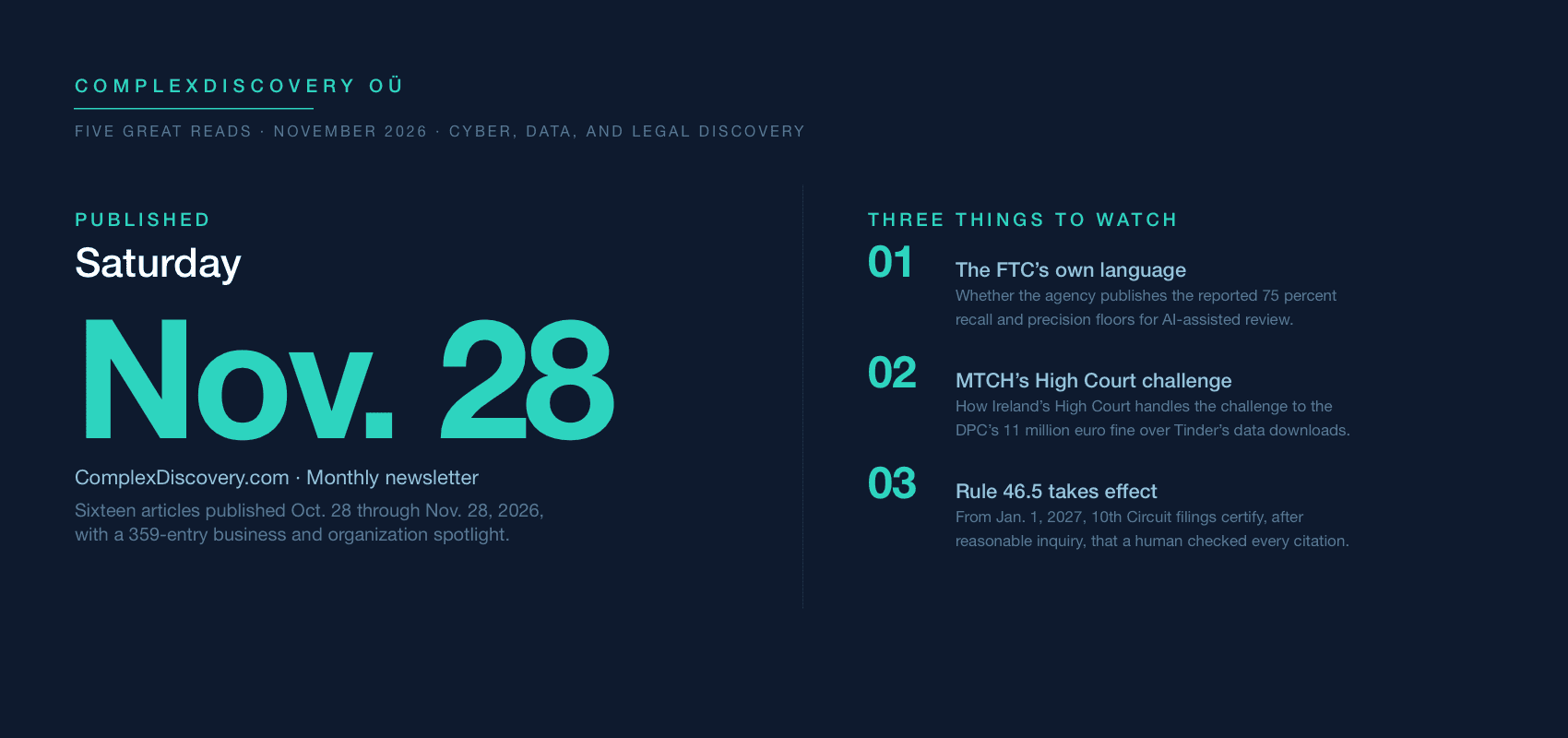
About ComplexDiscovery OÜ
ComplexDiscovery OÜ is an independent digital publication and research organization based in Tallinn, Estonia. ComplexDiscovery covers cybersecurity, data privacy, regulatory compliance, and eDiscovery, with reporting that connects legal and business technology developments—including high-growth startup trends—to international business, policy, and global security dynamics. Focusing on technology and risk issues shaped by cross-border regulation and geopolitical complexity, ComplexDiscovery delivers editorial coverage, original analysis, and curated briefings for a global audience of legal, compliance, security, and technology professionals.
Learn more at ComplexDiscovery.com.
Assisted by GAI and LLM Technologies
- An Abridged Look at the Business of eDiscovery: Mergers, Acquisitions, and Investments
- eDisclosure Systems Buyers Guide – Online Knowledge Base
Source: ComplexDiscovery OÜ

ComplexDiscovery’s mission is to enable clarity for complex decisions by providing independent, data‑driven reporting, research, and commentary that make digital risk, legal technology, and regulatory change more legible for practitioners, policymakers, and business leaders.