You are viewing ARCHIVED CONTENT released online between 1 April 2010 and 24 August 2018 or content that has been selectively archived and is no longer active. Content in this archive is NOT UPDATED, and links may not function.
By K&L Gates
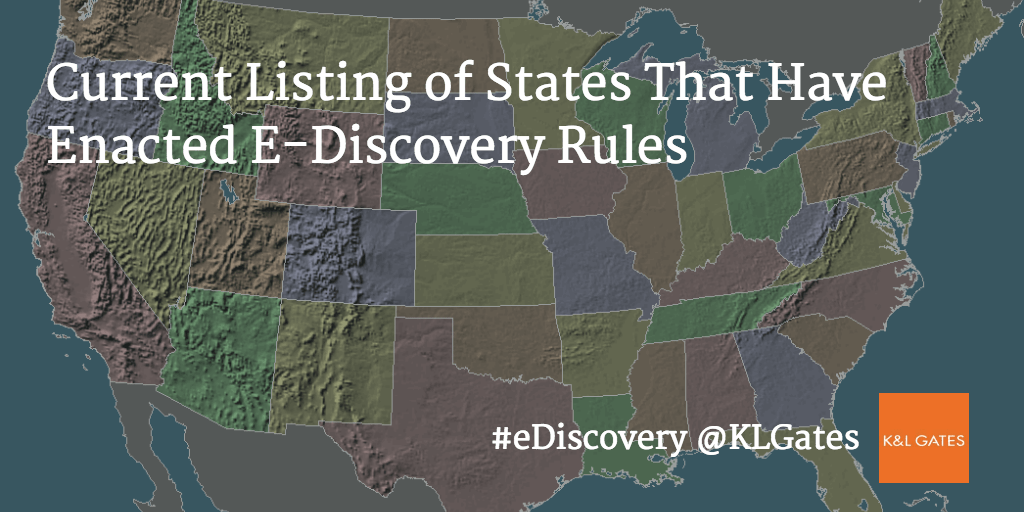
More and more states are adopting statutes and court rules addressing the discovery of electronically stored information. Here is a current list with links to the relevant provisions. Please note also that many judges have created their own forms or have crafted their own preferred protocols for e-discovery. These are generally available on the website of the individual judge and care should be taken to ensure you are aware of any such forms or guidelines in any court you may appear in.
If you have information or offering requests that you would like to ask us about, please let us know, and we will make our response to you a priority.
ComplexDiscovery OÜ is an independent digital publication and research organization based in Tallinn, Estonia. ComplexDiscovery covers cybersecurity, data privacy, regulatory compliance, and eDiscovery, with reporting that connects legal and business technology developments—including high-growth startup trends—to international business, policy, and global security dynamics. Focusing on technology and risk issues shaped by cross-border regulation and geopolitical complexity, ComplexDiscovery delivers editorial coverage, original analysis, and curated briefings for a global audience of legal, compliance, security, and technology professionals. Learn more at ComplexDiscovery.com.
Generative Artificial Intelligence and Large Language Model Use
ComplexDiscovery OÜ recognizes the value of GAI and LLM tools in streamlining content creation processes and enhancing the overall quality of its research, writing, and editing efforts. To this end, ComplexDiscovery OÜ regularly employs GAI tools, including ChatGPT, Claude, Gemini, Grammarly, Midjourney, and Perplexity, to assist, augment, and accelerate the development and publication of both new and revised content in posts and pages published (initiated in late 2022).