
Editor’s Note: Hackers breached Cloud One, the U.S. Air Force’s flagship cloud computing platform, and the Pentagon has not said what, if anything, they took. Reuters reported Nov. 27, 2026, that the intrusion surfaced during a system upgrade; its discovery blocked updates for applications hosted on the platform. A person who spoke to the Associated Press said Cyber Defense Command has since mitigated the threat and described the episode as a minor nuisance that did not touch mission-critical or classified systems. The Defense Department says its systems are “safe, secure, and managed 24-7 by the best experts and teams in the world.”
The episode compresses problems cybersecurity, privacy, compliance and eDiscovery professionals manage daily: a compromise of the control plane, the management layer above a cloud platform’s workloads; a patching freeze that arrived as new software vulnerabilities were disclosed; a prime-contractor handoff from SAIC to Leidos on a task order worth up to $454.9 million; and a Treasury incident that extended filing deadlines under the Bank Secrecy Act, the nation’s anti-money-laundering reporting law, to Dec. 30. Watch three markers: whether Cloud One migrations resume, whether Congress summons program officials, and whether the National Security Council review produces new cloud-security mandates.
Content Assessment: Hackers breached the Air Force's Cloud One platform. Your cloud contract could be next.
Information - 93%
Insight - 93%
Relevance - 94%
Objectivity - 92%
Authority - 92%
93%
Excellent
A percentage-based assessment of the value of this ComplexDiscovery analysis, which uses the Air Force’s Cloud One breach to examine three questions for cloud customers: when to pause patching, how to preserve evidence, and which incident-response obligations should survive a change in contractors.
News Analysis – Cybersecurity Beat
Hackers breached the Air Force’s Cloud One platform. Your cloud contract could be next.
ComplexDiscovery Staff
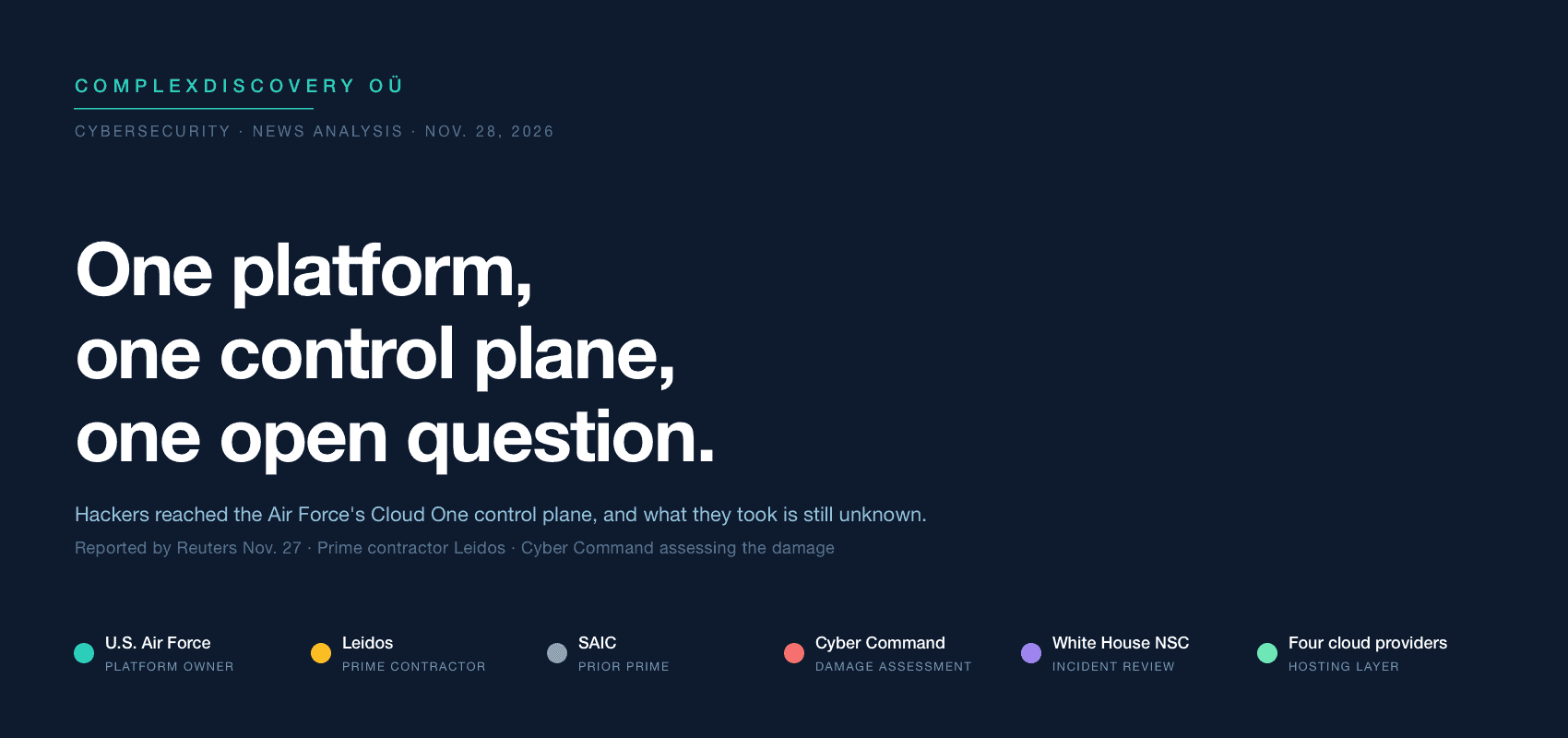
Hackers breached Cloud One, the flagship cloud platform of the U.S. Air Force, and officials have not disclosed whether anything was taken. The intrusion at Cloud One, the service’s central cloud environment since 2017, surfaced during a system upgrade and has disrupted work across the platform, Reuters reported on Nov. 27.
Cloud One consolidated the Air Force’s IT onto one platform, drawing on Microsoft, Amazon, Oracle and Alphabet. Its public portal lists 189 production systems, and two of Reuters’ sources count it among the U.S. military’s biggest cloud platforms. It hosts the Cloud-Based Command and Control system, which assembles radar and other air-defense feeds from across North America, and the Theater Integrated Combat Munitions System, which follows bombs and missiles at over 200 Air Force sites worldwide. “A breach here is a big deal,” one person familiar with the matter told Reuters.
Two of the people familiar with the matter said the discovery came within the past month or so during upgrade work on the system, and it has disrupted operations across the platform. Reuters could not determine who the hackers were, the intrusion’s full scope or whether any data was stolen. All five people familiar with the matter spoke on condition of anonymity, according to Reuters. The Associated Press, citing a person familiar with the incident, reported that the intrusion occurred in early 2026 and described it as a minor nuisance that did not touch mission-critical or classified systems. NBC News, citing a U.S. official, reported that the breach could have exposed sensitive military information.
How the intrusion surfaced
One person familiar with the matter told Reuters the intruders exploited a software flaw to reach the control plane, the management layer that sits above a platform’s workloads. The person likened the control plane to a universal remote, telling Reuters an intruder with access could in theory review the status of military aircraft or follow spare-parts shipments. Whether the hackers did so remains unclear. Reuters could not pin down the vulnerability they used.
Updates to applications already running on Cloud One were blocked at a bad moment: a new batch of serious software vulnerabilities had just been disclosed across the technology industry, and Air Force personnel could not apply the fixes, Reuters reported. Migration of back-office applications to the platform, a longstanding military priority, has been paused. A fifth source said some users lost their administrator access.
The record will sting, too. In a 2023 commentary for FedScoop, attributed to Cloud One’s leadership, the team claimed a success rate it put at 100 percent against what it described as a “staggering” volume of attempts to penetrate the cloud. “There is no room for error when it comes to security,” the leaders wrote.
The response and the patching freeze
In a statement to Reuters, the Air Force said it “does not comment on the security posture, vulnerabilities or operational status of specific networks and systems.” The statement added that the service “continuously take[s] prudent measures to protect Department (of the Air Force) information, systems and mission capabilities.” The Defense Department told AFP its systems are “safe, secure, and managed 24-7 by the best experts and teams in the world.”
Behind the statements sits the dilemma information governance professionals know well: the freeze-versus-patch tension that follows every legal hold and incident response, scaled to a warfighting platform. Cloud One’s public portal lists systems spanning Impact Level 2 through Impact Level 6, from unclassified administrative workloads to classified enclaves, though public reporting does not establish which impact levels the pause reached. Guidance from the National Institute of Standards and Technology, whose Special Publication 800-61 Rev. 3 frames incident response within its Cybersecurity Framework, recommends that organizations preserve evidence and record response actions as they go. An exception log with expiry dates, compensating controls and a named owner keeps a remediation pause from becoming an indefinite one. For eDiscovery teams, the same incident demands a custody memo: which systems stopped changing, when, and under whose control, so that any records drawn from the platform later carry a defensible chain of custody.
SAIC was Cloud One’s prime contractor until 2026, when Leidos took over, according to Reuters. Leidos’ takeover followed a task order worth up to $454.9 million, awarded in December 2025 according to Washington Technology and announced by Leidos in March. “Modernizing Cloud One helps the Air Force deploy mission-critical operations faster and defend them more effectively,” said Steve Hull, president of Leidos’ digital modernization, in the March announcement. SAIC, the prior prime, did not respond to a Reuters request for comment, and Leidos referred questions to the Air Force. One source said investigators called in Cyber Command to measure the harm. The White House National Security Council and Homeland Security Council are reviewing the incident, the AP reported, and a person familiar with the incident said Cyber Defense Command has mitigated the threat.
Contractor reporting duties under DFARS
Neither SAIC nor Leidos has said whether the intrusion triggered formal incident reporting, but the acquisition-regulation framework governing both companies is explicit about what an incident affecting covered defense information demands. Defense Federal Acquisition Regulation Supplement (DFARS) clause 252.204-7012 requires contractors to “rapidly report” cyber incidents affecting covered defense information within 72 hours of discovery, and its cloud-services provision routes cloud computing to clause 252.239-7010, which carries its own incident-reporting requirement. Clause 7012 remains in force after the Defense Department suspended Cybersecurity Maturity Model Certification Phase 2 verification requirements in July. Which provision reaches Cloud One’s task order, and whether any notification occurred, are not established by public reporting.
The contract question outlasts the incident. Incident-response obligations, forensics access and data-portability guarantees must survive vendor transitions in writing, and Cloud One’s prime contractor changed within the past year, so enterprises that cannot show those terms are discovering them during incidents rather than negotiations.
The intrusion also landed amid a string of disclosed federal cyber incidents.
A bruising month for federal networks
In congressional testimony on Nov. 18, Director of National Intelligence Jay Clayton addressed a series of nationwide technical outages before the House Homeland Security Committee. “Based on what we know today, after a great deal of digital diligence, these are separate service outages associated with maintenance and technical changes,” he said. “They are not a coordinated or state-sponsored attack.” Separate intrusions disclosed in the days afterward showed the month’s problems did not stop at outages.
The Treasury Department’s Financial Crimes Enforcement Network disclosed unauthorized access to some systems and, by order FIN-2026-R002 issued Nov. 24, gave certain filers until Dec. 30 to submit Bank Secrecy Act reports otherwise due from Nov. 18 through Dec. 29. Compliance teams at regulated institutions should treat that deadline as live and the underlying incident record as input to their own vendor-risk reviews. The New York Times reported Nov. 24 that a system the CIA and the Office of the Director of National Intelligence use to analyze public and commercially available information had been breached; officials said no classified data was exposed. Counting the intelligence and Treasury breaches, Reuters tallied at least six recent federal cyber incidents besides Cloud One, including two at the FBI, a Pentagon data hack and a leak of Homeland Security personnel information.
The White House dismissed National Cyber Director Sean Cairncross on Nov. 19 and installed Pentagon Chief Information Officer Kirsten Davies in an acting capacity after a string of nationwide technical outages. On Nov. 23 it named Director of National Intelligence Jay Clayton acting national cyber director, with Davies nominated for the permanent post. President Donald Trump addressed the breach of the FBI’s National Crime Information Center, the second major FBI breach in recent months. “Well, we just heard about it, and I will say that it’s not good. I don’t like that,” Trump said in a Fox News interview, according to ABC News.
The Cloud One assessment will test whether November was an anomaly or a baseline.
What comes next for Cloud One
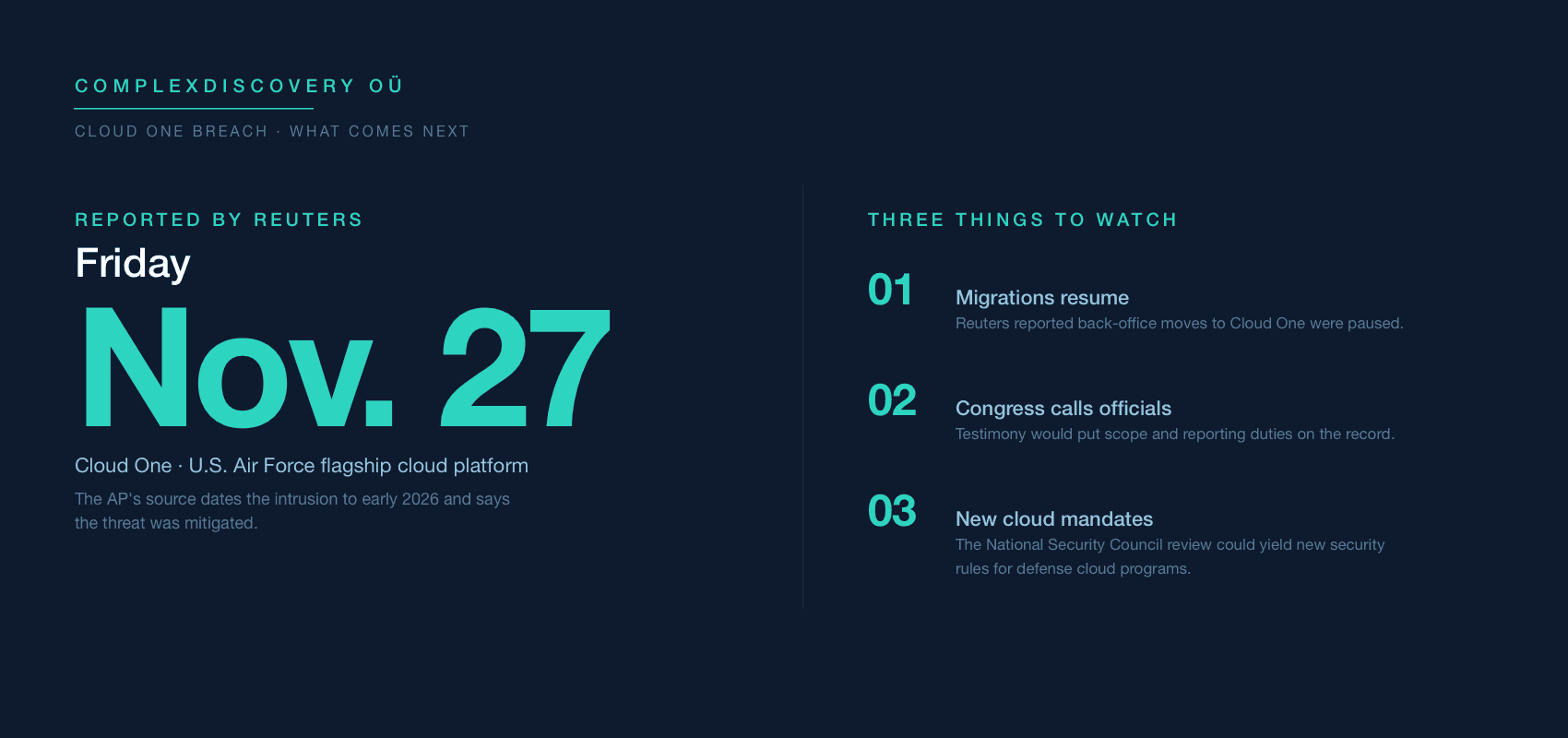
Watch for three markers: whether migration plans resume, whether Congress summons program officials for testimony, and whether the National Security Council review produces new cloud-security mandates for defense programs. The Air Force has not said whether data left the environment, and Cyber Command has not disclosed the results of the damage assessment.
Reuters’ sources place the discovery during upgrade work on the system; a second account, reported by Federal News Network citing a person familiar with the incident, described the breach being found earlier in the year while patching a vulnerability. The Pentagon has not said what, if anything, was taken. Data governance teams should run the same inventory now: where custody sits, what a freeze preserves, and what a pause leaves exposed in the systems their organizations moved to the cloud.
A platform built to end fragmentation concentrated the Air Force’s records, pay systems and weapons tracking behind one control plane, and a single software flaw put that layer in play. If consolidation built the target, what does your own consolidation strategy say about where the next control plane sits?
News Sources
- 48 CFR 252.204-7012: Safeguarding Covered Defense Information and Cyber Incident Reporting (Cornell Legal Information Institute)
- 48 CFR 252.239-7010: Cloud computing services (Cornell Legal Information Institute)
- Cloud One (U.S. Air Force)
- Incident Response Recommendations and Considerations for Cybersecurity Risk Management: A CSF 2.0 Community Profile (NIST)
- Cybersecurity Maturity Model Certification (Department of Defense Chief Information Officer)
- Order FIN-2026-R002: Temporary, limited exceptive relief for certain Bank Secrecy Act and Corporate Transparency Act submissions (FinCEN)
- Hackers breach US Air Force flagship Cloud One computing platform (Reuters via Military Times)
- Hackers breach U.S. Air Force flagship Cloud One computing platform (Reuters via CNBC)
- Hackers got into the Air Force cloud computing system, but critical parts not impacted (AP via U.S. News & World Report)
- US military says cyber systems secure after reports of Air Force hack (AFP via Tribune.com.pk)
- FBI’s national crime database targeted in hack, Trump says (ABC News)
- Sean Cairncross was fired as national cyber director (The Hill)
- Hackers attack and penetrate Air Force’s computing platform (NBC News)
- Hackers breach Air Force’s “Cloud One” computing environment (Federal News Network)
- DNI Jay Clayton says recent US service outages not coordinated cyberattack (Fox News)
- S. CIA, ODNI suffer cybersecurity breach of some unclassified information, Reuters source says (Reuters via CP24)
- Cybersecurity Breach Reported At CIA And National Intelligence Director’s Office (Forbes)
- Leidos wins $455M Air Force cloud architecture job (Washington Technology)
- Leidos Wins $454.9M Contract to Modernize Air Force’s Cloud One Platform (WashingtonExec)
- Cloud One: Taking aim at the enemy, one application at a time (FedScoop)
- US Air Force Cloud One Breach: Hackers Hit Military Cloud (Cybernews)





Assisted by GAI and LLM Technologies
Additional reading
- Microsoft lists Salt Typhoon among ARTEX users but ties no campaign to it
- CNIL fines Macif Vie 5 million euros over clear-text passwords and a 21-year login log
- Johnson Controls agrees to pay $5 million over alleged security plan gaps in federal contracts
- Officials tie FAA ground stop to contractor router work, not hackers, but the specific fault is still undetermined
- Notion AI chats surface in Fireworks breach, testing what zero retention covers
- France ties October supermarket fridge sabotage to Iran’s IRGC and seeks arrest warrants
- ENISA’s update advisory turns the patch pipeline into an evidence trail
- Britain’s cyber agency warns of a possible surge, and its own incident figures raise a question
- Supermarket freezer attacks reach at least six European countries, and the record linking them to US base failures stays thin
- Microsoft finds 2 North Korean groups using ARTEX, a tool that alone cannot name an attacker
- With over 40 percent of the record Binance theft frozen, getting it back becomes a legal project
- Estonia’s cyber authority saw no state-sector PHP crisis as three state institutions shut or restricted services
- AI recording spreads in Estonian health care as the regulator says the audio needs its own legal basis
Source: ComplexDiscovery OÜ

ComplexDiscovery’s mission is to enable clarity for complex decisions by providing independent, data‑driven reporting, research, and commentary that make digital risk, legal technology, and regulatory change more legible for practitioners, policymakers, and business leaders.