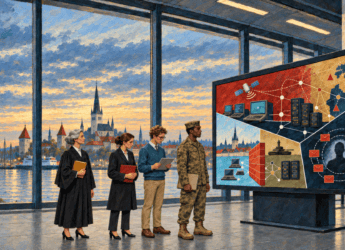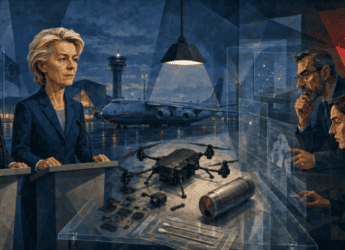
Editor’s Note: Estonia’s Victory Day offers a timely lens for examining how historical memory, national resilience, and modern deterrence intersect on NATO’s eastern flank. This article connects the June 23 commemoration of the 1919 Battle of Võnnu/Cēsis with Estonia’s current defense posture, including the Baltic Defence Line, elevated defense spending, conscription, reserve mobilization, allied presence, and cyber-defense readiness.
For cybersecurity, data privacy, regulatory compliance, and eDiscovery professionals, Estonia’s experience shows how geopolitical risk increasingly links physical security, digital infrastructure, public-sector continuity, and cross-border resilience. Its 2007 cyberattacks, continued investment in national defense, and role as host to NATO’s cyber defense center make Estonia a relevant case study for understanding how small states prepare for multidomain threats while preserving democratic continuity.
Content Assessment: The flame and the frontier: how Estonia carries a 1919 victory into a tense 2026
Information - 93%
Insight - 94%
Relevance - 93%
Objectivity - 92%
Authority - 93%
93%
Excellent
A short percentage-based assessment of the qualitative benefit expressed as a percentage of positive reception of the recent article from ComplexDiscovery OÜ titled, "The flame and the frontier: how Estonia carries a 1919 victory into a tense 2026."
Industry News – Geopolitics Beat
The flame and the frontier: how Estonia carries a 1919 victory into a tense 2026
ComplexDiscovery Staff
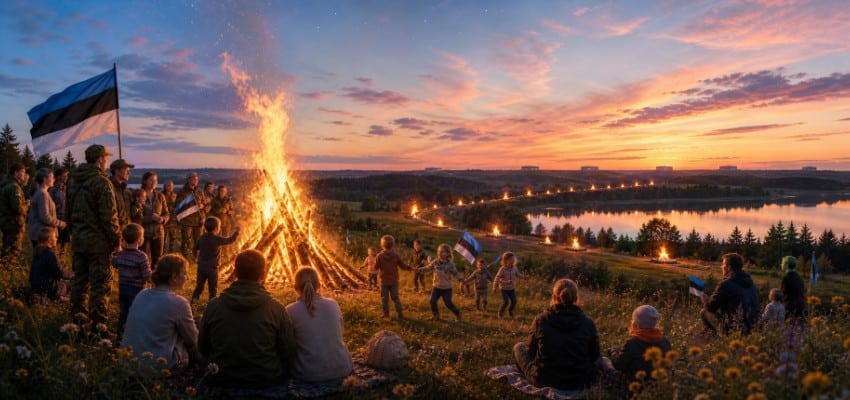
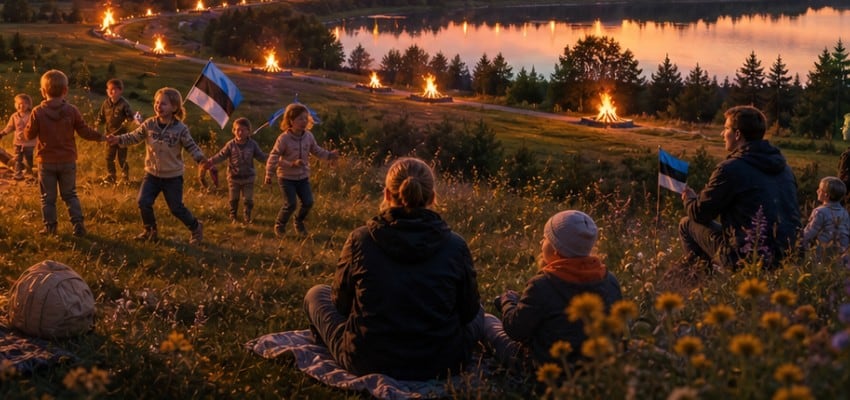
Each year on June 23, Estonia lights a victory flame and carries it the length of the country, kindling bonfire after bonfire until much of the nation glows against the short northern night. The Defense League tends the tradition, and the flame travels from town to town as a thread between generations. The ritual is gentle. The history beneath it is anything but.
This year the flame reached Rapla, a quiet town in north-central Estonia, where about 1,000 soldiers, volunteers and allied troops marched for Võidupüha, Victory Day, the public broadcaster ERR reported. The holiday commemorates a decisive moment in Estonia’s War of Independence. President Alar Karis, Estonia’s supreme commander of national defence under the constitution, reviewed the ranks and then offered a quiet surprise of his own. It was the last time, he told the nation in remarks carried by ERR, that he would wish them a happy Victory Day as head of state; he will not seek a second term. Even a holiday built on continuity had its turning point.
To understand why a small country still lights fires for a battle fought 107 years ago, and why it is now cutting trenches along its Russian border, you have to follow the flame back to a desperate June in 1919.
A desperate June in 1919
Estonia was barely a year old and fighting for its survival. In the fields near Võnnu, the town Latvians call Cēsis, a combined Estonian and Latvian force met the Baltische Landeswehr, a German-led army of Baltic German nobles intent on keeping the region under German rule. The defenders were outgunned and held anyway. On June 23 they turned a desperate stand into a rout, breaking the military power of an aristocracy whose grip on the land reached back centuries to the medieval crusades, and swinging the wider War of Independence in Estonia’s favor.
What the soldiers won on the field, the diplomats made permanent the following winter. In the Tartu Peace Treaty of Feb. 2, 1920, Soviet Russia ‘unreservedly’ recognized Estonia’s independence and gave up, in the document’s own words, ‘forever all sovereign rights’ over the Estonian people and their land. Estonians have called that page their birth certificate ever since, the first time the world recognized their republic in law.
The years the flame went out
Independence did not hold. The Riigikogu, Estonia’s parliament, had made June 23 a national holiday in 1934, but within a decade two occupations swallowed the country whole. Nazi Germany banned the celebration during the war, and the Soviet Union banned it again after 1944, when it absorbed Estonia and treated the country’s independence as a legal fiction. The flame went dark for nearly half a century.
It returned in 1992, lit once more in the courtyard of Kadriorg Palace, a year after Estonians reclaimed their country, and the Defense League has carried the commemorations since 2000. This is why the parade in Rapla is no costume drama. The people watching it can remember, or were raised by those who remember, what it felt like to be erased from the map.
Reading the threat from the east
Estonia studies its neighbor the way you study weather you have lived through before. Defense Minister Hanno Pevkur has been reported as warning that Russia could need only two to four years to rebuild the army it is spending in Ukraine, a clock that runs faster than many in the West care to admit. Through the autumn of 2025, Russian aircraft slipped into NATO airspace often enough that allied officials stopped calling it an accident and began calling it a test. Analysts at the European Council on Foreign Relations and Poland’s Centre for Eastern Studies place the sharpest near-term danger in the period already underway, as Russia’s production, refurbishment and readiness lines converge.
So Estonia has changed how it means to fight. The old Baltic plan assumed small nations would trade land for time, falling back and counterattacking later. The new plan, forward defense, refuses to surrender ground that holds most of the country’s people and cities. The line is to be held from the first meters of the border.
Digging in, and looking ahead
Drive toward the Russian frontier today and the new thinking shows up in the soil. Estonia, Latvia and Lithuania announced the Baltic Defence Line in January 2024, and Estonia’s share calls for some 600 bunkers strung along its border, braced by anti-tank ditches and the forests and rivers already there. Each bunker, about 35 square meters, is built to shrug off a 152-millimeter shell. The first were set into the ground late in 2025, and crews have begun cutting ditches across the southeast.
Behind the concrete stands a whole society arranged for defense. Estonia kept conscription when much of Europe let it lapse, and young Estonians serve 11 months. Borrowing Finland’s model, the country leans on its reserves, so that a small active force expands in wartime to roughly 43,000, drawn from the nearly 230,000 people, close to a fifth of the population, who sit on the mobilization rolls. On top of that sit Estonia’s allies: a British-led NATO battlegroup and rotating American armor parked near the border.
All of it costs money, and Estonia has decided to pay. Its 2026 budget sends at least 5 percent of the country’s economic output to defense, about 844.5 million euros above the year before, buying air defense, drones and counter-rocket systems, with a further 0.25 percent of GDP supporting Ukraine, including through Estonian defense-industry production. The country reached the 5 percent mark NATO leaders set at The Hague in June 2025, under the alliance’s Hague Investment Plan and well above the old 2 percent benchmark, a full nine years ahead of the 2035 deadline. Its defense even reaches into places the soldiers of 1919 could never have pictured: in 2007, a three-week wave of cyberattacks battered the country’s banks, ministries and newsrooms, and Estonia answered by making Tallinn the home of NATO’s cyber defense center.
And so the flame that crosses Estonia each June carries two meanings at once. It honors the people who won the country, and it watches the one neighbor that has taken the country away before. As the rest of Europe argues about how quickly Russia can rearm and how much deterrence is worth, Estonia has already answered the harder question for itself, the one buried beneath all the bunkers and budgets: what is a country willing to do to keep the independence it celebrates?
News sources
- Gallery: Estonia’s Victory Day marked with annual parade in Rapla (ERR)
- Tartu Peace Treaty, 2 February 1920 (Estonian Ministry of Foreign Affairs)
- Feature: June 23, Estonia’s Victory Day (ERR)
- World War I and the War of Independence (Estonian War Museum)
- Baltic Defence Line (Estonian Centre for Defence Investments)
- Estonia erects first of 600-strong Baltic bunker wall on Russia border (Defense News)
- Conscript service (Estonian Defence Forces)
- Government approved the 2026 state budget (Republic of Estonia Government)
- The Hague Summit Declaration (NATO)
- The bear in the Baltics: reassessing the Russian threat in Estonia (European Council on Foreign Relations)





Assisted by GAI and LLM Technologies
Additional reading
- Estonia aims to be first to give AI agents official digital IDs
- Parliament hits pause on high-risk AI rules and bans nudifier apps
- Europe’s AI labeling rules arrive with a voluntary code and a hard deadline
- AI is becoming an advisor, and it is rewriting how buyers find you
- What marketing confidence actually looks like
- When credibility comes first, capability sells itself: The case for news-led marketing
- The one question that reveals whether your marketing plan is actually a plan
- How Prompt Marketing Is Redefining Thought Leadership In The AI Era
- Raising The Age Ceiling: How AI Is Extending Executive Leadership
- Staying Curious: One Practical Defense Against Creative Burnout
- From Longbows To AI: Lessons In Embracing Technology
- 20 Ways Creative Professionals Battle Burnout And Find Fresh Ideas
- 14 Points For Brands To Consider Before Making Sociopolitical Statements
Source: ComplexDiscovery OÜ
ComplexDiscovery’s mission is to enable clarity for complex decisions by providing independent, data‑driven reporting, research, and commentary that make digital risk, legal technology, and regulatory change more legible for practitioners, policymakers, and business leaders.