
Editor’s Note: Ukraine’s Defense Ministry said Oct. 24 that its forces’ Starlink and Starshield terminals again hold stable connections at movement speeds above 400 kilometers per hour, 10 days after Kyiv first reported an unannounced cap that cut connections near 160 kilometers per hour and disrupted drone missions. Starlink is SpaceX’s commercial satellite internet service; Starshield is its government-grade version. Who imposed the cap remains disputed.
The Wall Street Journal reported that Elon Musk ordered it; Reuters, that the instruction came from inside the White House. The White House blamed a technical malfunction, Secretary of State Marco Rubio said nobody ordered it, and Musk said Starshield limits are decided by the U.S. military and, ultimately, the president. Nine U.S. senators asked the Defense Department’s inspector general to investigate, and four asked SpaceX who can change Ukraine’s access and what notice it owes.
For cybersecurity, information governance and eDiscovery professionals, it tests vendor control, change notice and records preservation when a private company runs critical systems. Watch the senators’ Nov. 1 and Nov. 2 deadlines and an aid-mission ceasefire around Oleshky, a Russian-occupied town in Ukraine’s Kherson region, which Ukraine’s negotiator says starts Oct. 27 and the White House dates to Oct. 29.
Content Assessment: Kyiv says Starshield speeds are back, but who capped them is still disputed
Information - 93%
Insight - 94%
Relevance - 92%
Objectivity - 93%
Authority - 94%
93%
Excellent
A short percentage-based assessment of the qualitative benefit expressed as a percentage of positive reception of the recent article from ComplexDiscovery OÜ titled, "Kyiv says Starshield speeds are back, but who capped them is still disputed."
News Analysis – Geopolitics Beat
Kyiv says Starshield speeds are back, but who capped them is still disputed
ComplexDiscovery Staff
Ukraine’s Defense Ministry said Saturday that Starlink and Starshield terminals are again holding stable connections at speed, 10 days after Kyiv first reported an unannounced cap that neither SpaceX nor Washington has acknowledged imposing.
The recovery shows the link works again, not who can switch it off. That question, who sets the terms Kyiv operates under, ran through Ukraine’s week: Vladimir Putin described occupied Ukrainian land as historically Russian, and Ukrainian negotiators agreed to a U.S.-brokered pause in fighting so aid can reach occupied Oleshky. Kyiv helped write the Oleshky terms; the communications cap reached its front lines without warning, and the territorial demands came from Moscow.

How an unannounced speed cap reached the front
The communications cap is the plainest case, and it hit Starshield, SpaceX’s government-grade variant of its Starlink network. Ukraine first reported it Oct. 14, when units found their Starshield terminals dropping offline as they neared about 160 kilometers per hour, Euronews reported; a bipartisan Senate letter places the restrictions themselves between Oct. 12 and 14. The cap applied to how fast a terminal could travel while staying connected, not to download speeds, the Ukrainian outlet Hromadske reported. The affected missions included mid-range strike drones and the interceptor drones Ukraine flies against Russian aerial attacks on its cities, according to Euronews.
A week later, Washington and Kyiv disagreed over whether service had returned. President Donald Trump said Oct. 22 that Elon Musk had lifted the restrictions, Hromadske reported. “We are currently seeing no indication that the Starlink restrictions have been lifted,” Serhii Beskrestnov, a defense technology adviser to President Volodymyr Zelensky, wrote on Facebook on Oct. 23, according to Euronews. Defense Ministry sources told Hromadske the same day that terminals were still dropping connections at 161 kilometers per hour, about 100 miles per hour. The Institute for the Study of War (ISW) called the situation unclear in its Oct. 23 assessment, with Ukrainian sources still reporting trouble reaching the terminals.
By Saturday the reading had changed. The ministry’s monitoring systems “are officially recording the restoration of Starlink/Starshield operating speed,” the Defense Ministry said, with connections stable at movement speeds above 400 kilometers per hour, the operating limit Zelensky had said the system held before the cap. Defense Minister Yevhenii Khmara credited “direct dialogue and the persistent stance of the President of Ukraine at the highest level,” and the ministry said it continues to monitor the system.
Who set the limit remains in dispute
That recovery does not settle who imposed the cap or why. The Wall Street Journal reported Oct. 20, citing U.S. officials and people familiar with the decision, that Musk personally ordered the restriction amid his frustration with Ukraine’s strikes on Russian oil refineries, according to Hromadske. The Journal also found conflicting accounts of whether Trump knew in advance, and Hromadske noted that Musk and Trump had both expressed anger over those strikes. Reuters reported Oct. 15 that the instruction to curb Starshield reached Pentagon officials “from inside the White House,” according to a Snopes review of the competing accounts. The Telegraph reported that the idea originated with Musk, who raised it with Trump, Snopes said.
The principals have offered competing explanations. Musk placed the decision with the government in an Oct. 14 post on X, quoted by Snopes and by four U.S. senators in a letter to SpaceX: “Starshield systems are owned and controlled by the US government. Any limits on speed or usage are decided by the US military and ultimately POTUS.” The White House has blamed a technical malfunction, Hromadske reported. Trump said Oct. 16 that he did not think it was him or Musk, according to Snopes. Secretary of State Marco Rubio told reporters at Joint Base Andrews on Oct. 17 that “nobody ordered” the slowdown, according to a State Department transcript. Zelensky told NBC’s “Meet the Press” on Oct. 18 that the limit came as a message from the American government and that SpaceX technically carried it out, Snopes reported. Trump declined on Oct. 22 to confirm a Journal report that he had called Musk to ask that the limit be lifted, Hromadske reported.
Even Ukraine’s access to Starshield is disputed. In his Oct. 17 remarks, Rubio said Ukraine does “not have Starshield now” and has asked for access, while the senators’ letter to SpaceX says Ukraine “has received access to Starshield services procured by the U.S. Government.” Musk’s post drew a separate line around the commercial product, saying Starlink use is limited to “civilian or defensive activities” because offensive use “would be inappropriate for a commercial company.” SpaceX did not return Snopes’ request for comment on who ordered the slowdown.
The contract questions senators want answered
Senators started asking for the paper trail the day after Ukraine reported the cap. In an Oct. 15 letter, nine senators led by Jeanne Shaheen, D-N.H., and Thom Tillis, R-N.C., asked the Defense Department’s inspector general to investigate disruptions to U.S.-supported communications and intelligence sharing in Ukraine. They asked whether any U.S. officials “directed, authorized, approved, or had advance knowledge” of changes to Starlink and Starshield services. Another question asks whether SpaceX, the Defense Department or other government entities “directed, authorized, or implemented” any restrictions, and whether those restrictions were consistent with government contracts. The letter requests an initial briefing by Nov. 1.
A separate Oct. 19 letter to SpaceX from Shaheen and fellow Democrats Richard Blumenthal, Sheldon Whitehouse and Chris Coons frames the governance problem directly. SpaceX “owns and operates the underlying Starlink network and infrastructure upon which certain Starshield services rely,” the senators wrote, and that arrangement raises “important questions about the respective technical, contractual, and operational authorities retained by SpaceX and the U.S. government.” The letter asks who may restrict Ukraine’s Starshield access, how any change must be “documented and noticed,” and whether SpaceX can refuse a “government-directed change.” It asks for SpaceX’s Starshield contracts related to Ukraine and its communications with federal agencies about the restriction, sets a Nov. 2 deadline and says Germany funds Ukraine’s Starlink access.
The arrangement has been tested before, in both directions. Reuters reported in July 2025, citing three unnamed people, that Musk ordered Starlink coverage cut during Ukraine’s fall 2022 counteroffensive in Kherson Oblast. A Ukrainian military official told Reuters the outage stalled an attempt to encircle a Russian position in Beryslav. A SpaceX spokesperson called the reporting “inaccurate” without specifying any errors, Reuters said, and Musk has denied in past statements that he disabled terminals. In February 2026, by contrast, Ukraine’s Defense Ministry said a terminal whitelist built “in cooperation with SpaceX” would disable unregistered terminals that Russian forces had been mounting on attack drones, Euronews reported.
What the episode asks of vendor oversight
Those swings, from a reported cutoff to open cooperation, are what make the senators’ questions useful beyond Ukraine. For security, governance and legal teams, the case is vendor dependence at its most consequential. The senators’ questions work as a checklist any organization can put to a critical provider: who may change service terms, what notice is owed, how a change is recorded and whether the provider can refuse an instruction.
The inspector general letter also asks that communications, contractual records, technical directives and correspondence between the department and SpaceX be preserved. That list maps onto the records most organizations would need after an unexplained service change, which argues for capturing change notices, configuration logs and provider correspondence when a change happens rather than when a regulator or court asks. Ukraine is hedging its own exposure. In an Oct. 22 letter of intent, its Defense Ministry and the Finnish firms ICEYE and Nokia agreed to study a satellite network Ukraine would own and control, though Euronews said the effort remains preliminary.
Putin restates claims that reach past Donetsk
A network Ukraine owns would not change the other terms it faces, and those are set in Moscow. Asked by state television correspondent Pavel Zarubin on Oct. 22 about Zelensky’s offer to freeze the war along the current front, Putin said the territory belonged not to Ukraine but to historical Russia, Meduza reported. He also claimed that recent genetic research shows Russians and Ukrainians are “one people,” without identifying the research.
ISW assessed that the reference likely points to “Novorossiya,” which it called an invented region the Kremlin has described as integral to Russia, covering Crimea, the four oblasts Russia claims to have annexed, and Kharkiv, Dnipropetrovsk, Mykolaiv and Odesa oblasts. By ISW’s count, the claim would require Ukraine to give up the 20.5 percent of Donetsk Oblast, 24.5 percent of Zaporizhia Oblast and 30 percent of Kherson Oblast it still controls. ISW read the remarks as a rejection of Zelensky’s proposal and as evidence that the Kremlin seeks Ukraine’s surrender rather than a compromise.
Zelensky’s position was not new. ISW noted that he has been open to freezing the line since November 2024, accepting de facto Russian control without legal recognition. Putin also said he was ready to discuss the broader European security architecture, a demand ISW traced to Moscow’s December 2021 ultimatum on NATO deployments. Kremlin aide Yuri Ushakov said Oct. 21 that Russia is ready in principle to resume three-way talks with the United States and Ukraine around Nov. 10. Zelensky said Oct. 23 that the three countries had agreed to a team-level meeting planned for the first half of November, adding that “it all depends on the Russians.”
An aid mission for Oleshky, with a staged ceasefire
Before any such talks, both sides confirmed a humanitarian agreement centered on a single occupied town. The White House said Oct. 23 that first lady Melania Trump, in her role as “Exclusive Intermediary,” secured a ceasefire localized to Oleshky that would begin Oct. 29. Its purpose is to let aid enter and to evacuate civilians who want to leave. “The situation in Oleshky is dire,” she said in the release. ISW said the Kremlin had rejected three earlier humanitarian ceasefire proposals from Lubinets, in May, July and September.
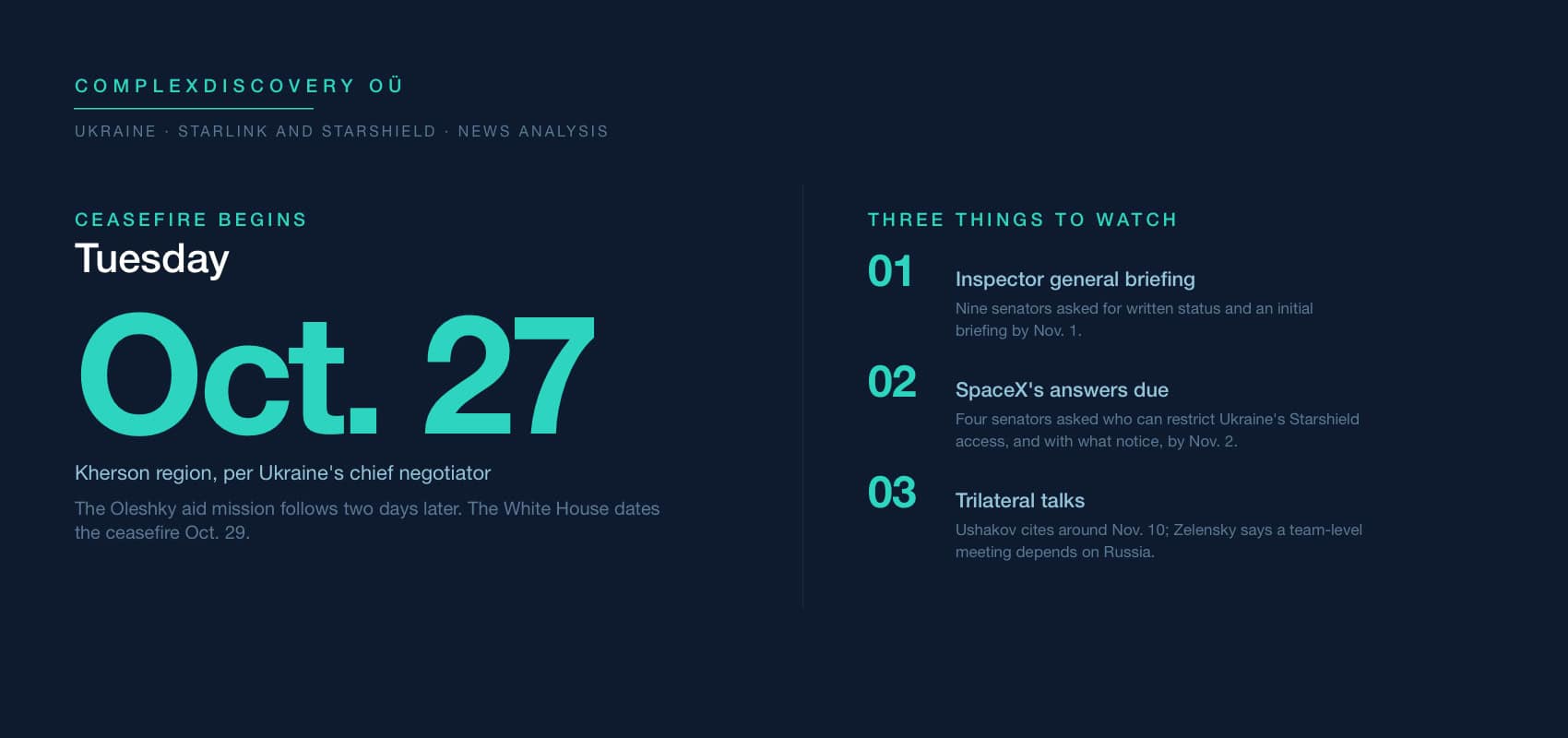
This time Moscow agreed, and Ukraine’s account sets out a staged sequence. Dmytro Lubinets, Ukraine’s human rights commissioner and its chief negotiator in the talks, told The Associated Press that the ceasefire starts Oct. 27, with the mission itself following two days later. He said the pause applies across Kherson Oblast and the nearby areas the operation depends on. Hromadske reported that both armies’ general staffs set the start for 3 a.m. Kyiv time on Oct. 27, the same moment as the 4 a.m. Moscow time announced by Gen. Valery Gerasimov, chief of Russia’s general staff. Lubinets said the routes into Oleshky would be demined first, before aid deliveries and evacuations.
How many people remain is uncertain. The White House estimates that 1,700 to 2,000 of Oleshky’s roughly 24,000 prewar residents remain, most of them older people, along with about 50 children, while noting that no formal count has been made since 2022. Hromadske reported that over 6,000 people, about 200 of them children, may still be in Oleshky and nearby areas.
Deadlines that converge in the coming weeks
For those residents and for the Starshield questions, the coming weeks set the calendar. The ceasefire is due to start Oct. 27 and the Oleshky mission two days later, by Lubinets’ account. The senators requested the inspector general’s briefing by Nov. 1 and SpaceX’s answers by Nov. 2, and both Moscow and Kyiv have pointed to possible trilateral talks in the first half of November.
If the ministry’s reading of 400 kilometers per hour holds, it restores a capability, not an answer. Until the contracts the senators requested show who may move that threshold, and with what notice, any operator that depends on a provider’s network is depending on a decision it may never see. Which of your organization’s critical services could change overnight, and who would be able to tell you why?
News sources
- First Lady Melania Trump Secures Ceasefire Between Russia and Ukraine, Localized to Oleshky (The White House)
- Starlink and Starshield speed restored in Ukraine (Ministry of Defence of Ukraine)
- We Need Trilateral Talks Between Ukraine, America, and Russia: President’s Online Address at the Hudson Institute (Office of the President of Ukraine)
- Secretary Of State Marco Rubio Remarks To The Press (U.S. Department of State via Public Technologies)
- Shaheen, Tillis Lead Bipartisan Senators in Calling for Department of Defense Inspector General Investigation into Starlink Disruptions in Ukraine (U.S. Senate Foreign Relations Committee, Democratic staff)
- Cornyn, Colleagues Call for Investigation into Starshield Disruptions in Ukraine (Office of U.S. Sen. John Cornyn)
- Shaheen, Blumenthal, Whitehouse, and Coons Demand Answers from SpaceX after Starlink and Starshield Failure Leaves Ukraine Vulnerable to Russian Attacks (U.S. Senate Foreign Relations Committee, Democratic staff)
- Russian Offensive Campaign Assessment, October 23, 2026 (Institute for the Study of War)
- Russian Offensive Campaign Assessment, October 22, 2026 (Institute for the Study of War)
- Russian Offensive Campaign Assessment, October 21, 2026 (Institute for the Study of War)
- Melania Trump forges ceasefire deal in Russian-occupied Ukrainian city (The Associated Press)
- Russia signals readiness to resume trilateral talks as Putin meets with US envoy (TASS)
- «Режим тиші буде діяти на всій Херсонщині». Омбудсман Лубінець розповів деталі про гуманітарну місію в Олешках (Hromadske, in Ukrainian)
- Musk ordered shutdown of Starlink satellite service as Ukraine retook territory from Russia (Reuters)
- Ukraine Says Restrictions on Starlink Speed Have Been Lifted (Bloomberg)
- Ukraine restores ‘stable’ connection to Musk’s Starlink, Kyiv says (Euronews)
- Starlink restrictions not lifted in Ukraine despite Trump’s claims, defence officials say (Euronews)
- Trump says Musk lifted Starlink restrictions in Ukraine, but Kyiv reports limits remain (UPDATED) (Hromadske)
- Musk ordered Starshield restrictions that disrupted Ukrainian drones: WSJ (Hromadske)
- Who ordered Starlink, Starshield slowdown in Ukraine? What we know (Snopes)
- Putin cites unspecified genetic research to claim Russians and Ukrainians are ‘one people’ (Meduza)
- Russia announces October 27 ceasefire on southern Ukraine’s Kherson front to evacuate residents of occupied Oleshky (Meduza)
- Musk’s SpaceX and Ukraine’s defence ministry to block Russia’s use of Starlink (Euronews)
- Musk ordered Starlink shutdown during Ukraine’s 2022 Kherson counteroffensive, Reuters reports (Kyiv Independent)

Assisted by GAI and LLM Technologies
Additional reading
- Diesel license, Starshield cap and intelligence warnings strain US support for Ukraine
- Drones hit two Yandex data centers, and a Kremlin decree sets terms for state management
- A cell tower near Lyman and Russia’s fight over its own war record
- How a general’s walk across a bridge tested Putin’s claim to Svyatohirsk
- Germany names Russia for the Leipzig drone, and keeps most of its evidence out of view
- Estonia scrambled jets over a drone no official has identified
- Russia leans on drones and dissent-proofing as fuel crisis bites
- Senate passes Graham sanctions act, shifting Russia pressure from policy to statute
Source: ComplexDiscovery OÜ

ComplexDiscovery’s mission is to enable clarity for complex decisions by providing independent, data‑driven reporting, research, and commentary that make digital risk, legal technology, and regulatory change more legible for practitioners, policymakers, and business leaders.