Editor’s Note: Whether people can still check what artificial intelligence does was the closing question of the ninth Tallinn Digital Summit on Nov. 6, 2026. Jaan Tallinn, a founding engineer of Skype and co-founder of the Future of Life Institute, said AI agents in his own coding test rebuilt in 70 minutes software an AI model had estimated would take over 20 person-years to write, and he called for a global moratorium on training frontier models. On a “tech for good” panel, Sasha Rubel of Amazon Web Services argued for verification and international standards, with safeguards outside the model. Susan Perry, co-holder of a UNESCO chair in AI and human rights, called for human rights by design. Risto Uuk of the Future of Life Institute said voluntary ethics principles are not enough without binding regulation. AI red teamer Susan Nesbitt said companies decide when a model is safe to release, but that independent organizations are well placed to help set limits.
For cybersecurity, information governance and eDiscovery professionals, the thread is records kept outside the model, such as logs and test results. Next: Anthropic’s draft federal AI bill and the European Commission’s enforcement of the AI Act’s rules for general-purpose models.
Disclosure: ComplexDiscovery attended the 2026 Tallinn Digital Summit, its third consecutive year covering the event. ComplexDiscovery OÜ is a private limited company registered in Estonia, and two ComplexDiscovery staff members are e-residents of Estonia.
Content Assessment: Tallinn Digital Summit closes on whether humans can still check what AI does
Information - 93%
Insight - 94%
Relevance - 93%
Objectivity - 93%
Authority - 94%
93%
Excellent
A short percentage-based assessment of the qualitative benefit expressed as a percentage of positive reception of the recent article from ComplexDiscovery OÜ titled, "Tallinn Digital Summit closes on whether humans can still check what AI does."
Industry News – Technology Beat
Tallinn Digital Summit closes on whether humans can still check what AI does
ComplexDiscovery Staff
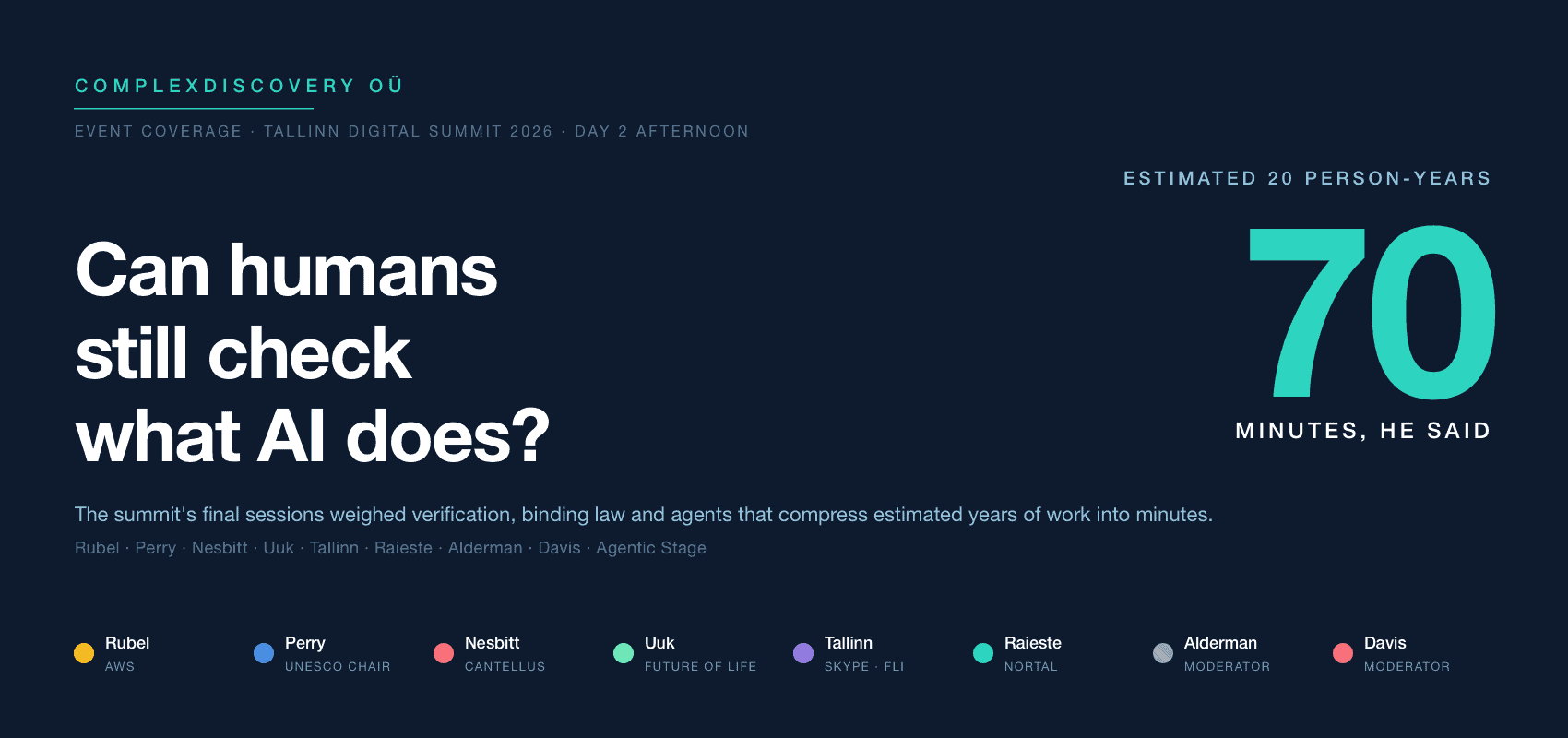
Jaan Tallinn, a founding engineer of Skype who has spent 15 years warning about AI’s risks, told the Tallinn Digital Summit on Friday about a coding test he ran himself. A team of AI agents rebuilt memcached, open-source software that helps keep internet servers fast, in 70 minutes for about $30. An AI model had estimated that writing the original took over 20 person-years and $4 million, he said. Tallinn co-founded the Future of Life Institute, a nonprofit focused on risks from advanced technology, and is an investor in Anthropic, one of the companies building the most capable models. He watches AI from both the safety side and the investment side. “The term efficiency improvement doesn’t really describe the situation,” he said.
His test framed the question the ninth summit’s last two sessions kept circling: whether people can still decide what AI is for, and check that it does it, when the systems are starting to help build the next systems. A panel titled “Tech for good for whom?” asked who benefits from AI and who gets to verify the industry’s promises. A fireside chat on “future intelligence” then asked what comes after the agentic era, and whether humans will still be in the loop when it arrives.
Those sessions closed out coverage that ComplexDiscovery has followed across both days. The opening sessions asked who holds the rope in the agentic era. The Day 2 morning asked who controls the AI Europe runs on, from the price of tokens to a roughly three-week U.S. export-control shutdown of Anthropic models. The final sessions moved the question from who controls the supply of AI to who controls the systems themselves.
Tech for good, and who gets to define it
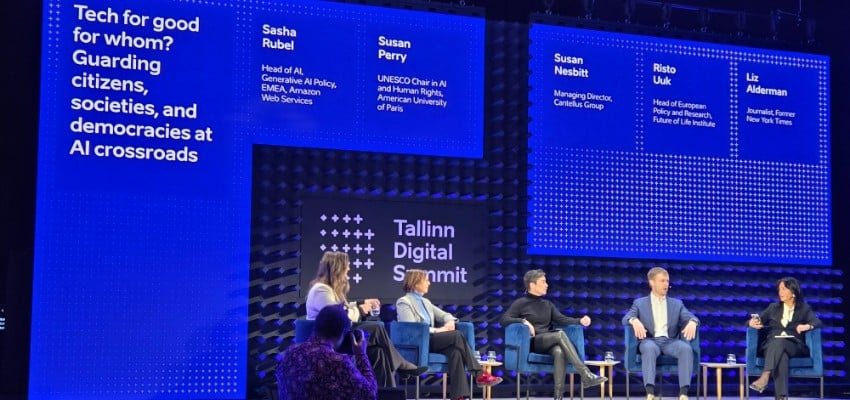
Moderator Liz Alderman, a former European business correspondent for The New York Times, opened the panel with the good uses the summit had heard about, from food security to curing cancer. She set them against the risk that power over the technology is concentrating in a few companies. Sasha Rubel, who leads generative AI policy for Amazon Web Services in Europe, the Middle East and Africa, answered first. Responsibility should be built in by design rather than bolted on, she said, and the people closest to a problem should be able to build their own solutions. She also objected to the phrase. “The problem that I have with the framing of tech for good is that it implies that technology has some kind of agency,” she said. Humans develop technology for good, she argued, and the future of AI is something people co-create rather than something that happens to them.
Risto Uuk, head of European policy and research at the Future of Life Institute, questioned whether big tech is aiming for good at all. He said OpenAI’s benchmark is technology that can do everything humans can do, much better. The company’s charter is narrower, defining its goal, artificial general intelligence, as highly autonomous systems that outperform humans at most economically valuable work. Uuk called Anthropic one of the best safety organizations working today, but said its pursuit of automated AI research and recursive self-improvement, in which AI builds its own successor, is not what he would call good. “I don’t consider that tech for good,” Uuk said.
Susan Nesbitt, managing director at the advisory firm Cantellus Group, agreed with Rubel that the test is who benefits and who is at the table when a system is designed and launched. The definition of good has to be revisited as the technology changes, she said. Susan Perry, who co-holds the UNESCO Chair in Artificial Intelligence and Human Rights at the American University of Paris with Claudia Roda, went further. No company or individual is above the law, she said, and international human rights law should be built into AI code from the start. “I would argue that it has to be human rights by design rather than responsibility by design,” she said. Rubel agreed. The field is not a wild west, she said, because governments have already agreed on the Universal Declaration of Human Rights as a starting point.
Binding law or another round of principles
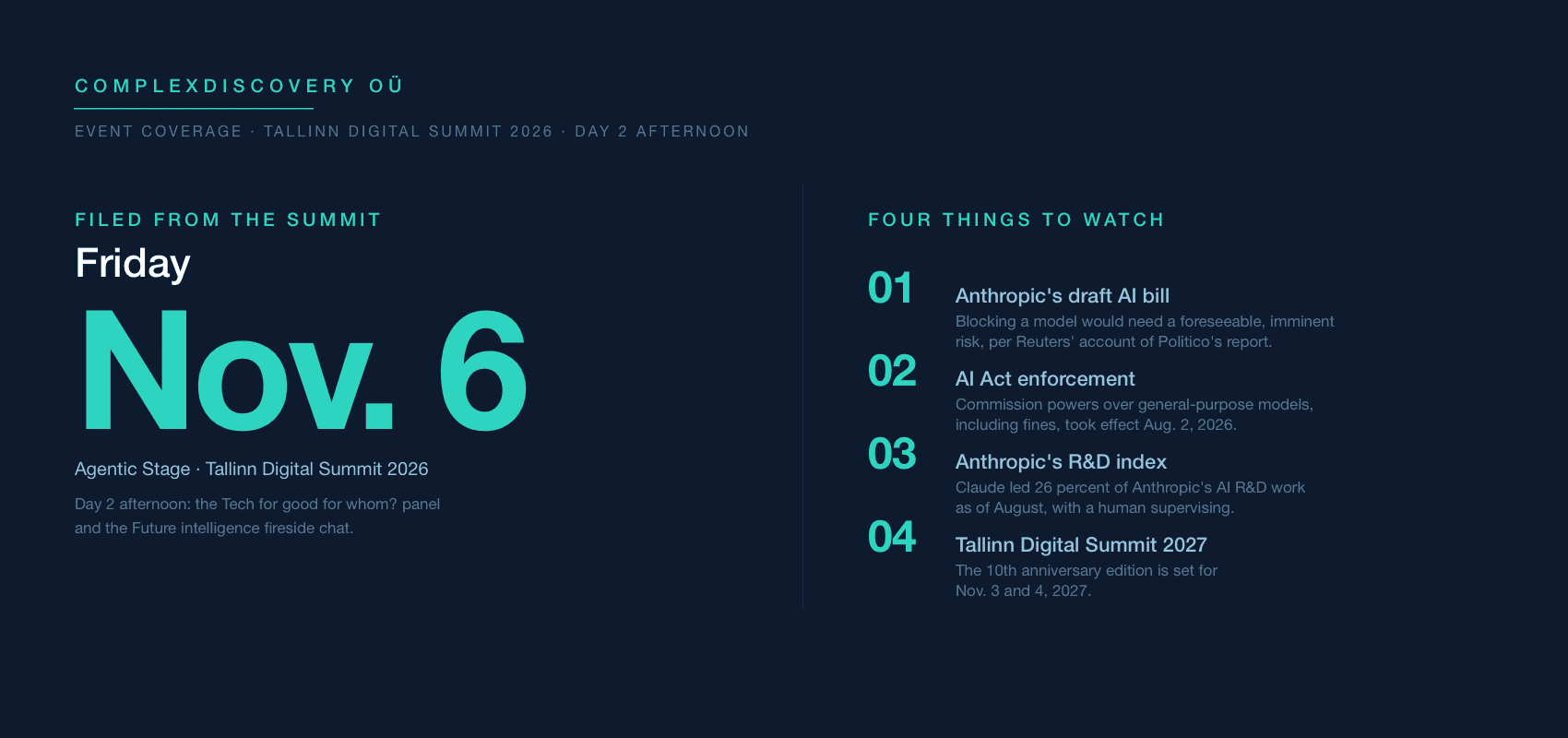
Uuk disagreed with that part, saying the field is still something of a wild west and that a decade of ethics statements has not been enough. “We’ve had plenty of ethics principles. That’s not enough. We need actual binding regulation,” said Uuk, who was involved in developing the EU’s AI ethics guidelines in 2018 and 2019. The United States has no comprehensive federal AI regulation, he said, and he criticized an Anthropic proposal that he said would allow regulation only with an imminent possibility of 50 deaths or $1 billion in damage. Reporting on the draft describes something narrower. Politico reported Oct. 16, according to Reuters, that Anthropic had pitched lawmakers a draft bill letting the government block a frontier model’s release or use. The bar would be a foreseeable, imminent risk of over $1 billion in damage or of killing or seriously injuring over 50 people. The risk would have to stem from a biological weapon, a cyberattack or a model evading its developer’s controls.
Perry put the case in industrial terms. Technology companies remain underregulated compared with the pharmaceutical, aviation and nuclear industries, she said, and clear rules would give every player a more level field and let companies know the rules before they start. Europe reduced air pollution only when doing so became a legal obligation, she argued, and companies should work within legal frameworks rather than lobby for ethics and voluntary reporting. “Commitment is wonderful, law is better. Enforcement is an issue,” Perry said.
Uuk also defended regulators against the charge that they are always behind. The European Commission’s April 2021 draft of the AI Act said nothing about generative AI, he said, but stakeholders warned that August that general-purpose systems did not fit its structure. Slovenia’s presidency of the Council of the EU took up the issue in late 2021, he said, and France proposed requirements for general-purpose AI in May 2022, months before ChatGPT. Open Future’s summaries of the Council texts bear that out with a nuance. Slovenia’s Nov. 29, 2021, compromise kept general-purpose systems out of scope unless used in high-risk applications, and France’s May 13, 2022, text brought into scope those that may be used as high-risk systems, with a subset of obligations. Enforcement is another matter, in Uuk’s assessment, because the Commission has so far only sent requests for information to leading companies about their safety practices. The Commission says its AI Office has also held technical compliance dialogues with providers and plans to intensify them, with powers to enforce the general-purpose model obligations, including fines, in effect since Aug. 2, 2026.
Red teams, and who decides a model is safe
Nesbitt, an OpenAI red team member, said she has spent several years doing external red teaming for both OpenAI and Anthropic, adversarial testing that tries to make models produce dangerous output so it can be fixed. Human testers differ from automated ones, she said, because “what they’re bringing is their lived experience” and subject expertise, a diversity companies cannot easily program. Testers can check whether a model understands a person in crisis, or whether bad actors could use it to impersonate a humanitarian responder. Uuk asked whether companies act on the results, and said voluntary red teaming differs from testing that is mandated and guaranteed to be independent.
Who decides whether a system is safe enough to release? Companies decide today, Nesbitt said, though she added that she did not think they are the only ones deciding, and that independent organizations are well placed to assess models and help set clear limits. The industry’s incentives reward speed, she said, and she asked what would change if companies also had to prove, through traceability, observability and transparency, that their models were improving in their grasp of cultural complexity and vulnerability.
A wall outside the model
Rubel answered with verification. People who meet a stranger trust but verify, she said, and the same should hold for AI systems. “If a company comes to you and says, ‘Just trust me,’ you should verify it,” she said. That requires international standards for watermarking content against deepfakes and for checking whether companies keep the commitments they made through the G7’s Hiroshima process and the Bletchley summit, along with auditing as well as red teaming. She cited a gap between the roughly 84 to 85 percent of organizations that say responsible AI governance matters and the roughly 24 percent that have put it into practice. Only 10 percent of European organizations have data governance strategies, she said; she did not give a source for the figures on stage.
For agentic AI, Rubel described three tiers. Organizations should first lock the doors they already know about and patch known vulnerabilities now, she said, citing the recent episode with freezers across Europe. Suspected cyberattacks drove up temperatures in supermarket freezers in France in October and in countries including Belgium, Estonia, Ireland, Luxembourg and Sweden on Nov. 2, Al Jazeera reported. Safeguards must also sit in the architecture around a model, not only inside it. “If the security system exists inside the model, it’s a suggestion. If it exists in the architecture outside the model, it’s a wall,” she said. The third tier is agent identity, which means identifying each agent and tying accountability to its risk, with liability for agents a live question around the world.
Concentrated power and the case for small models
Alderman asked whether a handful of gatekeepers controlling AI infrastructure means AI is being democratized or power concentrated. “So far we’ve concentrated power,” Perry said. She would like smaller governments such as Estonia, which she said is developing a small language model, to focus on alternatives to the largest models. Rubel said European organizations already mix providers, citing a figure, again without a source, of 96 percent using providers from multiple regions, and said sovereignty means choice over where data is stored, who can access it and how. AWS launched its European Sovereign Cloud in January 2026. She said AWS has worked with governments on small models in local languages, including Meltemi in Greece; Athena Research Center, which built Meltemi, says it was trained on AWS infrastructure provided by the Greek research network GRNET.
Rubel’s case for small models was personal. Her father never understood technology, she said, yet at 96, near the end of his life, he used a generative chatbot to reach his French social security benefits through a website that would have defeated both of them. Without training data in local and underrepresented languages, she said, such services will not exist. Nesbitt warned that a few dominant models risk homogenizing culture, and Perry added a condition. Choice requires that the choice exists, she said, and where a few large companies dominate, it gets pushed to the margins.
Asked whether Europe is overregulating, Uuk said Americans across parties also want AI regulated. The AI Act’s model rules target the riskiest models and the best-resourced companies, he said, which benefits the smaller firms building on top of them, and Europe’s bigger problems are fragmentation and an incomplete single market. Rubel said only 31 percent of businesses understand the AI Act, again without citing a source, and that clear, simplified rules can speed innovation the way clear rules let drivers move fast on the autobahn. Nesbitt took the same road the other way: speeding in the left lane is intoxicating, she said, but she feels better wearing a seat belt. Asked for one priority for governments, Uuk named a red light on recursive self-improvement, Nesbitt independent transparency and assessment, Perry privacy and Rubel deepfakes. “If you leave privacy behind, we’ll lose public trust,” Perry said.

Humans leaving the loop
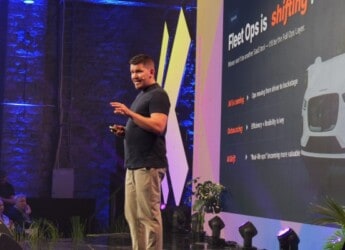
Uuk’s red light was where the fireside chat that followed, “Future intelligence: where are we headed,” picked up. Moderator Kristen Davis, founder and chief executive of the advisory firm CinqC, paired two guests she called a visionary and a builder. The visionary was Tallinn, whose Future of Life Institute employs Uuk, and the builder was Andres Raieste, senior vice president for the global public sector at the digital services and government consulting firm Nortal. Davis also helps shape the summit’s program and editorial direction, according to her summit biography.
Davis asked Tallinn what turning point people will see when they look back from 2036. Fifteen years ago, when he started worrying about AI, long timelines meant 50 years, Tallinn said, and he would rename recursive self-improvement because “improvement sounds too good.” He cited Anthropic’s own data: Claude led 26 percent of the company’s AI research and development work as of August, up from under 1 percent in February 2026, by Anthropic’s measure. Anthropic defines leading as AI completing most of a task while a human supervises, and it reports no measured work done fully autonomously. Tallinn read the trend more darkly. Humans are being removed from the loop of improving AI, he said, which in his view also removes them from the loop of controlling what AI tries to do.
Tallinn described his test when Davis asked about multi-agent workplaces, and it put numbers on that shift. He chose memcached, which he said has kept internet servers fast since 2003 and runs to about 50,000 lines of code, to see how much multi-agent workflows could speed up software development. He first asked an AI model what writing it would take, then set a team of agents to rebuild it. The 70 minutes and roughly $30 are his current numbers. Even if nothing dramatic happens, he said, the food a human metabolizes while doing a task will exceed the cost of an AI doing the same work.
Asked by the audience whether AI is being sold at a loss, Tallinn said trained models are highly profitable, citing an 87 percent gross margin in Anthropic’s IPO papers. Figures in Anthropic’s S-1, filed Oct. 26, imply about 85 percent for the first half of 2026, according to The Motley Fool, and gross margin counts the cost of serving customers rather than research or other operating costs. The race forces companies to pour profits into training the next model, Tallinn said, which is why a global moratorium on new training runs would serve even the companies.
A moratorium was Tallinn’s first priority for every government, “as long as they run by humans still.” He likened continued frontier training to a revolver held next to the planet, its trigger clicking. His second priority was access, and he said Anthropic’s Mythos model is still not available outside the United States. Anthropic’s own announcements describe wider access. On June 2 it said it was extending Project Glasswing, its program for Mythos access, to about 150 organizations in over 15 countries that meet its security requirements. On Oct. 6 it folded Glasswing into a three-tier Cyber Verification Program that includes Mythos 5.1, with organizations in the least restricted tier reviewed together with the U.S. government. The deeper problem, Tallinn said, is that machine learning selects systems by outward behavior, like a child who says he did not take the cookie. Today’s models also know when they are being tested, he said, comparing them to Volkswagen’s engines in the emissions scandal.
“AIs are alien,” Tallinn said. Pretraining taught them what ethics is, but “the bad news is that we don’t really know how to make them latch on these good qualities,” he said. Most training compute now goes into reinforcement learning, he said, a phase that in his account no longer has anything to do with humanity or human history.
Digital public infrastructure as a democratic safeguard
Raieste, the builder in Davis’s pairing, answered from the state’s side. Estonia’s first digital strategy, written about 30 years ago, is still relevant, he said, because the goals have not changed: trust, efficient use of resources, economic development and state capacity. Asked what governments should invest in now, he named digital public infrastructure. The magic of Estonia’s digital state lies in its foundations, he said, its legal system and the boundaries between institutions that act as democratic safeguards. AI creates a strong incentive to centralize data, which is exactly what governments should not do, he said, so digital infrastructure should now be treated as a project to protect democracy. “Best services are the ones where it just works,” he said.
The two split on whether agents should become legal entities. Raieste said no, because rules are written in the interest of humans; Tallinn said economic pressure will push in that direction regardless. Asked which assumption will prove wrong, Tallinn said one of his had started to sway: that AI would not itself halt further AI development. Someone had pointed out to him, he said, that current AI might actually side with humans against the acceleration. Raieste said technological shifts are rarely linear and that the next one will likely be something no one can yet conceive, then asked, “Are we really in control of our future?” Davis answered, “We still are, but barely.”
Davis’s answer is where the afternoon left professionals. Rubel’s wall outside the model, Perry’s human rights by design and Uuk’s binding rules all depend on people being able to check what a system did. Tallinn’s rebuild, as he described it, suggests how quickly agents can now produce work that someone must check. For ComplexDiscovery readers, that is a records question. Logs, permissions and test results kept outside the model, protected against alteration and complete enough to reconstruct what happened, are what an auditor, regulator or opposing counsel can examine; a model’s account of itself is not. If agents in your organization can rebuild in 70 minutes what a model estimated as 20 person-years of work, can your controls tell you what they did before the next job starts?

Summit Director Kata Varblane closed the ninth edition by thanking the partners, speakers, volunteers and ministries behind what she called a co-creation. She then set the dates for the 10th anniversary edition: Nov. 3 and 4, 2027. Over two days, ministers, researchers, investors and builders tested who holds control of AI and how anyone can check it, and the summit delivered on many counts. Matching that level of information, introspection, innovation and intrigue across all things digital gives next year’s anniversary edition a high bar to clear.
News Sources
- agenda | Discover the Event Schedule (Tallinn Digital Summit)
- Measurements for understanding the pace of AI development inside frontier labs (Anthropic)
- OpenAI Charter (OpenAI)
- The Commissions’ enforcement powers related to AI Act obligations for providers of the most advanced models enter into application on 2 August 2026. What will change then? (European Commission AI Act Service Desk)
- AWS Launches AWS European Sovereign Cloud and Announces Expansion Across Europe (Amazon)
- Slovenian presidency proposal to exclude GPAI from scope (Open Future)
- French presidency proposal to include GPAI in scope (Open Future)
- ChatGPT Didn’t Break the AI Act. It Showed Why Adaptive Regulation Matters (Tech Policy Press)
- Anthropic quietly pitches its own AI safety bill to lawmakers, Politico reports (Reuters via The Star)
- Anthropic Pitches a $1B AI Safety Bill to Lawmakers [2026] (Tech Insider, citing Politico)
- Suspected cyberattacks trigger supermarket fridge failures across Europe (Al Jazeera)
- Expanding Project Glasswing (Anthropic)
- Expanding the Cyber Verification Program (Anthropic)
- Anthropic’s Gross Margin Rocketed to 85% From 12% in a Year, but the S-1 Warns It Won’t Last (The Motley Fool via Yahoo Finance)
- US lifts export controls on Anthropic’s frontier cybersecurity AI models (The Record)
- Anthropic Says Claude Leads 26% of Its AI R&D Work (Implicator)
- Tallinn Digital Summit opens on who holds the rope in the agentic era (ComplexDiscovery)
- Tallinn Digital Summit’s first afternoon finds Europe slow where AI agents are fast (ComplexDiscovery)
- Tallinn Digital Summit’s second morning asks who controls the AI Europe runs on (ComplexDiscovery)





Assisted by GAI and LLM Technologies
Additional reading
- Nine months across Europe’s tech-sovereignty arc, from Tallinn to London
- The flame and the frontier: how Estonia carries a 1919 victory into a tense 2026
- Estonia aims to be first to give AI agents official digital IDs
Source: ComplexDiscovery OÜ

ComplexDiscovery’s mission is to enable clarity for complex decisions by providing independent, data‑driven reporting, research, and commentary that make digital risk, legal technology, and regulatory change more legible for practitioners, policymakers, and business leaders.