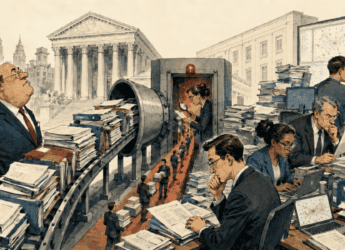

Editor’s Note: The billable hour is losing its grip on legal discovery, and the pressure is no longer theoretical. When automated tools can compress hours of document work into minutes, the unit that priced legal effort for decades begins to look less like a neutral convention and more like a planning instrument — one that rewards legibility to managers over value to the people paying the bills. Corporate legal departments have been pressing on that weakness for years through legal operations discipline, panel counsel programs, and alternative fee arrangements. Cybersecurity, information governance, and eDiscovery professionals sit where the combined pressure will land first. Discovery pricing decisions increasingly shape how data is handled, how AI-assisted judgment is documented, and how defensible a workflow is when a regulator, client, or court asks how the work was actually done. This commentary treats the billable hour as a systems question rather than a vendor question, and argues that the honest choice ahead is whether to keep defending duration as a proxy for value or to build something that measures judgment, defensibility, and outcome directly.
Content Assessment: The billable hour's information problem in eDiscovery
Information - 92%
Insight - 93%
Relevance - 91%
Objectivity - 88%
Authority - 89%
91%
Excellent
A short percentage-based assessment of the qualitative benefit expressed as a percentage of positive reception of the recent article from ComplexDiscovery OÜ titled, "The billable hour's information problem in eDiscovery."
Industry News – eDiscovery Beat
The billable hour’s information problem in eDiscovery
ComplexDiscovery Staff
The billable hour has long functioned as something beyond a pricing tool in legal discovery. It has operated as an organizing logic for labor, incentives, and status, shaping how law firms, service providers, and practitioners define value, measure productivity, and justify cost. In that sense, the billable hour can be examined not simply as a business convention, but as a system of managed economic behavior with surprising parallels to socialism’s recurring problems of central targets, distorted incentives, and weak price signals.
That comparison should be made carefully. The modern legal market is plainly not socialist. It is competitive, profit-seeking, and privately owned. Yet inside the legal discovery ecosystem, the billable hour often behaves like a planning mechanism: management sets quotas, workers organize around utilization, and clients struggle to determine whether the resulting output reflects necessity, value, or merely the successful performance of timekeeping.
This paradox persists despite the legal industry’s outward competitive intensity. While a firm must navigate a free market to win a client’s business, once the engagement begins, the economic signals often invert. The external price is replaced by an internal production target, where the firm’s primary metric of health — the utilization rate — many times ignores the efficiency of the outcome. In this environment, the billable hour acts as a vestigial planning organ: it organizes internal labor around an artificial quota while shielding the actual value of the work from the corrective forces of the market. The firm is not just selling expertise; it is managing a closed information loop where more effort is always equated with more value, regardless of the technological reality.
The hour’s arrival
The billable hour is not an ancient practice. For most of the profession’s history, legal work was priced through retainers, fixed fees, or negotiated amounts for defined results. The turn toward time as the dominant metric is traceable to a specific person, a specific firm, and a specific decade.
Reginald Heber Smith, a Harvard-trained lawyer who led the Boston Legal Aid Society from 1914 to 1918 and published the influential “Justice and the Poor” in 1919, became managing partner of Hale and Dorr that same year. Smith’s innovation was internal. He asked his partners — accustomed to genteel workdays of roughly five and a half hours — to record how they spent their time. By 1940, he had refined the daily time sheet to its working form, with work logged in tenths of an hour because the division simplified calculation. The American Bar Association published its “Law Office Organization” the same year. In Smith’s design, the timesheet was a management tool, used internally for organization, planning, and budgeting. It was not meant to be shown to clients.
The shift from internal measurement to client pricing is usually credited to the American Bar Association’s 1958 pamphlet “The 1958 Lawyer and His 1938 Dollar,” prepared by the association’s Special Committee on Economics of Law Practice. The pamphlet lamented that lawyers’ real earnings had fallen below those of physicians and dentists, urged firms to become more businesslike, and argued that lawyers who tracked their time and billed accordingly out-earned those who did not. It recommended a target of roughly 1,300 billable hours a year. That target has since risen by roughly half at major firms, where current requirements typically range from 1,800 to 2,200 hours, but the foundational principle — that time is the unit — was established there. The ABA’s Special Committee was elevated to a Standing Committee on Economics of Law Practice in 1961 under the chairmanship of Richmond lawyer Lewis F. Powell — later a United States Supreme Court justice — and spent the following two decades turning a single pamphlet into a sustained institutional campaign of conferences, newsletters, and further publications that cemented the hour as the profession’s economic default.
By the 1970s and 1980s, hourly billing had become the near-universal method. William G. Ross’s “The Honest Hour,” the canonical academic treatment of time-based billing, documented both the completeness of that dominance and the persistent ethical stresses that came with it. The history matters for what follows, because it shows the hour was never designed to price client value. It was designed to make lawyers legible to the people managing them, and only later colonized the invoice.
Hours as output
The billable hour became dominant in modern legal practice because it offered an administratively simple way to price uncertainty. When the scope of a matter was unclear, hours could be counted even when outcomes could not be predicted. Over time, however, the convenience of time-based billing hardened into an institutional orthodoxy that rewarded more recorded effort rather than better or faster results.
In legal discovery, that logic fit naturally with the rise of large-scale document review, litigation support teams, and vendor-managed workflows. Review projects could be staffed in tiers, time could be sliced into measurable units, and invoices could be defended with references to complexity, urgency, and volume. The result was an ecosystem in which time became the dominant proxy for value, even where the true client objective was speed, defensibility, cost control, or strategic clarity.
That is where the socialism parallel becomes analytically useful. In centrally planned systems, quotas can become substitutes for real value because they are easier to measure than human preference or market demand. In a billable-hour discovery culture, hours often function similarly. They provide a clean managerial metric, but they can also obscure whether the work performed was the best way to solve the problem.
Drawing on the socialist calculation debate — pioneered by Ludwig von Mises in his 1920 essay “Economic Calculation in the Socialist Commonwealth” and sharpened by Friedrich Hayek in his 1945 essay “The Use of Knowledge in Society” — three structural parallels to billable-hour discovery culture become visible. First, utilization targets operate like production quotas: legible to management but silent on whether the output serves its end-user. Second, the client’s cost uncertainty mirrors Hayek’s dispersed-knowledge critique, in which the decision-maker cannot see in advance whether resources were rationally allocated or whether alternatives were considered and rejected. Third, the hour itself functions as a substitute for a missing price signal — present because a real one cannot easily be constructed for bespoke legal work, not because it accurately reflects value. Those are architectural parallels, not political ones, and they explain why the critique bites.
The practitioner’s burden
For discovery professionals, the billable hour is not abstract. It shapes daily conduct, professional identity, and psychological strain. Research and commentary on legal billing have tied high billable targets to poorer mental health, burnout, and dissatisfaction, especially when professionals feel they are under constant pressure to convert working time into defensible invoice entries.
This pressure falls unevenly but broadly across the discovery community. Review attorneys may feel reduced to throughput units. Litigation support and project managers can find themselves caught between the efficiency demands of clients and the revenue expectations of employers. Vendor professionals, meanwhile, often operate in service models where the market rewards responsiveness and scale but still frequently monetizes labor intensity.
The billable hour also changes how practitioners think. Time that should be spent experimenting, reengineering, documenting better workflows, or building institutional knowledge can appear economically suspect if it displaces revenue-generating work. What emerges is a culture of procedural compliance rather than sustained innovation, one that resembles systems in which measured activity matters above adaptive improvement.
The client’s information problem
The billable hour persists in part because it appears transparent. A client can see an hourly rate and a time entry. But that surface clarity often masks a deeper information problem. The client rarely knows in advance what the final cost will be, whether the staffing mix is optimal, or whether more efficient workflows were available but economically disfavored.
This dynamic echoes one of the central critiques in the socialist calculation debate: systems that lack effective price signals struggle to allocate resources rationally because decision-makers do not have complete, timely, or trustworthy information about value and alternatives. In legal discovery, the client is not facing a state ministry, but the practical problem can feel similar. By the time enough information exists to evaluate whether the work was priced appropriately, the work is often already complete, and the invoice already issued.
That uncertainty can poison relationships. Clients may hesitate to ask questions for fear of triggering new charges. Lawyers and providers may feel pressure to defend staffing choices that were shaped at least in part by business model constraints rather than pure case strategy. Discovery then becomes not only a technical and legal process, but also a negotiation over trust, opacity, and acceptable inefficiency.
The in-house counterpressure
In legal discovery, the client is rarely an individual. It is overwhelmingly the corporate legal department — a general counsel’s office, an in-house litigation team, or a legal operations function — and the push against the billable hour has been building on the buyer side of the market for years, not just on the provider side.
Legal operations functions inside large corporations, organized around benchmarking, panel counsel discipline, and structured procurement, have progressively pressed outside counsel toward fixed fees, capped engagements, task-based budgets, and alternative fee arrangements. The legal operations community, which coalesced as a formal professional discipline in the mid-2010s, has since institutionalized this work across the corporate legal function, turning what used to be ad-hoc budget fights into a recognized practice.
That maturity is not evenly distributed. It is most developed at large, sophisticated legal departments with dedicated operations teams, and still emerging in mid-market and smaller corporate legal offices. Industry surveys in 2025 found that a majority of corporate legal departments prefer alternative fee arrangements, while actual deployment across the legal market remains closer to a quarter of billable work — a gap that captures both the direction of buyer intent and the stubbornness of the hourly model. Where the discipline is established, corporate legal departments now often approach substantial matters with pricing expectations set, scope language standardized, and reporting requirements specified. The billable hour still appears on invoices, but often within boundaries the buyer has drawn.
Even inside sophisticated legal departments with mature operations teams, many matters still run on classic hourly engagements — shaped by bandwidth, matter profile, urgency, or internal preference. The billable hour is not only the default clients inherit; it is often the arrangement they actively choose when it best fits the work.
Outside counsel have been navigating the tension between their own utilization economics and buyer-driven pricing discipline for roughly as long. Firms that tried to move past the billable hour often found the internal math pulling them back, because the hour’s managerial legibility still rewarded duration in performance reviews, compensation decisions, and partnership tracks. Service providers faced a parallel version of the same bind, monetizing labor intensity even while their own clients were asking for outcome-based clarity.
That is the context in which AI-driven pricing change is actually arriving. It is not that artificial intelligence suddenly introduces the question of whether time is the right unit. Corporate legal departments have been asking that question openly for years, and outside counsel and providers have been carrying the internal tension of answering it. AI is the accelerant that changes the math for everyone — including firms and providers that have genuinely tried to move past the billable hour and struggled against the economics that kept pulling them back.
Why AI changes the equation
Artificial intelligence poses a structural challenge to the billable hour because it compresses labor time in areas that long supported discovery economics. Generative AI and related tools are increasingly being applied to search refinement, review acceleration, privilege analysis, summarization, and workflow support across legal matters. Even where adoption is uneven, the direction of travel is clear: many discovery tasks that once required large blocks of human time can now be completed faster, or at least re-scoped around machine-assisted judgment.
That creates a contradiction for hourly billing. If a lawyer or provider solves in twenty minutes what once took four hours, the system must either accept less revenue, raise rates, hide efficiency inside larger scopes, or move to a different pricing logic. This is why AI is not just another technology upgrade in discovery. It directly challenges the unit of economic measurement on which much of the ecosystem has depended.
Non-hourly pricing is not new to discovery. Managed-review services, fixed-fee document review, and subscription-style hosting have operated successfully across the market for years, and a notable share of providers and firms now run sustained practices around them. What AI does is extend the zone in which non-hourly pricing is structurally credible. Commentary on AI-enabled discovery pricing now points to a widening mix of per-document, usage-based, and hybrid approaches that aim to connect cost more closely to platform value, matter profile, or output rather than raw labor time alone. For clients, those models can improve predictability. For firms and providers, they shift risk: revenue depends less on keeping people busy and more on designing systems that deliver repeatable results at scale.
From hours to platforms
AI may weaken the old billable-hour order, but it may also create a new concentration of control. If discovery workflows increasingly run through a small number of platforms, those platforms can begin to shape what counts as reasonable review, acceptable speed, necessary staffing, and standard cost architecture. That is not socialism in any orthodox political sense, but it may represent a new kind of soft planning in which control shifts from partnership committees and utilization reports to software defaults, procurement contracts, and platform economics.
This possibility matters for the provider community as much as for law firms. Under the old model, vendors often monetized labor, hosting, processing, and project expertise through combinations of service intensity and complexity premiums. Under the new model, value may accrue more to whoever controls the workflow environment, the AI layer, the data architecture, and the commercial terms under which efficiency is packaged and sold.
In other words, AI can liberate discovery from the tyranny of the six-minute increment while simultaneously centralizing economic power elsewhere. The practitioner may bill fewer hours, but still live under stricter performance expectations. The client may receive a more predictable invoice, but have less visibility into how automated judgment was applied. The provider may deliver work faster, but capture less margin unless it owns the platform or the differentiated expertise around it. Pricing alone cannot carry the change. AI-driven efficiency in discovery has to sit inside the professional responsibility framework — competence, supervision, confidentiality, privilege, and the defensibility standards courts and regulators apply to evidence work — which places AI governance, model transparency, and defensible workflow documentation firmly on every discovery team’s agenda.
The better question
The real issue is not whether the billable hour is identical to socialism. It is not. The analogy is architectural, not ideological — a vocabulary for describing what happens when managerial legibility overtakes market value, nothing more. The more useful question is whether the billable hour, like poorly designed planning systems, rewards legibility to managers over value to stakeholders, and whether it survives because it serves institutional power even when it frustrates those who work within it.
In legal discovery, the answer has increasingly looked like yes. The billable hour has provided order, auditability, and a common language for uncertainty, but it has also encouraged burnout, client mistrust, and resistance to productivity-enhancing change. AI is now exposing those weaknesses more aggressively because it makes visible an uncomfortable truth: if value can be delivered with dramatically less time, then time was never the most honest measure of value in the first place.
Whether the future belongs to fixed fees, subscriptions, usage models, or some hybrid of human and machine-assisted pricing, the discovery community now faces a more basic choice. It can continue defending a system that measures labor as though duration were destiny, or it can build a model that rewards judgment, defensibility, speed, and strategic usefulness more directly. AI will not make that choice automatically. But it may make avoiding that choice impossible.
News Sources
- Slice of History: Reginald Heber Smith and the Birth of the Billable Hour (WilmerHale)
- The 1958 Lawyer and His 1938 Dollar (ABA Special Committee on Economics of Law Practice, primary document) (DC Bar archive)
- The Honest Hour: The Ethics of Time-Based Billing By Attorneys (William G. Ross) (Carolina Academic Press)
- Economic Calculation in the Socialist Commonwealth (Ludwig von Mises, 1920) (Mises Institute)
- The Use of Knowledge in Society (F.A. Hayek, 1945) (Econlib)
- ACC Legal Operations Maturity Model 2.0 (Association of Corporate Counsel)
- 2025 Annual Legal Pricing and Budgeting Trends Analysis (BigHand)
- Striking the Balance: How to make alternative fee arrangements work for everyone (Wolters Kluwer)
- In House and In Distress: Mental Health and Wellness CLE (Association of Corporate Counsel)
- Work demands, self-care, and mental health in lawyers (Taylor and Francis)
- Legal AI adoption: time savings and ethical risks (Wolters Kluwer)
- The 2025 Clio Legal Trends Report (2Civility)

Assisted by GAI and LLM Technologies
Additional Reading
- When agents act: the Rule 26(f) disclosure threshold for agentic AI in eDiscovery
- The EU’s E-Evidence Framework Goes Live in August and Most of Europe Isn’t Ready
- We Wanted Smarter Legal Tech, but Instead Got an Expensive Dependency
- The AI Sanction Wave: $145K in Q1 Penalties Signals Courts Have Lost Patience with GenAI Filing Failures
- FTC’s OkCupid Action Reframes AI Training Data as a Consumer Protection Issue
- White House AI Framework Signals New Compliance Stakes for Legal, Cybersecurity, and eDiscovery
- The Gatekeeper’s Key: How the Conformity Assessment Unlocks the EU AI Market
Source: ComplexDiscovery OÜ

ComplexDiscovery’s mission is to enable clarity for complex decisions by providing independent, data‑driven reporting, research, and commentary that make digital risk, legal technology, and regulatory change more legible for practitioners, policymakers, and business leaders.