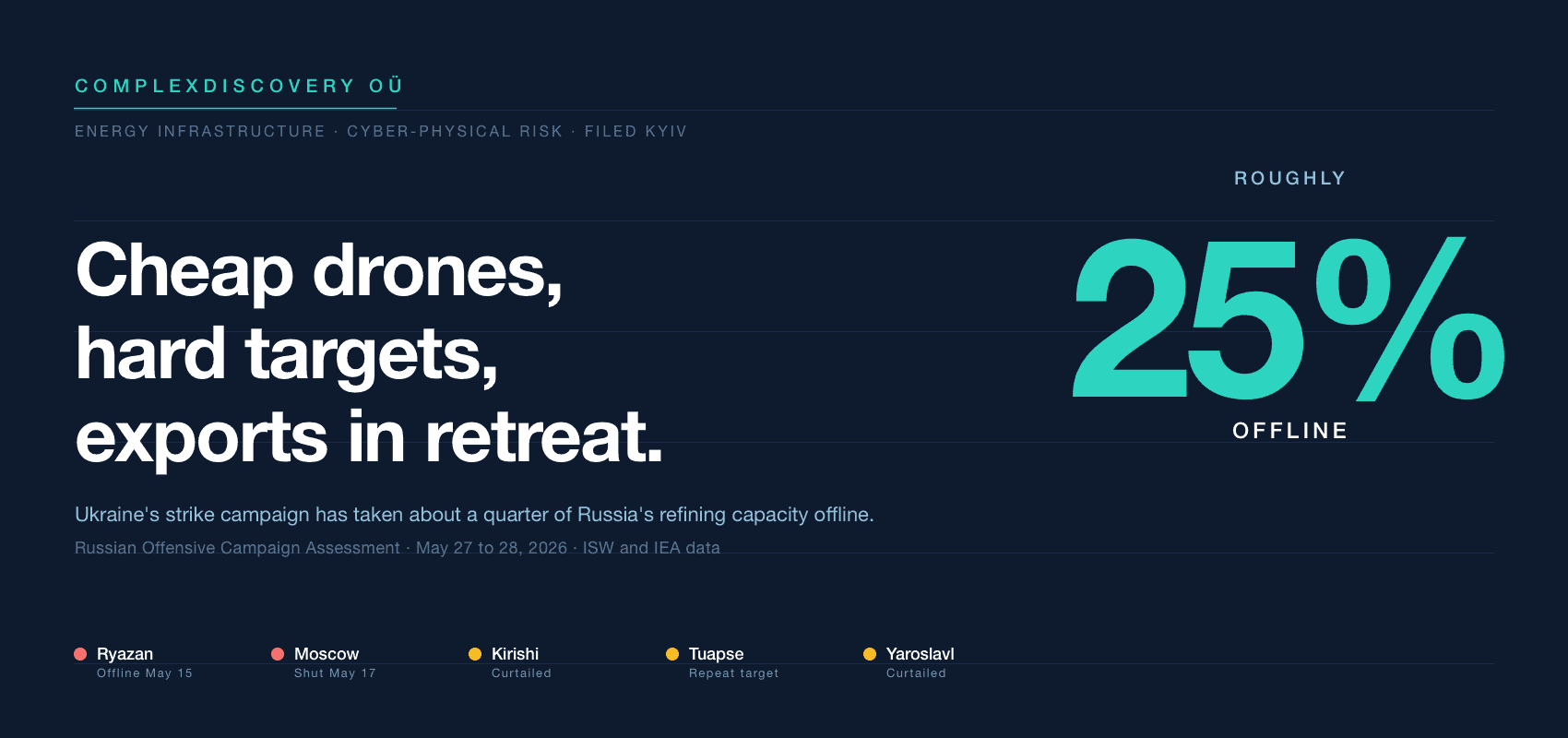
Editor’s Note: Russia’s move to weigh diesel and jet fuel export limits marks the moment a months-long Ukrainian drone campaign started rewriting the Kremlin’s economics. With roughly a quarter of refining capacity offline and April runs at a 16-year low, Moscow is choosing to keep fuel at home rather than sell it abroad, a reversal of a revenue stream it has protected since the war began. The Institute for the Study of War, which tracks the conflict in daily assessments, reported the export deliberation on May 27 and again May 28.
For cybersecurity, data privacy, regulatory compliance and eDiscovery professionals, the story sits squarely on the cyber-physical fault line. Inexpensive, software-guided systems are degrading hardened industrial assets, and the same processing unit can be lost to a drone or a manipulated control system. The lessons map onto critical-infrastructure resilience work: concentration risk, distributed defense, and the data discipline needed to ration and reroute under pressure.
Watch three things next: whether the export restriction is formalized, how Ukraine’s funded procurement reshapes the strike tempo, and how energy and transport operators outside the war begin to treat physical and cyber threats as one continuity problem.
Content Assessment: When the refineries burn: Ukraine's strikes turn Russia's energy backbone into a cautionary tale
Information - 93%
Insight - 92%
Relevance - 90%
Objectivity - 90%
Authority - 92%
91%
Excellent
A short percentage-based assessment of the qualitative benefit expressed as a percentage of positive reception of the recent article from ComplexDiscovery OÜ titled, "A short percentage-based assessment of the qualitative benefit expressed as a percentage of positive reception of the recent article from ComplexDiscovery OÜ titled, "When the refineries burn: Ukraine's strikes turn Russia's energy backbone into a cautionary tale."
Industry News – Geopolitics Beat
When the refineries burn: Ukraine’s strikes turn Russia’s energy backbone into a cautionary tale
ComplexDiscovery Staff
Russia is weighing a temporary halt to diesel and jet fuel exports, a defensive turn forced by a Ukrainian drone campaign that has taken roughly a quarter of the country’s refining capacity offline.
The retreat would reverse a revenue stream Moscow has guarded throughout the war. It also offers the clearest case study yet of how sustained strikes on fixed energy infrastructure can bend a wartime economy, a dynamic that security and resilience planners far from the front are now studying closely.
The Institute for the Study of War, a Washington research group that publishes a daily campaign assessment, reported May 27 and again May 28 that the Russian government is considering the export limits after months of strikes on its oil refineries. The same assessments described a deepening Ukrainian effort to choke Russian supply lines, with drone activity now blanketing a wide band of territory from the rear areas to the front.
A quarter of refining capacity offline
The damage has surfaced in Russia’s own numbers. April refinery runs fell to about 4.7 million barrels a day, the lowest level since December 2009, according to Reuters reporting on industry data. Rosstat, the Russian state statistics service, recorded output of coke and oil products down 9.2 percent from a year earlier and 11.3 percent from March.
The plants knocked fully or partly out of service carry combined capacity above 83 million tons a year, about one-fourth of Russia’s total, Reuters reported. The Ryazan refinery near Moscow suspended operations after a May 15 strike, and the Moscow refinery shut down two days later. Facilities at Kirishi, Nizhny Novgorod, Yaroslavl and Tuapse have also gone dark or curtailed runs. Together the affected sites account for over 30 percent of Russia’s gasoline production and about 25 percent of its diesel output.
The pressure is registering in global forecasts. The International Energy Agency’s May 2026 Oil Market Report projected refinery throughput would drop by 4.5 million barrels a day in the second quarter, citing infrastructure damage, export restrictions and tighter feedstock supply among the causes.
Moscow moves to ration exports
The export curbs under review would extend a pattern of rationing. Russia already banned gasoline exports through July 31, and oil companies were advised to pull back product sales abroad after a meeting on the domestic fuel market led by Deputy Prime Minister Alexander Novak. Novak said the country had to act to protect domestic supply, and acknowledged that shortages in some regions were being covered by accumulated reserves.
A diesel and jet fuel restriction would carry weight beyond Russia’s borders. Russia exports a large share of its diesel output and ranks among the world’s top fuel suppliers, so a pullback tightens a global diesel market already strained by disruptions elsewhere. For Moscow, the move is damage control: keeping fuel at home because there is less of it to sell.
Kyiv formalizes the deep-strike doctrine
Ukraine is institutionalizing the campaign rather than treating it as a series of opportunistic raids. Defense Minister Mykhailo Fedorov said May 27 that Ukraine was launching what he called a “logistics lockdown” of Russian forces, scaling up medium-range strikes against rear-area supply and logistics.
The plan comes with money and a procurement mechanism. Fedorov said the Defense Ministry and General Staff had allocated an additional 5 billion hryvnia, about $112.3 million, to buy medium-range strike systems. The funds flow first to units that have performed best under Ukraine’s “E-Points” system, which awards points for completed front-line tasks that units can trade for equipment. A second phase will run centralized tenders for larger batches, with results Fedorov expects to reach the front by summer.
The logic is attrition by supply denial. Fedorov said a clear pattern had emerged: the more Russian logistics are destroyed, the fewer assaults Russian forces mount. ISW’s analysts framed the same problem from the manpower side, arguing that drones, not troop numbers, have become the binding constraint. On their reading, throwing more reserves at the front buys Russia little while Ukrainian strike units own the rear.
What infrastructure defenders are taking away
The campaign is being read as a live demonstration of cyber-physical risk, where a handful of cheap, software-guided systems can degrade industrial output that took decades to build. The first lesson resilience teams cite is concentration risk. When output sits in a small number of high-value processing nodes, the loss of one cascades downstream into fuel, transport and revenue. Mapping those single points of failure, and the dependencies that radiate from them, is where any resilience review should start.
A second lesson concerns defense geometry. Analysts tracking the strikes note that layered, co-located defenses lose effectiveness when forced to spread thin across many sites, an observation that translates directly to how organizations position monitoring and protective controls across distributed assets. A third is data discipline: operators that maintain accurate, current pictures of capacity, inventory and reserve margins recover faster than those working from stale figures, because they can reroute and ration with precision rather than guesswork.
The strikes also collapse a distinction that infrastructure owners have long treated as separate. Physical sabotage and cyber intrusion now share a target surface, and the same processing unit can be taken offline by a drone or a manipulated control system. Treating the two as one threat, with unified detection, response and continuity planning, is the practical conclusion practitioners are drawing.
Russia’s refineries were among the hardest assets in its war economy, fixed, defended and central to state revenue. They have proven strikeable anyway. As governments and operators reassess what counts as a protected asset, the question facing every infrastructure owner is uncomfortable but unavoidable: if the most defended nodes can be reached, which of yours have you simply assumed are safe?
News sources
- Russia Weighs Curbing Diesel, Jet Fuel Exports as Ukraine Attacks Grow (Bloomberg)
- Russian refining output fell 9.2% in April as Ukrainian drone strikes hit fuel plants (Euromaidan Press)
- Drone Strikes Force Central Russian Refineries to Halt or Cut Output (The Moscow Times)
- Ukraine to intensify middle strike drone campaign as Fedorov unveils ‘logistical lockdown’ (The Kyiv Independent)
- Russian Offensive Campaign Assessment, May 27, 2026 (Institute for the Study of War/Critical Threats)
- Russian Offensive Campaign Assessment, May 28, 2026 (Institute for the Study of War)
- Oil Market Report, May 2026 (International Energy Agency)

Assisted by GAI and LLM Technologies
Additional reading
- The night Ukrainian drones exposed gaps in Moscow’s defenses and state TV gave it 60 seconds
- From warning to funding: Russia’s expanding media machine and the risk signals ahead
- Invisible by design: NATO’s 2026 cognitive warfare paper and the crisis of discovery
- When Your Legal Tech Vendor Gets Breached: DocketWise Incident Exposes 116,666 Immigration Records and a Profession’s Blind Spot
- The DOJ’s Cyber FCA Playbook Is Working as Enforcement Triples and Shows No Signs of Slowing
- FTC’s OkCupid Action Reframes AI Training Data as a Consumer Protection Issue
- White House AI Framework Signals New Compliance Stakes for Legal, Cybersecurity, and eDiscovery
- The Gatekeeper’s Key: How the Conformity Assessment Unlocks the EU AI Market
Source: ComplexDiscovery OÜ

ComplexDiscovery’s mission is to enable clarity for complex decisions by providing independent, data‑driven reporting, research, and commentary that make digital risk, legal technology, and regulatory change more legible for practitioners, policymakers, and business leaders.