

Editor’s Note: Marketing departments across cybersecurity, information governance and eDiscovery face a structural pull that few discuss openly: the temptation to make every deliverable look, sound and feel like the company, regardless of where it lands or who reads it. This commentary argues the opposite: that confidence in marketing shows up as the willingness to write in AP Style for journalists, design natively for each platform, flex brand standards by audience and translate domain expertise into plain language.
The piece matters to vendors, law firms and corporate teams selling into regulated buyers because every misalignment between marketer preference and audience preference is a tax on reach, credibility and conversion. Trade-press editors discard formatted-as-news brochures. Buyers tune out jargon. Designers in the audience notice forced aspect ratios. Each friction point compounds, and confident operators have learned to take them off the table.
Watch for marketing leaders who can defend a campaign that quietly disappeared into its audience and landed as if it belonged there. That’s the discipline this piece is about.
Content Assessment: What marketing confidence actually looks like
Information - 92%
Insight - 93%
Relevance - 90%
Objectivity - 88%
Authority - 93%
91%
Excellent
A short percentage-based assessment of the qualitative benefit expressed as a percentage of positive reception of the recent article from ComplexDiscovery OÜ titled, "What marketing confidence actually looks like."
Industry News – Leadership Beat
What marketing confidence actually looks like
ComplexDiscovery Staff
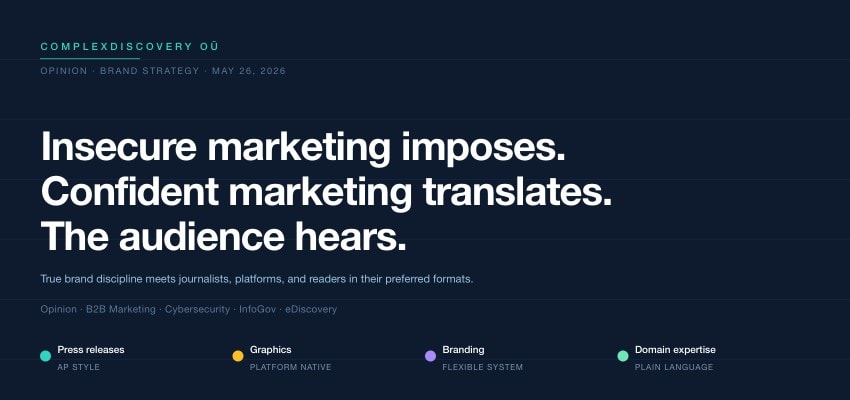
One tell in marketing departments betrays insecurity faster than any quarterly report. It is the insistence that every press release sound like a brochure, every graphic match the founder’s color obsession, every technical explanation use internal jargon, every surface carry the full corporate lockup. That isn’t brand discipline. It’s anxiety wearing a strategy costume.
Real confidence looks different. It adapts without dissolving. It accepts that audiences, journalists, designers and platforms have preferences of their own, and works within them rather than against them. The strength isn’t in imposing. It’s in translating.
Press releases: AP Style isn’t a suggestion
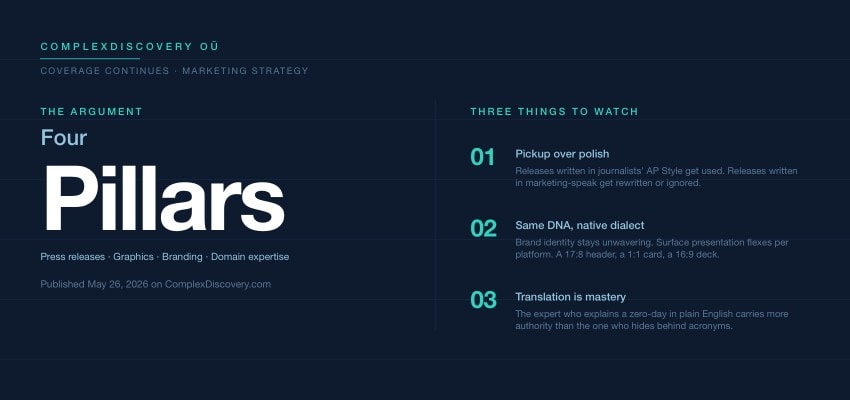
Reporters work in AP Style because their editors, wire services and readers expect it. When a release lands in their inbox dressed up as marketing copy (“revolutionary,” “best-in-class,” embedded taglines, three trademark symbols in the first paragraph), the message isn’t that the company is bold. The message is that the company doesn’t respect the journalist’s craft enough to write in the journalist’s language.
The confident version writes the way the newsroom writes. Inverted pyramid. Verifiable claims. Quotes that sound like humans, not pull-quotes from a sales deck. The reward is the release that gets picked up nearly verbatim, not because the reporter was lazy, but because the writer did the work the reporter would have had to do anyway. Reporters who covered a story this way once tend to return to the next one from the same source. Reporters who had to rewrite from scratch typically don’t.
Graphics: the platform has opinions
LinkedIn isn’t Instagram. Instagram isn’t a trade publication. A trade publication isn’t a conference stage banner. Each surface has its own grammar: aspect ratios, density tolerance, text-to-image relationships, and how much context viewers bring with them.
Forcing one treatment across every surface isn’t consistency. It’s ego. The brand that ships the same square graphic to LinkedIn, the article header and the booth backdrop is broadcasting that its design team would rather repeat itself than think about the audience. Real brand systems flex: same DNA, native vocabulary per surface. A 17:8 header for the article. A 1:1 for the social card. A 16:9 for the deck. Recognizable as the same family, sized and styled for the room.
Branding: standards that bend without breaking
Brand guidelines exist to enable, not police. The insecure version requires that every asset include the full lockup, the tagline, three product names and a footer of trademark symbols. The confident version knows when to lead with the parent brand, when to lead with the product, when to disappear entirely and let the work speak.
The same applies to language. A document written for outside counsel doesn’t read the same as one written for a general counsel at a Fortune 100, which doesn’t read the same as one written for a federal agency program manager. Adjusting the register isn’t going off-brand. It’s brand maturity. The brand is the through-line, not the surface text.
None of this argues for brand chaos. The core identity (positioning, values, and the visual anchors that make a company recognizable across years and channels) stays unwavering. What flexes is the surface: format, register, density, the conventions of the room. Confident brands draw a hard line around what is non-negotiable so they can relax everything else. Brand equity erodes when the core dissolves, not when the wrapper adapts.
Domain expertise: translation over performance
Jargon functions as a status signal, masking a lack of clarity. A cybersecurity vendor walking a general counsel through a zero-day vulnerability, an eDiscovery provider explaining AI-driven document review to a litigation support team, an information governance consultant briefing a CIO on data minimization. Each conversation goes wrong the same way. The expert reaches for acronyms and proprietary frameworks instead of plain English, and the listener nods politely while disengaging.
This pattern has a name. Behavioral economists Colin Camerer, George Loewenstein and Martin Weber identified it in 1989 as the curse of knowledge: the cognitive inability of experts to imagine what their information feels like to someone who doesn’t already possess it. The implication for marketing is direct: every translation an expert refuses to do, the audience has to do for them. Most won’t.
The expert who can explain their field to a smart outsider carries more authority than the one who hides behind acronyms, because the translation itself is the proof of mastery. Simplification demands deep mastery. The marketer who insists on the internal term, the proprietary framework name, the seven-syllable category descriptor isn’t displaying depth. They’re displaying that the audience must do the work of meeting them halfway. Confident expertise does the opposite: it meets the audience where they are and lifts from there.
The underlying pattern
Insecure marketing asks: how do I make this look like me? Confident marketing asks: how does this need to look to land? The first question centers the marketer. The second centers the work and, by extension, the person on the receiving end.
The brands that get this right aren’t the ones with the loudest visual identities or the most aggressive style guides. They’re the ones whose point of view is strong enough that they don’t need to shout it on every surface. They write in AP Style when the channel is journalism. They design for the platform when the platform is LinkedIn. They flex the brand when the audience changes. They speak the reader’s language when the reader is the customer.
This isn’t an argument for passivity, or for marketing that dissolves into whatever the audience prefers. The brands worth following have an unmistakable point of view: taste, judgment, often a measure of edge. The trick is that the point of view shows through the work, not in spite of it. The writing reads as journalism and is recognizably theirs. The graphic looks native to LinkedIn and is recognizably theirs. The explanation lands in plain English and the expertise behind it is recognizably theirs.
That’s not compromise. It’s what confidence actually looks like.
Which would your team rather defend in a postmortem: the campaign that bent to its audience and landed, or the one that stayed perfectly on brand and didn’t?
News sources
- AP Style Press Release: A Complete Guide for 2026 (PressReleaseZen)
- Aspect Ratio: Social Media Sizes Guide for Every Platform (2026) (Posteverywhere)
- Brand Processes for the Modern Era (ACS Creative)
- The Curse of Knowledge: How Expertise Can Hurt Your Communication (CXL)
- Why Flexibility in Brand Standards is Important (Marjoram Creative)
Assisted by GAI and LLM Technologies
Additional reading
- When credibility comes first, capability sells itself: The case for news-led marketing
- The one question that reveals whether your marketing plan is actually a plan
- How Prompt Marketing Is Redefining Thought Leadership In The AI Era
- Raising The Age Ceiling: How AI Is Extending Executive Leadership
- Staying Curious: One Practical Defense Against Creative Burnout
- From Longbows To AI: Lessons In Embracing Technology
- 20 Ways Creative Professionals Battle Burnout And Find Fresh Ideas
- 14 Points For Brands To Consider Before Making Sociopolitical Statements
Source: ComplexDiscovery OÜ
ComplexDiscovery’s mission is to enable clarity for complex decisions by providing independent, data‑driven reporting, research, and commentary that make digital risk, legal technology, and regulatory change more legible for practitioners, policymakers, and business leaders.