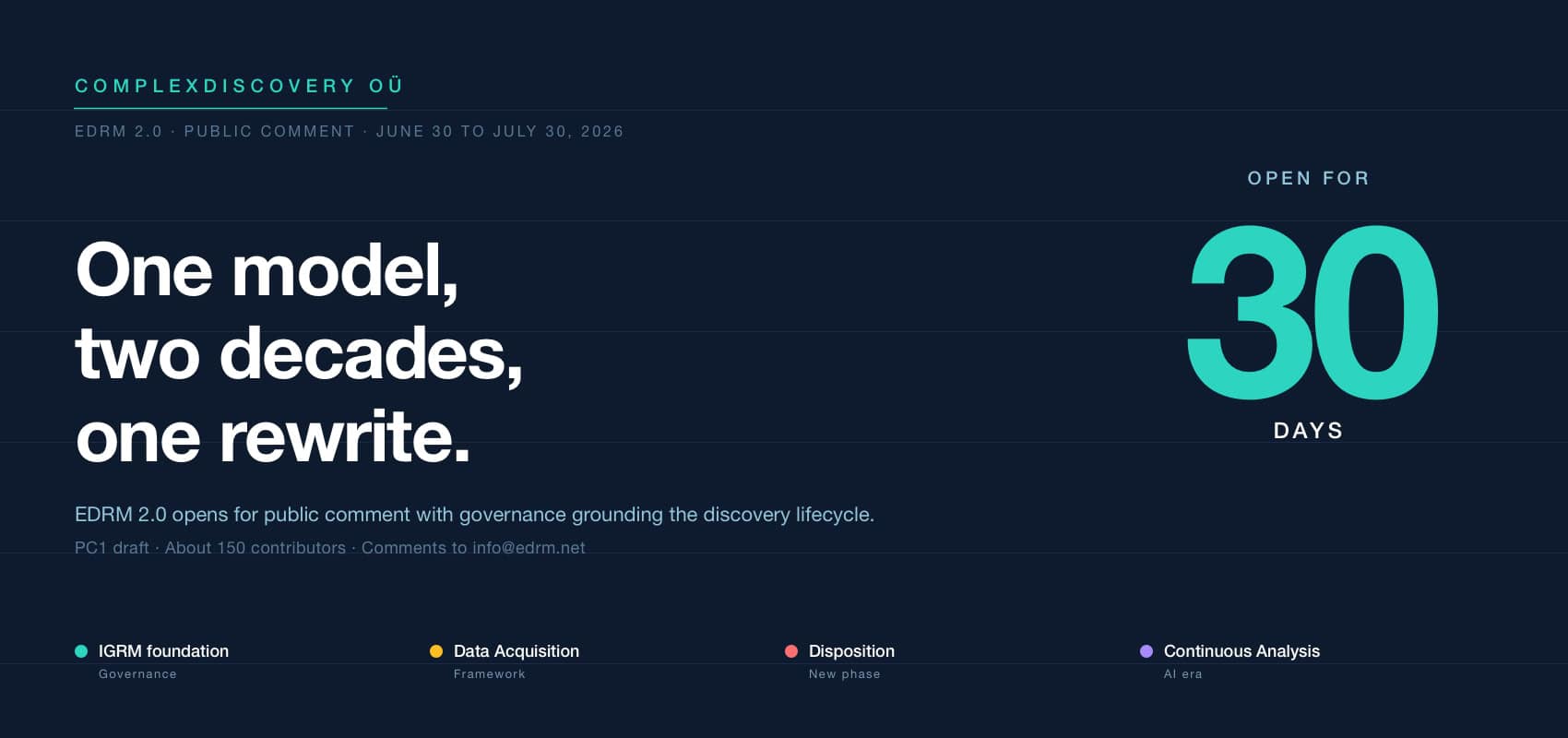
Editor’s Note: Two decades after George Socha and Tom Gelbmann sketched the boxes and arrows that became the common language of electronic discovery, the EDRM community has redrawn the diagram and asked the profession to grade its work. Public comment on EDRM 2.0 opened on June 30 and runs through July 30, 2026, creating a 30-day window to help shape the framework that may guide discovery practice for years to come.
The draft introduces four structural changes. Information governance now grounds the lifecycle. Early-phase activities consolidate into a Data Acquisition framework. Disposition becomes a core obligation rather than an afterthought. And analysis is positioned as a continuous activity spanning every stage.
Those changes carry implications well beyond eDiscovery. Cybersecurity teams gain a model that treats defensible deletion as standard practice. Privacy and compliance professionals gain a framework aligned with data minimization principles. And eDiscovery practitioners gain a map that better reflects iterative, AI-assisted workflows. The draft also addresses an ongoing debate over whether the model needed revision at all, a question that practitioners, including Craig Ball and Doug Austin, raised publicly this spring. With trustee review to follow on July 30, the next 30 days are the community’s chance to shape its own framework.
Content Assessment: EDRM opens public comment on EDRM 2.0, inviting the profession to redraw its own map
Information - 94%
Insight - 91%
Relevance - 92%
Objectivity - 92%
Authority - 90%
92%
Excellent
A short percentage-based assessment of the qualitative benefit expressed as a percentage of positive reception of the recent article from ComplexDiscovery OÜ titled, "EDRM opens public comment on EDRM 2.0, inviting the profession to redraw its own map."
Industry News – eDiscovery Beat
EDRM opens public comment on EDRM 2.0, inviting the profession to redraw its own map
ComplexDiscovery Staff
The diagram that has defined electronic discovery for two decades is being redrawn, and the profession has 30 days to weigh in. The Electronic Discovery Reference Model (EDRM) opened public comment June 30 on EDRM 2.0, which the organization describes as the first substantive update since the model incorporated the full Information Governance Reference Model (IGRM). Feedback is accepted through July 30, 2026.
The stakes reach well beyond a refreshed graphic. George Socha and Tom Gelbmann launched the EDRM project in 2005, and the first public version of the diagram followed in 2006. It has since served as what the organization calls a shared framework and common language for courts, corporate legal teams, government agencies, law firms, service providers, technology professionals, and academics, tracing how electronic evidence moves from creation through presentation at trial. A change to the model can change the vocabulary of workflows, training, RFPs, and service descriptions across an industry.
What changes in the updated model
EDRM 2.0 was developed by about 150 contributors from the organization’s global community, including in-house counsel, law firm practitioners, service providers, technologists, academics, and members of the judiciary, according to the June 30 announcement. The project, launched in March 2023, spent roughly two years reviewing each element of the model.
Four structural shifts define the revision. The IGRM now anchors the discovery lifecycle as a foundational layer, a recognition that governance decisions made long before litigation shape every downstream discovery activity. Identification, Preservation, Collection, and Processing are grouped within a new Data Acquisition framework, reflecting that these early-stage activities increasingly operate together rather than as strictly sequential steps. Disposition joins the model as a discrete core phase, acknowledging the practical, legal, and ethical obligation to address data after a matter concludes. And Analysis is elevated to a continuous activity spanning every phase, described in the announcement as the connective tissue between iterative stages of discovery.
“EDRM remains the best entry point for understanding eDiscovery, and Model 2.0 gives the profession a stronger foundation for the future,” said Shannon Lex Bales, an EDRM 2.0 co-project trustee. “Its increased focus on Analysis reflects where legal technology is headed: toward better insight, better strategy, and more informed decision-making.”
The updated model also adopts a single, consistent color across all phases, a design choice the project page says improves accessibility for viewers with color-vision differences while presenting the framework as an integrated whole. Bidirectional arrows signal that practitioners move iteratively between stages rather than through a one-way sequence, and the Review phase is positioned as the nexus where data volume, legal relevance, and strategic decision-making converge.
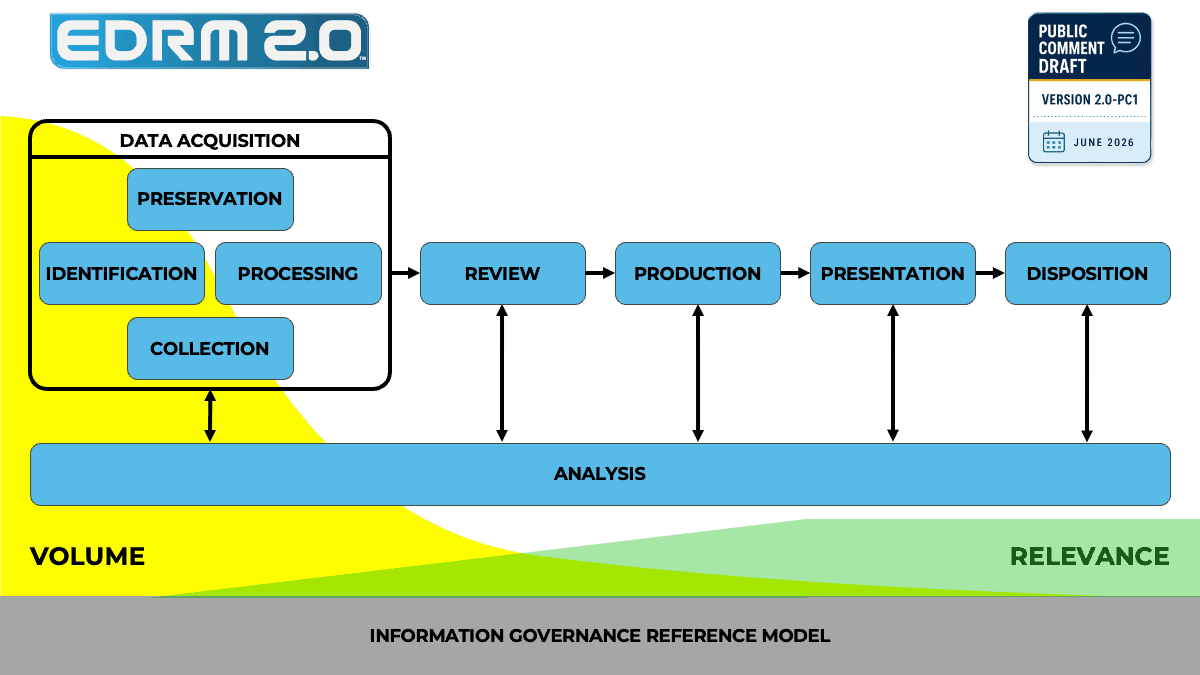
EDRM 2.0-PC1 Public Comment Draft (June 2026)
Two years of debate behind the draft
Consensus did not come quickly. David R. Cohen, CEO of ATJustice and chair of EDRM’s board of project trustees, said the revision drew on input from over 100 EDRM members, with each aspect of the model reviewed and discussed multiple times. “There were many spirited debates during the process,” Cohen said, crediting the project trustees’ leadership for producing a draft that “has captured such broad support from the project participants.”
Rian Kennedy, a co-project trustee, said the team repeatedly weighed reverting to the original design. “While we continually debated going back to the original model, the updates better reflect today’s eDiscovery workflows,” Kennedy said. “The biggest improvements in my mind are making the IGRM the foundation, extending Analysis across the workflow, and better grouping of the phases on the left side.”
Co-project trustee Stephanie Clerkin pointed to the breadth of the drafting committee. “Having a committee that pulled in practitioners from every corner of the legal industry was instrumental in making sure the model continues to reflect how discovery actually works across different roles,” she said.
The project was led by co-project trustees Bales, Kennedy, Clerkin, and Brett Burney, with leadership support from Cohen and guidance from the EDRM global advisory council chaired by Robert Keeling. EDRM acknowledged charter co-trustee Charisma Starr and the late Kaylee Walstad, the organization’s chief strategy officer and project champion, for their contributions.
Not everyone thought the model needed fixing
The draft arrives amid a public debate over whether the model needed changing at all. Craig Ball, an attorney and computer forensic examiner who serves as EDRM’s general counsel but wrote in March that his views were his alone, argued on his Ball in Your Court blog that the model’s critics misread its purpose as a reference model rather than a workflow. “Think of it as a compass, not a GPS turn-by-turn,” Ball wrote March 18. “It orients you. It doesn’t drive for you, and it ain’t broke.” The model, he wrote, remains “a durable, vendor-neutral conceptual foundation that helps you ask the right questions in the right sequence.”
Doug Austin, who has published the daily eDiscovery Today blog since 2010, accepted Ball’s premise but rejected his conclusion. Perception has outrun intent, Austin wrote March 23: software providers position themselves as left-side or right-side solutions, and an industry has been built on treating the diagram as a workflow. “It looks too much like a workflow now for most people to see it as anything else,” Austin wrote, arguing that only a redesign would change how practitioners read it.
The PC1 draft reads in places like a direct answer to that exchange. Its guidance on reading the model states that the EDRM is a conceptual view of the eDiscovery process rather than a literal or linear workflow, and the bidirectional arrows and continuous Analysis band are drawn to defeat the assembly-line reading that Ball and Austin agree took hold.
How the comment process works
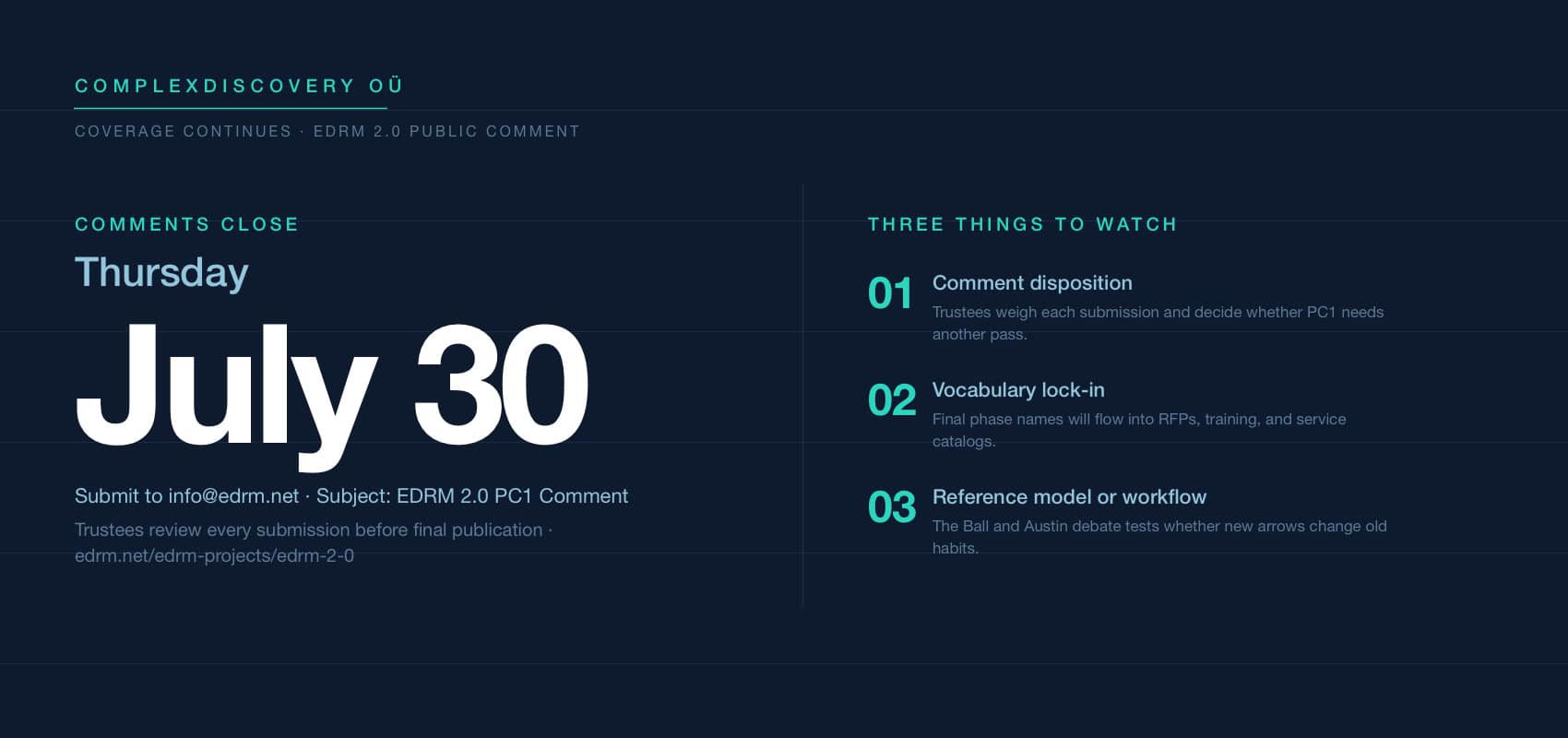
Practitioners and other stakeholders can review the draft, designated Public Comment Version PC1, at the EDRM 2.0 project page and submit feedback to info@edrm.net with the subject line “EDRM 2.0 PC1 Comment.” The comment window is the second of three phases described on the project page: trustees, contributors, and the EDRM Global Advisory Council completed their iterations in Phase 1, the public weighs in during Phase 2, and in Phase 3 the trustees will consider each submission and determine whether further revisions are needed before final publication.
The organization also addressed a question that shadows any standards body funded by commercial sponsors: whether money buys influence. EDRM said it operates with a strict separation between sponsorship, Trusted Partner status, and community consensus project work, and that commercial support does not weight or accelerate any comment. Trustees adjudicate on substance alone, according to the announcement.
“Public comment is where the EDRM community makes our community consensus work better,” said Mary Mack, CEO and chief legal technologist for EDRM. “We welcome thoughtful feedback from our global, multidisciplinary, collaborative legal technology community.” Mack said the volume, variety, and velocity of data in the agentic AI era is challenging familiar digital evidence workflows with an intensity the organization has not seen since its founding.
Why the timing matters
EDRM 2.0 builds directly on IGRM v4.1, released in June 2026 as the first major revision to the information governance framework since 2012. Together, the two updated models offer an integrated reference for how organizations manage information from creation through final disposition in the AI era. For EDRM, which reports an international presence in 145 countries spanning six continents, the pairing positions governance rather than litigation as the starting point of discovery thinking.
Practical homework before July 30
Discovery, governance, and security teams each have something to test against the draft. Legal operations groups can benchmark internal workflows against the new Data Acquisition grouping to see whether identification, preservation, collection, and processing hand-offs match how their teams actually operate. Records and governance professionals should compare the draft Disposition definition, “a systematic, defensible process to retain, delete, transfer or return data after use,” against their own retention schedules. Privacy and security teams have a stake as well: a model that treats disposition as a core obligation reinforces data minimization mandates and shrinks the stale-data exposure that breach litigation feeds on. And service providers may want to map product and service catalogs to the revised phases before the final model locks vocabulary into RFPs and statements of work for years to come.
Co-trustee Burney framed the revision as overdue but respectful of the original. “While the foundations of the EDRM continue to remain strong, it was inevitable that it needed to adapt to better reflect the ever-changing nature of ESI and today’s litigation practice,” he said.
The comment window closes July 30, giving practitioners a defined period to test the draft before trustees consider revisions and move toward final publication. After two decades of practicing to the same map, what would you change about the way the industry draws its own process?
News Sources
- EDRM Invites Global Community to Shape EDRM 2.0 via Public Comment (EDRM)
- EDRM 2.0 Project Page and Public Comment Version PC1 (EDRM)
- EDRM Releases Information Governance Reference Model (IGRM) v4.1 with Comprehensive Updates for Unified Governance (EIN Presswire)
- EDRM Launches EDRM 2.0 Project to Update Iconic Model (EIN Presswire)
- EDRM 2.0 is Coming: E-Discovery Reference Model Seeks Global Scope, Modern Updates (EDRM)
- EDRM Expands IGRM v4.1 Guidance for AI-Era Information Governance (ComplexDiscovery)
- The EDRM Isn’t Broken; It’s Misunderstood. (Ball in Your Court)
- I Agree with Craig Ball That the EDRM Isn’t Broken. It Doesn’t Matter (eDiscovery Today)
Editor’s disclosure: ComplexDiscovery OÜ is an EDRM partner, and ComplexDiscovery’s Rob Robinson is listed among the EDRM 2.0 contributors named in the June 30 release.





Assisted by GAI and LLM Technologies
Additional reading
- EDRM expands IGRM v4.1 guidance for AI-era information governance
- An Oxford tutorial for cybersecurity, governance and eDiscovery
- Estonia aims to be first to give AI agents official digital IDs
Source: ComplexDiscovery OÜ

ComplexDiscovery’s mission is to enable clarity for complex decisions by providing independent, data‑driven reporting, research, and commentary that make digital risk, legal technology, and regulatory change more legible for practitioners, policymakers, and business leaders.