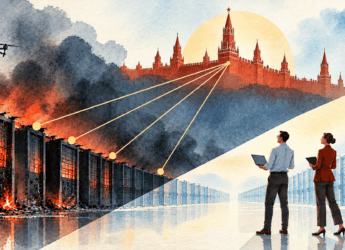

Editor’s Note: A satellite connection is restricted. Battlefield footage is assessed as artificial-intelligence-generated. A refinery near Moscow burns again. A disputed bus-strike narrative moves ahead of another strike package. In Crimea, fuel is rationed through coupons as exposed supply routes come under pressure. Across three days of reporting on the Russia-Ukraine war, the central contest is not only over territory, but over what can be seen, trusted, verified, and proven.
That contest matters well beyond the battlefield. For cybersecurity, data privacy, regulatory compliance, and eDiscovery professionals, Ukraine’s information environment offers a concentrated view of risks already moving into corporate and legal settings: vendor-access dependency, synthetic-media provenance, chain-of-custody integrity, evidentiary authentication, sanctions exposure, records integrity, and resilience across critical supply networks. The peace track adds another layer. A negotiating position tied to an agreement no one has published shows how an undocumented record can become a strategic asset for competing narratives.
This news analysis draws primarily from Institute for the Study of War assessments from June 18 to 20, 2026, supplemented by independent public reporting. It follows the same underlying question across satellite access, synthetic footage, open-source verification, refinery strikes, fuel shortages, sanctions pressure, diplomatic claims, and Crimea logistics: when the record itself becomes contested, how does an organization prove what is real?
Content Assessment: The data war over Ukraine: blocked satellites, synthetic footage and a record that fights back
Information - 93%
Insight - 92%
Relevance - 90%
Objectivity - 90%
Authority - 93%
92%
Excellent
A short percentage-based assessment of the qualitative benefit expressed as a percentage of positive reception of the recent article from ComplexDiscovery OÜ titled, "The data war over Ukraine: blocked satellites, synthetic footage and a record that fights back."
Industry News – Geopolitics Beat
The data war over Ukraine: blocked satellites, synthetic footage and a record that fights back
ComplexDiscovery Staff
A commercial satellite link was restricted, battlefield videos were assessed as synthetic or AI-generated, and a refinery on the edge of Moscow burned for the second time in a week. Three days of front-line assessments point to one conclusion that has little to do with the map: the contest over Ukraine now runs through networks, narratives and verified pixels as much as through trench lines.
For professionals who spend their days on data integrity, digital evidence and information governance, the week of June 18 to 20 read less like a war diary and more like a field manual on contested information. The daily assessments published by the Institute for the Study of War tracked Ukrainian deep strikes, Russian information operations and a measurable strain on the Russian economy. The thread worth pulling, for a cybersecurity audience, is how each side now manufactures, blocks or exposes information to control what the other can see and prove.
When the satellites went dark
One of the clearest signals in the source record came from orbit. By early February 2026, SpaceX’s restrictions on unauthorized Starlink terminals were disrupting Russian use of the service, including on drones, according to open-source reporting and Ukrainian-linked battlefield assessments. Ukrainian sources described an operational cost. A Ukrainian air defense anti-drone battalion commander, cited in the June 20 assessment, said Russian crews had used Starlink-equipped BM-35 and BM-39 Italmas drones to hit moving targets deep behind the line as recently as January. According to that account, the loss of access forced Russian operators to pull those drones back to shorter ranges and turn to cheaper reconnaissance models flown at altitude and in radio-silent mode to slip past electronic warfare detection. The description is single-source and attributed to a Ukrainian officer, not independently confirmed.
Serhiy “Flash” Beskrestnov, a drone and electronic warfare adviser to Ukraine’s Defense Ministry, published footage on June 20 that he said showed a Russian unmanned-systems unit intercepting two Ukrainian strike drones along the Rostov-Crimea highway near occupied Melitopol. The takeaway for anyone who builds on commercial infrastructure is blunt: a single vendor’s access decision can reshape an entire operational capability overnight. Dependency is a control surface, and someone else may own the switch. For an organization running a multi-vendor cloud or communications stack, that is a textbook dependency risk: a provider’s policy decision, not a contract clause, can end a business-critical capability overnight, and many organizations do not fully price that scenario into vendor-risk planning.
Manufactured advances and AI footage
Russian forces spent the three days raising flags for the camera. Ukrainian units published video of troops striking Russian servicemembers planting flags in the Kupyansk direction, a tactic that recent assessments, including ISW’s, frame as cognitive warfare staged to fabricate a picture of sweeping gains. The Russian Defense Ministry paired daily claims of advances around Slovyansk and Kostyantynivka with battlefield video that analysts assessed was likely generated by artificial intelligence on June 15, 16 and 17.
That detail should hold the attention of anyone who handles digital evidence. Combat video assessed as synthetic or AI-generated, released by a state defense ministry and amplified through official channels, is provenance poisoning at scale. The same methods that fake a flag-raising can fake a deposition exhibit, a chain-of-custody log or a breach-notification timeline, and they arrive wrapped in the authority of an official source. Under evidence rules that require authenticity to be proven rather than presumed, a custodian who cannot establish provenance is one challenged exhibit away from exclusion.
Information conditions, from a false flag to a peace essay
A cast for the data war: the spokesman, the banker, the analyst, and the switch flipped from orbit.
Disinformation appeared to run ahead of the missiles, a pattern recent battlefield assessments captured by tracking Russian narrative-setting alongside strike preparation. On June 17, Russian and Belarusian officials accused Ukraine of striking a bus carrying a Belarusian children’s soccer team in Bryansk Oblast, a claim those assessments said they could not independently verify. Ukraine denied the strike, and Ukraine’s Security Service claimed it had intercepted internal Russian reports concluding that no Ukrainian drone was near the site, an assertion that has not been independently corroborated. The sequence reads as the Kremlin setting information conditions to justify its next large strike package, an interpretation the daily assessments share.
The framing extended to the top of the government. Kremlin spokesperson Dmitry Peskov and Foreign Minister Sergei Lavrov both signaled on June 19 that strikes on Ukraine would continue, with Peskov claiming Russian air defenses were performing well “despite everything” after Ukraine’s June 18 attack on Moscow. The pattern is a familiar one to compliance teams: build the record that justifies the action before the action, then point back to it.
The diplomatic track carried the same logic. On June 7, the leaders of France, the United Kingdom and Germany joined Zelensky in a joint statement setting five conditions for a settlement: a full and immediate ceasefire, the current line of contact as the starting point for talks, legally binding security guarantees for Ukraine, Russian state assets staying frozen until Moscow pays for war damage, and European consent on anything touching the European Union or NATO. Lavrov answered on June 19 with an essay titled “Ukraine, Europe, and Global Security” that rejected those terms and argued Europe cannot serve as a mediator, accusing European leaders of using talks as cover for geopolitical expansion.
What should hold the attention of records professionals is what Lavrov anchored his position to. He said Russia remained committed to a settlement the United States allegedly proposed at an August 2025 summit in Alaska, an agreement neither government has ever published. The Kremlin had already rejected Zelensky’s June 4 offer of a leader-level meeting and has worked to keep European governments out of the room. A negotiating posture built on an agreement with no codified document is, in governance terms, a claim without an artifact, and it is exactly the kind of gap that lets each side narrate the same history differently. That undocumented summit becomes a useful fog, and the assessments read the Kremlin’s reliance on it as a way to conceal an unwillingness to compromise.
Verification as a battlefield
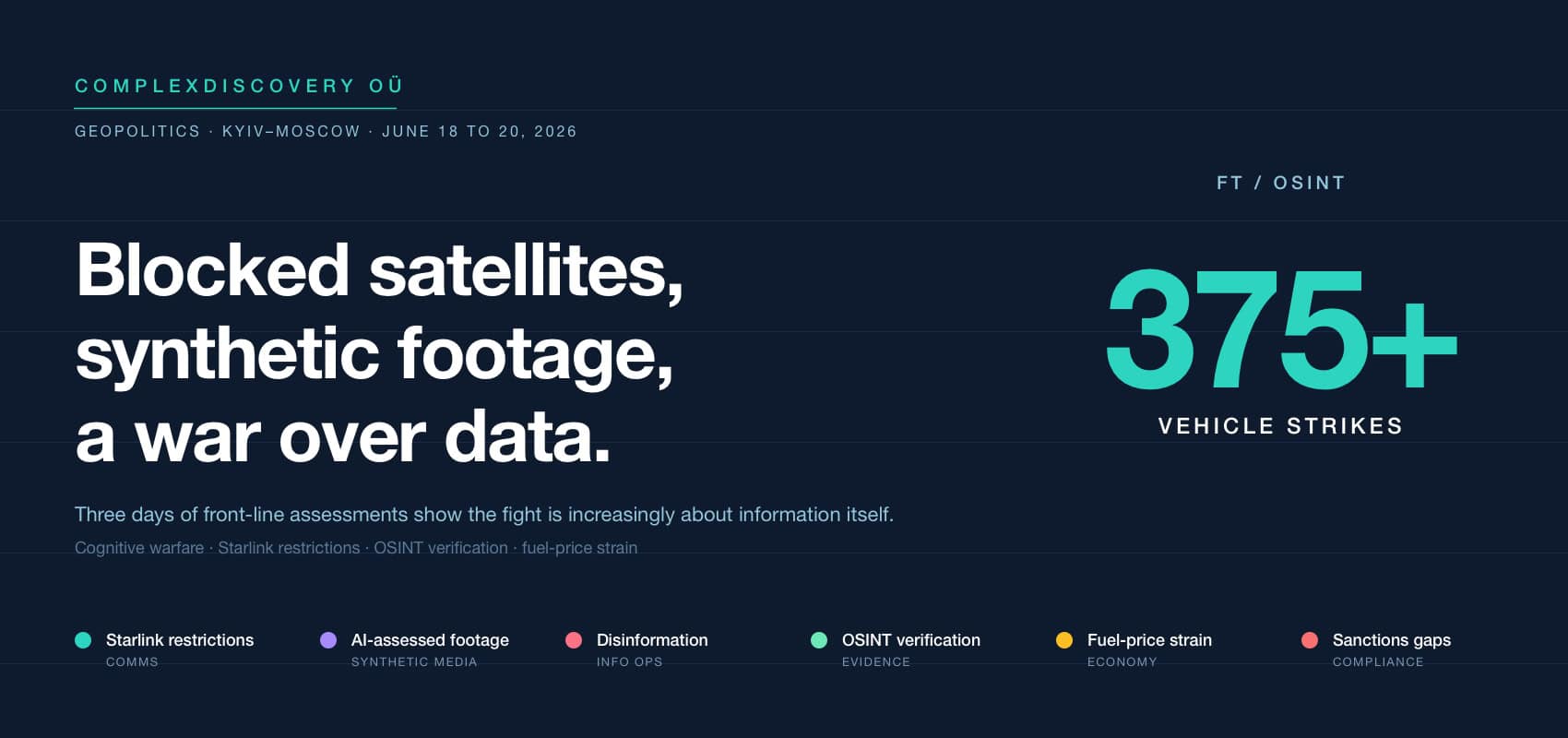
The counterweight to manufactured content is verification, and the week showed how that work gets done. Confirming or rejecting a claim now means geolocated footage, commercial satellite imagery and NASA fire-detection data rather than either side’s word. The sharpest illustration came not from a government but from open-source analysts: the Financial Times, drawing on French analyst Clement Molin, documented at least 375 verified Ukrainian drone strikes on Russian vehicles since May, about half along the Rostov-Crimea highway. The count matters less than how it was assembled, frame by geolocated frame, which is the same evidentiary chain a litigator or investigator has to show before a number means anything.
That discipline also cuts against overclaiming: advances that lacked geolocated proof went unconfirmed in the daily assessments, even when Russian sources claimed them, because those analysts work only from publicly available information. For eDiscovery and governance teams, the method will feel familiar: a claim is only as good as the artifact that anchors it, and metadata beats assertion every time. Open-source verification has become a professional discipline, and its standards are converging with the ones courts and regulators already expect.
Economic pressure the Kremlin can no longer hide
The data war carried a balance-sheet dimension. Ukrainian strikes on refineries and fuel logistics pushed gasoline shortages across Russia, a pattern documented in broader reporting on rationing in Moscow and over a dozen Russian regions. Rosneft Chief Executive Igor Sechin denied any restrictions on June 19. That same day, the Russian Central Bank cut its key interest rate to 14.25 percent, its lowest since October 2023, even as Chairperson Elvira Nabiullina warned that the spike in fuel prices was feeding inflation.
The cut sits awkwardly against the bank’s own inflation warnings, a contradiction that battlefield analysts, including ISW, read as the Kremlin pressing the bank to keep capital flowing to the war industry while projecting calm. The sanctions picture points the same way from a different angle: CBS News, citing Ukrainian officials, reported that export controls have choked off guidance seekers and control modules for Russia’s S-300 interceptors. For a compliance audience, that is the export-control feedback loop made visible, a regime’s effectiveness measured not in penalties but in an adversary’s depleted inventory.
What the strikes are doing to Crimea
Occupied Crimea is where the campaign’s logic shows up most plainly. Across the three days, Ukraine systematically struck the bridges and transport infrastructure linking occupied Kherson Oblast with the peninsula, disrupting the ground lines of communication that supply Russian forces on the left bank and in Crimea, according to the daily assessments and Ukrainian open-source imagery showing the bridge from occupied Henichesk to the Arabat Spit hit at least three times. The peninsula depends on a narrow set of supply arteries, and each exposed route is a potential point of failure, the fragility a governance team would flag in any dependency that has no redundancy.
The pressure reached civilians. Since May 31, gasoline on the peninsula has been sold mainly through coupons, with A-95 restricted to coupon holders and daily caps near 20 liters per vehicle, according to reporting from The Moscow Times, RBC-Ukraine and Kyiv Post; the largest station networks, TES and ATAN, suspended coupon sales as supplies tightened. A local channel claimed that about a quarter of stations had restricted sales, a precise figure that rests on that single source. Kherson occupation administration head Vladimir Saldo, an official with an obvious interest in the framing, said Ukrainian strikes on energy and bridge infrastructure left about 20,000 residents across 22 settlements without power.
The defense of that supply line has become its own contest. Russia redeployed elements of its elite Rubikon drone units away from the front to conduct anti-drone patrols along the M-14 Rostov-Crimea highway, the road Russian occupation officials label the R-280, the daily assessments reported. Pulling a frontline asset back to guard a rear logistics route is a tell: it suggests the strike campaign is imposing operational costs, and it turns a highway into contested infrastructure that has to be watched, jammed and defended around the clock. For anyone who manages critical dependencies, the pattern rhymes with defending a network perimeter that an adversary has already learned to reach.
What practitioners should track
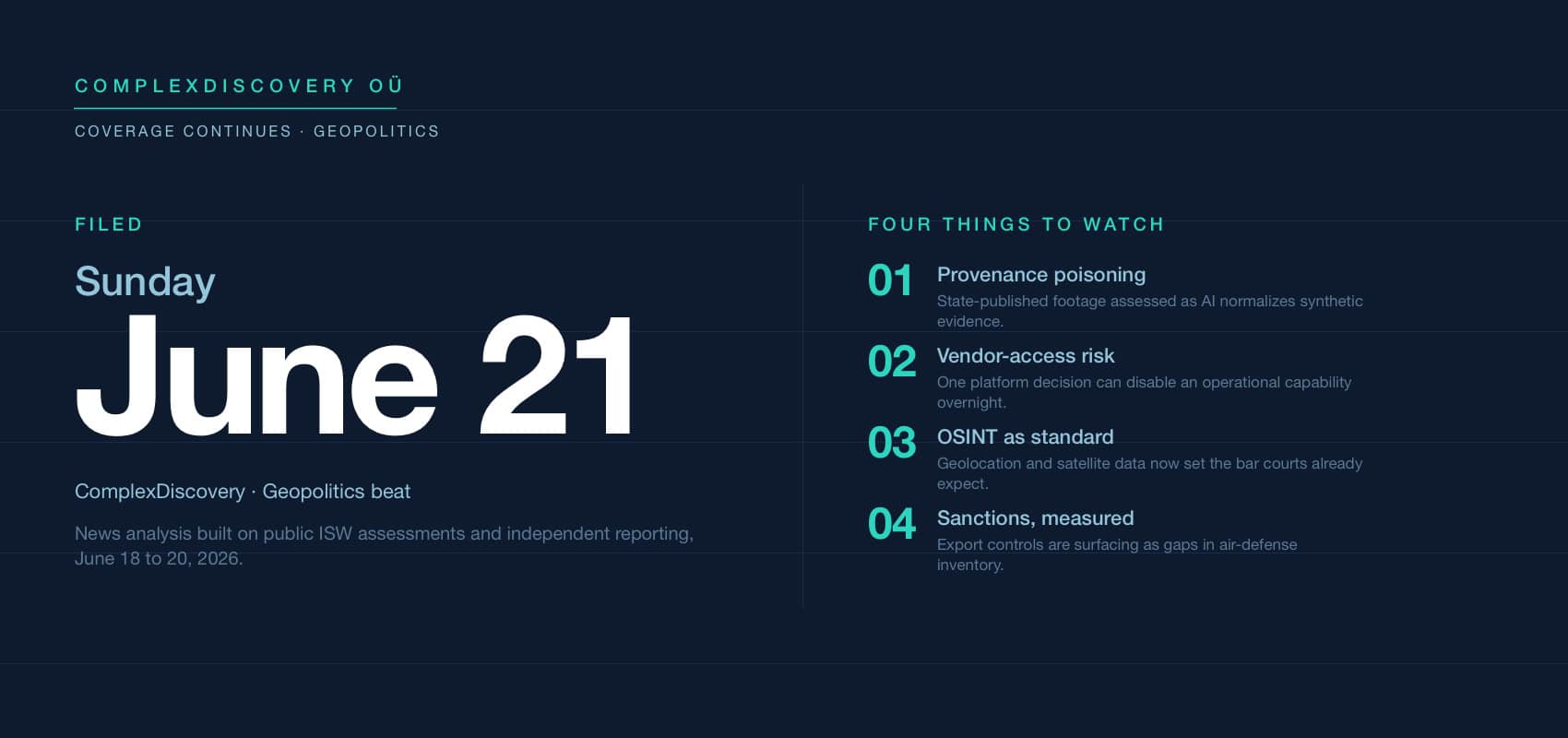
None of these threads stays on the battlefield. Commercial platform dependencies, synthetic media from official sources, pre-positioned false narratives and open-source verification are the same forces reshaping breach response, regulatory disclosure and litigation. The organizations that weather the next contested-information event will be the ones treating provenance, vendor-access risk and evidence authentication as standing disciplines rather than incident-day scrambles.
As state actors normalize AI-generated “evidence” and turn the platforms everyone relies on into instruments of coercion and denial, one question belongs on every governance agenda: when the record itself becomes a target, how will your organization prove what is real?
News sources
- Russian Offensive Campaign Assessment, June 20, 2026 (Institute for the Study of War)
- Russian Offensive Campaign Assessment, June 19, 2026 (Institute for the Study of War)
- Russian Offensive Campaign Assessment, June 18, 2026 (Institute for the Study of War)
- Ukraine Launches Record Drone Attack on Moscow, Hits Oil Refinery (Bloomberg)
- Russian Central Bank Slashes Key Rate to 14.25% (The Moscow Times)
- SpaceX Blocks Russia’s Starlink Access but Ubiquiti’s Tech Remains Ubiquitous (Foundation for Defense of Democracies)
- Russian Forces in Ukraine Scramble to Overcome Musk’s Starlink Restrictions (The War Zone)
- Ukraine drone strike hits Russian oil refinery, Zelenskyy says “Moscow will burn” if Putin continues war (CBS News)
- Russia’s Fuel Shortages Are Manageable. But the Kremlin’s Options Are Shrinking. (The Moscow Times)
- Russia signals slower rate cuts amid high Ukraine war spending (France 24)
- Joint E3 Leaders’ Statement with President Volodymyr Zelenskyy of Ukraine: 7 June 2026 (GOV.UK)
- Annexed Crimea’s Largest Gas Station Chain Suspends Fuel Vouchers as Shortage Worsens (The Moscow Times)

Assisted by GAI and LLM Technologies
Additional reading
- When the flag may be fake: Ukraine’s June war and the new burden of proof
- When the drone war reaches the reactor fence: Ukraine and the cyber-physical front
- When the refineries burn: Ukraine’s strikes turn Russia’s energy backbone into a cautionary tale
- The night Ukrainian drones exposed gaps in Moscow’s defenses and state TV gave it 60 seconds
- From warning to funding: Russia’s expanding media machine and the risk signals ahead
- Invisible by design: NATO’s 2026 cognitive warfare paper and the crisis of discovery
- When Your Legal Tech Vendor Gets Breached: DocketWise Incident Exposes 116,666 Immigration Records and a Profession’s Blind Spot
- The DOJ’s Cyber FCA Playbook Is Working as Enforcement Triples and Shows No Signs of Slowing
- FTC’s OkCupid Action Reframes AI Training Data as a Consumer Protection Issue
- White House AI Framework Signals New Compliance Stakes for Legal, Cybersecurity, and eDiscovery
- The Gatekeeper’s Key: How the Conformity Assessment Unlocks the EU AI Market
Source: ComplexDiscovery OÜ

ComplexDiscovery’s mission is to enable clarity for complex decisions by providing independent, data‑driven reporting, research, and commentary that make digital risk, legal technology, and regulatory change more legible for practitioners, policymakers, and business leaders.