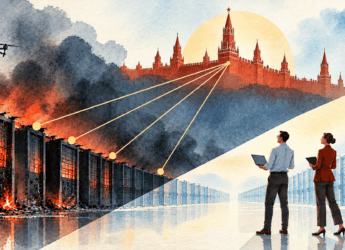

Editor’s Note: A slow front line and an accelerating propaganda machine made the last week of June 2026 a study in divergence. On the stretch’s final reporting day, neither side registered a confirmed advance, according to the daily assessments of the Institute for the Study of War, yet the Kremlin worked to sell a story of inevitable victory, even as Ukrainian long-range strikes hit Russian oil infrastructure and Washington let a sanctions waiver on Russian seaborne oil lapse.
For cybersecurity, data privacy, regulatory compliance, and eDiscovery professionals, the relevance is direct. The same Russian state and aligned networks behind the narrative offensive draw the focus of EU monitors and Microsoft researchers documenting information manipulation and cyber activity against critical sectors. Sanctions exposure shifted not through new rules but through an expiration date, the kind of change a screening program must catch in real time.
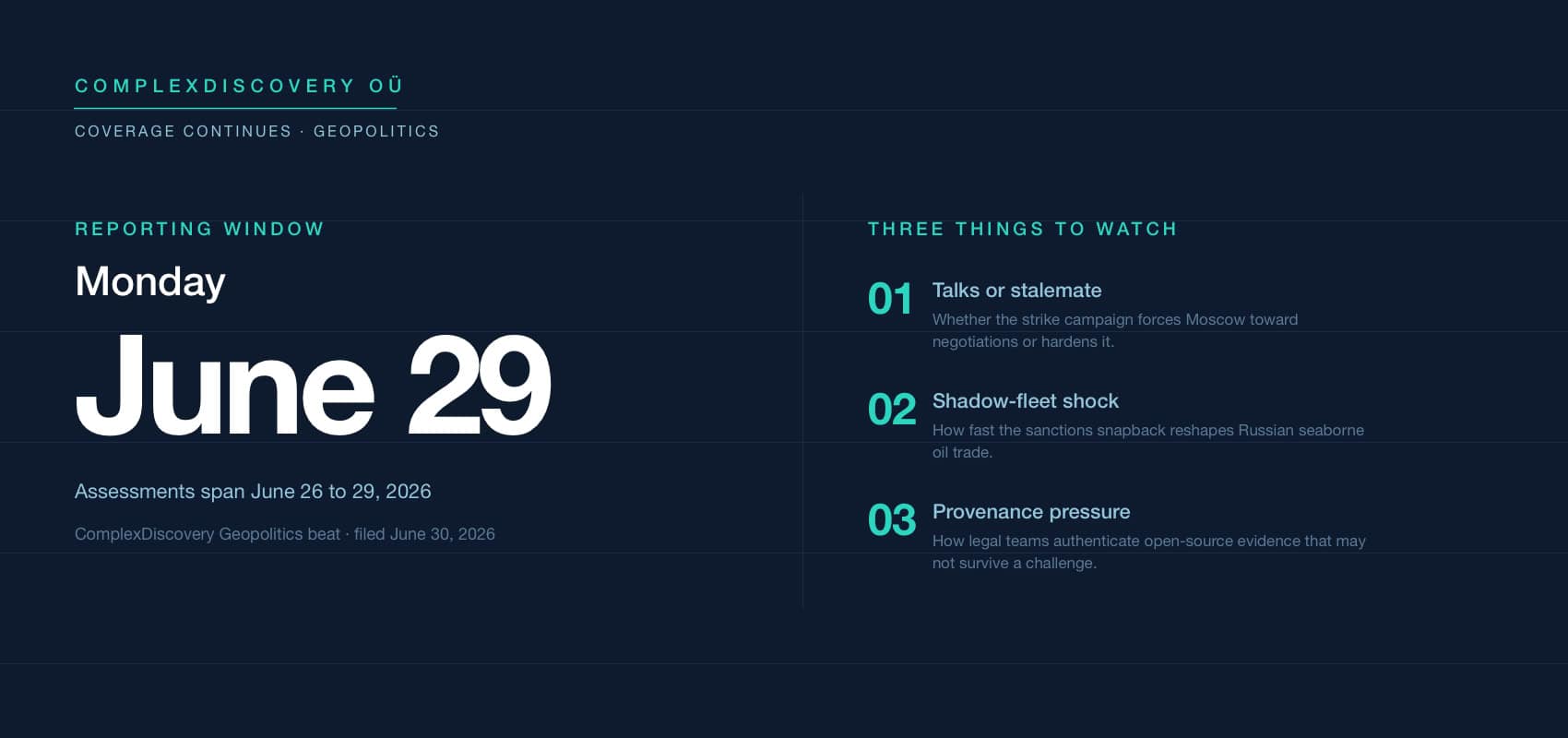
Watch three things next: whether the strike campaign forces Moscow toward talks, how quickly the snapback reshapes shadow-fleet trade, and how legal teams adapt provenance and chain-of-custody practice to open-source evidence that may not survive a challenge.
Content Assessment: Confirmed versus claimed: reading the gap in Russia's June offensive
Information - 93%
Insight - 93%
Relevance - 91%
Objectivity - 91%
Authority - 92%
92%
Excellent
A short percentage-based assessment of the qualitative benefit expressed as a percentage of positive reception of the recent article from ComplexDiscovery OÜ titled, "Confirmed versus claimed: reading the gap in Russia's June offensive."
Industry News – Geopolitics Beat
Confirmed versus claimed: reading the gap in Russia’s June offensive
ComplexDiscovery Staff
Vladimir Putin spent the final week of June describing a war that the battlefield did not support.
While the Russian president told a party congress that his forces were winning and that talks could wait, oil infrastructure inside Russia was under sustained attack, gas stations were rationing fuel, and at least one day’s tally of confirmed territorial gains came up empty.
That gap, between the war Moscow narrates and the war that observers can verify, ran through the closing days of June 2026 in the daily assessments of the Institute for the Study of War (ISW) and other analysts tracking the conflict. It also sets up a problem that lands squarely on the desks of people who authenticate evidence, govern records, and screen counterparties for a living.
A war narrated two ways
Those daily assessments described Putin through late June as assembling a controlled version of events: victory framed as inevitable, economic pain waved off, advances claimed that field reporting could not confirm.
On June 28, Putin used a United Russia party congress to project strength and rule out a negotiated settlement. A day later, analysts noted that neither Russian nor Ukrainian forces had made any confirmed advance. The contrast was the story. Exaggerated claims of progress, paired with a quiet acknowledgment that something was hurting at home, read less like reporting and more like stagecraft.
Russian officials and state media tell the period differently, as a story of steady progress and resilience; this account relies instead on assessments and threat reporting whose methods and sourcing are documented and open to scrutiny.
Putin also appeared to concede privately what he would not say publicly: the August 2025 US-Russia summit in Alaska produced no written, actionable agreement. Foreign Minister Sergei Lavrov spent part of the week assigning that failure to Washington. Two recent Ukrainian ceasefire proposals went unanswered.
The strike campaign Moscow tried to talk past
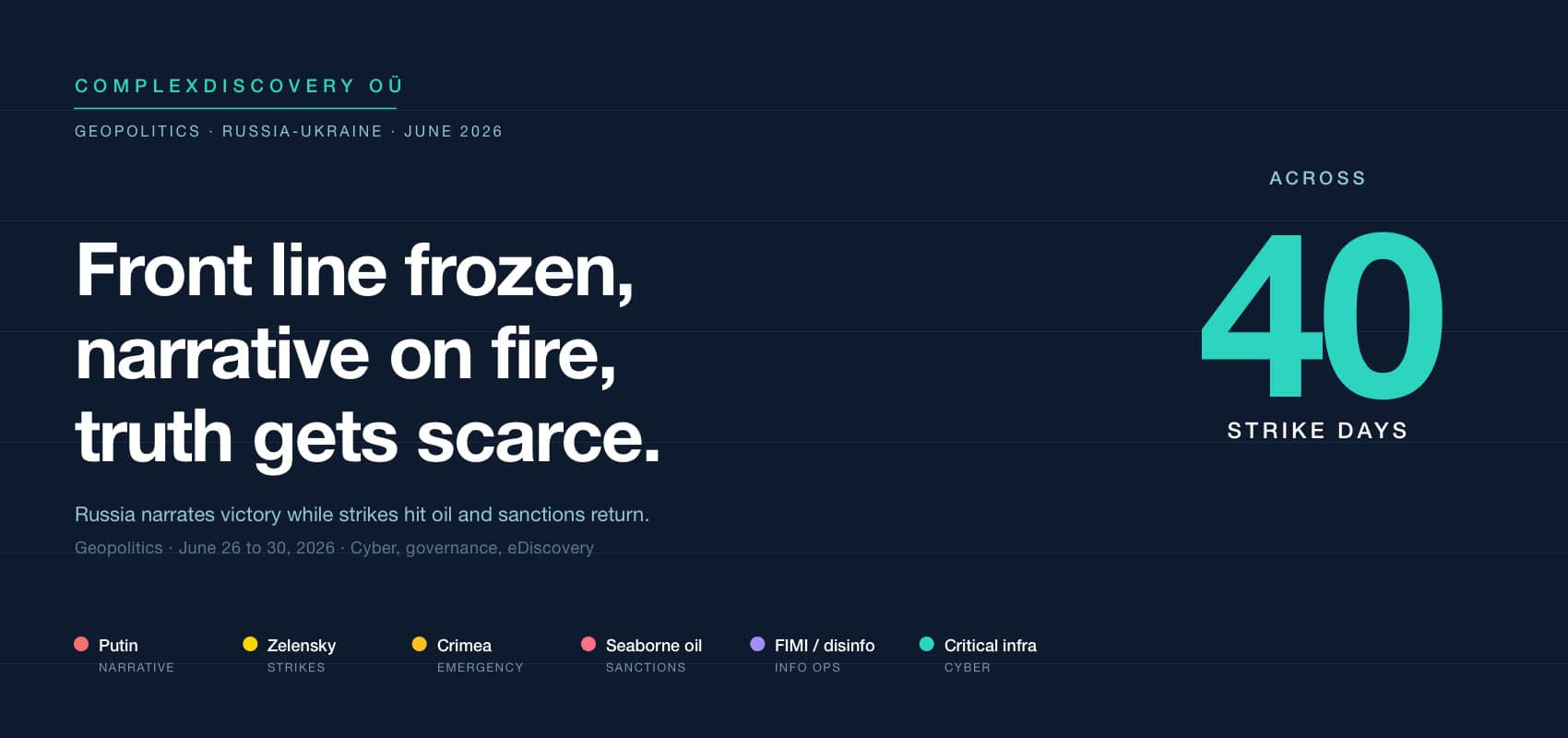
The thing Putin was talking past has a date attached to it. On June 25, Ukrainian President Volodymyr Zelensky said he had authorized a 40-day intermediate- and long-range strike campaign aimed at pushing Russia toward ending the war.
What followed was a sustained reach into Russian territory. Ukrainian forces struck oil infrastructure in Vladimir Oblast and, overnight on June 26 to 27, hit a plant tied to Russian ballistic missile production. Occupation officials in Crimea declared a state of emergency as strikes on logistics routes triggered fuel shortages, water problems, and an exodus from the peninsula. Inside Russia, gasoline shortages spread while officials insisted the economy was steady.
Independent economic analysis backs the strain. Timothy Ash, an emerging-markets economist who writes frequently on Russia, has argued that Ukrainian strikes on energy assets combined with tightening sanctions cut Russian energy export receipts to roughly half their level at the start of the full-scale invasion and pushed the budget deficit toward its full-year target within the first two months of 2026. The strikes had already produced a sharp peak earlier in the year: Reuters calculated in late March, about three months before the week in focus, that around 40 percent of Russian oil export capacity, about 2 million barrels per day, was offline at once, what it called the most severe oil supply disruption in modern Russian history. The campaign has pressed on since. Russia, for its part, kept launching missiles and drones nightly, with overnight salvos ranging from about 108 to 189 drones across the four days.
Sanctions snap back as waivers lapse
The economic vise tightened from Washington too. After three temporary waivers that had let sanctioned Russian seaborne oil keep moving, the US let the last one expire June 17 and did not renew it, according to S&P Global and The Moscow Times. By late June, sanctions on Russian seaborne oil exports were back in force.
For anyone running a sanctions desk, that sequence is the lesson. Exposure did not change because a new rule was written. It changed because an existing waiver was allowed to die on a calendar date. Screening models calibrated to the permissive window were, overnight, calibrated to the wrong reality.
Why a manufactured reality matters to data professionals
Here is where a distant war becomes a near problem. The defining feature of late June was not a breakthrough on the ground. It was an organized effort to make people believe in one. Assessments of the period describe the Kremlin elevating loyal milbloggers to help build that picture, a coordinated push to flood the field with claims faster than they can be checked.
For information governance and cybersecurity teams, the same Russian state and its aligned networks behind those narrative operations are also the focus of EU and Microsoft reporting on information manipulation and cyber activity. The European External Action Service, which runs the EU’s foreign information manipulation monitoring, reported that AI-enabled tactics appeared in 27 percent of the incidents it detected in 2025, with the number of such cases climbing from 41 to 147, about a 259 percent increase over 2024. Microsoft’s 2025 Digital Defense Report has described continued Russia-linked targeting of NATO states and critical sectors, including energy. Narrative construction and network intrusion run on the same track.
For litigation and investigations teams, the practical takeaway is provenance. When a battlefield claim, a leaked document, or a viral clip arrives as potential evidence, the question is no longer only what it shows but whether it is authentic, when it was created, and who moved it. Building chain-of-custody discipline around open-source material, and capturing metadata before it degrades, is becoming standard practice rather than a specialty.
What practitioners can do now
Three habits travel well from the war desk to the compliance desk. Treat sanctions posture as a moving target tied to expiration dates, not just to new designations, and rerun counterparty screening when a waiver lapses rather than waiting for the next enforcement headline. Map third-party and vendor exposure to the shadow-fleet and energy-trade networks that sanctions snapbacks disrupt, because supply chains absorb that shock indirectly. And govern incoming information the way an analyst governs a battlefield claim: corroborate against an independent source before it hardens into a record, and preserve the provenance trail in case it ends up in front of a court or a regulator.
None of this requires accepting any single source as gospel. The discipline that keeps a daily war assessment honest, separating confirmed advances from claimed ones, is the same discipline that keeps an investigation defensible.
The contest over what is true
The week closed with the front line essentially frozen and the information space anything but. Putin’s wager is that a confidently told story can outrun an inconveniently true one, at least long enough to shape what comes next. The professionals who will eventually have to reconstruct this period, in archives, in compliance files, and possibly in courtrooms, are wagering the opposite.
As verified ground truth grows scarcer and manufactured certainty grows louder, who in your organization owns the job of telling the difference, and would their work survive a challenge?
News Sources
- Russian Offensive Campaign Assessment, June 29, 2026 (Institute for the Study of War)
- Russian Offensive Campaign Assessment, June 28, 2026 (Institute for the Study of War)
- Russian Offensive Campaign Assessment, June 27, 2026 (Institute for the Study of War)
- Russian Offensive Campaign Assessment, June 26, 2026 (Institute for the Study of War)
- US lets Russian oil sanctions waiver expire amid Iran deal (S&P Global Commodity Insights)
- U.S. Extends Russian Oil Waiver for a Second Time (The Moscow Times)
- At least 40% of Russia’s oil export capacity halted, Reuters calculations show (Reuters)
- Putin Admits Ukrainian Strikes Driving Fuel Shortages (The Moscow Times)
- New found confidence in Ukraine (Timothy Ash)
- Microsoft Digital Defense Report 2025 (Microsoft)
- 4th EEAS Report on Foreign Information Manipulation and Interference Threats (European External Action Service / EUvsDisinfo)

Assisted by GAI and LLM Technologies
Additional reading
- When the flag may be fake: Ukraine’s June war and the new burden of proof
- When the drone war reaches the reactor fence: Ukraine and the cyber-physical front
- When the refineries burn: Ukraine’s strikes turn Russia’s energy backbone into a cautionary tale
- The night Ukrainian drones exposed gaps in Moscow’s defenses and state TV gave it 60 seconds
- From warning to funding: Russia’s expanding media machine and the risk signals ahead
- Invisible by design: NATO’s 2026 cognitive warfare paper and the crisis of discovery
- When Your Legal Tech Vendor Gets Breached: DocketWise Incident Exposes 116,666 Immigration Records and a Profession’s Blind Spot
- The DOJ’s Cyber FCA Playbook Is Working as Enforcement Triples and Shows No Signs of Slowing
- FTC’s OkCupid Action Reframes AI Training Data as a Consumer Protection Issue
- White House AI Framework Signals New Compliance Stakes for Legal, Cybersecurity, and eDiscovery
- The Gatekeeper’s Key: How the Conformity Assessment Unlocks the EU AI Market
Source: ComplexDiscovery OÜ

ComplexDiscovery’s mission is to enable clarity for complex decisions by providing independent, data‑driven reporting, research, and commentary that make digital risk, legal technology, and regulatory change more legible for practitioners, policymakers, and business leaders.