Editor’s Note: Russia’s war economy is running short on gasoline at the same moment its military leans harder on North Korean missiles and troops to sustain the fight, and the Kremlin is managing both stories with the same tool: control of the narrative. Four consecutive days of assessments from the Institute for the Study of War trace likely AI-altered battlefield footage, a fuel crisis serious enough that Russia reportedly deployed its internal security force to at least 13 fueling stations, and an opposition party banned from elections weeks before Russians vote.
For cybersecurity, information governance and eDiscovery professionals, the throughline is authentication and continuity. Doctored video, disrupted infrastructure and reported North Korean military transfers are not abstractions confined to a war zone.
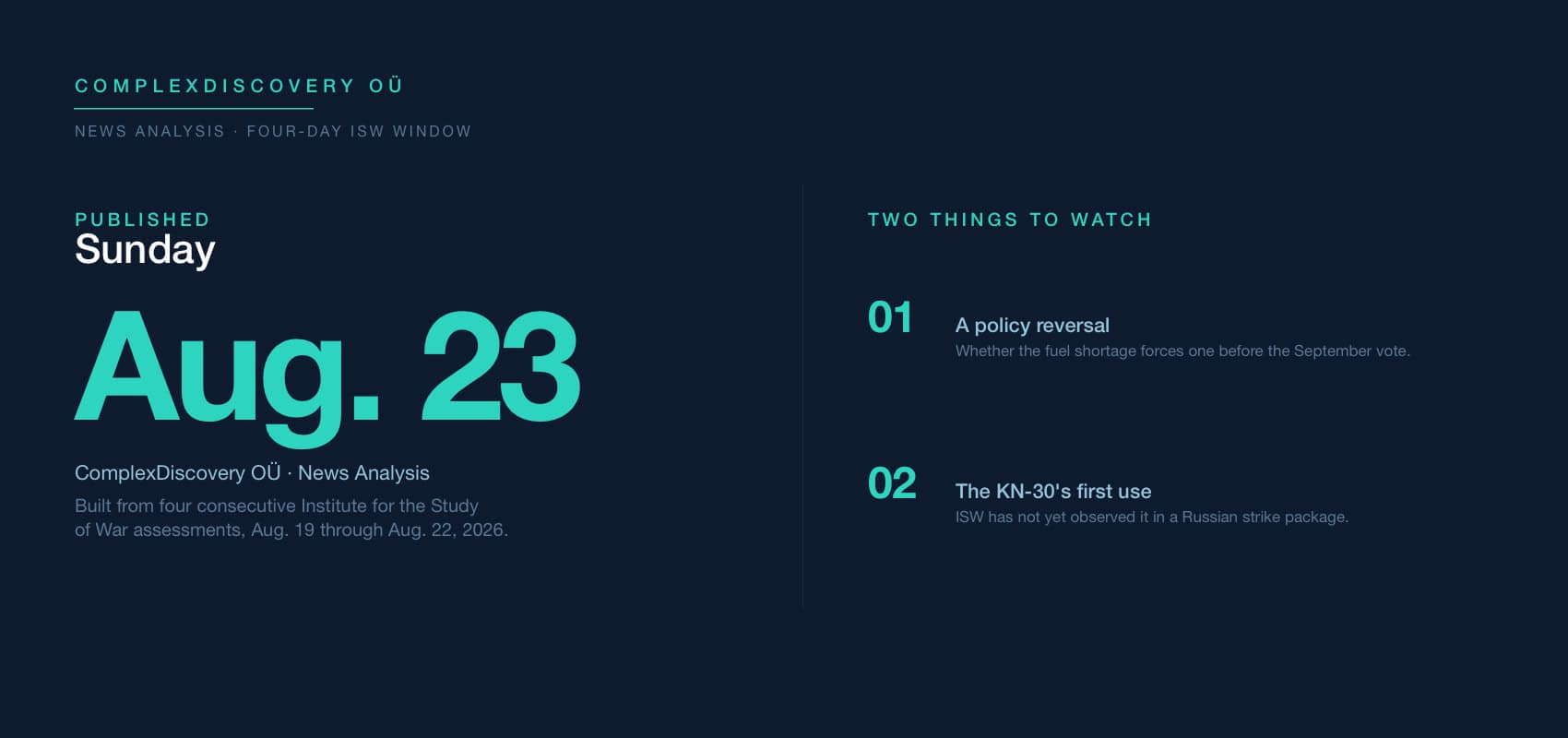
Watch whether the fuel shortage forces a policy reversal before the mid-September elections, and whether the reported KN-30 appears in a Russian strike package.
Content Assessment: Russia leans on drones and dissent-proofing as fuel crisis bites
Information - 93%
Insight - 91%
Relevance - 90%
Objectivity - 90%
Authority - 94%
92%
Excellent
A short percentage-based assessment of the qualitative benefit expressed as a percentage of positive reception of the recent article from ComplexDiscovery OÜ titled, "Russia leans on drones and dissent-proofing as fuel crisis bites."
News Analysis – Geopolitics Beat
Russia leans on drones and dissent-proofing as fuel crisis bites
ComplexDiscovery Staff
Ukraine is building what it cannot buy. Russia is trying to silence what it cannot fix.
Four days of assessments from the Institute for the Study of War, covering Aug. 19 through Aug. 22, describe a war economy under strain on one side and an improvised air-defense race on the other, while the Kremlin works to keep its own population from seeing either problem clearly.
Ukraine answers missile scarcity with homemade interceptors
A global shortage of air-defense interceptors has pushed Ukraine’s military and defense ministry toward tools it can build or borrow instead. The Ukrainian Ministry of Defense said Aug. 21 that Ukraine has developed the Alexa Spatium, a jet-powered interceptor drone designed to catch Russia’s faster Geran-3, Geran-4 and Geran-5 strike drones along with reconnaissance drones and helicopters, according to ISW’s Aug. 21 assessment. Russian forces have recently prioritized production and use of the faster, jet-powered Geran-4 and Geran-5 variants in combined strike packages, and ISW said their higher sustained speed, compared with Russia’s older piston engine-driven drones, complicates Ukraine’s ability to intercept them.
Ukraine is pairing that hardware push with a separate workaround for satellite access. Sources told the Financial Times, in a report ISW’s Aug. 21 assessment attributes directly to the FT, that Ukraine is seeking approval to fly Starlink-equipped drones up to 200 kilometers inside Russia to strike mobile ballistic-missile launchers. Approval for defined-area Starlink access over Russia could help Ukrainian forces locate and strike mobile launchers before they fire, an offensive workaround as shortages of Patriot and other interceptors leave Ukraine particularly exposed to ballistic and quasi-ballistic missiles.
The scale of what Ukraine’s defenses face keeps climbing. On the night of Aug. 19 to 20, Russia launched a combined package of ballistic and quasi-ballistic missiles, cruise missiles, Banderol loitering munitions, and Shahed-type drones that Ukraine’s air force says it intercepted at about an 88.6 percent rate for cruise missiles specifically. President Volodymyr Zelensky separately said Ukrainian forces generally intercept 93 percent of cruise missiles, a broader running figure rather than a restatement of the same night’s tally, and the two figures should not be read as measuring the same thing. Even a high interception rate left the strikes lethal: Russian ballistic-missile strikes damaged a children’s hospital, a school, residential buildings, industrial facilities and fuel infrastructure across Kyiv City and Kyiv Oblast. In Kyiv City alone, the strikes killed at least 12 people and injured at least 40, according to ISW’s Aug. 20 assessment. Prime Minister Serhiy Koretskyi separately reported that the strikes against Kyiv City lasted almost nine hours and noted that Russian forces also struck Red Cross facilities and food warehouses near Boryspil, Kyiv Oblast.
North Korea is adding new stress to that math. Ukraine’s Main Military Intelligence Directorate, known as the GUR, said Aug. 20 that North Korea had transferred about 50 KN-23, KN-24 and KN-30 ballistic missiles to Russia as of July. The KN-30, an upgraded KN-23 variant, is capable of carrying a warhead of up to 2,500 kilograms, over five times the roughly 480-kilogram warhead on Russia’s own Iskander-M missiles, and would produce larger craters and shock waves when it hits. GUR reportedly added that Russia has begun deploying six North Korean missile launchers in Voronezh Oblast and that the launchers will be able to launch a combined 120 missiles at targets including Sumy, Kharkiv, Kyiv and Dnipropetrovsk oblasts; that 120-missile launch capacity is a separate figure from the roughly 50 missiles GUR said North Korea had transferred as of July, and ISW said it has not yet observed Russia using the KN-30 against Ukraine. Ukrainian military expert Anatoly Khrapchinsky offered a caveat worth keeping in view: Russia’s own Iskander-M missiles land within five to 20 meters of their targets, he said, while North Korean KN-23 missiles regularly miss by hundreds of meters or even kilometers, an accuracy gap that, if it holds for the KN-23 specifically, tempers how much the North Korean transfers change Russia’s precision-strike capacity even as they add volume and warhead size.
North Korea’s contribution is not limited to missiles. GUR Deputy Head Maj. Gen. Vadym Skibitskyi said Aug. 21 that North Korea currently has about 8,500 troops based mainly in Kursk Oblast, including a 400-strong drone unit whose crews are equipped to watch and hit targets across the border, even though the broader troop contingent is expected to stay out of direct fighting inside Ukraine. Skibitskyi said North Korea has rotated about 25,000 soldiers through the Russian military overall and that Putin may ask North Korean leader Kim Jong Un for up to 50,000 more troops in September.
Separately, drone activity continued to create spillover risks beyond Ukraine’s borders. Moldova’s Ministry of Defense reported that a likely Russian Shahed-136/Geran-2-type drone crossed into Moldovan airspace for six minutes on Aug. 20, and Romania’s Ministry of National Defense said a Romanian F-16 destroyed a naval drone of unspecified origin near the Neptune Deep gas platform, roughly 116 kilometers from the Ukrainian border, that same morning; Romanian authorities did not identify the drone’s origin, though Defense Minister Radu-Dinel Miruta said it was not Ukrainian. ISW’s own Aug. 20 key takeaways separately characterized the naval drone as Russian, an inconsistency with its more cautious body text that this analysis does not resolve. Moldovan President Maia Sandu said Aug. 18 that Russia deliberately sends some drones into Moldovan and NATO airspace and that trajectory data can establish intent, though ISW said it could not independently confirm the intent behind these specific incursions.
Putin frames economic pain as strength ahead of elections
Putin has an economic story he needs Russians to believe before September’s State Duma elections, and the numbers are not making it easy. Putin said Russia’s gross domestic product growth is currently around 1 percent, calling the growth “modest” but positive, according to a Kremlin transcript of his remarks that ISW’s Aug. 19 report cites directly. He acknowledged that “external pressure” and “terrorist attacks,” Kremlin code for Ukraine’s long-range strike campaign, are weighing on that growth, and he conceded that Ukrainian strikes on Wildberries logistics facilities in late July and August have left some warehouses needing “restoration,” even as he insisted the country’s trade infrastructure is functioning well overall.
The Kremlin’s tighter challenge is that censorship works on the war narrative in ways it cannot on the economy. ISW’s assessment describes a broad censorship campaign that has let Putin present a rosier picture of battlefield progress than the fighting supports, but strikes on refineries, warehouses and fuel supplies are visible to ordinary Russians and businesses in a way state media cannot fully paper over. Putin used his Aug. 22 speech to the United Russia Party Congress to lean the other way rhetorically, telling the party it has a duty to do “everything possible to achieve victory” in Ukraine and using the party’s expected election victory as evidence, in his framing, of public support for a war ISW describes as increasingly protracted and costly. Putin separately said in his Aug. 22 interview that Ukraine’s and Europe’s peace proposals are “exotic” and “unacceptable” to Russia. Deputy Foreign Minister Sergei Ryabkov reinforced the same posture Aug. 21, saying Russia will accept only a peace proposal that matches Putin’s own war aims and reflects what he called “ground realities,” while Zelensky has repeatedly said he remains willing to negotiate in good faith, according to ISW’s reporting.
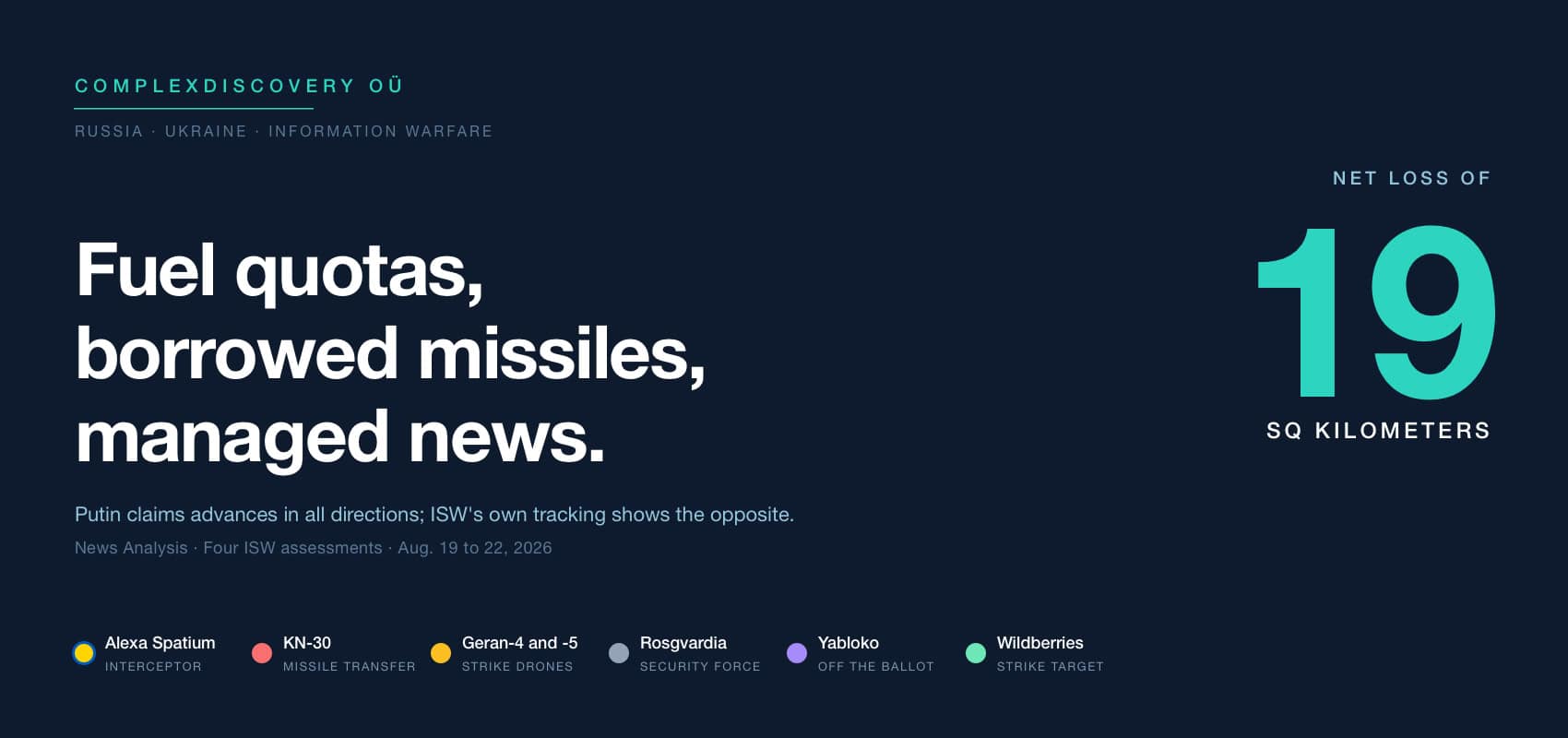
Putin’s claims about the battlefield itself do not hold up against ISW’s own tracking. He said in an Aug. 22 interview that Russian forces are advancing in all directions at an increased pace. ISW’s own accounting shows Russian forces seized or infiltrated 8.52 square kilometers in August through Aug. 22 while losing control of 27.09 square kilometers over the same 22-day stretch, not counting areas Russian troops may have infiltrated without holding; that is a net loss of about 18.57 square kilometers, or roughly 0.84 square kilometers a day net, even though the 8.52 square kilometers seized or infiltrated works out to a gross gain of about 0.39 square kilometers a day, a rate ISW says has been declining steadily since January. The Ukrainian General Staff’s reporting, aggregated by ISW, put Russian casualties at around 29,120 between July 31 and Aug. 22, a 23-day span that overlaps with, but is one day longer than, the 22-day territorial-change window described above.
AI-altered footage and flag-raising stunts
Much of what Russia cannot deliver on the battlefield, it tries to manufacture on camera. ISW’s Aug. 19 report assessed that footage circulated by Russian sources purporting to show soldiers waving flags in Novomykolaivka, in the Kostyantynivka area, to claim the village’s capture was likely doctored or AI-altered, part of what ISW calls a cognitive-warfare campaign using aggrandized advance claims and manipulated footage to suggest broader Russian gains than the front line supports. The Aug. 20 report documented the same pattern again: footage purportedly showing Russian troops in Mykolaipillya, west of Kostyantynivka, that visual analysis indicated may also be AI-altered or AI-generated.
The Aug. 22 report adds a case of disinformation that does not even require new footage. Russian sources circulated old footage of strikes against Ukrainian positions in Kostyantynivka and Kleban-Byk, behind the current front line, and mischaracterized it as showing fresh Russian success in Oleksiyevo-Druzhkivka, according to ISW, which said Russian state newswire TASS carried the mischaracterized footage as well. ISW attributed the tactic to the Kremlin’s broader cognitive-warfare effort to aggrandize Russian gains and said Russian forces have been using doctored footage, false locations and mischaracterized infiltration footage together to sustain the appearance of progress the ground situation does not support.
Ukraine’s own flag encounters get less theatrical coverage. Ukraine’s State Border Service said its forces hit a Russian team as it tried to stage a flag-planting stunt near Vovchansk on Aug. 18, an episode ISW filed under the same Kremlin pattern of manufacturing a false sense of advance for the cameras.
Fuel shortages force the Kremlin’s hand at home
Fuel scarcity is one place where Ukraine’s long-range strikes are reaching ordinary Russians, including the urban populations the Kremlin has sought to shield. Russian state newspaper Izvestia reported Aug. 18 that fuel was available at only 28 percent of the Russian gas stations tracked by the crowd-sourced app GdeBENZ, down from 41 percent the week before. Izvestia correspondents also reported Aug. 17 that 21 gas stations across Moscow City and Moscow Oblast were experiencing varying levels of gasoline shortages, particularly of high-quality grades. Gazprom Neft’s own hotline told Russian outlet RBK it had imposed gasoline quotas at some Moscow stations while claiming it was working to increase supply.
The shortage is spreading sideways into other sectors. Russian outlet Kommersant reported Aug. 19 that Russia is also short on motor oil because raw inputs are scarce and harder to import, and reported a day earlier that a Russian government panel overseeing economic development had gathered around mid-August to weigh a ban on exporting aromatic hydrocarbons, chemicals refineries have begun diverting toward lower-quality gasoline production under a July 2 decree, according to ISW’s Aug. 19 assessment. That diversion helps gasoline output but, ISW assessed, worsens shortages in other sectors, including the availability of motor oil, while starving defense-linked production of synthetics, rubbers and polymers.
Deputy Prime Minister Alexander Novak said Aug. 19 that the Kremlin is “monitoring” the crisis and pointed to fuel imports, an export ban and lower-grade fuel approvals as responses, telling Russians that several refineries will resume operations “soon” and that “the situation will improve significantly,” according to ISW’s Aug. 20 report. Ukraine’s Foreign Intelligence Service reported the same week that rising fuel costs pushed road freight transport prices up 4.5 to 5.5 percent, with costs rising even further on routes between Russia and China because of a fuel collapse in Zabaikalsky Krai. Russian Union of Industrialists and Entrepreneurs President Alexander Shokhin said Aug. 20 that Ukrainian drone strikes have cut Russian oil-refining capacity by 25 to 30 percent and degraded mineral fertilizer and chemical production, adding that strikes on logistics operators such as Wildberries affect both domestic and export markets, a point Putin himself echoed two days later when he acknowledged that Ukrainian strikes cause “economic damage” and said Russia needs to improve its air defenses through cooperation between state and private industry.
The shortage has a security dimension the Kremlin is not hiding well. An unnamed Russian insider source told a Telegram channel that Putin sent Rosgvardia, Russia’s militarized internal security force, into Moscow Oblast fueling stations, and ISW’s Aug. 19 assessment said the deployment covered at least 13 stations across Russia and occupied Crimea. The claim originated with one unnamed-source post and was subsequently repeated by several Western and Ukrainian-aligned outlets; the four assessments provide no independent confirmation. Russia’s legislative commission separately approved a draft bill Aug. 18 letting Emergency Situations rescue forces use physical force and firearms when nonviolent means fail, framed publicly as a counter-drone measure but one that also gives the Kremlin a broader legal tool against domestic unrest, ISW assessed.
Dissent gets managed rather than debated
Russian authorities are narrowing the space for public gatherings as election-related dissent and fuel-shortage pressures grow. The Spasskaya Bashnya military music festival, held annually in Red Square since 2007 except in 2020, was canceled Aug. 17 “for reasons beyond the organizers’ control,” according to the festival’s own Telegram announcement cited by ISW, and Russian authorities had already canceled a Red Square concert planned for Russia Day in June. Ukraine’s Center for Countering Disinformation noted that the cancellations followed protests over the Russian Supreme Court’s decision barring the opposition Yabloko Party from the Sept. 18 to 20 State Duma elections, and ISW assessed that the cancellations let security services preserve bandwidth for managing fuel-shortage unrest and other competing demands rather than staffing large public gatherings.
The Yabloko ban carries forward into how Putin is remaking his own party’s identity. Putin used the Aug. 22 party congress to position United Russia as the only party that matters, ISW said, and to fold the elimination of Yabloko, the party ISW describes as the only nominally antiwar party in the race, into that effort. Yevgeny Poddubny, a Kremlin-coopted war correspondent and deputy head at Russia’s state broadcaster who is also a United Russia candidate, said Aug. 19 the party wants to land somewhere between 40 and 100 combat veterans in the incoming Duma, or roughly 9 to 22 percent of the chamber’s 450 seats. United Russia General Council Secretary Vladimir Yakushev said in June that 20 graduates of the Kremlin’s Time of Heroes program, which places war veterans into government positions, had already won the party’s preliminary vote, with 10 running on party lists and 10 in single-mandate races.
Ukraine confirms two Cabinet posts amid the pressure
The Verkhovna Rada confirmed Zelensky’s appointment of Yevheniy Khmara as defense minister Aug. 19, following Zelensky’s July 16 interim appointment and an Aug. 18 formal nomination, and lawmakers separately confirmed the president’s decision to keep Andriy Sybiha on as foreign affairs minister, a post Sybiha has held since September 2024.
What this means for cybersecurity, information governance and eDiscovery professionals
The likely AI-altered flag-raising and Kostyantynivka footage that ISW documented across three of the four reports is not an abstract information-warfare curiosity for professionals who authenticate digital evidence for a living. The footage raises analogous questions about provenance, manipulation history and independent verification. ISW cites visual analysis and geolocation in assessing the material; formal authentication requirements would depend on the jurisdiction and proceeding. Authentication protocols built for deepfake-era evidence, including metadata verification and independent geolocation cross-checks, are directly applicable to any record custodian handling conflict-adjacent open-source material headed toward a legal file.
Ukraine’s long-range strikes against Russian refineries, logistics hubs and space-launch infrastructure, and Russia’s own strikes against Ukrainian energy and transportation systems, illustrate a business-continuity problem that extends well past the two countries fighting. The Ukrainian General Staff confirmed Aug. 19 that an Aug. 14 to 15 strike hit the Soyuz launch-vehicle engine assembly workshop at Russia’s Progress Space Launch Center in Samara Oblast, the main production site for the Soyuz rockets Russia uses to launch satellites for Rassvet, its Starlink-analogue constellation. Any organization with data processing, satellite connectivity or supply-chain dependencies touching Russian or Ukrainian energy, logistics or space infrastructure, the kind of facilities ISW’s four reports describe being hit on both sides, needs continuity plans that assume infrastructure disruption rather than infrastructure resilience as the working case.
The Kremlin’s internal censorship campaign, paired with its external drone incursions into Moldovan and Romanian airspace and the naval-drone incident near Romania’s Neptune Deep gas platform that ISW documented Aug. 20, is a live test case for open-source-intelligence verification workflows. When state media and independent Telegram channels disagree on basic facts, as ISW’s endnotes distinguish throughout these four reports between direct government sourcing and secondary relay reporting, the same tiering discipline that separates a primary government release from a secondary outlet’s account belongs in any OSINT verification pipeline that touches geopolitical risk assessment.
Finally, the cross-border military transfers ISW documents involving North Korea, missiles and troops moving into Russia’s war effort, are the kind of transactional pattern sanctions-screening and denied-party-list programs are built to flag. Organizations with counterparties, vendors or data flows touching Russian, North Korean or intermediary jurisdictions named in these assessments should treat the transactional patterns ISW describes as a reminder that sanctions-screening and denied-party-list checks need updating at the same pace the underlying conflict does.
What should information governance teams outside the conflict zone take from a war that increasingly runs on drones, doctored footage and fuel logistics rather than territorial breakthroughs?
News sources
- Russian Offensive Campaign Assessment, August 19, 2026 (Institute for the Study of War)
- Russian Offensive Campaign Assessment, August 20, 2026 (Institute for the Study of War)
- Russian Offensive Campaign Assessment, August 21, 2026 (Institute for the Study of War)
- Russian Offensive Campaign Assessment, August 22, 2026 (Institute for the Study of War)

Assisted by GAI and LLM Technologies
Additional reading
- Senate passes Graham sanctions act, shifting Russia pressure from policy to statute
- Lithuania’s false-flag warning puts drone attribution on NATO’s eastern flank
- Three accounts from one wartime morning in Russia
- When an air defense engagement becomes a criminal case file
- The week the war reached Russia’s e-commerce supply chain
- The three silent hours: How Russia’s cyber war targets Ukraine’s newsrooms
- Confirmed versus claimed: reading the gap in Russia’s June offensive
- When the flag may be fake: Ukraine’s June war and the new burden of proof
- When the drone war reaches the reactor fence: Ukraine and the cyber-physical front
- When the refineries burn: Ukraine’s strikes turn Russia’s energy backbone into a cautionary tale
- The night Ukrainian drones exposed gaps in Moscow’s defenses and state TV gave it 60 seconds
- From warning to funding: Russia’s expanding media machine and the risk signals ahead
- Invisible by design: NATO’s 2026 cognitive warfare paper and the crisis of discovery
- When Your Legal Tech Vendor Gets Breached: DocketWise Incident Exposes 116,666 Immigration Records and a Profession’s Blind Spot
- The DOJ’s Cyber FCA Playbook Is Working as Enforcement Triples and Shows No Signs of Slowing
- FTC’s OkCupid Action Reframes AI Training Data as a Consumer Protection Issue
- White House AI Framework Signals New Compliance Stakes for Legal, Cybersecurity, and eDiscovery
- The Gatekeeper’s Key: How the Conformity Assessment Unlocks the EU AI Market
Source: ComplexDiscovery OÜ

ComplexDiscovery’s mission is to enable clarity for complex decisions by providing independent, data‑driven reporting, research, and commentary that make digital risk, legal technology, and regulatory change more legible for practitioners, policymakers, and business leaders.