
Editor’s Note: Germany’s Sept. 1 attribution of the Leipzig/Halle airport drone to Russia came with a consulate closure, a lease termination and a sanctions push, and with categories of evidence rather than the underlying material. The Federal Prosecutor General’s Aug. 6 release names no suspect, no state and no service. The ministers named the state four weeks later but no suspect or intelligence service, though ARD reported that investigators had turned up at least one person believed to be tied to a Russian service and had made no arrests. Most physical detail in view, from the Semtex in a tin can to the DNA traces, arrived through unnamed security sources, and some of it has already been revised: the reported DNA link to the 2024 DHL fire was contradicted within a day, and the reported collision with a DHL freighter is now assessed as probably a bird.
For cybersecurity, information governance, and eDiscovery readers, this is attribution under two standards: the sufficient-probability standard one lawyer says diplomatic measures require, and the criminal standard a Stuttgart court applied on Aug. 18 to convict one recruit and acquit two.
Watch the Federal Prosecutor General’s office for an arrest or an indictment, and the Bundestag for the intelligence-law reform.
Content Assessment: Germany names Russia for the Leipzig drone, and keeps most of its evidence out of view
Information - 94%
Insight - 93%
Relevance - 92%
Objectivity - 93%
Authority - 94%
93%
Excellent
A short percentage-based assessment of the qualitative benefit expressed as a percentage of positive reception of the recent article from ComplexDiscovery OÜ titled, "Germany names Russia for the Leipzig drone, and keeps most of its evidence out of view."
News Analysis – Geopolitics Beat
Germany names Russia for the Leipzig drone, and keeps most of its evidence out of view
ComplexDiscovery Staff
Berlin has decided which state was behind the bomb-laden drone found beside a Ukrainian cargo plane at Leipzig/Halle Airport. It has told the public what kinds of evidence it holds and released little of the underlying material. That gap, between an attribution and the proof behind it, is the part of Tuesday’s announcement that will outlast the consulate closure it triggered, because the next attribution will be argued on the same terms.
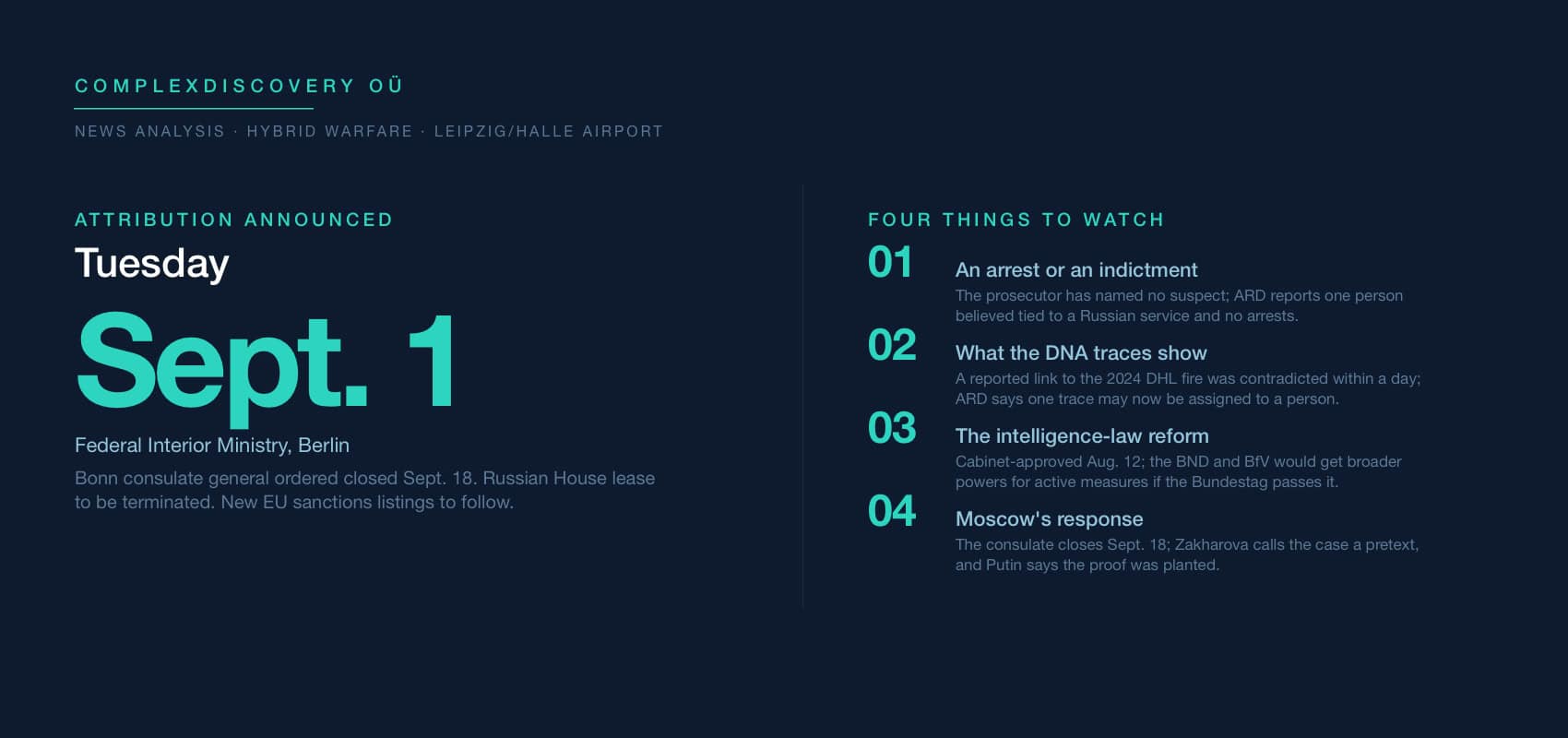
Interior Minister Alexander Dobrindt and Foreign Minister Johann Wadephul told reporters Sept. 1 that the German government holds Russia responsible for the attempted attack of Aug. 4. Dobrindt said police investigations, the pattern of the act and intelligence findings together prove Russian responsibility, according to The Associated Press. Wadephul said Russia’s leadership had chosen to damage an already heavily burdened bilateral relationship. The Russian consulate general in Bonn would close Sept. 18, he said, and the lease on Berlin’s Russian House, a cultural center, would be terminated. Germany would also propose new European Union sanctions listings, tighten entry checks on Russian nationals and bear down on the shadow fleet, the tankers suspected of carrying Russian oil around sanctions. The Russian ambassador was summoned while the ministers were still speaking.
Allies lined up the same day. NATO Secretary-General Mark Rutte wrote on X after a call with Chancellor Friedrich Merz that the alliance stood “in full solidarity with Germany,” the AP reported. Hours earlier, Polish Prime Minister Donald Tusk had spoken of fresh sabotage against Poland, arson among it, one day after a fire at the drone maker WB Electronics, a company Warsaw calls the largest of its kind in Europe. Polish prosecutors said they suspected foreign intelligence activity without naming a country. EU foreign ministers meet in Ireland on Wednesday. Behind the diplomatic record sits a criminal one, and it is thinner.
What the prosecutor’s release says
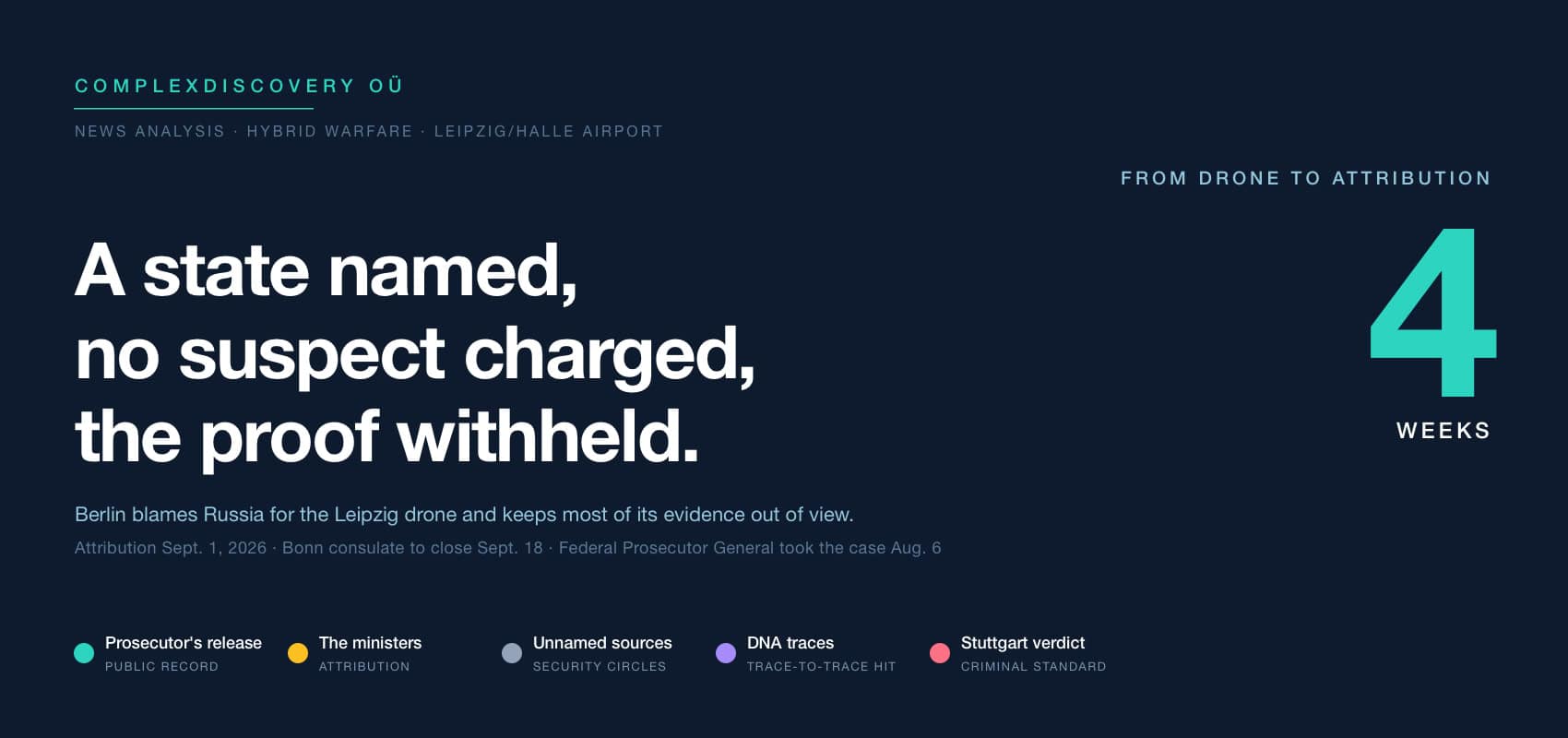
On Aug. 6 the Federal Prosecutor General’s office took the investigation over from Saxony’s prosecutor general’s office in Dresden, citing the special importance of the case. Its release describes sufficient factual indications that someone intended to cause an explosion on the airport grounds on the evening of Aug. 4 by means of a drone fitted with professional explosive and a detonator. It adds that a cargo aircraft forced to abort its landing collided in the air, in the airport’s wider area, with an object presumed to be a second drone. The suspected offenses are attempted causing of an explosion under Section 308 of the Criminal Code and dangerous interference with air traffic under Section 315, paragraph 1, number 4. The Federal Criminal Police Office was assigned the police investigation.
The release names no suspect, no state and no intelligence service. Four weeks later, the ministers have named the state but no suspect or intelligence service. Intelligence points to “people being involved who acted on behalf of Russian state entities,” Dobrindt said, according to the AP, without saying which entities. The configuration of the drone, its components, its explosives and its detonator were “known to us from other Russian hybrid operations and its war against Ukraine,” he said, and the device showed “a high degree of technical expertise,” while the people who carried out the plan appear to have been “low-level” agents. ARD reported on Sept. 1 that investigators had turned up at least one person believed to be tied to a Russian intelligence service, and no arrest had been announced as of Wednesday. Security officials told ARD that not everything can be made public while the network behind the attempt is still active. What has reached the public has mostly come by another route.
Most of the evidence in public view came through unnamed sources
Most physical detail in circulation reached the public through unnamed security sources rather than through the prosecutor. Bild reported that the explosive was Semtex packed into a resealed commercial tin can with a detonator mounted through its base. NDR, WDR and Süddeutsche Zeitung put the charge at about 600 grams; dpa sources added PETN. Bild reported on Aug. 10 that a DNA trace from the drone matched a trace from the July 20, 2024, incendiary fire at the DHL logistics center at the same airport. The three-outlet consortium reported the next day that the DNA traces are not connected to that earlier plot. One, it said, is a trace-to-trace hit that could relate to a different case, and another apparently leads to Lithuania. On Sept. 1, ARD reported that a trace on the drone apparently could be assigned to a person. A spokesperson for the federal prosecutor declined to comment on the DNA reporting, airliners.de reported. The consortium also reported on Aug. 25 that parts of another drone had been found Aug. 14 in a field at Kabelsketal, west of the airport. Investigators found a substance at the site the next day, it said, preliminarily assessed as possibly about 50 grams of hexogen. ABC News reported on Aug. 26 that a U.S. official briefed on the investigation described the explosives and structure as typical of devices used by Russia’s military intelligence directorate, the GRU.
None of that has been confirmed on the record by German authorities, and parts of the picture have moved. Die Zeit reported that airport surveillance footage shows the drone striking the wing of a parked Antonov at about 7:30 p.m. and falling to the ground; the AP reported that a flying object was sighted shortly before midnight and that an airport employee found the drone near the south runway. Those are stages of one sequence, several hours apart, rather than competing versions, though officials have not confirmed the earlier timing. The second aircraft is a different matter. On Aug. 25, NDR, WDR and Süddeutsche Zeitung reported that an examination of the tail damage on the DHL freighter had ruled out a bird strike. On Sept. 1, ARD reported that the collision reports had not been confirmed and that investigators now assume the aircraft probably hit a bird. The prosecutor’s release says a collision with an object is presumed and that an explosion was intended. It says nothing about a wing strike, a tin can or a bird.
Practitioners who handle evidence for a living will recognize the shape of the problem. The public record shows discovery by an airport employee and then transfers of investigative responsibility, from the federal police to Saxony’s state police and on to the Federal Criminal Police Office, according to the government’s Aug. 5 briefing and the prosecutor’s release. It shows nothing about item-level custody of the drone, the can or the DNA swabs. No source reports a defect in that handling. What the public has is a visibility gap: a set of partially overlapping leaks, each attributed to security circles, none checkable against the investigative file. Nor does a German criminal file become public on indictment. Section 475 of the Code of Criminal Procedure conditions third-party access on a legitimate interest, so more of the record may surface if charges are filed, and much of it may never. On Heinemann’s reading, the political response does not require the criminal standard a court would apply.
Two standards of proof, and the one Berlin needed
The government is not pretending otherwise, and on one lawyer’s reading it does not have to. Patrick Heinemann, an administrative-law specialist and partner at Bender Harrer Krevet in Freiburg, argued in Legal Tribune Online on Aug. 6 that a security-policy response to the incident does not need evidence that would hold up in court. In his analysis, a sufficient probability of Russian responsibility is enough for diplomatic and sanctions measures. Heinemann also argued that the incident, with no detonation and minimal damage, falls below the intensity the International Court of Justice’s 1986 Nicaragua judgment set for an armed attack under Article 51 of the U.N. Charter, and on his reading NATO’s Article 5 is not in play. Article 4 consultations remain available, and Estonia and Poland used them in September 2025 after airspace violations.
Germany’s security agencies describe the same distinction from the other side. In their assessment, ARD reported on Sept. 1, Russian services rely on throwaway recruits and front men in part because the arrangement makes the principals almost impossible to convict. Whether the accumulated findings justify an attribution then becomes, in the end, a political call as much as an evidentiary one. Dobrindt made the political call in those terms: Germany is not at war, he told reporters, but it is a daily target of hybrid warfare, according to a dpa account of his remarks. A consulate closure, a lease termination and a sanctions proposal are the tools that the standard Heinemann describes unlocks, and they were the tools on the table Tuesday. An indictment is not among them.
Berlin has gone further before, in a different domain. On May 3, 2024, then-Foreign Minister Annalena Baerbock and then-Interior Minister Nancy Faeser attributed the intrusion into the Social Democratic Party’s email systems to APT28, a group they said was steered by Russia’s military intelligence service, the GRU, Al Jazeera reported at the time. That attribution named the service and the group. Tuesday’s named neither, and the most specific public suggestion of a service so far has come from the unnamed U.S. official speaking to ABC News. Cyber attributions often come with a vocabulary, threat-actor names and indicators, that lets outside analysts test them against their own telemetry. A drone in a field does not, which leaves the public with the ministers’ word that the components match. The distance between that word and a conviction is measured in a courtroom in Stuttgart.
What a Stuttgart courtroom showed about the gap
On Aug. 18 the Higher Regional Court in Stuttgart delivered a verdict on the recruitment model Dobrindt described. Three Ukrainian nationals, ages 30, 22 and 25, had been charged with conspiracy to commit aggravated arson and with agent activity for a Russian state entity, according to Legal Tribune Online’s report on the judgment. In March 2025 the men had sent two parcels of car parts fitted with activated GPS trackers from Germany toward Ukraine. The court found that a Russian state body stood behind the shipments and wanted to scout targets and transport routes for sabotage. The federal prosecutor had alleged that parcels carrying incendiary devices were to follow. The court could not establish that plan or the men’s knowledge of it, Legal Tribune Online reported, so the arson-conspiracy charge failed for all three. It convicted the 30-year-old of agent activity for sabotage purposes and sentenced him to one year and three months, already served; he had taken the assignment through an intermediary in occupied Mariupol and acted for pay. It acquitted the two younger men, who were unpaid and did not know the principals. The court could not prove they had even considered a sabotage purpose possible. German reporting calls recruits of this kind, untrained and easily replaced, disposable agents. Legal Tribune Online did not say whether the verdict is final, and it cited the July 2024 DHL fire only as context, not as part of the charges.
That is what a German trial tied to sabotage scouting produced, just over two years after the DHL fire: one conviction of a courier-level participant, two acquittals, and, in that case, no publicly reported charge against anyone who gave the orders. The Leipzig drone case is four weeks old. Dobrindt’s phrase, low-level agents, describes what the security agencies told ARD is a deliberate feature of the operations he is attributing, not an accident of this one. If the model holds, the people most easily arrested in Germany may be the people who know least, and a court applying the criminal standard to them may acquit some, as Stuttgart did. The gap between what the agencies say they know and what a court can use is not unique to sabotage cases.
Where the evidence problem lands on this beat
Readers who manage forensic collections, litigation holds or incident records work inside the same gap every week. The Leipzig sequence is a live case study in what attribution looks like when the physical evidence disclosed to the public is limited and much of the intelligence cannot be published. Three points carry over directly.
First, the state’s own record diverged early, and it kept moving. At the Aug. 5 government press conference, according to the published transcript, the Interior Ministry spokesman said the incident had taken place at 4 a.m. that night, while the Transport Ministry spokesman said flight operations were halted at 1:55 a.m. for about two hours. The prosecutor’s release places the attempt on the evening of Aug. 4, the AP had the sighting shortly before midnight, and Die Zeit’s footage account places the wing strike at about 7:30 p.m. Some of those timestamps describe different events in one night rather than competing versions of one event. The public record did not consistently distinguish among those stages. The DHL collision went from reported, to backed by a damage examination, to probably a bird, in three weeks. Any organization reconstructing an event from its own logs should expect the same drift. Preserve the original camera footage, access-control logs and radio traffic with hashes before anyone writes a summary, and timestamp the moment each version entered the record, because the first version is the one that gets quoted.
Second, the DNA reporting shows how a match and an identification get conflated. The Aug. 10 report of a hit against the 2024 DHL fire was contradicted within a day. Three weeks later ARD reported that a trace apparently could be assigned to a person. A trace-to-trace hit tells investigators that two samples share a profile. It does not, on its own, say whose profile it is. Organizations that rely on any matching technology, from biometric access logs to email threading, should record a match and an identification as two separate events with two separate dates, because that is the distinction a regulator or a court will ask about.
Third, the German Cabinet approved a reform of intelligence law on Aug. 12 that would give the Federal Intelligence Service, the BND, and the Federal Office for the Protection of the Constitution, the BfV, broader powers, including authority for active measures against sabotage and hacking operations, according to the government’s own summary. The bill still needs the Bundestag. If it passes, more of the evidence behind the next attribution will originate with agencies whose material can stay classified or outside the public criminal record, which widens rather than narrows the gap this article describes.
Moscow’s response was to deny the evidence exists. Foreign Ministry spokesperson Maria Zakharova called the accusation a “far-fetched and contrived pretext,” the AP reported, and Russian President Vladimir Putin, speaking in Kyrgyzstan early Wednesday, said the proof had been planted, without elaborating. Berlin can answer that most directly by publishing what it has, and it has so far chosen not to, for the reasons its security officials gave ARD. That choice is defensible under the standard Heinemann describes, and it leaves the argument where it started. Should governments that attribute hybrid attacks be expected to publish a declassified evidentiary summary, the way cyber attributions increasingly come with technical indicators, or does that requirement hand the adversary a map of what the investigators know?
News sources
- Übernahme der Ermittlungen nach Drohnenfund am Flughafen Leipzig/Halle (Der Generalbundesanwalt)
- Germany blames Russia for last month’s attempted drone attack at Leipzig airport (The Associated Press via NPR)
- Außenminister Wadephul bei der gemeinsamen Pressekonferenz mit Innenminister Dobrindt (Auswärtiges Amt)
- Drone with explosives found at German airport, official sees ‘new quality’ of threat (The Associated Press via NPR)
- Regierungspressekonferenz vom 5. August 2026 (Bundesregierung)
- Versuchter Anschlag mit Sprengstoffdrohne: Bundesregierung will Generalkonsulat und Russisches Haus schließen (Der Tagesspiegel)
- Versuchter Drohnenanschlag in Leipzig: Welche Beweise die Bundesregierung gegen Russland anführt (Stuttgarter Nachrichten)
- Russlands Anschlagsversuch mit Drohnen: Warum sich die Bundesregierung jetzt sicher ist (tagesschau.de / ARD)
- Nach Vorfall am Flughafen Leipzig: Verdächtige DNA-Spuren und eine Antenne (tagesschau.de / NDR, WDR, SZ)
- Anschlagsversuch am Leipziger Flughafen: Ermittler finden weitere Drohne und Sprengstoff (tagesschau.de / NDR, WDR, SZ)
- Explosive drone at Leipzig airport: Whose DNA was found on the device? (Euronews)
- DNA-Spur bringt Leipziger Drohnenfund in Verbindung mit DHL-Anschlag (airliners.de)
- Sprengstoff in Konservendose? Neue Details zum Drohnen-Vorfall in Leipzig (Euronews)
- Neue Spur am Flughafen Leipzig: Was über eine dritte Drohne berichtet wird (ZDFheute)
- Explosive drone at German airport linked to Russian military intelligence, US intel source says (ABC News)
- Bewaffneter Angriff am Leipziger Flughafen? Wie Deutschland auf den Drohnenvorfall reagieren kann (Legal Tribune Online)
- OLG verurteilt ‘Wegwerf-Agenten’: Pakete mit GPS-Tracker gespickt (Legal Tribune Online)
- OLG Stuttgart: Urteil und Freisprüche für “Wegwerfagenten” (ZDFheute)
- Bundeskabinett beschließt Reform des Rechts der Nachrichtendienste (Bundesregierung)
- Germany accuses Russia of ‘intolerable’ cyberattack, warns of consequences (Al Jazeera)
- Germany Says Russia Behind ‘Hybrid Attack’ At Leipzig Airport (RFE/RL)

Assisted by GAI and LLM Technologies
Additional reading
- Estonia scrambled jets over a drone no official has identified
- Russia leans on drones and dissent-proofing as fuel crisis bites
- Senate passes Graham sanctions act, shifting Russia pressure from policy to statute
- Lithuania’s false-flag warning puts drone attribution on NATO’s eastern flank
- Three accounts from one wartime morning in Russia
- When an air defense engagement becomes a criminal case file
- The week the war reached Russia’s e-commerce supply chain
- The three silent hours: How Russia’s cyber war targets Ukraine’s newsrooms
- Confirmed versus claimed: reading the gap in Russia’s June offensive
- When the flag may be fake: Ukraine’s June war and the new burden of proof
- When the drone war reaches the reactor fence: Ukraine and the cyber-physical front
- When the refineries burn: Ukraine’s strikes turn Russia’s energy backbone into a cautionary tale
- The night Ukrainian drones exposed gaps in Moscow’s defenses and state TV gave it 60 seconds
- From warning to funding: Russia’s expanding media machine and the risk signals ahead
- Invisible by design: NATO’s 2026 cognitive warfare paper and the crisis of discovery
- When Your Legal Tech Vendor Gets Breached: DocketWise Incident Exposes 116,666 Immigration Records and a Profession’s Blind Spot
- The DOJ’s Cyber FCA Playbook Is Working as Enforcement Triples and Shows No Signs of Slowing
- FTC’s OkCupid Action Reframes AI Training Data as a Consumer Protection Issue
- White House AI Framework Signals New Compliance Stakes for Legal, Cybersecurity, and eDiscovery
- The Gatekeeper’s Key: How the Conformity Assessment Unlocks the EU AI Market
Source: ComplexDiscovery OÜ

ComplexDiscovery’s mission is to enable clarity for complex decisions by providing independent, data‑driven reporting, research, and commentary that make digital risk, legal technology, and regulatory change more legible for practitioners, policymakers, and business leaders.