Editor’s Note: A cell tower standing in Russian footage of Nove, which a pro-war Russian blogger said Ukrainian video had shown destroyed a day earlier, was enough for him to mock the Sept. 29 Russian claim as anything but fresh. That small check anchors a wider week drawn from four Institute for the Study of War assessments and reporting from Reuters, the Kyiv Independent, ERR, Politico and UPI. Moscow restricted public data on fuel exports and the buyers behind them, Reuters reported that Russia’s actual 2026 defense spending is classified, and Russia escalated strikes on Ukraine’s power grid ahead of winter.
For cybersecurity, information governance and eDiscovery professionals, the throughline is evidentiary. Authenticity and currency are separate questions for any video exhibit, sanctions diligence has less open data to work with as a U.S. tariff deadline arrives Oct. 18, and Estonia’s security service has urged organizations supporting Ukraine to strengthen both physical and cyber protection.
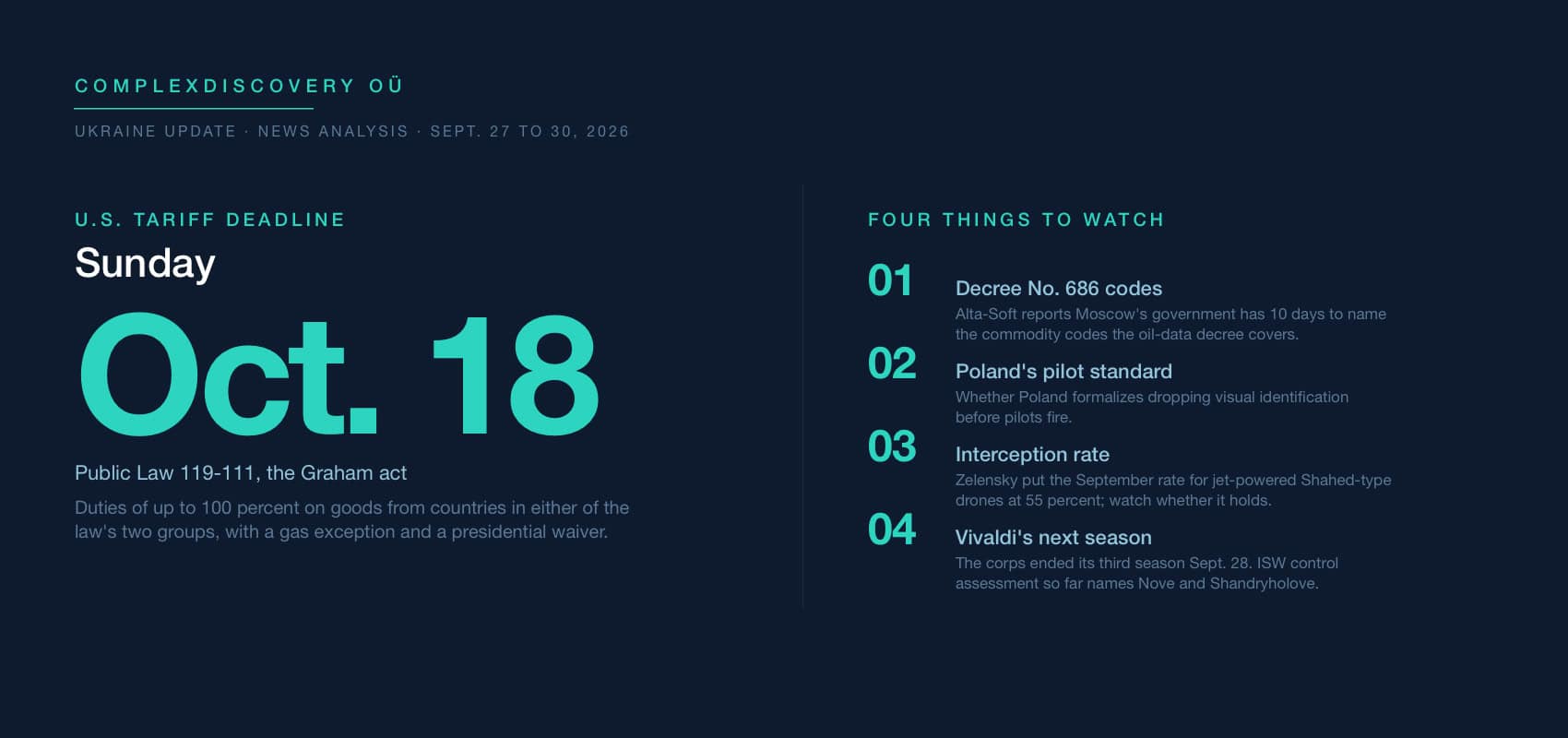
Watch which commodity codes Moscow attaches to its data decree, how Washington applies the Graham act’s tariff test and whether Poland formalizes its new identification standard for pilots.
Content Assessment: A cell tower near Lyman and Russia's fight over its own war record
Information - 92%
Insight - 91%
Relevance - 90%
Objectivity - 92%
Authority - 94%
92%
Excellent
A short percentage-based assessment of the qualitative benefit expressed as a percentage of positive reception of the recent article from ComplexDiscovery OÜ titled, "A cell tower near Lyman and Russia's fight over its own war record."
News Analysis – Geopolitics Beat
A cell tower near Lyman and Russia’s fight over its own war record
ComplexDiscovery Staff
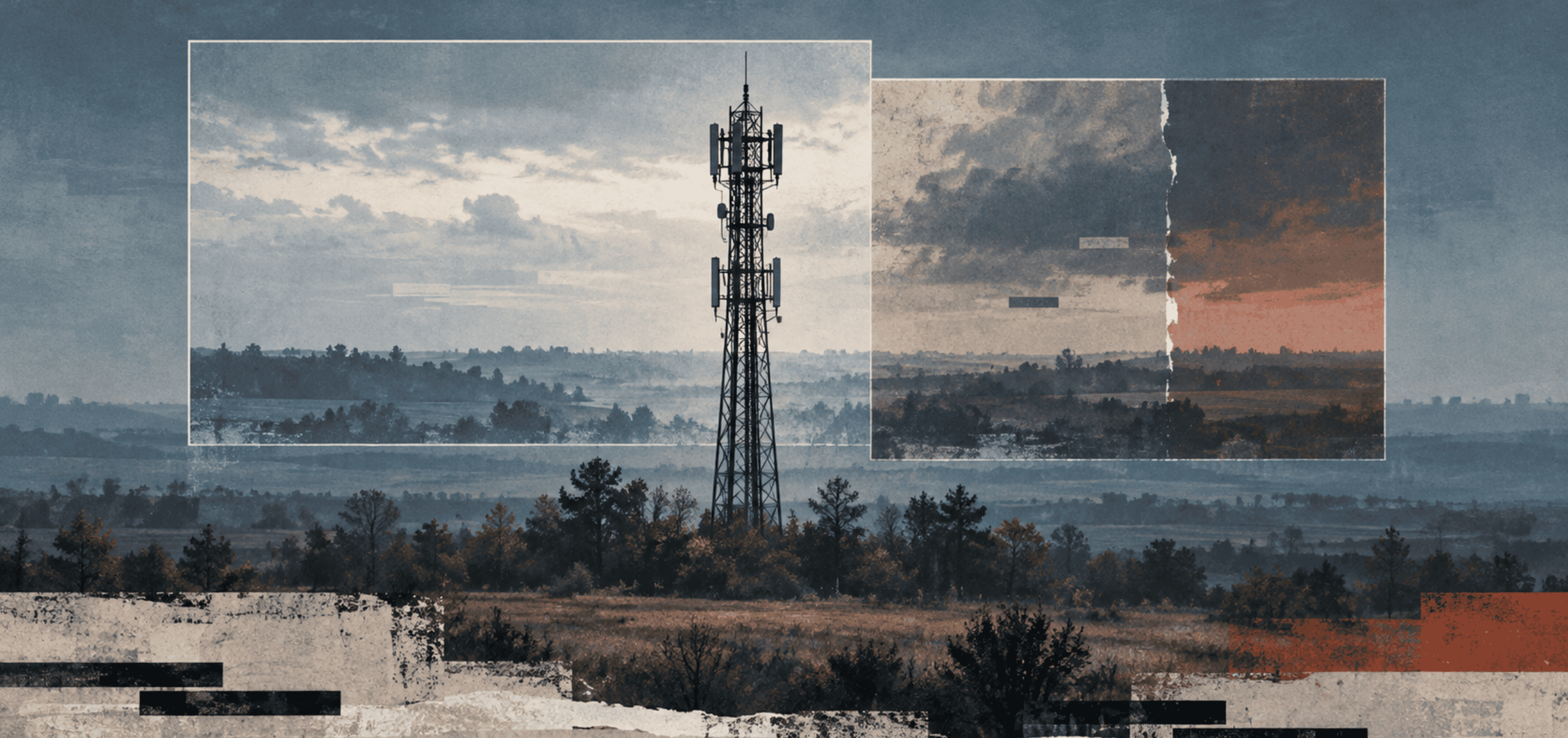
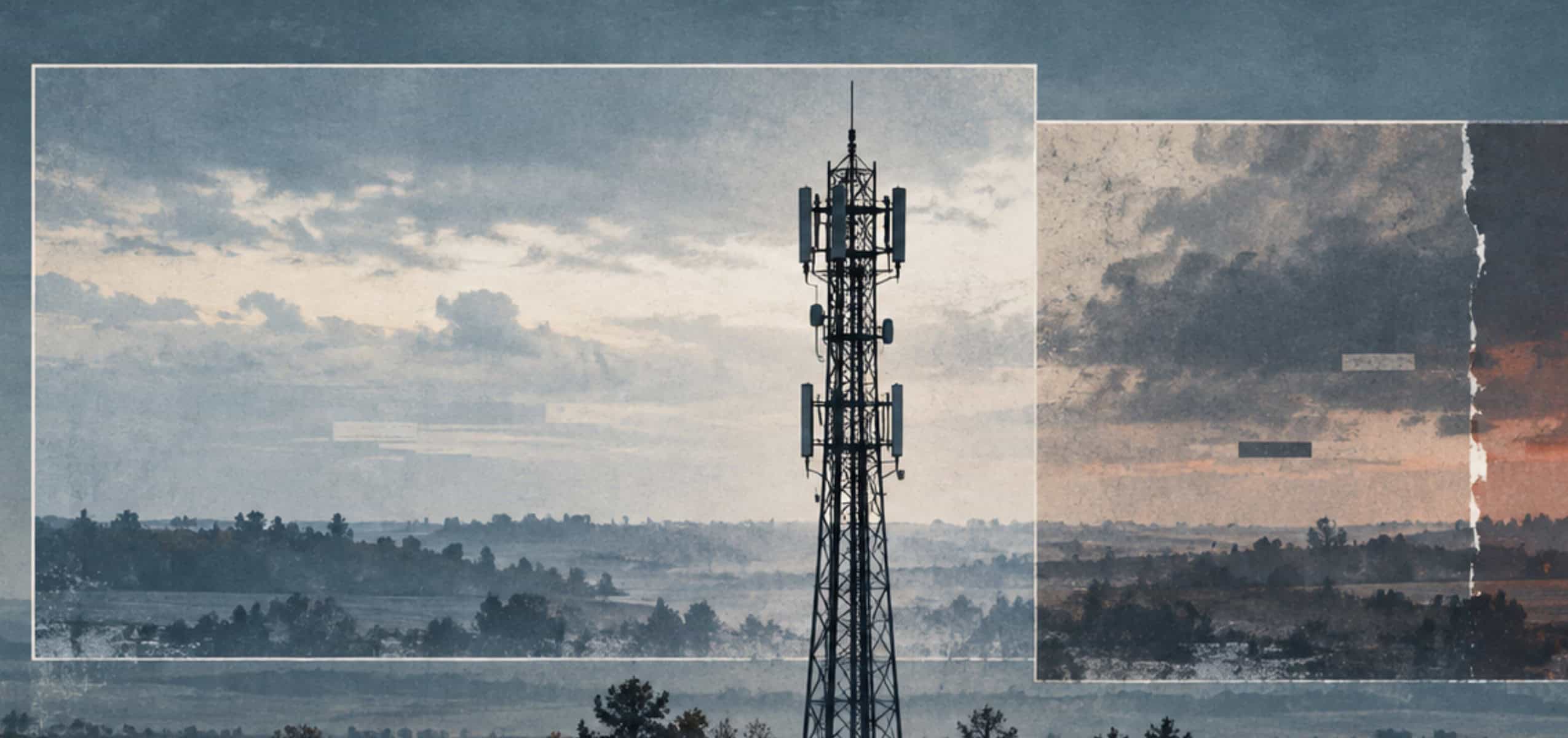
The giveaway was a cell tower. When Russian military channels posted video Sept. 29 claiming troops still held a village north of Lyman, a pro-war blogger noticed the mast in the shot still standing.
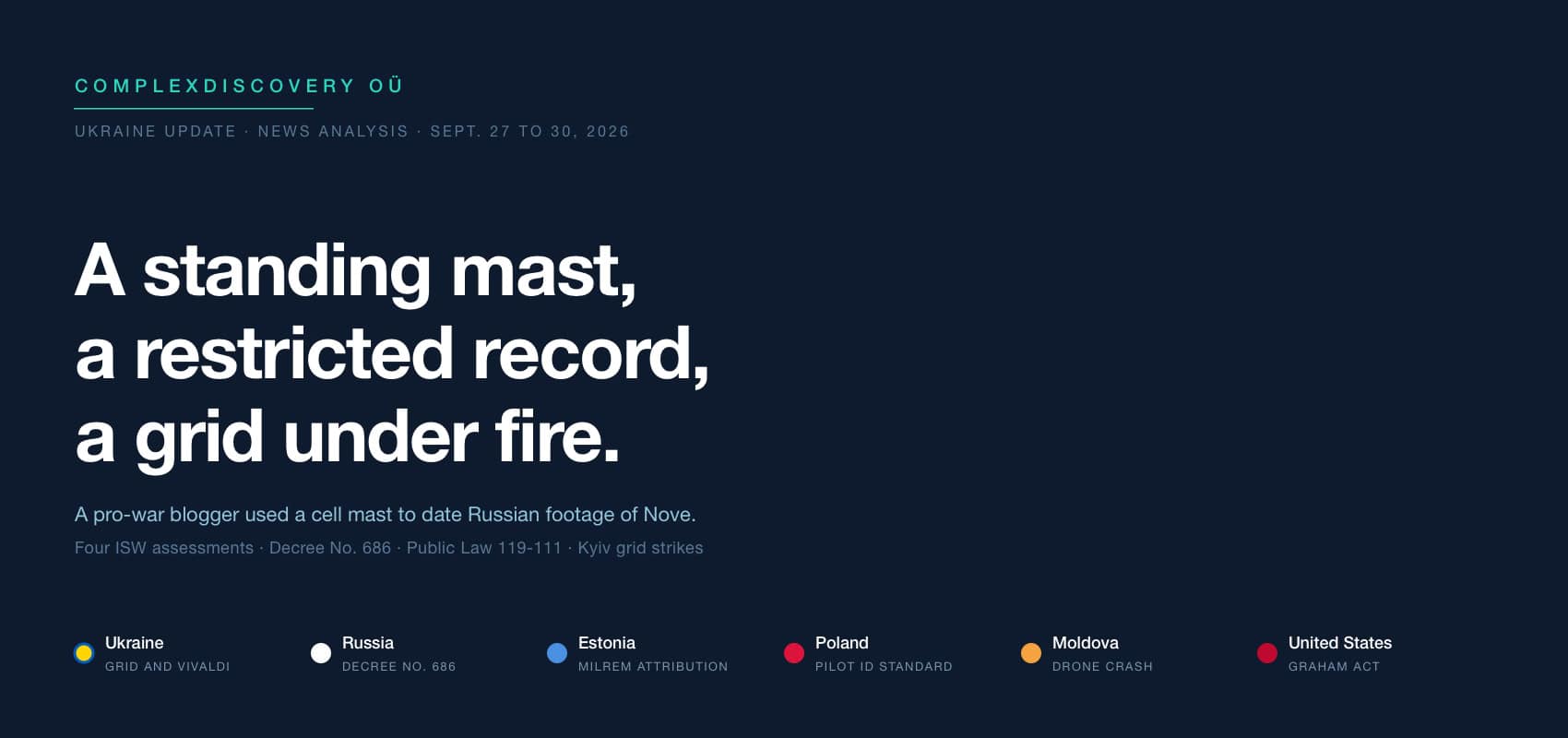
In footage Ukrainian forces had released a day earlier, the blogger wrote, the same mast lay destroyed. Read across four Institute for the Study of War (ISW) assessments covering Sept. 27 to 30, that mismatch frames the week. It was a contest over which records can be trusted, which are being withheld and which can still be checked, as Russia escalated its strikes on Ukraine’s power grid ahead of winter.
How a cell mast dated the footage
Two posts on the Russian Defense Ministry’s Telegram channel on Sept. 29 said soldiers of Russia’s West group of forces still held positions in Nove and Ridkodub. Both villages lie in Ukraine’s Donetsk Oblast. The same day, the pro-war channel Voenny Osvedomitel (Military Informant) wrote that footage from the West group’s media office showed the Nove mast upright, while Ukrainian video had already shown it destroyed. The channel remarked sarcastically that the troops had apparently raised it again within a day.
The post went further. It said unreliable information kept flowing from that sector with the aim of misleading Russia’s own command and the country’s leadership, as had happened earlier over Sviatohirsk, Kupyansk and Borova.
ISW, a Washington-based think tank whose daily assessments are openly critical of the Kremlin, cited the blogger’s comparison and assessed that the Russian footage is genuine but old, likely filmed when Russian forces first took the villages in 2025, before this year’s Ukrainian counterattacks. On Sept. 30, ISW assessed that Ukrainian forces control both Nove and nearby Shandryholove, with the nearest Russian positions ISW could assess roughly 8.5 kilometers or more from Nove.
The mast was not an isolated case. ISW reported that the ministry published footage on Sept. 26 to claim two Kharkiv Oblast villages, Petropavlivka and Lozova, after using the same footage on Sept. 21 to claim a third. On Sept. 30, according to ISW, the ministry cited video of four soldiers raising flags in Yehorivka, northeast of Orikhiv, as proof of capture. ISW assessed the flag-raising as part of an infiltration mission.
Anyone who authenticates video for a living will recognize the distinction at work here. Authenticity and currency are separate questions, and a clip can be unaltered while still misrepresenting when it was filmed. Exact-match hashing finds identical copies of a file, but re-encoding changes the hash. Perceptual matching and reverse-image search can surface altered copies of a recycled clip, though even they can miss. Comparing fixed landmarks across independently sourced recordings can expose the genuine but stale clip, which metadata alone may not reveal once a file has been re-encoded for posting.
Operation Vivaldi and the cost of good-news reporting
Nove and Ridkodub sit inside Ukraine’s Operation Vivaldi, a counteroffensive north of Lyman that Brig. Gen. Andrii Biletskyi publicly confirmed Sept. 15. “This operation is being conducted under conditions of maximum information silence,” said Biletskyi, who commands the 3rd Army Corps, according to the Kyiv Independent. In the same piece, senior reporter Francis Farrell noted that DeepState, an independent Ukrainian mapping project, had not yet marked changes in the area.
On Sept. 28, the corps said it had “liberated Nove, Ridkodub, and Katerynivka and restored control over Karpivka and Novomykhailivka,” ending what it calls the operation’s third season. The corps said that stage reclaimed 51 square kilometers, bringing the total since the offensive began to 176. Those are Ukrainian figures, and ISW’s own control assessment so far names Nove and Shandryholove rather than every village on the list.
ISW reported that what it calls the Defense Ministry’s continuous denial of those Ukrainian gains is fueling criticism inside Russia’s own information space. The prominent milblogger Dva Mayora wrote Sept. 28 that official messaging understates Ukrainian capabilities and leaves officials struggling to explain setbacks once they surface, ISW reported. Another blogger, Starshe Edy, said inaccurate reporting about the Lyman sector had impeded Russian planning and reinforcement decisions. ISW links both complaints to what Russian bloggers criticize as a culture of “beautiful reports,” in which inflated claims travel up the chain of command.
The Kyiv Independent drew the operational consequence in September. If Russian commanders lacked an accurate view of Ukraine’s progress, Farrell wrote, Moscow would be less likely to commit the resources a response required. Records managers know the pattern from any organization whose internal reporting rewards good news. A record created to please its recipient degrades the decisions built on it, and the damage tends to stay hidden until someone outside the reporting chain produces a conflicting record.
Moscow pulls data off the public record
What Russia restricts matters as much as what it asserts. Russian President Vladimir Putin signed Decree No. 686 on Sept. 28, approving a list of fuel and energy sector information to which access is restricted, according to the decree’s title on Russia’s official legal publication portal. The business daily Vedomosti reported that the list covers exports and the sellers, buyers, and others involved in them. It also covers the transport carrying exports, the volume and refining of product at Russian refineries, and the dates and times of transactions, and the decree took effect the day it was signed, Vedomosti reported.
The decree’s reach is not yet fixed. Customs-law publisher Alta-Soft reported that the ban on spreading the information, including through media and the internet, does not cover what a company discloses about its own activities, that the restricted list also includes aggregated customs statistics on exports, and that the government has 10 days to name the commodity codes the decree covers.
Vedomosti described the decree as a response to unfriendly actions by the United States and its allies and set it beside a U.S. law signed days earlier. President Donald Trump signed the Lindsey O. Graham Sanctioning Russia and Iran Act of 2026 on Sept. 18, and it became Public Law 119-111. Within 30 days of enactment, the law requires the president to impose duties of up to 100 percent on all goods from a country that falls into one of two groups. The first covers countries that were among the five largest importers, by volume, of Russian crude oil or natural gas in the 12 months before enactment and that knowingly make new purchases 30 or more days after enactment. The second covers the top five countries facilitating evasion of Russian oil sanctions over the same period.
The law leaves room for relief. Where natural gas is the basis for the duty, an exception applies if the country’s purchases were under 15 percent of Russia’s gas exports and it has taken “significant steps” to reduce them, in the law’s words. The president can also waive the duties after certifying to Congress in writing that a waiver serves the national interest and submitting a report explaining why.
As for Moscow’s motive, ISW assessed that the decree likely aims to shield the oil industry from Ukrainian strikes, blunt Western sanctions, and hide the scale of domestic fuel shortages. For sanctions compliance teams, the practical effect is narrower visibility into who is buying, shipping, and refining Russian oil. That loss arrives just as the U.S. law’s Oct. 18 deadline approaches, with its tariff test turning on those same facts. Due diligence files should record which data could not be obtained and why, not only what was found.
The budget tells a parallel story. Reuters reported Sept. 28, citing government documents it had seen, that Russia plans to spend 17.1 trillion rubles ($202.58 billion) on defense in 2027. That is about 27 percent above the 13.5 trillion rubles in the earlier plan and the largest defense allocation since Russia’s full-scale invasion of Ukraine began in 2022, according to Reuters. The same report said the government had planned 12.1 trillion rubles for defense in 2026, but that the year’s actual spending is classified and will not be made public. The government sent its draft budget for 2027 through 2029 to the State Duma on Sept. 30, state news agency TASS reported, citing a government statement.
Russia hits the grid ahead of winter
Away from the ledgers, the week’s sharpest test came on Ukraine’s power grid, which Kyiv had tried to take off the table. After meeting Trump on Sept. 22, Ukrainian President Volodymyr Zelensky said the two had discussed an energy truce and that the U.S. side would share the proposal with Russia, Ukrainian outlet Liga.net reported. Zelensky added that he did not know Russia’s position.
Eight days later, Russia struck energy facilities in Kyiv, the surrounding region and other areas overnight Sept. 29 to 30. Ukrainian Prime Minister Serhii Koretskyi said attacks on energy infrastructure had come almost daily since summer, but that an attack this massive and combined was the first since the end of the last heating season. UPI reported at least three people killed in Kyiv, while Ukraine’s grid operator, Ukrenergo, reported outages in the capital and the surrounding region. The grid was not the only network under fire: in a Sept. 26 address, Zelensky said Russia was striking Ukrainian data centers and communications infrastructure with the aim of leaving Ukrainians without internet, communications and digital services.
TASS claimed the strikes hit the Kyiv Hydroelectric Power Plant in Vyshhorod and the Trypilska thermal plant south of the capital, UPI reported. The Ukrainian Air Force said the attack involved ballistic, cruise and hypersonic missiles and at least 188 drones, a large share of them jet-powered. ISW assesses that the strike opened a campaign to degrade Ukraine’s energy security before winter. It further argues that Putin has likely adopted a modified theory of victory, built on long-range strikes, to force Ukraine to capitulate during the winter of 2026 to 2027, after Ukrainian battlefield gains this year. That is ISW’s analytic judgment, not a stated Kremlin position.
Interception rates decide much of that contest. In the same address, Zelensky said Russia had launched over 2,730 jet-powered Shahed-type drones in September and that over 1,500 had been shot down or suppressed, putting Ukraine’s interception rate for them at 55 percent. Ukrainian defense technology adviser Serhiy “Flash” Beskrestnov reported that a jet-powered Geran-5 struck a Kyiv business center Sept. 25 while a second Shahed-type drone flew overhead as a mesh radio repeater, ISW reported. ISW said such jet-powered variants can transmit live video and evade Ukrainian jamming.
Sabotage, airspace and the threshold of proof
Outside Ukraine, the week’s decisions turned on how much evidence is enough to act. Estonian Prime Minister Kristen Michal said it could now be stated with full certainty that the Aug. 15 arson at a Tallinn building used by defense company Milrem Robotics was sabotage ordered by Russian special services, public broadcaster ERR reported Sept. 29. Michal said the Internal Security Service reached that conclusion after a thorough assessment. Kremlin spokesman Dmitry Peskov called the claims unfounded, Russian media reported, according to ERR, which also reported that Latvia had transferred three suspects, all Latvian citizens, to Estonia in mid-September.
Margo Palloson, director general of the Internal Security Service, said Russian services keep trying to recruit people and exert influence in Europe, including to commit sabotage, according to ERR. Palloson recommended that organizations and defense companies supporting Ukraine strengthen both physical and cyber protection. Milrem supplies THeMIS unmanned ground vehicles to Ukraine together with EU countries, ERR reported. Suppliers anywhere in that chain can read Palloson’s advice as a single threat model, in which a badge reader and a firewall protect the same asset.
Poland, meanwhile, plans to change the identification standard its pilots must meet before they fire. Deputy Defense Minister Cezary Tomczyk said Sept. 28 that the ministry plans to drop the requirement that pilots visually identify an aerial threat. “After the changes, the pilot or operational commander will only need to read the radar to make a decision about the shot,” Tomczyk said, according to Politico. ISW described the replacement as a positive identification drawing on radar data such as flight path, speed, and the point of the airspace violation, along with whether the object responds to communications. The announcement came the same day a Russian jet-powered drone struck less than 1.5 kilometers from the Polish border near Ukraine’s Yahodyn crossing, according to ISW. It also came five days after a Russian Mi-8 helicopter spent 42 seconds about 300 meters inside Polish airspace, Politico reported.
Moldova faced its own incursion on Sept. 30. Police there reported, according to ISW, that a drone crashed and exploded near Hirbovat, about 18 kilometers from the Ukrainian border, and ISW assessed the drone as likely Russian.
Corporate assets become bargaining chips
The last thread runs through European balance sheets. Russia placed the Russian assets of Nestlé, Metro AG and Auchan under temporary management in September, Reuters reported Sept. 29, and a senior government source who spoke on condition of anonymity told the agency that “the time has come for asymmetric measures.” Asked whether the Russian units of UniCredit and Raiffeisen could be next, the source said, “Let them be scared.”
Peskov tied the decisions to what he called the growing involvement of “unfriendly countries” in hostilities but said the moves could be reversed, Reuters reported. He added that he saw no grounds for a reversal yet. Citing data compiled by TASS, Reuters said 135 foreign-affiliated firms have been placed under temporary administration since the full-scale invasion began, most of them from EU countries. For counsel advising companies with Russian subsidiaries, these decrees show that management of a local unit, and with it the systems and records it holds, can pass to a manager Moscow chooses. Counsel may want to preserve what litigation, audit or sanctions defense would require before control changes hands.
What the mast leaves behind
The cell tower worked as evidence because, by the blogger’s account, it appeared in recordings made by opposing sides and could not be standing and destroyed at once. Much of the past week’s record shows Moscow thinning out comparable fixed points, with the true 2026 defense figure classified, export data restricted, and capture claims resting on recycled video. A cell mast caught one of them, and a channel loyal to the war effort was the one that pointed it out. As more of the record moves behind decrees and classification stamps, what will analysts, investigators and compliance teams use as their mast?
News sources
- Russian Offensive Campaign Assessment, Sept. 30, 2026 (Institute for the Study of War)
- Russian Offensive Campaign Assessment, Sept. 29, 2026 (Institute for the Study of War)
- Russian Offensive Campaign Assessment, Sept. 28, 2026 (Institute for the Study of War)
- Russian Offensive Campaign Assessment, Sept. 27, 2026 (Institute for the Study of War)
- Post on Russian footage from Nove, Sept. 29, 2026 (in Russian) (Voenny Osvedomitel (Military Informant) on Telegram)
- Posts on Nove and Ridkodub, Sept. 29, 2026 (in Russian) (Russian Ministry of Defense on Telegram)
- Analysis: Through the fog of war, Ukraine reveals ‘Operation Vivaldi’ counterattack near Lyman (Kyiv Independent)
- Operation Vivaldi (3rd Army Corps)
- Operation Vivaldi: Ukraine liberates three more villages near Lyman (Ukrainska Pravda)
- Decree of the President of the Russian Federation of 28.09.2026 No. 686 (in Russian) (Official Internet Portal of Legal Information)
- Putin signed a decree restricting access to information in the fuel and energy sector (in Russian) (Vedomosti)
- A list of fuel and energy sector information with restricted access has been established (in Russian) (Alta-Soft)
- R.5334, Lindsey O. Graham Sanctioning Russia and Iran Act of 2026 (Public Law 119-111) (Congress.gov)
- EXCLUSIVE: Russia raises 2027 military spending by 27%, budget documents show (Reuters)
- Russian government presents draft budget for 2027-2029 to State Duma (TASS)
- Zelenskyy: We discussed an energy truce with Trump, US will convey proposal to Russia (LIGA.net)
- We Have Already Identified Interceptors That Can Become Our Primary Means of Defense: Address by the President (President of Ukraine)
- Russian strikes against Kyiv energy facilities kill at least 3, injure 5 (UPI)
- Koretskyi: Russian mass strikes cause damage and destruction across energy sector (Ukrinform)
- Michal: Russia is behind the arson of the Milrem building in Lasnamäe (in Russian) (ERR)
- Poland eases engagement rules for pilots guarding against Russia (Politico)
- ‘Let them be scared’: Moscow sends EU message with widening corporate crackdown (Reuters)

Assisted by GAI and LLM Technologies
Additional reading
- How a general’s walk across a bridge tested Putin’s claim to Svyatohirsk
- Germany names Russia for the Leipzig drone, and keeps most of its evidence out of view
- Estonia scrambled jets over a drone no official has identified
- Russia leans on drones and dissent-proofing as fuel crisis bites
- Senate passes Graham sanctions act, shifting Russia pressure from policy to statute
- Lithuania’s false-flag warning puts drone attribution on NATO’s eastern flank
- Three accounts from one wartime morning in Russia
- When an air defense engagement becomes a criminal case file
- The week the war reached Russia’s e-commerce supply chain
- The three silent hours: How Russia’s cyber war targets Ukraine’s newsrooms
- Confirmed versus claimed: reading the gap in Russia’s June offensive
- When the flag may be fake: Ukraine’s June war and the new burden of proof
- When the drone war reaches the reactor fence: Ukraine and the cyber-physical front
- When the refineries burn: Ukraine’s strikes turn Russia’s energy backbone into a cautionary tale
- The night Ukrainian drones exposed gaps in Moscow’s defenses and state TV gave it 60 seconds
- From warning to funding: Russia’s expanding media machine and the risk signals ahead
- Invisible by design: NATO’s 2026 cognitive warfare paper and the crisis of discovery
Source: ComplexDiscovery OÜ
ComplexDiscovery’s mission is to enable clarity for complex decisions by providing independent, data‑driven reporting, research, and commentary that make digital risk, legal technology, and regulatory change more legible for practitioners, policymakers, and business leaders.