

Editor’s Note: Mandatory sanctions drafting just cleared the Senate, 27 days after the death of the senator whose name it carries. The 86-11 passage of the Lindsey O. Graham Sanctioning Russia and Iran Act on Aug. 7 would put Russia designations and tariff duties on 30-day statutory clocks, tempered by presidential waivers, rate discretion and congressional review of any termination. Much of the bank list is already designated under executive orders; the bill’s force would be writing those requirements into statute and reaching the institutions that keep dealing with them.
For cybersecurity, data privacy, compliance and eDiscovery professionals, the value now is the planning window, since the statutory deadlines begin only at enactment. Screening volumes could climb once determinations and foreign-institution exposure take hold. Cross-border investigations will meet European data protection, transfer and secrecy rules, and the proposed Iran Sanctions Act extension would extend through 2031 a U.S. statute already covered by the EU and U.K. blocking regimes. A 10-year limitations period, with applicable OFAC recordkeeping requirements aligned to it, keeps covered records exposure-sensitive into the mid-2030s.
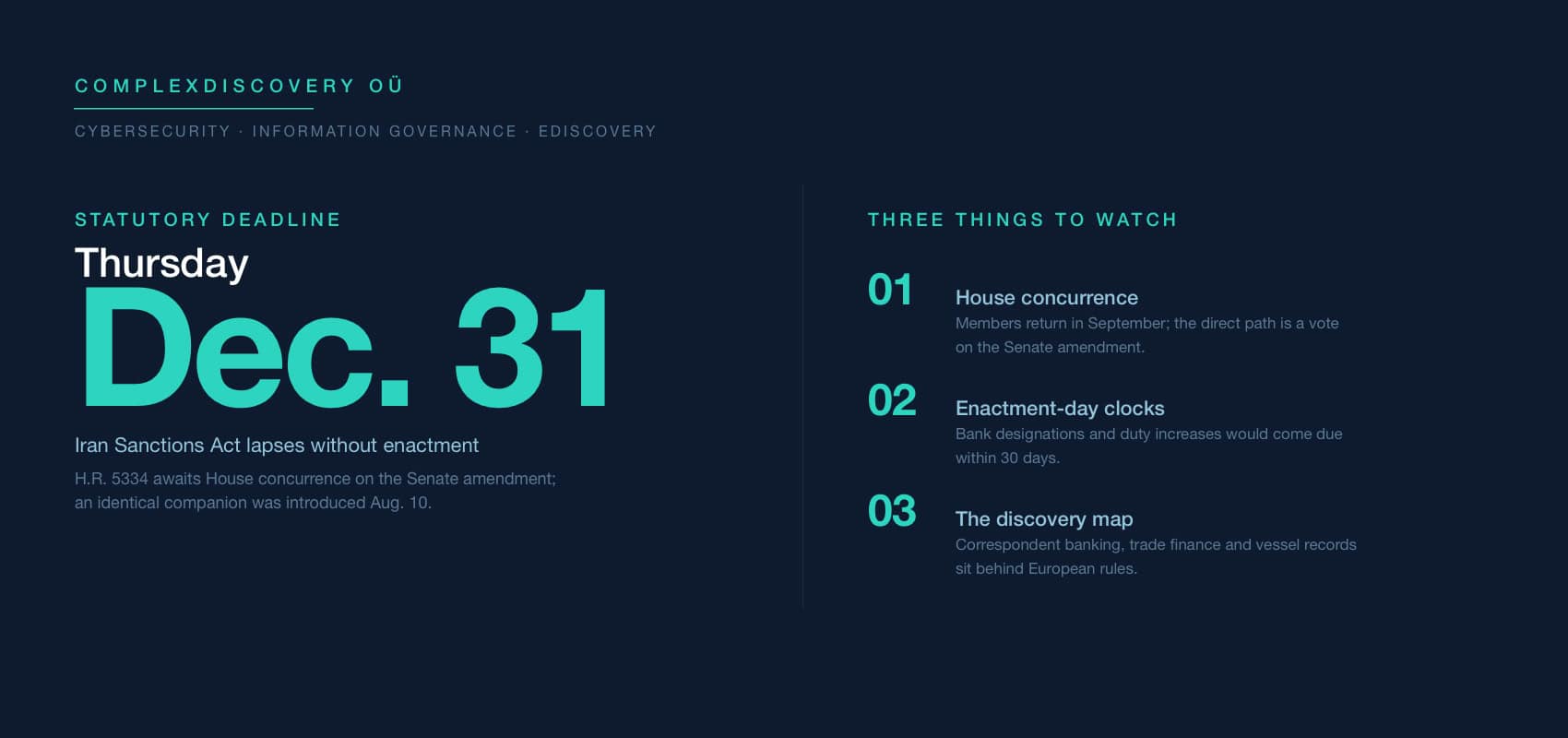
Watch September, when the House returns and may weigh concurrence or the identical companion, and Dec. 31, when the Iran Sanctions Act lapses absent enactment.
Content Assessment: Senate passes Graham sanctions act, shifting Russia pressure from policy to statute
Information - 92%
Insight - 91%
Relevance - 90%
Objectivity - 92%
Authority - 91%
91%
Excellent
A short percentage-based assessment of the qualitative benefit expressed as a percentage of positive reception of the recent article from ComplexDiscovery OÜ titled, "Senate passes Graham sanctions act, shifting Russia pressure from policy to statute."
Industry News – Geopolitics Beat
Senate passes Graham sanctions act, shifting Russia pressure from policy to statute
ComplexDiscovery Staff
The Senate voted 86-11 on Aug. 7 to pass the late Sen. Lindsey Graham’s signature Russia sanctions bill, sending mandatory sanctions and tariffs toward an uncertain September in the House. Graham died unexpectedly July 11, a day after securing White House backing; the chamber passed the bill bearing his name 27 days later, with his sister, Sen. Darline Graham, in his seat.
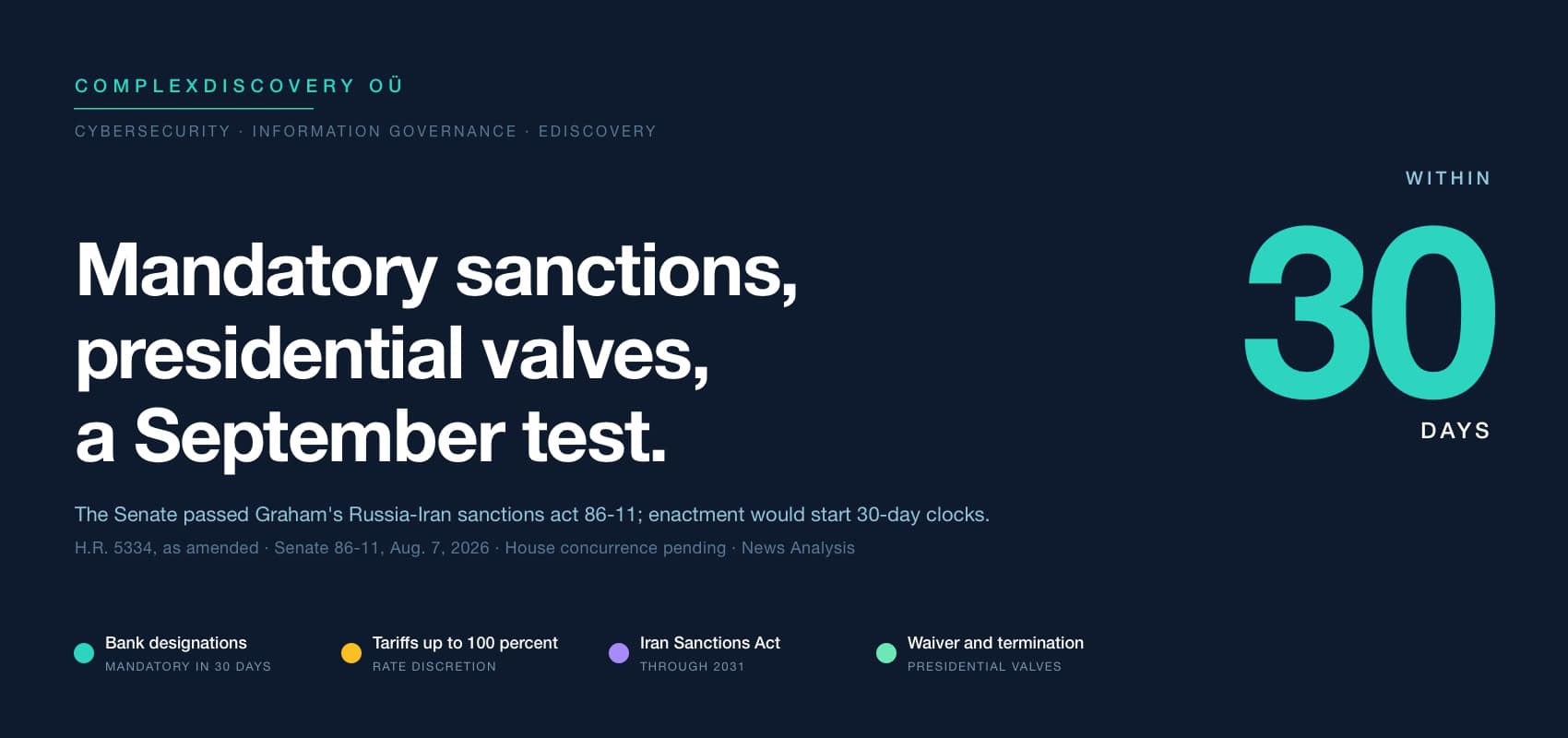
The Lindsey O. Graham Sanctioning Russia and Iran Act of 2026 would convert much of Washington’s discretionary pressure on Moscow into statutory command. Within 30 days of enactment, the bill would require at least two menu sanctions on Russia’s central bank and the full menu on Sberbank, VTB and Gazprombank — commercial banks already designated under executive orders. Those requirements would move from executive order into statute, and reach any foreign financial institution still dealing with the named banks past a threshold the text sets out but never quantifies, subject to a Treasury exception. U.S. persons would be barred from buying Russian sovereign debt. A second tier would become mandatory only when the president determines a target meets the statute’s criteria: senior officials, oligarchs, defense-industrial suppliers, enablers, financial messaging providers and the shadow-fleet tankers dodging the price cap.
How a tax bill became a sanctions vehicle
The Senate did not, formally, pass S. 5025, the bill Darline Graham introduced July 16. Because the package carries tariffs, and revenue measures must originate in the House, the Senate attached the text as Division A of H.R. 5334, a House-passed educator tax deduction bill. The House’s direct path is concurrence in that Senate amendment, not a fresh bill. Clear that, and it goes to President Donald Trump, who supports it, according to Sen. Richard Blumenthal, D-Conn., the bill’s longtime co-author.
Mandatory clocks, discretionary rates, a waiver valve
The tariff title runs on the same clock. Within 30 days, the president would have to raise duties, at a rate he sets up to 100 percent, on goods from two groups of countries: the five largest importers of Russian crude oil or natural gas, if they knowingly make new purchases beginning 30 days after enactment, and the five leading facilitators of Russian oil sanctions evasion, regardless of whether they buy Russian energy themselves. A carve-out spares countries whose share of Russia’s gas exports ran under 15 percent and who keep cutting. Duties on direct Russian imports would rise to as much as 500 percent. The tariff on buyer countries, by contrast, is capped at 100 percent — already scaled back from Graham’s original proposal of a 500 percent rate for buyers, with China and India as the intended targets. An amendment by Sen. Rand Paul, R-Ky., to strike the tariff title failed 32-64.
The mandates come with valves. Section 115 lets the president waive any sanction or duty by certifying to Congress, with written justification, that the waiver serves U.S. national interests. Ending them is harder: for Russia the president may terminate only by certifying that Moscow has signed a peace agreement Ukraine’s government accepts and has stopped fighting; other targets get a separate test. Any termination would wait 30 days — 60 days for certifications made between July 10 and Sept. 7 — and could then take effect absent an enacted joint resolution of disapproval. The new Russia authorities would sunset five years after enactment. The Iran side, added at Trump’s request, is narrower: the bill would strike the Iran Sanctions Act of 1996’s year-end expiration and extend the statute through 2031. Maia Nikoladze of the Atlantic Council called the Iran piece largely symbolic, given Iran’s decades under statutory sanctions.
The 11 no votes came from Paul and 10 Democratic caucus members, including Sen. Ron Wyden. A July 28 procedural vote ran 86-12, hours after Graham’s funeral, with Ukrainian President Volodymyr Zelenskyy watching from the gallery.
Compliance planning before the clocks start
For compliance teams, the fact that these mandates are drafted as mandatory, not discretionary, changes planning well before day-one screening begins. With the named banks already designated, the near-term effect for many institutions would be codification, requirements a future administration could not simply lift, a point the Atlantic Council analysis makes. Growth sits at the edges: foreign-institution exposure, shadow-fleet vessels and determination-driven designations could push screening volumes up sharply once the act is law. The pre-enactment window is for refreshing ownership analysis under OFAC’s 50 percent rule and rereading sanctions exclusion and force majeure clauses in energy, shipping, insurance and commodities agreements.
The discovery collision in the records
Secondary-sanctions enforcement runs through correspondent banking records, trade finance files, vessel-tracking data and messaging archives in non-U.S. systems. There, U.S. demands run into European data protection, transfer, bank secrecy and retention rules. The blocking statutes are a separate, narrower collision: the EU and U.K. regimes cover listed U.S. measures on Iran and Cuba, not these Russia provisions, and the Iran Sanctions Act the bill would extend sits on that list. Congress stretched the limitations period for IEEPA and Trading With the Enemy Act violations from five years to 10 in 2024. OFAC extended its applicable recordkeeping requirements to match, so for organizations subject to them, relevant records stay exposure-sensitive into the mid-2030s. Legal teams should map where those records live, who controls them, and what preservation looks like when demands and prohibitions cross.
A September test in the House
As of Aug. 12, the House, in recess until September, had scheduled nothing, though Reps. Michael McCaul, R-Texas, and Steny Hoyer, D-Md., introduced an identical bipartisan companion Aug. 10. Passage is not assured. Rep. Gregory Meeks, D-N.Y., ranking Democrat on House Foreign Affairs, labeled the text unacceptable, citing what he called expansive unilateral tariff power, a concern Wyden and Ways and Means ranking Democrat Richard Neal share. Steptoe LLP’s client alert rates House prospects uncertain on the same grounds. Speaker Mike Johnson said he was heartened by the deal and the House would take it up. And the calendar presses: without enactment by Dec. 31, the Iran Sanctions Act lapses with the year.
Foreign Relations Chairman Jim Risch, R-Idaho, said the measure could push Moscow toward negotiations. Whatever September does with the bill bearing Graham’s name, the screening lists, ownership analyses and preservation maps get built in this planning window or under a statutory clock. Which will your team work from: the map built before enactment, or the one assembled after the demand arrives?
News sources
- U.S. Senate Roll Call Vote 224, On Passage of H.R. 5334, as Amended (U.S. Senate)
- H.R. 5334, Lindsey O. Graham Sanctioning Russia and Iran Act of 2026, Engrossed Amendment Senate (GovInfo)
- Senate Approves Sweeping Russia Sanctions Bill (Office of Sen. Kevin Cramer)
- Sanctions Update: August 10, 2026 (Steptoe LLP, via Mondaq)
- Senate Passes Long-Stalled Russia Sanctions Bill Championed by Lindsey Graham (CBS News)
- What the Latest US Sanctions Bill Means for Russia, and for China, India, and Iran (Atlantic Council)
- US House Launches Push for Sweeping Russia, Iran Sanctions Bill After Senate Win (RFE/RL)
- US Senate Passes Sweeping Russian Energy Sanctions Bill Amid Ukraine War (Al Jazeera)
- Senate Passes Bill Sanctioning Russia, Iran (UPI)
- Hours After His Funeral, Senate Takes First Step to Advance Lindsey Graham’s Russia Sanctions Bill (Deseret News)
- Gov. McMaster Appoints Darline Graham to the U.S. Senate (Office of the Governor of South Carolina)
- McCaul, Hoyer, Colleagues Introduce the Lindsey O. Graham Sanctioning Russia and Iran Act of 2026 (Office of Rep. Michael McCaul)
- Treasury Sanctions Gazprombank and Takes Additional Steps to Curtail Russia’s Use of the International Financial System (U.S. Department of the Treasury)
- Extraterritoriality (Blocking Statute) (European Commission)
- Protection of Trading Interests Guidance (U.K. Department for Business and Trade)
- Reporting, Procedures and Penalties Regulations, Final Rule (90 FR 13286) (Federal Register / OFAC)

Assisted by GAI and LLM Technologies
Additional reading
- Lithuania’s false-flag warning puts drone attribution on NATO’s eastern flank
- Three accounts from one wartime morning in Russia
- When an air defense engagement becomes a criminal case file
- The week the war reached Russia’s e-commerce supply chain
- The three silent hours: How Russia’s cyber war targets Ukraine’s newsrooms
- Confirmed versus claimed: reading the gap in Russia’s June offensive
- When the flag may be fake: Ukraine’s June war and the new burden of proof
- When the drone war reaches the reactor fence: Ukraine and the cyber-physical front
- When the refineries burn: Ukraine’s strikes turn Russia’s energy backbone into a cautionary tale
- The night Ukrainian drones exposed gaps in Moscow’s defenses and state TV gave it 60 seconds
- From warning to funding: Russia’s expanding media machine and the risk signals ahead
- Invisible by design: NATO’s 2026 cognitive warfare paper and the crisis of discovery
- When Your Legal Tech Vendor Gets Breached: DocketWise Incident Exposes 116,666 Immigration Records and a Profession’s Blind Spot
- The DOJ’s Cyber FCA Playbook Is Working as Enforcement Triples and Shows No Signs of Slowing
- FTC’s OkCupid Action Reframes AI Training Data as a Consumer Protection Issue
- White House AI Framework Signals New Compliance Stakes for Legal, Cybersecurity, and eDiscovery
- The Gatekeeper’s Key: How the Conformity Assessment Unlocks the EU AI Market
Source: ComplexDiscovery OÜ

ComplexDiscovery’s mission is to enable clarity for complex decisions by providing independent, data‑driven reporting, research, and commentary that make digital risk, legal technology, and regulatory change more legible for practitioners, policymakers, and business leaders.