
Editor’s Note: AI adoption in eDiscovery just posted its fourth consecutive climb, and for the first time the survey series has a number for what comes next: governance. The 1H 2026 survey from ComplexDiscovery OÜ and EDRM finds 69.39 percent of organizations deploying LLMs and GAI while 57.14 percent document how; cross-tabulation shows roughly three in 10 deployers running production AI on inconsistent or absent rules.
The barrier data should reorganize 2026 planning conversations. Cost objections collapsed to 8.16 percent, while regulatory and privacy compliance climbed to second place and the skill gap posted its highest reading of the series. For privacy, compliance, and security professionals, that migration from price to proof is the clearest signal yet that AI programs will be judged on validation and oversight, not procurement.
This report is Part 3 of a five-part series on the 1H 2026 eDiscovery Business Confidence Survey; a complete-look overview of the full results closes the series.
Content Assessment: From deployment to discipline: AI and governance in the 1H 2026 eDiscovery Business Confidence Survey
Information - 94%
Insight - 93%
Relevance - 93%
Objectivity - 94%
Authority - 95%
94%
Excellent
A short percentage-based assessment of the qualitative benefit expressed as a percentage of positive reception of the recent article from ComplexDiscovery OÜ titled, "From deployment to discipline: AI and governance in the 1H 2026 eDiscovery Business Confidence Survey."
Industry Research Beat
From deployment to discipline: AI and governance in the 1H 2026 eDiscovery Business Confidence Survey
ComplexDiscovery OÜ Staff
The adoption question is settled. The governance question just got its first answer, and it is incomplete by design and by practice.
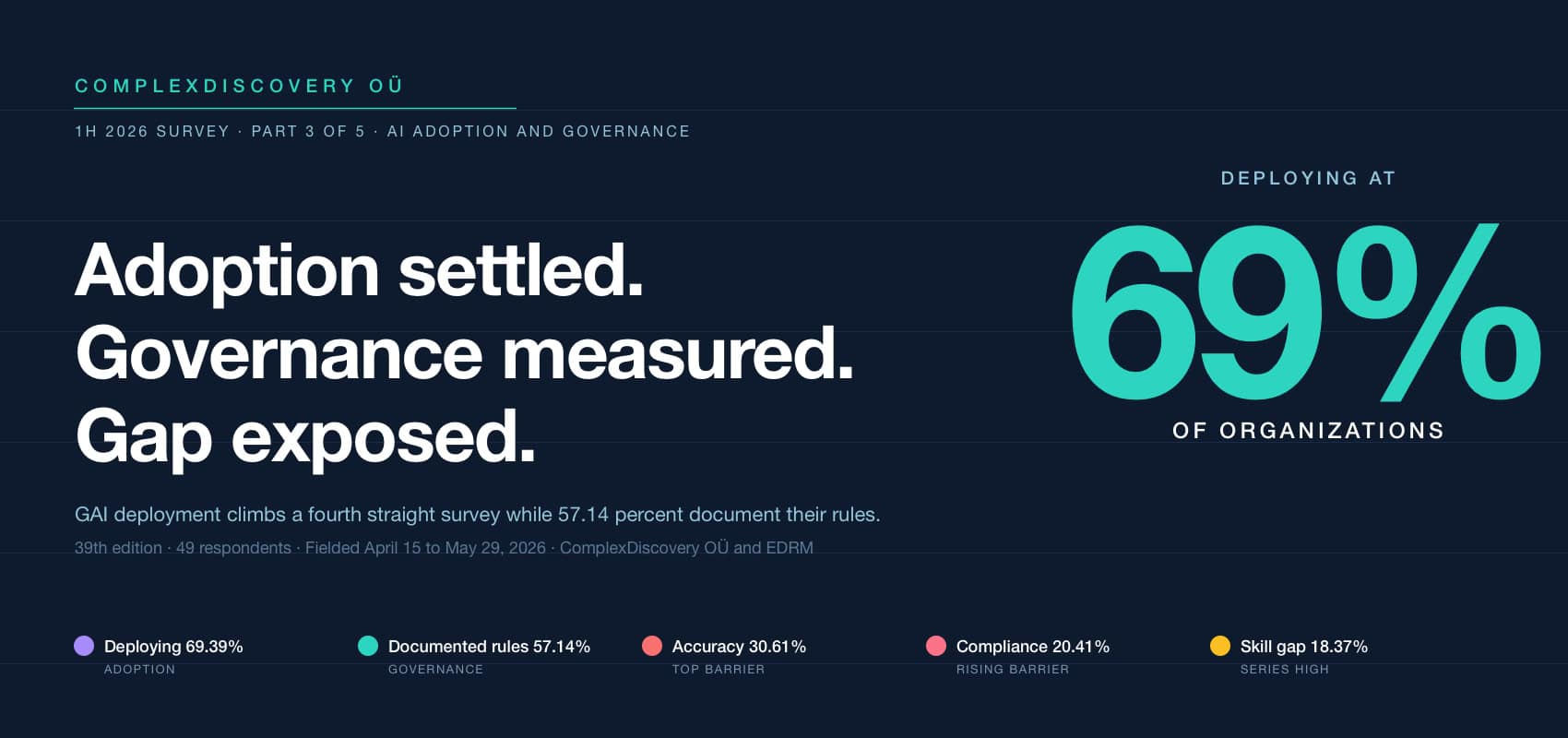
In the 1H 2026 eDiscovery Business Confidence Survey, 69.39 percent of 49 respondents reported that their organizations are integrating and deploying large language models (LLMs) and generative artificial intelligence (GAI) in operations or offerings, the fourth consecutive increase in the series and up 30 points from the 39.34 percent recorded in Fall 2024. For the first time, the survey, conducted April 15 through May 29, 2026, by ComplexDiscovery OÜ in collaboration with EDRM, also asked how those deployments are governed. A majority reported documented rules; among the organizations already deploying, roughly three in 10 did not.
Four surveys, one direction
The deployment curve has been relentless. Integration and deployment stood at 39.34 percent in Fall 2024, jumped to 57.14 percent in 1H 2025, reached 64.06 percent in 2H 2025, and now sits at 69.39 percent. Every intermediate stage has drained accordingly: organizations merely considering the technology fell from 27.87 percent to 14.29 percent over the same period, active pilots from 26.23 percent to 12.24 percent, and outright abstainers from 6.56 percent to 4.08 percent, two respondents in a field of 49.
The 2H 2025 series framed the shift as pilots giving way to production and declared the adopt-or-not debate effectively over. The 1H 2026 numbers close the argument. In this market, AI status is no longer a differentiator; what an organization can prove about accuracy, governance, and staffing is.
The respondent base rating these questions skews hands-on this cycle: tactical execution professionals led the seniority mix at 38.78 percent, law firms formed the largest segment at 34.69 percent, and legal or litigation support functions supplied 69.39 percent of the pool. Adoption claims from people who run the workflows carry a different weight than boardroom aspiration.
Use of LLMs and GAI in Organization's Operations or Offerings 1H26
The benefit case shifts from savings to standing
Improved service and product delivery remained the most-cited primary benefit at 48.98 percent, consistent with every edition since Fall 2024. The movement came underneath. Competitive advantage rebounded to 28.57 percent, its strongest reading of the last four surveys, doubling off a 14.06 percent low in 2H 2025 after 16.88 percent in 1H 2025 and 26.23 percent in Fall 2024. Enhanced decision-making drew 14.29 percent.
Cost savings, meanwhile, collapsed as a rationale, drawing 6.12 percent against 18.18 percent in 1H 2025 and 12.50 percent in 2H 2025. Only one respondent saw no benefit at all. The industry has stopped justifying AI as a way to spend less and started justifying it as a way to matter, a framing that conveniently sidesteps the harder question of whether the tools have yet paid for themselves.
Primary Benefit of Integrating LLMs and GAI into Organization's Operations or Offerings 1H26
Barriers migrate from price to proof
Results accuracy held the top barrier position at 30.61 percent, close to its 2H 2025 reading of 32.81 percent and consistent with the trust gap the series has documented since Fall 2024. What changed is everything beneath it. Regulatory and privacy compliance climbed to second at 20.41 percent, up from 14.29 percent in 1H 2025. The skill gap reached 18.37 percent, up from 14.29 percent in 1H 2025 and 8.20 percent in Fall 2024, its highest published reading of the period. Unclear ROI held at 18.37 percent.
High costs, cited by 19.67 percent in Fall 2024 and 18.75 percent as recently as 2H 2025, fell to 8.16 percent. Ethical concerns drew 4.08 percent. Read as a sequence, the barrier tables trace AI’s maturation: first, the tools seemed expensive, then their returns seemed uncertain, and now the binding constraints are trust, rules, and people. Organizations budgeting for 2H 2026 should note that the market’s revealed bottleneck is validation and expertise, not licensing; funding a defensible quality-control workflow and training program now buys more advantage than another platform seat.
Primary Challenge of Integrating LLMs and GAI into Organization's Operations or Offerings 1H26
Governance gets measured, and found half-built
The survey’s new governance question produced the cycle’s most consequential baseline. A defined internal framework, documented with clear roles, processes, and controls, was reported by 42.86 percent of respondents. Another 14.29 percent went further, describing governance that is operationalized, regularly reviewed, and audited. Together, 57.14 percent of organizations now document their AI rules.
The remainder is where risk lives. Emerging governance, basic policies inconsistently applied, covered 28.57 percent; no formal governance at all, 12.24 percent; and 2.04 percent reported the question not applicable. Cross-tabulating governance against adoption puts a precise number on the exposure: of the 34 organizations integrating and deploying, 24 report documented governance, while 10, or 29.41 percent of deployers, run production AI on emerging or absent rules. Deployers govern better than the full sample, but three in 10 production programs without consistent controls is a wide door in a sector where regulatory and privacy compliance just became the second most-cited barrier and where courts increasingly ask who validated the output.
For compliance and information governance leaders, the baseline is actionable in three moves. Inventory where LLMs already touch client data, because at 69.39 percent deployment the honest answer is more places than the policy contemplates. Convert emerging guidelines into a defined framework with named owners before external parties, whether regulators, clients, or opposing counsel, ask to see one. And connect the governance program to the accuracy concern that tops the barrier table, since a documented validation workflow answers both at once.
Organizational Governance of LLMs and GAI 1H26
The next measurement
Because 1H 2026 establishes the governance baseline, the 2H 2026 edition will deliver the first trend line. If the documented-governance share climbs toward the deployment share, the industry is closing its discipline gap; if deployment keeps rising while governance stalls, the gap becomes the story. A decade in, the survey series has watched eDiscovery adopt every consequential technology of its era, and the pattern repeats: adoption is fast, accountability arrives later, and the organizations that build accountability early collect the work when scrutiny comes. Where does your organization sit on that curve: deployed and documented, or deployed and hoping?
News sources
- 1H 2026 eDiscovery Business Confidence Survey Launches With Expanded AI and Revenue Focus (ComplexDiscovery)
- The Shift from AI Pilots to Production: Insights from the 2H 2025 eDiscovery Business Confidence Survey (ComplexDiscovery)
- Confidence Meets Complexity: Full Results from the 2H 2025 eDiscovery Business Confidence Survey (ComplexDiscovery)
- 1H 2025 eDiscovery Business Confidence Survey Results Released by ComplexDiscovery OÜ and EDRM (ComplexDiscovery)
- Optimism and Innovation in eDiscovery: Fall 2024 Business Confidence Survey Insights (ComplexDiscovery)
- EDRM: Empowering the Global Leaders of eDiscovery (EDRM)
- Steady money, softer mood: financial outlooks in the 1H 2026 eDiscovery Business Confidence Survey (ComplexDiscovery)
- Data diversity takes the top seat: impact issues in the 1H 2026 eDiscovery Business Confidence Survey (ComplexDiscovery)

Assisted by GAI and LLM Technologies
Additional reading
- Complete look: ComplexDiscovery OÜ’s 2025 to 2030 eDiscovery market size mashup
- The workstream of eDiscovery: Considering processes and tasks
- Andrew Haslam’s eDisclosure Systems Buyers Guide at 14: What the 1H 2026 update reveals
- A Complete Analysis of the Winter 2026 eDiscovery Pricing Survey
- The M&A Risk of Confusing Market Velocity with Marketing Capability
- Confidence Meets Complexity: Full Results from the 2H 2025 eDiscovery Business Confidence Survey
Source: ComplexDiscovery OÜ

ComplexDiscovery’s mission is to enable clarity for complex decisions by providing independent, data‑driven reporting, research, and commentary that make digital risk, legal technology, and regulatory change more understandable for practitioners, policymakers, and business leaders.