

Editor’s Note: Business confidence in eDiscovery posted its largest half-to-half decline across the four editions reviewed, and the details matter for anyone budgeting, buying, or selling. The 39th eDiscovery Business Confidence Survey from ComplexDiscovery OÜ and EDRM finds good-conditions sentiment down over 20 points from autumn while revenue expectations hold firm and GAI deployment reaches 69.39 percent of organizations.
For cybersecurity, privacy, and eDiscovery professionals, the survey’s first governance readings are the headline inside the headline: 57.14 percent of organizations now document their AI controls, and roughly three in 10 deployers run production AI on inconsistent or absent rules. Pair that with 45.83 percent of respondents unable to describe their receivables trajectory, the highest in recent comparisons, and the operational agenda for 2H 2026 writes itself.
Watch the data-diversity number. With over half of respondents naming data types and volumes as the defining challenge, the second half of 2026 will test whether collection scoping and early-case assessment tools built for modern data can keep pace.
This complete-look overview is the culmination of a five-part series on the 1H 2026 eDiscovery Business Confidence Survey, following section reports on market sentiment and financial outlooks, impact issues, AI adoption and governance, and operational metrics.
Content Assessment: Confidence cools, commitment holds: full results from the 1H 2026 eDiscovery Business Confidence Survey
Information - 94%
Insight - 93%
Relevance - 93%
Objectivity - 94%
Authority - 95%
94%
Excellent
A short percentage-based assessment of the qualitative benefit expressed as a percentage of positive reception of the recent article from ComplexDiscovery OÜ titled, "Confidence cools, commitment holds: full results from the 1H 2026 eDiscovery Business Confidence Survey."
Industry Research Beat
Confidence cools, commitment holds: full results from the 1H 2026 eDiscovery Business Confidence Survey
ComplexDiscovery OÜ Staff
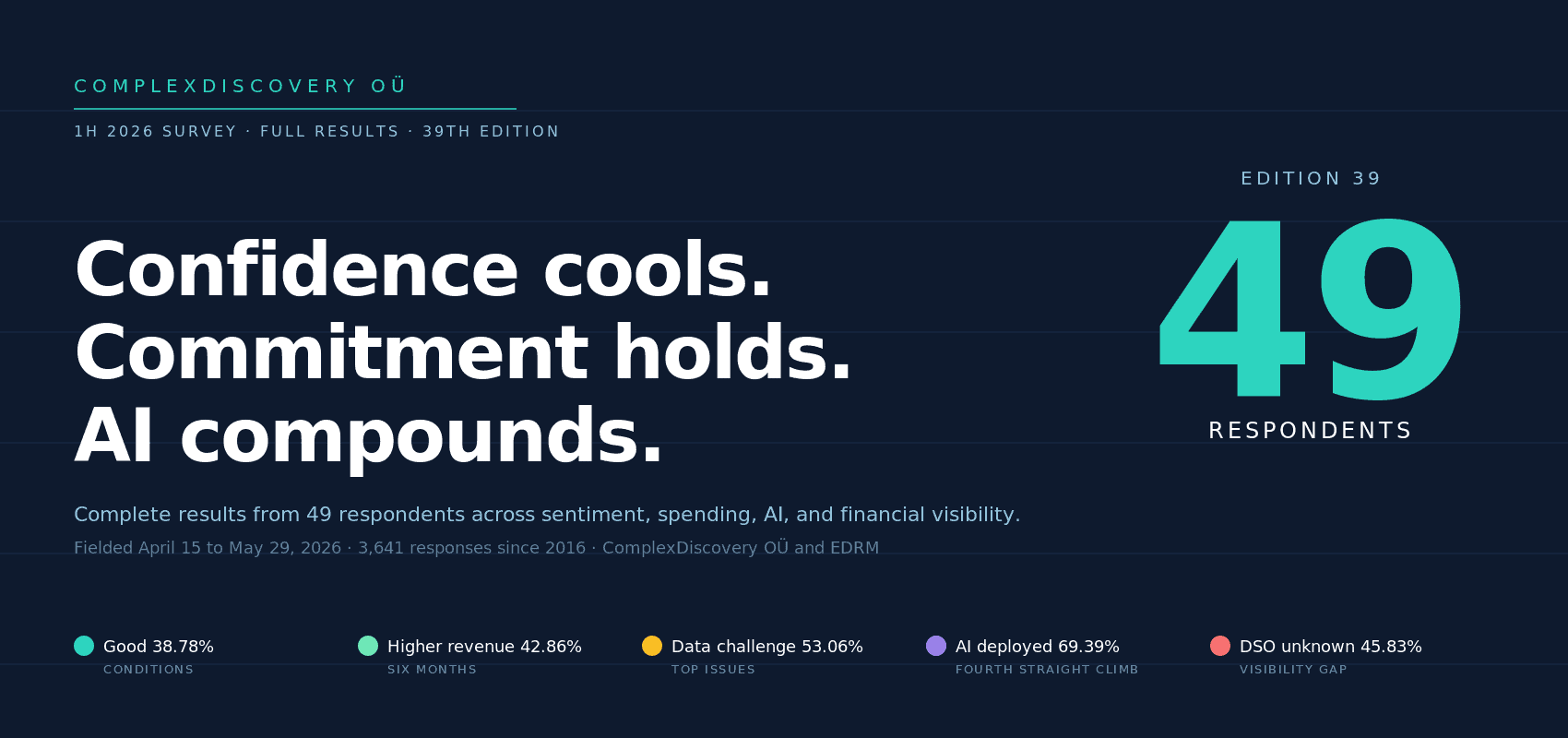
The optimism of last autumn did not survive the spring. Six months after 59.38 percent of respondents rated eDiscovery business conditions as good, that share has fallen to 38.78 percent, and normal is once again the industry’s center of gravity.
Yet the retreat is selective. Revenue expectations held their ground, profit pessimism actually shrank, and the share of organizations deploying generative artificial intelligence (GAI) climbed for a fourth consecutive survey. The 1H 2026 eDiscovery Business Confidence Survey, the 39th edition of the benchmark conducted by ComplexDiscovery OÜ in collaboration with EDRM, captures an industry that feels less exuberant but acts no less committed.
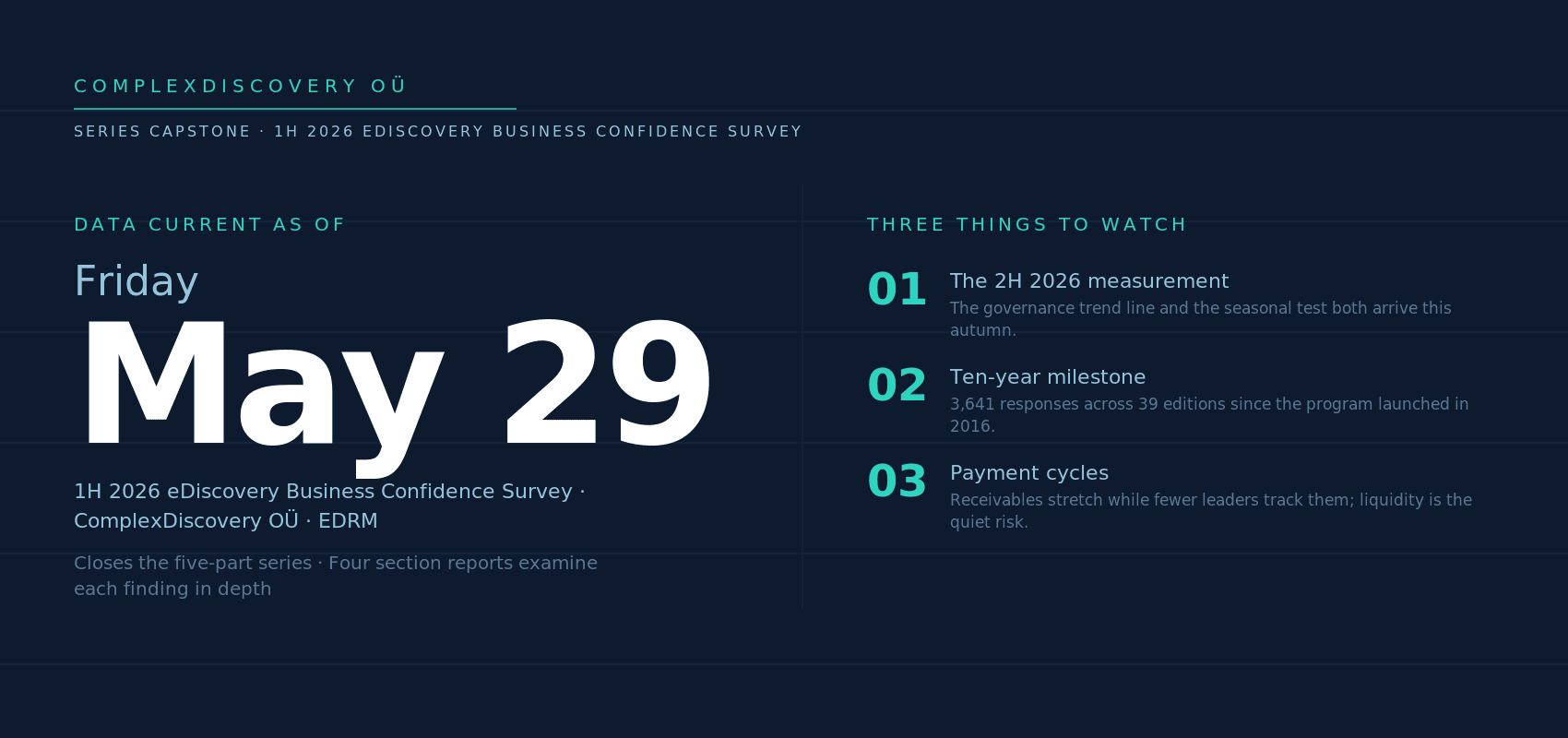
The survey ran April 15 through May 29, 2026, and drew 49 respondents through targeted outreach to the professional networks of both organizations. The program, launched in 2016 and now in its tenth year, has collected 3,641 responses across its 39 completed editions, including this cycle’s 49. As of May 2026, the instrument spans 17 questions, expanded this cycle to add two dimensions the series had never measured: formal AI governance and the annual revenue scale of respondent organizations.
A methodological note frames everything that follows. This targeted, nonprobability sample is not designed to represent the entire eDiscovery industry; the results describe the participating respondents, and no margin of sampling error applies. With 49 respondents, one response represents about 2.04 percentage points, and changes between editions may reflect differences in sample composition as well as changes in market sentiment.
Who answered, and why it matters
Law firms supplied the largest block of respondents for the second consecutive survey, at 34.69 percent, narrowly ahead of software and services providers at 32.65 percent, a one-respondent margin. Consultancies accounted for 12.24 percent, with corporations and media or research organizations at 8.16 percent each and governmental entities at 4.08 percent. The two-survey run of law-firm leadership marks a reversal from Fall 2024, when providers made up 50.82 percent of the pool and law firms just 21.31 percent.
Function and seniority shifted as well. Legal and litigation support roles dominated at 69.39 percent, continuing a steady climb from 63.93 percent in Fall 2024, while business support functions contributed 24.49 percent and IT or product development 6.12 percent. The seniority mix tells the more consequential story: tactical execution professionals, at 38.78 percent, now form the largest tier, ahead of operational management at 32.65 percent and executive leadership at 28.57 percent. The 2H 2025 edition ran the other way, with executives and operational managers together comprising nearly 74 percent of respondents. Readers comparing cycles should weigh that shift because it may have contributed to the cooler sentiment reading.
1h2026-overview-seniority-mix
Geographically, the survey remains anchored in the United States, where 91.84 percent of respondents primarily conduct business. But the respondent base itself stretched across seven countries this cycle, with participants located in the United Kingdom, Canada, Germany, South Africa, South Korea, and India alongside the American majority.
Sentiment steps back to normal
Just over half of respondents, 51.02 percent, rated current business conditions as normal, while 38.78 percent said good and 10.20 percent said bad. The good reading dropped over 20 points from 2H 2025, and the bad reading tripled from 3.13 percent.
Viewed across four cycles, a rhythm emerges. Good readings hit 54.10 percent in Fall 2024, fell to 37.66 percent in 1H 2025, surged to 59.38 percent in 2H 2025, and have now settled back to 38.78 percent. Two annual cycles are not enough to establish seasonality, and shifts in respondent composition complicate the comparison, but the repeated pattern of cooler first-half readings merits watching; one hypothesis is that the mood tracks the litigation calendar and budget cycle as much as any structural change.
1h2026-overview-conditions-trend
Expectations for the next six months reinforce the steady-state picture. A same outlook drew 59.18 percent, better drew 32.65 percent, and worse drew 8.16 percent, figures nearly identical to the 2H 2025 distribution.
Revenue holds while the mood softens
Whatever cooled the general mood did not reach the revenue line. Respondents expecting higher segment revenue in six months held at 42.86 percent, essentially unchanged from the 42.19 percent recorded in 2H 2025 and well above the 31.17 percent trough of 1H 2025. Those expecting lower revenue doubled to 12.24 percent from 6.25 percent, thinning the middle ground rather than eroding the optimists.
Profit expectations firmed. The higher-profit camp edged up to 38.78 percent from 37.50 percent, and the lower-profit camp fell to 8.16 percent from 12.50 percent, unwinding some of the margin-squeeze anxiety that colored the 2H 2025 findings. Fewer respondents now expect falling profits than falling revenue, reversing last autumn’s pattern; one reading is that cost discipline, and perhaps early AI efficiency gains, may be reaching the ledger, though the survey does not measure those drivers directly.
Data diversity takes the top seat
Increasing types of data claimed the top spot among issues expected to impact eDiscovery business over the next six months, cited by 30.61 percent of respondents, the highest reading for that issue in the last four surveys. Budgetary constraints followed at 28.57 percent, with increasing volumes of data at 22.45 percent. Together, the two data-centric issues now command 53.06 percent of the vote, up from 45.32 percent in 2H 2025; for the first time in the recent series, over half of respondents name the data itself as the defining business problem.
Down the table, the quieter findings deserve attention. Data security fell for a fourth consecutive survey, to 8.16 percent from 11.48 percent in Fall 2024, a slide that continues even as breach activity remains a fixture of the legal-technology news cycle. Lack of personnel, the top concern of the post-pandemic era, drew just 4.08 percent, and inadequate technology 6.12 percent. Practitioners planning for the second half of 2026 should read the pairing at the top literally: collections scoping, data-type triage, and early-case assessment workflows built for collaboration platforms, chat, and multimedia are where budgets and data pressures now collide.
AI moves deeper into production
Integration and deployment of large language models (LLMs) and GAI reached 69.39 percent of respondent organizations, the fourth consecutive increase in the series and up 30 points from the 39.34 percent recorded in Fall 2024. Organizations still merely considering the technology fell to 14.29 percent, active pilots stood at 12.24 percent, and just 4.08 percent reported no plans at all.
Improved service and product delivery remained the most-cited benefit at 48.98 percent, though competitive advantage rebounded to 28.57 percent, its strongest showing of the last four surveys and double its 14.06 percent low of 2H 2025. Cost savings collapsed as a rationale, drawing 6.12 percent against 18.18 percent in 1H 2025; the benefit responses suggest a shift toward treating AI as a value play rather than a cost play.
1h2026-overview-ai-deployment-trend
The barrier rankings shifted in a direction compliance officers will recognize. Results accuracy stayed on top at 30.61 percent, followed by regulatory and privacy compliance at 20.41 percent, with the skill gap and unclear ROI tied at 18.37 percent each, the former up from 8.20 percent in Fall 2024. High costs, cited by nearly a fifth of respondents two years ago, fell to 8.16 percent. The pattern suggests direct acquisition cost has become less prominent than accuracy, compliance, expertise, and return-on-investment concerns.
Governance arrives on the scorecard
The survey’s new governance question found a majority of organizations with documented rules: 42.86 percent reported a defined internal framework and 14.29 percent a formalized, monitored, and audited program, for a combined 57.14 percent. Another 28.57 percent described emerging governance applied inconsistently, 12.24 percent conceded no formal governance at all, and 2.04 percent, one respondent, marked the question not applicable. Cross-tabulating governance against adoption sharpens the picture: of the 34 organizations already integrating and deploying, 24 report documented governance, while 10, roughly three in 10 deployers, run production AI on emerging or absent rules. Deployers govern better than the full sample, but that remains a gap worth closing before regulators, clients, or opposing counsel close it for them.
1h2026-overview-governance-baseline
The other new question, on annual eDiscovery-related revenue, met the limits of self-reporting. Nearly half of respondents, 48.98 percent, said they did not know or preferred not to answer. Among the 25 who disclosed, 36 percent came in under $5 million, 24 percent between $5 million and $25 million, and 40 percent at $25 million or above, including two organizations reporting $250 million or greater.
The visibility gap widens
Reported financial visibility weakened across the survey sample. Asked about the trajectory of Days Sales Outstanding (DSO), 45.83 percent of the 48 who answered said they did not know, the weakest visibility reading in the series’ recent history. Across the 48 responses, 14 respondents, or 29.17 percent, reported increasing DSO, while one, or 2.08 percent, reported decreasing DSO. Among the 15 reporting a change, longer payment cycles outnumbered shorter ones 14 to one.
Monthly Recurring Revenue (MRR) told a similar story. The do-not-know share reached 39.58 percent, while the increasing share fell for a fourth straight survey, to 27.08 percent from 54.24 percent in Fall 2024. Revenue distribution across customer bases rounded out the picture, with 37.50 percent unaware of the trend and 10.42 percent reporting concentration into fewer clients. Organizations that cannot see their own receivables, recurring revenue, and concentration risk are navigating 2026 by feel; instrumenting those three metrics is a practical step toward stronger financial visibility.
1h2026-overview-visibility-trend
The 1H 2026 results describe a respondent pool that has stopped celebrating and started operating: revenue steady, AI embedded, governance half-built, and financial visibility fading just as reports of longer payment cycles multiply. When conditions read normal but 14 respondents report receivables slowing for every one reporting them speeding up, which number should leaders trust when they set budgets for 2H 2026?
News sources
- 1H 2026 eDiscovery Business Confidence Survey Launches With Expanded AI and Revenue Focus (ComplexDiscovery)
- The Shift from AI Pilots to Production: Insights from the 2H 2025 eDiscovery Business Confidence Survey (ComplexDiscovery)
- Confidence Meets Complexity: Full Results from the 2H 2025 eDiscovery Business Confidence Survey (ComplexDiscovery)
- 1H 2025 eDiscovery Business Confidence Survey Results Released by ComplexDiscovery OÜ and EDRM (ComplexDiscovery)
- Optimism and Innovation in eDiscovery: Fall 2024 Business Confidence Survey Insights (ComplexDiscovery)
- EDRM: Empowering the Global Leaders of eDiscovery (EDRM)
- Steady money, softer mood: financial outlooks in the 1H 2026 eDiscovery Business Confidence Survey (ComplexDiscovery)
- Data diversity takes the top seat: impact issues in the 1H 2026 eDiscovery Business Confidence Survey (ComplexDiscovery)
- From deployment to discipline: AI and governance in the 1H 2026 eDiscovery Business Confidence Survey (ComplexDiscovery)
- Paid slower, tracked less: operational metrics in the 1H 2026 eDiscovery Business Confidence Survey (ComplexDiscovery)

Assisted by GAI and LLM Technologies
Additional reading
- Complete look: ComplexDiscovery OÜ’s 2025 to 2030 eDiscovery market size mashup
- The workstream of eDiscovery: Considering processes and tasks
- Andrew Haslam’s eDisclosure Systems Buyers Guide at 14: What the 1H 2026 update reveals
- A Complete Analysis of the Winter 2026 eDiscovery Pricing Survey
- The M&A Risk of Confusing Market Velocity with Marketing Capability
Source: ComplexDiscovery OÜ

ComplexDiscovery’s mission is to enable clarity for complex decisions by providing independent, data‑driven reporting, research, and commentary that make digital risk, legal technology, and regulatory change more understandable for practitioners, policymakers, and business leaders.