

Editor’s Note: The deadlock narrowed. Last autumn’s three-way tie among data volumes, data types, and budgets resolved this spring into a two-issue race, with the diversity of modern data claiming the top of the eDiscovery issue table at 30.61 percent, one respondent ahead of budget pressure and that issue’s strongest reading in four editions of the ComplexDiscovery OÜ and EDRM survey.
The ranking matters well beyond eDiscovery operations. For cybersecurity teams, a fourth consecutive decline in security’s share of the issue vote signals shrinking internal appetite for protection spending even as AI adoption widens the attack surface. For information governance professionals, a majority of the industry now names the data itself, its variety and its volume, as the defining business problem, the strongest mandate for upstream data discipline this series has produced. For compliance leaders, budget pressure at 28.57 percent frames every tool and process conversation for the rest of 2026.
This report is Part 2 of a five-part series on the 1H 2026 eDiscovery Business Confidence Survey; a complete-look overview of the full results closes the series.
Content Assessment: Data diversity takes the top seat: impact issues in the 1H 2026 eDiscovery Business Confidence Survey
Information - 93%
Insight - 94%
Relevance - 92%
Objectivity - 92%
Authority - 93%
93%
Excellent
A short percentage-based assessment of the qualitative benefit expressed as a percentage of positive reception of the recent article from ComplexDiscovery OÜ titled, "Data diversity takes the top seat: impact issues in the 1H 2026 eDiscovery Business Confidence Survey."
Industry Research Beat
Data diversity takes the top seat: impact issues in the 1H 2026 eDiscovery Business Confidence Survey
ComplexDiscovery OÜ Staff
The three-way tie has narrowed to two. After a 2H 2025 survey in which data volumes, data types, and budgets deadlocked within two points of each other, data types and budgets have pulled clear of the pack, with the variety of the data itself taking the top seat by the narrowest of margins.
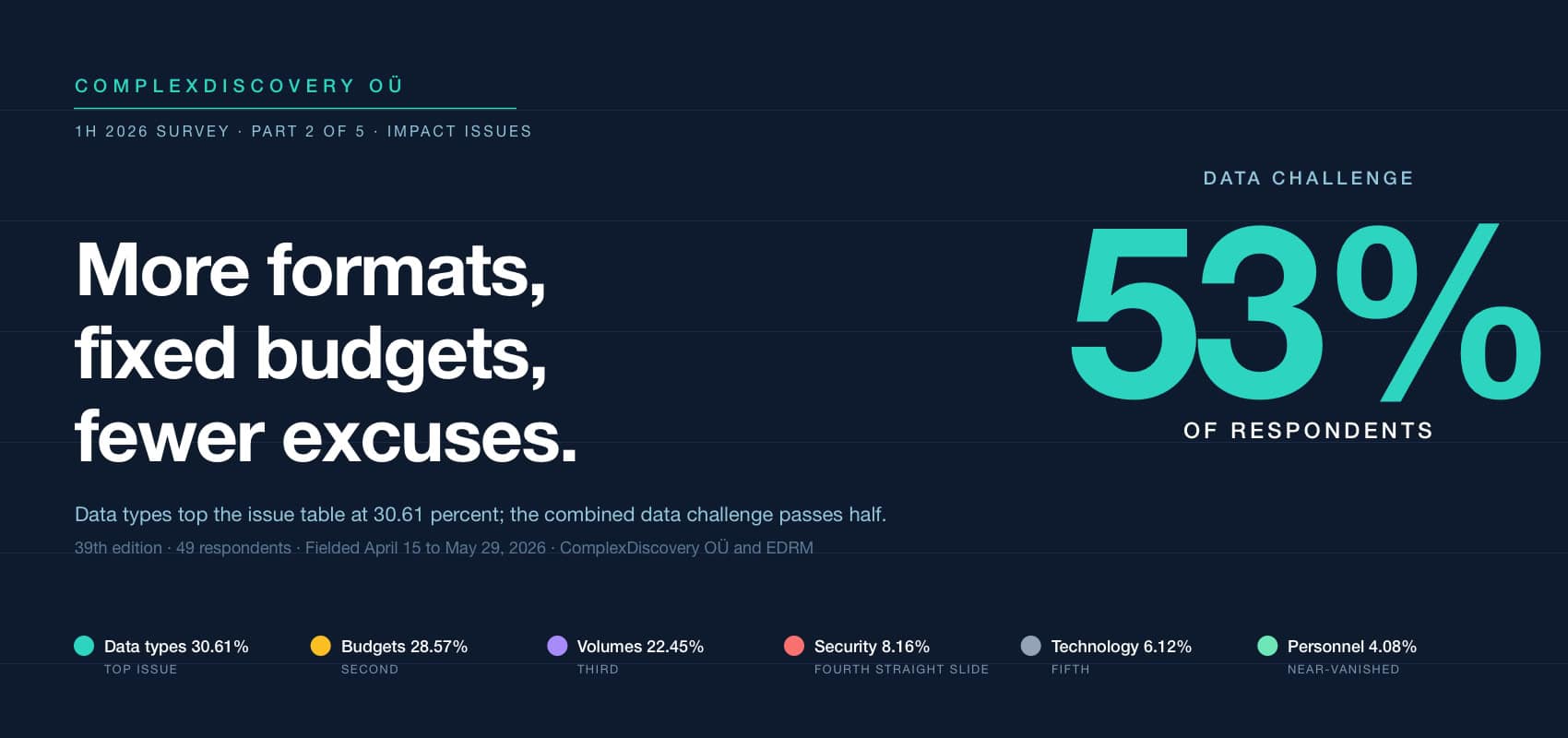
Increasing types of data topped the issue rankings in the 1H 2026 eDiscovery Business Confidence Survey at 30.61 percent, the strongest reading that issue has posted across the last four editions of the benchmark. The survey, conducted April 15 through May 29, 2026 by ComplexDiscovery OÜ in collaboration with EDRM, asked 49 industry professionals which of six issues would most impact the business of eDiscovery over the next six months. Their collective answer draws a market squeezed between modern data and fixed budgets.
How the six issues stacked up
Behind data types at 30.61 percent came budgetary constraints at 28.57 percent, a single respondent behind, and increasing volumes of data at 22.45 percent. In a field of 49, the top-two gap is statistical noise; the durable finding is that both pulled away from everything else. The remaining three issues barely registered: data security drew 8.16 percent, inadequate technology 6.12 percent, and lack of personnel 4.08 percent.
Combine the two data-centric issues and the message sharpens. Types plus volumes captured 53.06 percent of respondents, up from 45.32 percent in 2H 2025 and past the halfway mark for the first time in the recent series. The two data categories combined now outweigh the other four issues together, 26 respondents to 23; the industry’s core business problem is that evidence now arrives in more formats, from more sources, faster than the budgets provisioned to process it.
The respondent base gives the ranking added texture. Law firms formed the largest segment at 34.69 percent, software and services providers 32.65 percent, and legal or litigation support professionals 69.39 percent of the pool by function. Tactical execution roles, the people who touch collections and review directly, led the seniority mix at 38.78 percent, and their fingerprints show in a table that elevates workflow realities over abstract threats.
Issues Impacting eDiscovery Business Performance 1H26
A two-year migration of worry
Set against the three prior editions, the 1H 2026 table completes a migration. In Fall 2024, the issue vote spread broadly: types 24.59 percent, volumes 21.31 percent, budgets 19.67 percent, personnel 14.75 percent, security 11.48 percent, and technology 8.20 percent. By 1H 2025, budget anxiety had spiked to 36.36 percent, the highest single-issue reading of the period, before easing to 21.88 percent in 2H 2025 and rebounding to 28.57 percent now.
Budget pressure, in other words, never leaves the top three; it just trades places with the data. The two-cycle pattern mirrors the sentiment seesaw documented elsewhere in this survey series, with budget concern peaking in first-half editions when corporate legal departments reset spending and law firms absorb rate negotiations. Providers pricing for the second half of 2026 should assume procurement scrutiny at 1H 2025 intensity rather than 2H 2025 relief.
The quiet collapse of the talent panic
Lack of personnel commanded 14.75 percent of the vote in Fall 2024 and ranked as the perennial post-pandemic chart-topper before that. It has now fallen to 4.08 percent, its second collapse in two first-half surveys, after 3.90 percent in 1H 2025 and a brief 12.50 percent revival last autumn. Three forces plausibly share credit: a stabilized labor market, GAI absorbing first-pass work that once demanded armies of reviewers, and upskilling that has caught practitioners up to their tools. With 69.39 percent of organizations now deploying LLMs and GAI in production, the industry appears to have concluded that its constraint is no longer hands; it is formats and funding.
Inadequate technology tells a compatible story at 6.12 percent, down from 8.20 percent in Fall 2024 and 9.09 percent in 1H 2025. Professionals largely believe the tooling exists. Whether their organizations can afford it, govern it, and point it at Slack exports, mobile chat, collaboration platforms, and multimedia is the sharper question, and it is precisely where the top two issues intersect.
Security keeps sliding down the list
Data security fell for the fourth consecutive edition, from 11.48 percent in Fall 2024 to 10.39, 9.38, and now 8.16 percent. The 2H 2025 full-results analysis called the slide counterintuitive amid record breach activity, and the trend has since continued. The charitable reading holds that security has become a baseline assumption, priced into vendor contracts, certifications, and protective orders rather than experienced as a live business variable. The less charitable reading is complacency at exactly the moment AI adoption multiplies data movement, prompt-injection surface, and third-party model dependencies.
Security and information governance leaders can treat the number as a planning input: budget holders inside eDiscovery organizations are unlikely to volunteer funds for security uplift in 2H 2026, so initiatives will need to ride on the issues the market does prioritize. Framing data-type sprawl as an attack-surface problem, and budget discipline as an argument for consolidation onto governed platforms, aligns security asks with the two concerns that now command a combined 59.18 percent of industry attention.
What the table means for the next six months
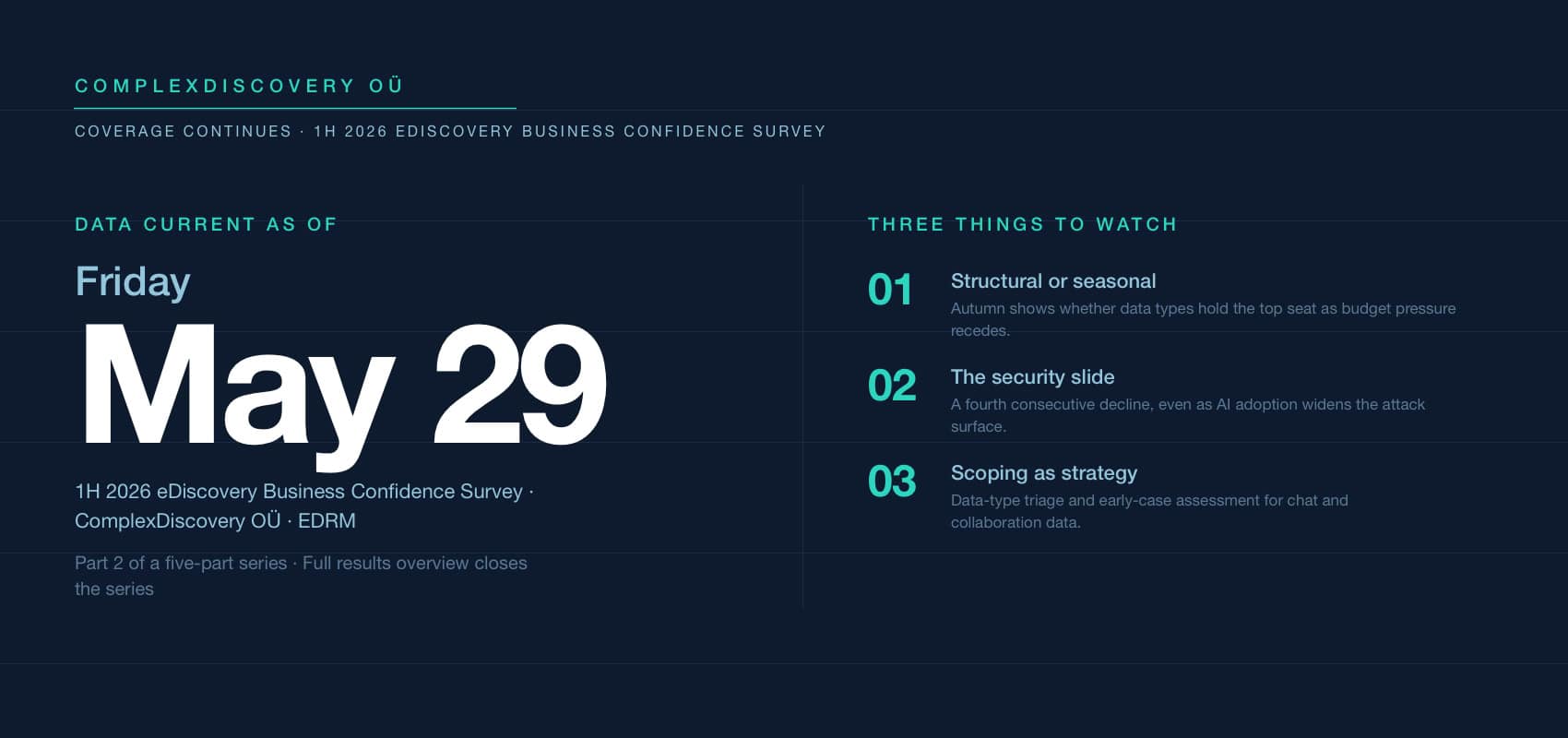
Issue rankings in this series have tended to preview where money and roadmaps move next. The 2024 talent panic preceded a wave of managed-review restructuring; the 1H 2025 budget spike preceded a year of pricing pressure and consolidation talk. If the pattern holds, the 1H 2026 table forecasts investment in data-type triage, early-case assessment for collaboration and chat data, and scoping discipline that keeps processing volumes, and therefore costs, contained.
The survey’s own trajectory will test the thesis in the 2H 2026 edition this autumn. If data types hold the top seat while budgets recede on schedule, the format explosion is structural, not seasonal. Which modern data source is stressing your workflows fastest, and does your 2H 2026 budget actually name it?
News sources
- 1H 2026 eDiscovery Business Confidence Survey Launches With Expanded AI and Revenue Focus (ComplexDiscovery)
- Data Volumes vs. Budgets: Core Conflicts from the 2H 2025 eDiscovery Business Confidence Survey (ComplexDiscovery)
- Confidence Meets Complexity: Full Results from the 2H 2025 eDiscovery Business Confidence Survey (ComplexDiscovery)
- 1H 2025 eDiscovery Business Confidence Survey Results Released by ComplexDiscovery OÜ and EDRM (ComplexDiscovery)
- Optimism and Innovation in eDiscovery: Fall 2024 Business Confidence Survey Insights (ComplexDiscovery)
- EDRM: Empowering the Global Leaders of eDiscovery (EDRM)
- Steady money, softer mood: financial outlooks in the 1H 2026 eDiscovery Business Confidence Survey (ComplexDiscovery)

Assisted by GAI and LLM Technologies
Additional reading
- Complete look: ComplexDiscovery OÜ’s 2025 to 2030 eDiscovery market size mashup
- The workstream of eDiscovery: Considering processes and tasks (ComplexDiscovery)
- Andrew Haslam’s eDisclosure Systems Buyers Guide at 14: What the 1H 2026 update reveals
- A Complete Analysis of the Winter 2026 eDiscovery Pricing Survey
- The M&A Risk of Confusing Market Velocity with Marketing Capability
- Confidence Meets Complexity: Full Results from the 2H 2025 eDiscovery Business Confidence Survey
Source: ComplexDiscovery OÜ

ComplexDiscovery’s mission is to enable clarity for complex decisions by providing independent, data‑driven reporting, research, and commentary that make digital risk, legal technology, and regulatory change more understandable for practitioners, policymakers, and business leaders.