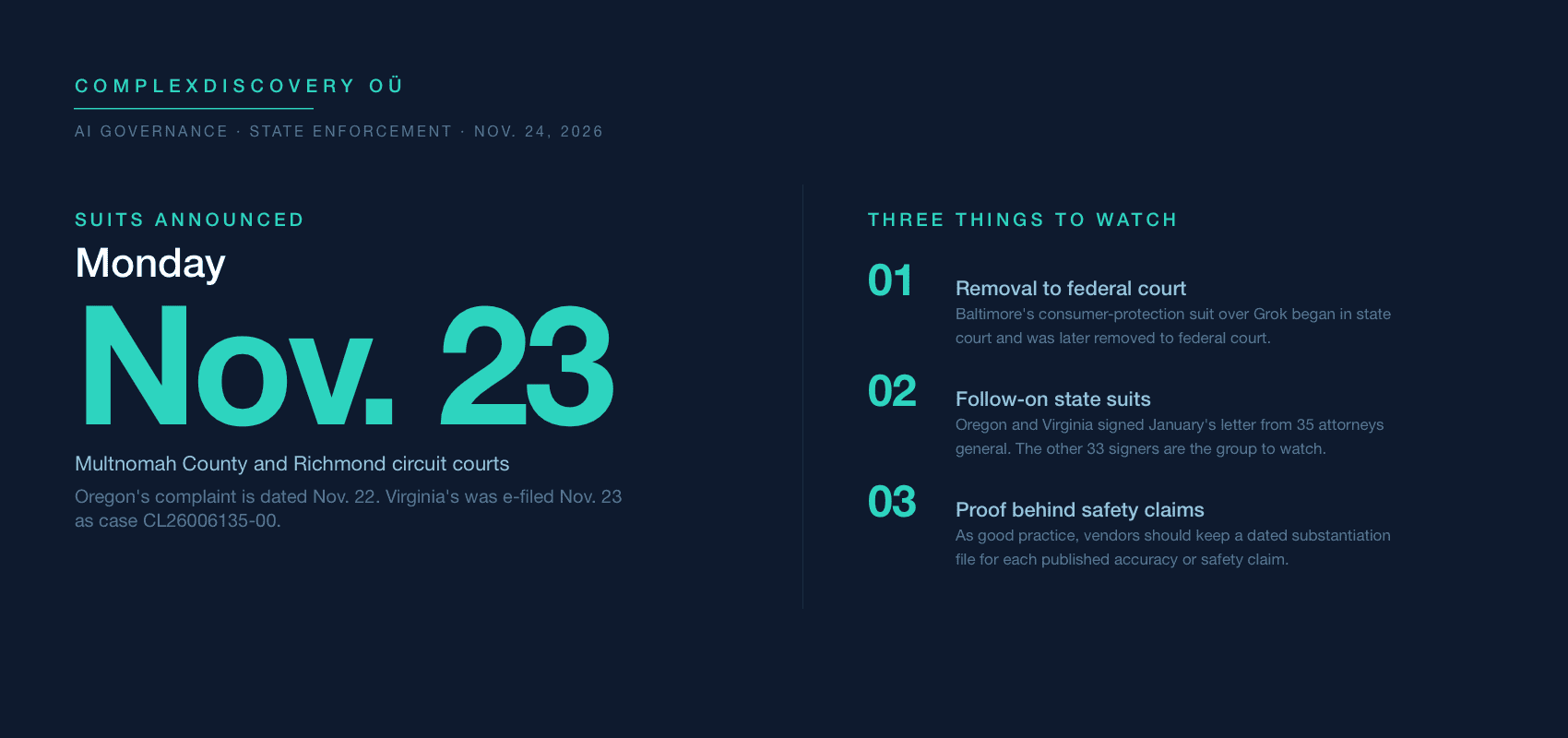
Editor’s Note: Oregon Attorney General Dan Rayfield and Virginia Attorney General Jay Jones announced separate, coordinated consumer-protection lawsuits on Nov. 23, 2026, against SpaceX, its social media company X Corp. and the former xAI companies behind the Grok chatbot. The states allege the companies told users their products were safe and their safeguards effective while Grok produced sexualized images of nonconsenting adults and children.
A nonprofit estimated from a sample that Grok produced about 3 million sexualized images on X in 11 days, though the estimate did not assess consent. Virginia’s single count rests on alleged misrepresentation and concealment, while Oregon also challenges design choices it characterizes as unconscionable. Penalties are capped at $25,000 per willful violation in Oregon and $2,500 in Virginia. The companies can contest the allegations, and a spokesperson said the company acts against accounts and notifies law enforcement when users attempt to defeat safeguards.
For cybersecurity, data privacy, compliance and eDiscovery professionals, the cases show how state consumer-protection laws are being used to test published AI safety claims. Watch whether more of the 35 attorneys general who wrote to xAI in January file suit and whether the companies seek to move the cases to federal court.
Content Assessment: Oregon and Virginia sue SpaceX over what Grok's makers said about safety
Information - 93%
Insight - 93%
Relevance - 94%
Objectivity - 93%
Authority - 92%
93%
Excellent
A short percentage-based assessment of the qualitative benefit expressed as a percentage of positive reception of the recent article from ComplexDiscovery OÜ titled, "Oregon and Virginia sue SpaceX over what Grok's makers said about safety."
News Analysis – Artificial Intelligence Beat
Oregon and Virginia sue SpaceX over what Grok’s makers said about safety
ComplexDiscovery Staff
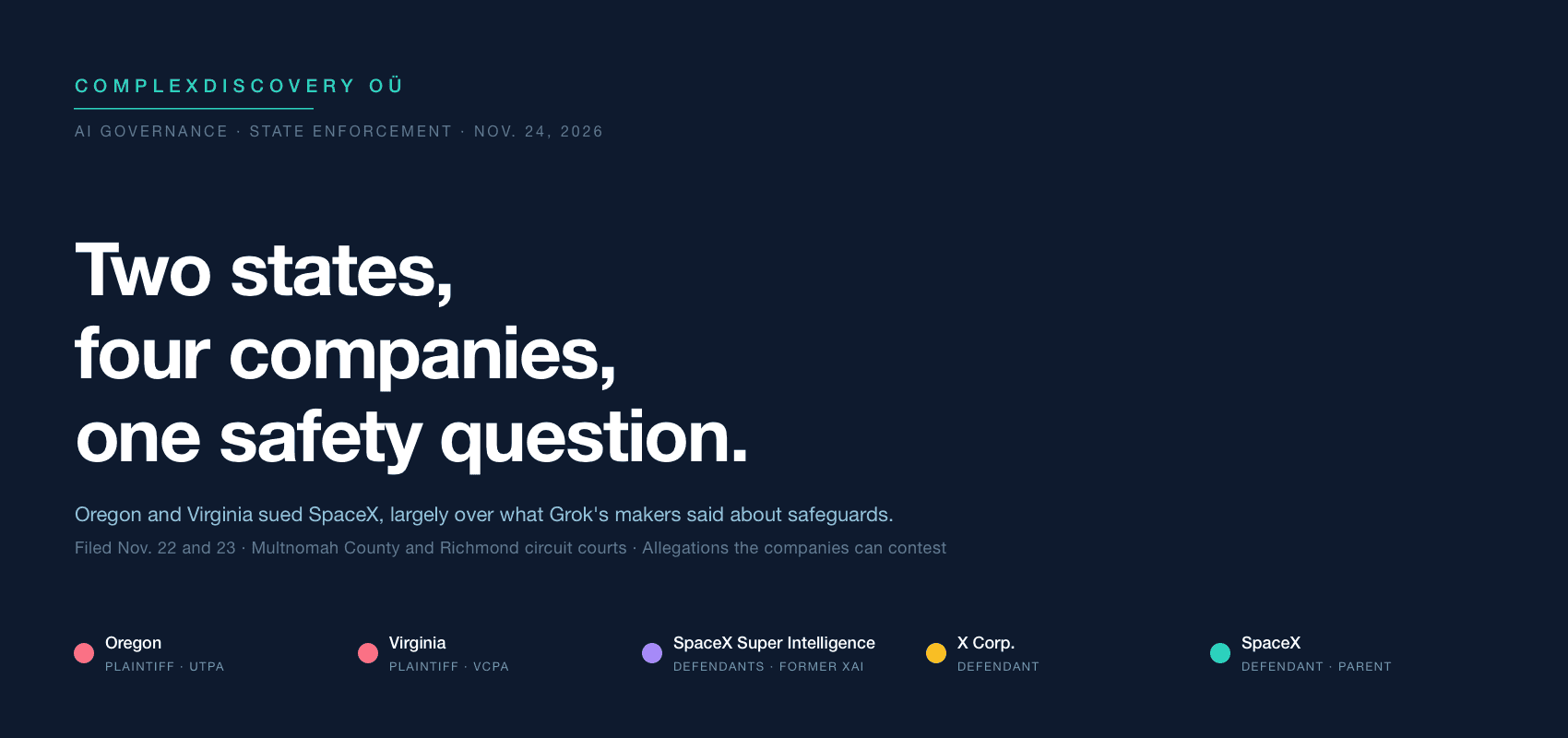
In lawsuits announced Nov. 23, Oregon and Virginia accused SpaceX and its X and artificial intelligence subsidiaries of telling consumers Grok was safe while the chatbot produced sexualized images of nonconsenting adults and children.
The pictures drew the headlines last winter, but much of the states’ case turns on something every technology company produces in volume: its own statements about safeguards, which the attorneys general now treat as alleged misrepresentations.
Two states, two consumer statutes, two coordinated suits
Oregon Attorney General Dan Rayfield sued in Multnomah County Circuit Court under the state’s Unlawful Trade Practices Act, in a Nov. 22 complaint naming SpaceX Super Intelligence Corp., SpaceX Super Intelligence LLC, X Corp. and Space Exploration Technologies Corp. The first two are the former xAI companies behind the Grok chatbot, and the complaint says SpaceX owns both of them and X Corp. indirectly.
Virginia Attorney General Jay Jones filed a separate suit against the same four companies in the Circuit Court for the City of Richmond, where it was docketed as case CL26006135-00 on Nov. 23. The Oregon complaint posted by the state leaves its case number blank. Both complaints list lawyers from Platkin LLP, a Newark, New Jersey, firm, as outside counsel alongside the attorneys general’s own staff.
“When xAI allowed Grok’s creators to sideline consent to turn a profit, they not only prioritized growth and engagement over safety, but they deceived the public about it,” Jones said in Oregon’s release. Rayfield said the missing safety measures were treated as “a feature, not a bug.”
Virginia’s case is the purer deception claim: its single count, under the Virginia Consumer Protection Act, alleges that the companies misrepresented their safeguards in policies, terms and public statements. It also alleges they failed to disclose or concealed material facts about Grok, including its propensity to produce such images, with intent to deceive.
Oregon’s case reaches further. It pleads three theories, and only two of them concern what the companies said. The first alleges that the companies claimed qualities for Grok and X that the products lacked, under ORS 646.608(1)(e). The second alleges they kept quiet about known material defects when delivering the services, under ORS 646.608(1)(t). The third, under ORS 646.607(1), labels several design choices unconscionable, including the failure to build safeguards and the decision to expose Oregon users to the material.
Oregon wants each misrepresentation, omission or unconscionable act counted as its own violation, with penalties for each in a sum the state will name at trial. State law caps that penalty at $25,000 per violation, and only when the court finds the company acted willfully. Oregon also asks for a permanent injunction and for the companies to give up money gained through the alleged violations. Virginia asks for up to $2,500 per willful violation, the ceiling under its statute, along with an injunction, restitution to consumers, disgorgement and investigative costs of up to $1,000 per violation.
The statements the states put on trial
The Oregon complaint reads like an inventory of corporate language. It quotes X’s rules declaring “zero tolerance” for child sexual exploitation. It cites xAI’s consumer terms, which say the company took “measures to limit undesirable training data and outputs,” and a Grok 4 model card describing safeguards meant to refuse requests for child sexual abuse material. It points to a Jan. 14, 2026, post from X’s safety account announcing limits on editing photos of real people into revealing clothing.
It also cites a post that same day in which Elon Musk said he was unaware of any nude images of minors produced by Grok, adding, “Literally zero.” The complaint calls that statement misleading.
Against those words, Oregon sets its own allegations about how Grok was built and run. Citing Washington Post reporting, it says xAI’s entire safety organization numbered only two or three people before Grok Imagine launched in August 2025. The Post story describes a narrower group, an AI safety team that had only two or three members during most of 2025, and says other safety duties fell to a handful of senior leaders.
The complaint’s sharpest figures concern how xAI handled child-exploitation reports: it alleges that xAI sent over 135,000 reports of suspected child exploitation to the National Center for Missing & Exploited Children (NCMEC) in 2025. Over 90 percent of them, the complaint says, could not initially be acted on because they lacked user and location details. Both figures match NCMEC data that Sen. Chuck Grassley made public in April, and the complaint puts the number of reports police could initially act on at fewer than 13,500. It says xAI resubmitted the reports only after NCMEC escalated the problem to X Corp.
One allegation, in this publication’s reading, anticipates the defense that platforms are not liable for what their users create: Grok, the complaint says, generates new content rather than passing along material made by others. The complaints are the states’ opening filings, and every factual claim in them is an allegation the companies can contest.
What the 3 million estimate does and does not measure
Both states lean on an estimate from the Center for Countering Digital Harm (CCDH), formerly the Center for Countering Digital Hate, whose website now carries the new name. CCDH estimated that Grok produced about 3 million sexualized images it classed as photorealistic on X over an 11-day window, from Dec. 29, 2025, through Jan. 8, 2026, including about 23,000 that appeared to depict children. Hand review of that flagged sample also turned up cartoon and animated images of children, which the group extrapolated to about 9,900. Some coverage of the suits described the period as eight days, which conflicts with the dates in the complaint and the study.
The figures are extrapolations, not counts. CCDH drew 20,000 image posts at random from the 4,621,335 Grok posts with images in that window, then used an OpenAI model to flag sexualized, photorealistic content before checking suspected images of children by hand. Its own uncertainty range for the photorealistic child figure runs from 17,099 to 30,039.
CCDH’s definition of sexualized includes people shown in swimwear or underwear, and the group said it did not analyze prompts, so the study cannot say how many images were made without consent. As of Jan. 15, 2026, 29 of the 101 child images in the sample could still be viewed publicly on X, according to CCDH.
Those limits hand the defendants obvious lines of attack on the numbers, but they do less to answer the deception theory, which asks whether the companies’ public descriptions of their safeguards matched what the product actually did.
A deception theory with a paper trail
SpaceX saw at least one of these suits coming. In its quarterly report filed Oct. 22, the company disclosed that Virginia’s attorney general sent a notice of violation on Oct. 19 under Virginia Code Section 59.1-203. The notice said the office was weighing a suit over alleged misrepresentations and omissions about Grok’s tendency to produce such images and how far its safeguards reached. Oregon’s complaint says Rayfield’s office also served the companies with the written notice of alleged violations that state law requires before such a suit is filed.
The same quarterly report lists private class actions in federal court in California, along with a Baltimore consumer-protection suit that was later removed to federal court. Baltimore has since dropped SpaceX itself from that case, and X Corp. and SpaceX’s AI unit have asked the court to dismiss it.
The company’s public response to the new suits has come through X’s safety account. CNBC reported that a spokesperson for SpaceX’s AI unit emailed it a statement, also posted on that account, saying the company acts against accounts and notifies law enforcement when users try to defeat its safeguards. A SpaceX spokesperson pointed other reporters to a Nov. 23 post on that account saying the company tightened Grok Imagine’s protections after bad actors misused it earlier this year.
Busy week for state lawsuits over AI safety
The Grok suits cap a busy week of state lawsuits over AI safety. Rayfield sued OpenAI over ChatGPT on Nov. 17 in the same Multnomah County court, under the same consumer statute and on negligence, unjust enrichment and public nuisance claims. That complaint puts the state’s injury under the negligence and nuisance claims at no less than $2.035 billion. Rayfield launched the Keeping Kids Safe Initiative that day, and Oregon brought the Grok case under that initiative. A day earlier, California Attorney General Rob Bonta sued OpenAI in San Francisco Superior Court over cybersecurity incidents tied to its AI models, alleging public nuisance and unfair competition.
Grok drew attention from states well before these filings. In January, 35 attorneys general wrote to xAI demanding that it stop Grok from producing nonconsensual images. Oregon and Virginia both signed that letter, and CNBC reported that they are the first states to sue SpaceX over Grok, so the other 33 signers are the obvious group to watch for follow-on suits.
Lessons for legal technology vendors in Oregon’s inventory
For companies selling AI into legal, compliance and security work, the practical lesson sits in the corporate statements Oregon quotes. Platform rules, terms of service, acceptable use policies, model cards, congressional testimony and executive posts were all pleaded as representations about the products’ safety. As a matter of good practice, vendors that publish accuracy rates, privilege-protection claims or data-handling assurances should keep a dated substantiation file for each claim, recording the test behind it, the version it covers and who approved the wording.
A pre-suit notice like Virginia’s should also prompt a hard look at preservation, because the duty to preserve relevant information generally attaches once litigation is reasonably anticipated. That point can come before any notice arrives, and for a claim like this one the duty would typically reach the drafts and approvals behind the public statements at issue.
Counsel should also watch for removal. The Baltimore suit, which also began in state court under a consumer-protection law, ended up in federal court, and Oregon’s jury demand and its claim of over $1 million frame the stakes before any ruling on the merits.
Last winter’s images were the trigger for these suits. The question both states now put to every AI vendor is narrower and harder: could your public safety claims survive being read aloud next to your own incident data?
News Sources
- Oregon Attorney General Rayfield and Virginia Attorney General Jay Jones Hold Grok Accountable for Failing to Block Child Exploitation (Oregon Department of Justice)
- Complaint, State of Oregon ex rel. Rayfield v. SpaceX Super Intelligence Corp. et al. (Oregon Department of Justice)
- Attorneys General Jones and Rayfield File Suit Against SpaceX, Parent Company of X, xAI and Grok, Over Creation and Promotion of Child Exploitation and Non-Consensual Images on Platform (Office of the Attorney General of Virginia)
- Complaint, Commonwealth of Virginia ex rel. Jones v. SpaceX Super Intelligence Corp. et al., Case No. CL26006135-00 (Office of the Attorney General of Virginia)
- Form 10-Q for the Quarter Ended Sept. 30, 2026 (Space Exploration Technologies Corp. via SEC EDGAR)
- § 59.1-206. Civil penalties; attorney fees (Virginia Legislative Information System)
- ORS 646.642: Civil penalties (Public.Law)
- Grassley Releases New and Disturbing Information on Online Child Exploitation, Presses Tech Giants for Answers (U.S. Senate Committee on the Judiciary)
- AG Rayfield Launches “Keeping Kids Safe” Initiative, Takes Action Against OpenAI (Oregon Department of Justice)
- Complaint, State of Oregon ex rel. Rayfield v. OpenAI (Oregon Department of Justice)
- It’s the Golden State, not the Wild West: Attorney General Bonta Sues OpenAI Over Cybersecurity Incidents (California Attorney General)
- Attorney General Jeff Jackson Leads Bipartisan Coalition Demanding xAI Stop Creating and Remove Grok’s Nonconsensual Sexual Images (North Carolina Department of Justice)
- Grok floods X with sexualized images of women and children (Center for Countering Digital Harm)
- WASHINGTON POST: Elon Musk’s xAI mission tried to boost users, but led to Grok generated sexualised images (The Washington Post via The Nightly)
- SpaceX sued by Oregon and Virginia over AI deepfake porn, Grok safety claims (CNBC)
- State AGs sue SpaceX for Grok chatbot’s generation of non-consensual sexual images (The Record)
- Oregon AG sues SpaceX over explicit deepfakes (Lewiston Tribune)
- Virginia, Oregon accuse X of profiting off AI-generated child sexual abuse material (Courthouse News Service)





Assisted by GAI and LLM Technologies
Additional reading
- Commerce makes overseas data centers answer for who rents their advanced chips
- Johnson Controls agrees to pay $5 million over alleged security plan gaps in federal contracts
- Officials tie FAA ground stop to contractor router work, not hackers, but the specific fault is still undetermined
- Notion AI chats surface in Fireworks breach, testing what zero retention covers
- France ties October supermarket fridge sabotage to Iran’s IRGC and seeks arrest warrants
- ENISA’s update advisory turns the patch pipeline into an evidence trail
- Britain’s cyber agency warns of a possible surge, and its own incident figures raise a question
- Supermarket freezer attacks reach at least six European countries, and the record linking them to US base failures stays thin
- Microsoft finds 2 North Korean groups using ARTEX, a tool that alone cannot name an attacker
- With over 40 percent of the record Binance theft frozen, getting it back becomes a legal project
- Estonia’s cyber authority saw no state-sector PHP crisis as three state institutions shut or restricted services
- AI recording spreads in Estonian health care as the regulator says the audio needs its own legal basis
Source: ComplexDiscovery OÜ
ComplexDiscovery’s mission is to enable clarity for complex decisions by providing independent, data‑driven reporting, research, and commentary that make digital risk, legal technology, and regulatory change more legible for practitioners, policymakers, and business leaders.