

Editor’s Note: June revealed a single tension running beneath very different stories — the widening distance between what systems can now do and who is accountable for what they do. In this month’s Five great reads newsletter, that gap shows up across cyber, data, and legal discovery in ways that are becoming harder to ignore.
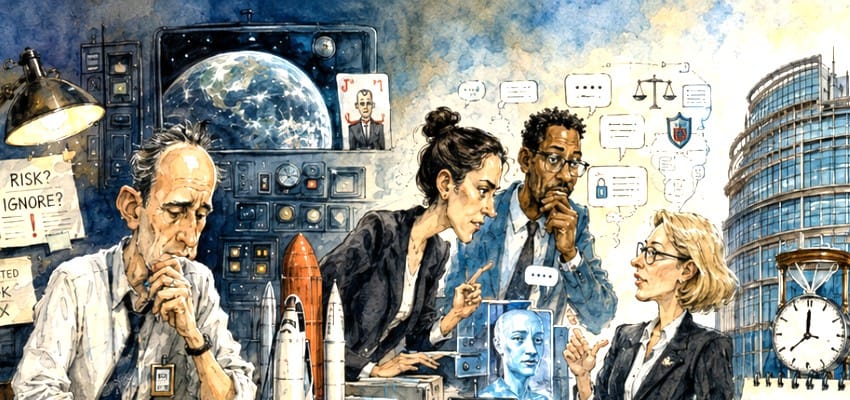
A former NASA technologist warned that a long record of success can quietly normalize risk until warnings stop reaching the people who decide. A leading eDiscovery vendor named the same problem in commercial terms, pitching “defensible by design” AI against a governance-maturity gap. Brussels reset its high-risk AI deadlines while drawing a hard new line against synthetic abuse imagery, and a centuries-old tutorial method was repurposed to teach practitioners how to defend a contestable claim rather than merely repeat a fashionable one. Estonia, characteristically, moved first — proposing official digital identities for AI agents so their actions can be scoped, revoked, and audited. Across all five, accountability is migrating from an afterthought to a design requirement.
This month’s Industry research puts numbers behind the squeeze: ComplexDiscovery’s 14th annual market-size mashup shows eDiscovery spending growing far slower than the data it must process, turning automation from an option into an arithmetic necessity.
The Lagniappe section follows the thread into the field — a $25 million deepfake fraud and the low-tech phrase that could have stopped it, Europe’s new AI-labeling code and its hard deadline, a nine-month tour of Europe’s tech-sovereignty arc, EDRM’s AI-era governance refresh, and a surge in merger filings that foreshadows a heavier discovery load.
Together they sketch a field learning, story by story, to put guardrails ahead of capability rather than behind it.
Content Assessment: Five Great Reads on Cyber, Data, and Legal Discovery for June 2026
Information - 93%
Insight - 92%
Relevance - 93%
Objectivity - 94%
Authority - 95%
93%
Excellent
A short percentage-based assessment of the qualitative benefit expressed as a percentage of positive reception of the recent article from ComplexDiscovery OÜ titled, "Five great reads on cyber, data, and legal discovery for June 2026."
Industry Newsletter
Five great reads on cyber, data, and legal discovery for June 2026
ComplexDiscovery Staff
Click on the links to read the complete article.
When success breeds complacency
Success bred complacency: a NASA warning for security and discovery leaders opens this month by turning a space-program tragedy into a governance lesson. Drawing on the 2003 Columbia disaster and the earlier Challenger loss, former NASA Johnson Space Center chief technologist John Saiz used his LegalTechTalk 2026 keynote to show how a long record of success can mute dissent and normalize risk — the “normalization of deviance” that sociologist Diane Vaughan identified, where schedule pressure and added management layers let frontline warnings die before they reach decision-makers. Saiz’s prescription — psychological safety to challenge, a learning culture over a zero-failure mandate, and knowledge that crosses boundaries — maps directly onto the breaches, sanctions, and governance failures that security and discovery teams confront. Read more in Success bred complacency: a NASA warning for security and discovery leaders.
The readiness gap
Relativity bets legal teams will talk to their data, not just search it reports on the company’s RelFest London push to make conversational, citation-backed AI a standard part of eDiscovery. CEO Phil Saunders framed the day around a widening gap between fast AI adoption and lagging governance maturity, pitching an end-to-end, “defensible by design” platform — backed by an Anthropic partnership bringing Claude to RelativityOne and the acquisition of drafting startup Gavel — as the answer. ComplexDiscovery flagged that most of the cited metrics were vendor-reported and not independently verified, leaving open whether “defensible by design” survives a contested court ruling. For practitioners weighing AI tools against defensibility obligations, the readiness gap is the question of the year. Read more in Relativity bets legal teams will talk to their data, not just search it.
Brussels resets the clock
Parliament hits pause on high-risk AI rules and bans nudifier apps examines the European Parliament’s June 16 approval of the AI portion of the bloc’s “digital omnibus,” which delays the EU AI Act’s high-risk obligations into 2027 and 2028 while moving content-labeling duties to December 2026. The same package draws a hard line — an Article 5 prohibition on AI systems that generate child sexual abuse material or non-consensual intimate imagery, the so-called “nudifier” apps — with a December 2026 compliance deadline. Civil-society group CDT Europe warned that the package advanced without an impact assessment and dilutes fundamental-rights protections. For compliance teams, the month’s lesson is that deadlines can move even as red lines harden. Read more in Parliament hits pause on high-risk AI rules and bans nudifier apps.
The discipline of the defensible claim
An Oxford tutorial for cybersecurity, governance and eDiscovery connects centuries-old pedagogy to present-day practice. ComplexDiscovery’s new tutorial adapts the Oxford method — a student defends a contestable claim under sustained questioning — to 21 propositions across three terms, training practitioners to distinguish a defensible argument from a merely fashionable one on breaches, attribution, privacy, and AI. The propositions are deliberately argued either way (“discovery manufactures a record,” “human-in-the-loop is a liability fiction”), drawing on legal authorities and scholars from Brandeis to Bruce Schneier. The piece positions critical thinking as an operational discipline — a way to slow consequential claims before courts, regulators, or markets test them. Read more in An Oxford tutorial for cybersecurity, governance and eDiscovery.
Identity for the machines
Estonia aims to be first to give AI agents official digital IDs captures a small state again moving first on digital infrastructure. Prime Minister Kristen Michal backed a proposal from the Eesti.ai advisory board for state-recognized “AI ID codes” that let agents act with scoped, revocable, auditable permissions rather than borrowing their owner’s full credentials — extending the same architecture behind Estonia’s personal ID and X-Road backbone. The announcement left liability and timing unresolved, even as courts and companies from Air Canada to American Express wrestle with the same accountability gap. ComplexDiscovery framed the design choices, especially tamper-evident logging, as decisive for whether the system aids or clouds chain-of-custody for governance and eDiscovery teams. Read more in Estonia aims to be first to give AI agents official digital IDs.
Industry research
Complete look: ComplexDiscovery OÜ’s 2025 to 2030 eDiscovery market size mashup quantifies the productivity squeeze defining the field. The 14th annual mashup places the worldwide eDiscovery market at an estimated $19.61 billion in 2025, rising to a projected $28.08 billion by 2030 — a reconciled 7.44 percent compound annual growth rate — even as worldwide data grows roughly 4.5 times over the same span. That mismatch translates into a 3.13-times productivity-per-dollar mandate by 2030, with software taking share from services, cloud becoming the default, and collection’s slice of task spend more than tripling. For teams budgeting against exploding data volumes, the numbers make the case for automation in stark terms. Learn more in Complete look: ComplexDiscovery OÜ’s 2025 to 2030 eDiscovery market size mashup.
Lagniappe
At LegalTechTalk, the password is blueberry hot dogs focuses on cyber governance through a memorable case study: a Hong Kong finance officer who wired more than $25 million after a video call in which every “board member” was an AI-generated deepfake. The panel — featuring HaystackID’s John Wilson and Cyril Amarchand Mangaldas’s Komal Gupta — argued that no single department can own cyber risk, and offered a low-tech defense: a verbal-only challenge phrase that is never recorded, so no AI can retrieve it. Read more in At LegalTechTalk, the password is blueberry hot dogs.
Europe’s AI labeling rules arrive with a voluntary code and a hard deadline reports on the European Commission’s June 10 Code of Practice for marking AI-generated content, a voluntary playbook operationalizing Article 50 of the AI Act ahead of transparency obligations that begin applying in August 2026. It leans on tamper-evident metadata and imperceptible watermarking — aligning in practice with the C2PA provenance standard — with non-compliance carrying fines up to 15 million euros or 3 percent of worldwide annual turnover. Read more in Europe’s AI labeling rules arrive with a voluntary code and a hard deadline.
Nine months across Europe’s tech-sovereignty arc, from Tallinn to London traces seven events across four cities, tracking how the tech-sovereignty argument hardened from rhetoric into rules, capital, and product. From Kaja Kallas on algorithmic threats to democracy to Estonia’s regulatory sandbox and HaystackID’s deepfake forensics workshop, each stop left a concrete compliance obligation — and showed small states like Estonia, Finland, and Ireland positioned to set exportable rules through the Brussels Effect. Read more in Nine months across Europe’s tech-sovereignty arc, from Tallinn to London.
EDRM expands IGRM v4.1 guidance for AI-era information governance reports on the EDRM’s June 18 update reframing its Information Governance Reference Model for AI, privacy, and cross-functional governance as Copilot transcripts, synthetic documents, and AI-conversation logs strain retention models. The revision breaks the prior three-camp stakeholder grouping into seven named roles and codifies a “perpetual policy-process cycle” to strengthen defensible-disposition positions, previewing the coming EDRM 2.0 revision. Read more in EDRM expands IGRM v4.1 guidance for AI-era information governance.
HSR Filings Hit 235 in May 2026, the Highest Monthly Total Since December 2021 connects merger activity to discovery workload. The FTC logged 235 Hart-Scott-Rodino transactions in May — a fiscal-year high and a 58.8 percent jump over May 2025 — even as first-quarter GDP growth cooled to 1.6 percent. If the pace holds, the year could approach 2,500 reportable transactions and 70 to 75 Second Requests, each a potential large-scale document review. Read more in HSR Filings Hit 235 in May 2026, the Highest Monthly Total Since December 2021.
- Click here to view recent Five Great Reads Newsletters
- Click here to subscribe to Five Great Reads Update
June 2026 industry spotlight
Individuals and Organizations Mentioned in the June Edition Reporting
- Anthropic – partner bringing a Claude conversational surface to RelativityOne.
- Arba Kokalari – European Parliament co-rapporteur who framed the digital omnibus delay as red-tape relief for entrepreneurs.
- Atomico – venture firm whose State of European Tech report framed the sovereignty retrospective.
- Baker McKenzie – law firm cited for completing a whistleblower investigation in four days using Relativity AI.
- Barry Scannell – partner at William Fry, who called Ireland the de facto global AI regulator.
- Bolt – ride-hailing company whose founder chairs the Eesti.ai advisory board.
- Brendan Quinn – Managing Director of the IPTC, whose analysis tied the labeling code to the C2PA provenance standard.
- Bureau of Economic Analysis – source of the Q1 2026 GDP and corporate-profit figures in the HSR report.
- C2PA – content provenance standard that the labeling code’s signed-metadata approach aligns with in practice.
- CDT Europe – Center for Democracy and Technology arm that warned the omnibus dilutes fundamental-rights protections.
- Chris Brown – Chief Product Officer of Relativity, who announced the Anthropic partnership and the Gavel acquisition.
- ComplexDiscovery OÜ – publisher of the newsletter, the market-size mashup, and the nine-month European retrospective.
- Cyril Amarchand Mangaldas – Indian law firm represented on the LegalTechTalk cyber-governance panel.
- David R. Cohen – CEO of ATJustice and Chair of EDRM’s Board of Project Trustees, on the importance of information governance amid AI.
- Diane Vaughan – Columbia University sociologist who coined “normalization of deviance” in her study of the Challenger launch decision.
- EDRM – Electronic Discovery Reference Model organization that published IGRM v4.1 and its new User Guide.
- ai advisory board – Estonian body that proposed the state-recognized AI ID codes.
- Elise Tropiano – Senior Director of Product Management at Relativity, who moved aiR Assist toward general availability.
- Eric Mandel – IGRM project trustee and Director of Global Advisory Services at KLDiscovery Ontrack, who framed v4.1 as a volunteer-practitioner product.
- European Commission – proposed the digital omnibus and published the Code of Practice on AI content labeling.
- European Parliament – adopted the AI portion of the digital omnibus, delaying high-risk deadlines and banning nudifier apps.
- Federal Trade Commission – agency that logged 235 HSR transactions in May 2026, a fiscal-year high.
- Future of Life Institute – organization represented on the Eesti.ai advisory board.
- Gabe Pereyra – President of legal-AI company Harvey, cited in the nine-month tech-sovereignty retrospective.
- Gavel – AI-native legal drafting platform acquired by Relativity to extend AI work product into Microsoft Word.
- Harvey – legal-AI company cited for scale across customers and countries.
- HaystackID – digital forensics firm behind the LegalTechTalk deepfake session and the Dublin forensics workshop.
- Henna Virkkunen – Executive Vice-President for Tech Sovereignty, Security and Democracy at the European Commission, who defended the AI content-labeling rules.
- Herbert Smith Freehills – law firm cited for running aiR across roughly 100,000 documents in 12 hours.
- IDC – source of the 181-zettabyte 2025 Global DataSphere baseline cited in the mashup.
- IPTC – International Press Telecommunications Council, whose analysis informed the AI-labeling coverage.
- Jaan Tallinn – Skype co-founder and Eesti.ai advisory board member.
- Javier Milei – President of Argentina, whose “non-human corporations” proposal addresses the same agent-accountability gap.
- John Saiz – former chief technologist at NASA’s Johnson Space Center, whose LegalTechTalk keynote on the “normalization of deviance” framed the month’s opening read.
- John Wilson – CISO and President of Forensics at HaystackID, who opened the LegalTechTalk deepfake-fraud session and co-led the Dublin forensics workshop.
- Kaja Kallas – EU foreign-policy chief and former Estonian Prime Minister, who warned of algorithmic threats to democracy at the Tallinn Digital Summit.
- KLDiscovery Ontrack – eDiscovery provider whose advisory leader serves as an IGRM project trustee.
- Komal Gupta – Chief Innovation Officer at Cyril Amarchand Mangaldas, who spoke on cross-functional cyber governance and sustained AI adoption.
- Kristen Michal – Prime Minister of Estonia, who backed the Eesti.ai proposal for state-recognized AI ID codes.
- Laura Lazaro Cabrera – policy analyst at CDT Europe, who warned the omnibus weakens fundamental-rights safeguards.
- LegalTechTalk – London conference hosting the NASA keynote and the cyber-governance and deepfake sessions.
- Markus Villig – founder and CEO of Bolt, who chairs the Eesti.ai advisory board behind the AI ID proposal.
- Mary Mack – CEO and Chief Legal Technologist of EDRM, on shared language and the coming EDRM 2.0.
- Michael McNamara – European Parliament co-rapporteur who tied the “nudifier” ban to its victims while preserving the AI Act’s architecture.
- NASA / Johnson Space Center – subject of the Columbia and Challenger case studies anchoring the opening keynote.
- OpenAI – AI company whose Irish operation featured in the governance discussion at Dublin Tech Summit.
- Phil Saunders – Chief Executive Officer of Relativity, who framed the AI adoption-versus-governance “readiness gap” at RelFest London.
- RAND Corporation – source of the 2012 task-composition baseline used in the market-size mashup.
- Relativity – eDiscovery vendor whose RelFest London announcements centered on conversational, “defensible by design” AI.
- Rob Robinson – Editor and Managing Director of ComplexDiscovery OÜ, author of the eDiscovery market-size mashup and the nine-month European retrospective.
- S. Department of Justice – co-issued the request for information on the premerger notification form.
- University of Oxford – source of the tutorial method and the Michaelmas, Hilary, and Trinity term structure.
- William Fry – Irish law firm whose partner called Ireland the de facto global AI regulator.
About ComplexDiscovery OÜ
ComplexDiscovery OÜ is an independent digital publication and research organization based in Tallinn, Estonia. ComplexDiscovery covers cybersecurity, data privacy, regulatory compliance, and eDiscovery, with reporting that connects legal and business technology developments—including high-growth startup trends—to international business, policy, and global security dynamics. Focusing on technology and risk issues shaped by cross-border regulation and geopolitical complexity, ComplexDiscovery delivers editorial coverage, original analysis, and curated briefings for a global audience of legal, compliance, security, and technology professionals.
Learn more at ComplexDiscovery.com.
Assisted by GAI and LLM Technologies
- An Abridged Look at the Business of eDiscovery: Mergers, Acquisitions, and Investments
- eDisclosure Systems Buyers Guide – Online Knowledge Base
Source: ComplexDiscovery OÜ
ComplexDiscovery’s mission is to enable clarity for complex decisions by providing independent, data‑driven reporting, research, and commentary that make digital risk, legal technology, and regulatory change more legible for practitioners, policymakers, and business leaders.