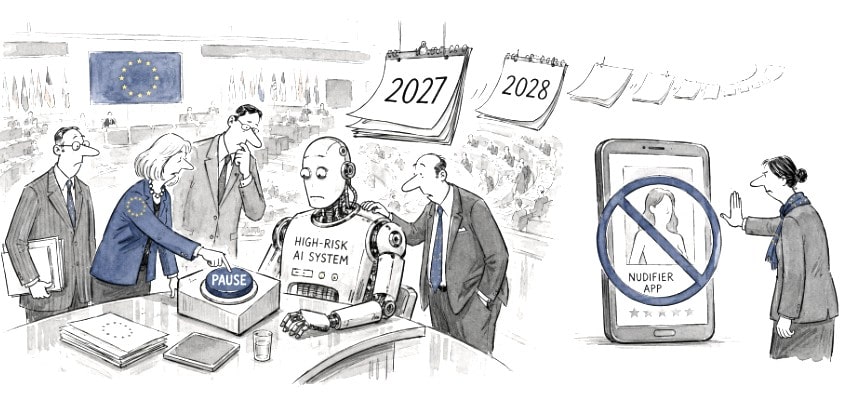
Editor’s Note: Regulators rarely admit a timeline got away from them, so the European Parliament’s June 16 vote stands out. Lawmakers delayed the AI Act’s high-risk obligations to December 2027 and August 2028, delayed AI-content watermarking to December 2026, and, in the same package, banned AI systems that generate child sexual abuse material or non-consensual intimate imagery.
For cybersecurity, data privacy, regulatory compliance and eDiscovery professionals, the dual signal matters. The delay buys time to build conformity programs for hiring, credit, biometric and law-enforcement tools, while the Article 5 ban sets a near-term December 2026 deadline that touches any provider of image or video generation. Privacy teams also gain a wider legal basis to process sensitive data for bias correction, with safeguards.
Watch the Council of the EU next. The text binds only on formal adoption and publication in the Official Journal, expected before August. Civil-society groups, including the Center for Democracy and Technology, warn the package weakens fundamental-rights safeguards even as it adds the nudifier ban, so expect continued scrutiny of how the changes are implemented. Until then, treat the August 2026 transparency duties as live and the new high-risk dates as runway to use, not to spend.
Content Assessment: Parliament hits pause on high-risk AI rules and bans nudifier apps
Information - 94%
Insight - 92%
Relevance - 92%
Objectivity - 90%
Authority - 92%
92%
Excellent
A short percentage-based assessment of the qualitative benefit expressed as a percentage of positive reception of the recent article from ComplexDiscovery OÜ titled, "Parliament hits pause on high-risk AI rules and bans nudifier apps."
Industry News – Artificial Intelligence Beat
Parliament hits pause on high-risk AI rules and bans nudifier apps
ComplexDiscovery Staff
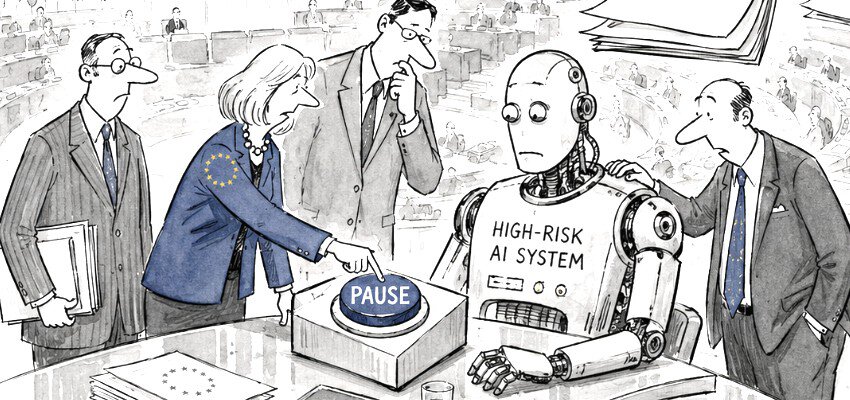
The European Parliament gave its final approval June 16 to a package that delays the EU AI Act’s toughest obligations and bans AI systems that generate sexual deepfakes.
The tally was 423 in favor, 57 against and 174 abstentions. The result resets the compliance calendar for companies deploying high-risk systems, hands businesses extra time on the rules they feared most, and draws a hard new line around AI that strips people of consent. The measure still needs formal adoption by the Council of the EU and publication in the Official Journal before it becomes law.
The vote adopted the AI portion of the bloc’s digital omnibus, a simplification package the European Commission proposed Nov. 19, 2025, after rollout of the 2024 AI Act fell behind schedule. Parliament and Council negotiators reached a provisional deal in early May, and member state representatives signed off May 13. June 16 marked Parliament’s formal adoption. The Council of the EU is expected to adopt the text before Aug. 2, 2026. Because the final legal text had not entered into force at filing, the compliance dates and obligations described here follow the Parliament-approved and provisionally agreed text.
What the vote actually changed
Most of the attention went to the calendar. Obligations for stand-alone high-risk systems listed in the Act’s Annex III, the tools used in hiring, credit scoring, education, law enforcement and border control, will now apply from Dec. 2, 2027. Obligations for AI built into regulated products under Annex I, such as medical devices, machinery and vehicles, move to Aug. 2, 2028. The agreed text swapped the Commission’s original conditional trigger for these fixed dates, a change attorneys at Gibson Dunn, in a May 27 client alert, called a deferral rather than a dismantling.
The package sets a Dec. 2, 2026, compliance date for machine-readable labeling of AI-generated content, often described as watermarking. That is earlier than the Feb. 2, 2027 date the Commission had proposed, and, according to a Gibson Dunn client alert, it works as a grace period for systems already on the market that would otherwise have faced the obligation from Aug. 2, 2026. The labeling lets systems detect and trace content that a machine produced.
A delay, not a retreat
Co-rapporteur Arba Kokalari, an Internal Market and Consumer Protection committee member from Sweden, framed the delay as relief for builders. “To all the entrepreneurs and engineers out there, we are pressing the pause button on the AI Act and we are reducing red tape,” she said during the plenary debate. “It must be simpler to build the future’s tech companies in Europe and to stay in Europe, so we can become an AI continent.”
Michael McNamara, the co-rapporteur from the Civil Liberties, Justice and Home Affairs committee and a member from Ireland, said the package kept the Act’s structure intact. “This omnibus was about establishing legal certainty by extending certain timelines while preserving the AI Act’s architecture and strengthening protections where possible,” he said.
The architecture survived. The risk-based tiers, the governance bodies and the core duties stay in place. What shifted is when the heaviest duties bite.
Not everyone read the package as a clean win. The Center for Democracy and Technology, a digital-rights group that sits on the AI Act’s advisory forum, said the final text dilutes fundamental-rights protections. In a June 17 analysis, CDT Europe policy analysts Laura Lazaro Cabrera and Magdalena Maier wrote that postponing the high-risk rules, paired with a clause that exempts systems already on the market, leaves people without those safeguards for the next year and a half and gives providers an incentive to rush products out before the deadlines take hold. The group also faulted lawmakers for advancing the changes without an impact assessment, and said that even the nudifier ban, which it called an important step, carries loopholes that could complicate enforcement.
Why the nudifier ban lands hard
The second headline is a new prohibition written into Article 5, the Act’s list of banned practices. As approved, the text would bar AI systems that produce child sexual abuse material, or that depict an identifiable person’s intimate parts or sexual activity without consent, in image, video or audio form. It would reach both providers that place such systems on the EU market and deployers that use them for that purpose.
Providers of general-purpose image and video tools would not be off the hook. The prohibition would extend to systems where such output is a reasonably foreseeable result and the system lacks adequate safeguards to prevent it, according to the Gibson Dunn analysis. McNamara tied the measure to its victims. “They impact real people, overwhelmingly women, with the purpose of humiliating, degrading and objectifying them,” he said. Companies would have until Dec. 2, 2026, to bring systems into line.
Compliance steps to take before December
For practitioners, the extra runway is a planning window, not a reason to stand down. Teams building or buying image and video generation tools should map foreseeable misuse now and document the technical safeguards that block non-consensual content, because the Article 5 ban arrives in December 2026, well ahead of the high-risk dates.
Governance leads should treat the 2027 and 2028 deadlines as time to build a real conformity program rather than a date to ignore. Privacy teams should note a quieter change too: the Act now allows processing of special-category data where strictly necessary to detect and correct bias, with safeguards, across both high-risk and other systems, widening a legal basis that had been confined to high-risk providers.
The deadline that did not move
The delay is narrower than the headlines suggest. The Act’s Article 50 transparency obligations, including disclosure duties for certain AI systems that interact with people or generate content, still apply from Aug. 2, 2026. The watermarking postponement works as a grace period for systems already on the market, not a blanket reprieve. The February 2025 prohibitions and the August 2025 rules for general-purpose AI models stay in force on their original schedule.
That leaves a split screen for compliance teams: relief on the high-risk track, steady pressure everywhere else. The package still depends on formal Council adoption, expected before August, and the text will bind only once it appears in the Official Journal.
Europe set out to write the world’s first comprehensive AI law and is now learning how hard it is to make one operable on a fixed clock. The omnibus buys time on the hardest rules while sharpening the ban on the most abusive uses.
For compliance teams, the real question is now sequencing: which obligations must be ready by August 2026, which by December 2026, and which belong in the 2027 to 2028 conformity planning cycle?
News Sources
- AI Act: deal on simplification measures, ban on “nudifier” apps (European Parliament)
- European Parliament approves AI Act amendments, ‘nudifier’ ban (The Sofia Globe)
- EU AI Act omnibus agreement: postponed high-risk deadlines and other key changes (Gibson Dunn)
- Artificial intelligence: Council and Parliament agree to simplify and streamline rules (Council of the EU)
- AI: European Parliament approves ban on “nudifier” apps and simplification measures (Eunews)
- EU agrees Digital Omnibus deal to simplify AI rules (White & Case)
- Final AI omnibus text dilutes fundamental rights protections (Center for Democracy and Technology)





Assisted by GAI and LLM Technologies
Additional reading
- Europe’s AI labeling rules arrive with a voluntary code and a hard deadline
- AI is becoming an advisor, and it is rewriting how buyers find you
- What marketing confidence actually looks like
- When credibility comes first, capability sells itself: The case for news-led marketing
- The one question that reveals whether your marketing plan is actually a plan
- How Prompt Marketing Is Redefining Thought Leadership In The AI Era
- Raising The Age Ceiling: How AI Is Extending Executive Leadership
- Staying Curious: One Practical Defense Against Creative Burnout
- From Longbows To AI: Lessons In Embracing Technology
- 20 Ways Creative Professionals Battle Burnout And Find Fresh Ideas
- 14 Points For Brands To Consider Before Making Sociopolitical Statements
Source: ComplexDiscovery OÜ
ComplexDiscovery’s mission is to enable clarity for complex decisions by providing independent, data‑driven reporting, research, and commentary that make digital risk, legal technology, and regulatory change more legible for practitioners, policymakers, and business leaders.