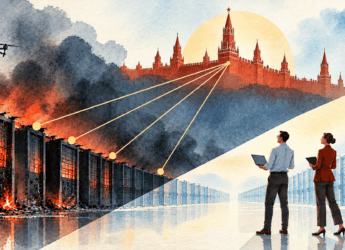

Editor’s Note: A Russian drone hit a building at a spent-nuclear-fuel storage site inside Ukraine’s Chornobyl exclusion zone on June 7, with no radiation release reported, and the same 48 hours saw NATO jets down a jammed drone over Latvia, oil terminals burn from long-range strikes, and a rail locomotive knocked out by an aerial hit. Read together, the June 7 and 8 assessments from the Institute for the Study of War describe a war increasingly fought through the data layer: remotely piloted drones tied to live wireless links, electronic warfare that pushes munitions across national borders, and open-source satellite feeds that serve as the evidence of record.
For professionals in cybersecurity, data privacy, regulatory compliance, and eDiscovery, this is not distant news. The targets are the same critical infrastructure and operational technology systems they defend. The verification methods are the same digital-evidence disciplines they practice. The rationing of fuel through a state-controlled app shows how access to essentials migrates onto contested platforms under stress.
Watch the convergence: kinetic and cyber risk are collapsing into a single register, and the teams that see it first will be the ones who plan for it.
Content Assessment: When the drone war reaches the reactor fence: Ukraine and the cyber-physical front
Information - 93%
Insight - 93%
Relevance - 91%
Objectivity - 94%
Authority - 93%
93%
Excellent
A short percentage-based assessment of the qualitative benefit expressed as a percentage of positive reception of the recent article from ComplexDiscovery OÜ titled, "When the drone war reaches the reactor fence: Ukraine and the cyber-physical front."
Industry News – Geopolitics Beat
When the drone war reaches the reactor fence: Ukraine and the cyber-physical front
ComplexDiscovery Staff
A Russian drone struck a building at Ukraine’s Centralized Storage Facility for Spent Nuclear Fuel inside the Chornobyl exclusion zone early on June 7. Ukrainian officials said the struck structure was not holding spent-fuel casks at the time, and the International Atomic Energy Agency reported that radiation levels stayed normal, but the strike damaged infrastructure at one of Europe’s most sensitive nuclear sites.
The incident arrived amid wider reporting that Russian forces are leaning on remotely controlled, data-linked drones, systems a human operator can watch and re-steer in flight rather than send to a fixed coordinate. That shift is what makes a battlefield story relevant to people who never read war dispatches. For professionals who defend operational technology, govern data, and preserve digital evidence, the June 7 and June 8 assessments from the Institute for the Study of War read less like distant dispatches and more like a field test of risks they already track. The week’s targets were energy terminals, rail locomotives, a radar station, and a nuclear waste store. The tools were drones, wireless command links, and electronic jamming. The verification ran on satellite heat data and geolocated video. Each of those elements has a practical analog in the cybersecurity, information governance, and eDiscovery work that defines the modern enterprise.
A reckless strike on a nuclear storage site
Energoatom, Ukraine’s state nuclear operator, reported that the drone hit at 2:10 a.m. local time on June 7, causing a fire and destroying part of the building. The site sits near Buryakivka, about 15 kilometers from the Chornobyl plant. Ukraine’s Security Service said the blast also damaged an administrative building used by the International Atomic Energy Agency and opened a criminal case treating the strike as a suspected war crime.
An IAEA team that inspected the impact area found the fuel-reception building seriously damaged. Director General Rafael Grossi called the incident deeply concerning because large amounts of nuclear material sat in casks a short distance from the strike. Attacks on nuclear sites are “completely unacceptable,” Grossi said, citing the agency’s seven pillars for nuclear safety during armed conflict.
ISW analysts Christina Harward, Grace Mappes, and Kateryna Stepanenko placed the strike in a pattern rather than treating it as an aberration. Russian strikes damaged the containment structure over Chornobyl’s melted-down Reactor No. 4 in February 2025 and hit substations supporting the plant in January 2026. ISW assessed that the latest strike fits a broader Russian pattern of accepting, or at least tolerating, high-risk attacks near nuclear sites, whether the hits are accidental or deliberate.
Drones that adjust on the way to the target
The detail that should hold a security professional’s attention is how the weapons now fly. ISW reported that Russian forces struck two civilian Ukrainian search-and-rescue vessels in the Black Sea on June 6, possibly using remotely controlled Shahed-type drones. Ukrainian Foreign Minister Oleksiy Kuleba said the boats carried protection under international humanitarian law because they were running a humanitarian mission.
The distinction from a preprogrammed loitering munition is that a person stays in the loop. Rather than flying to a fixed coordinate, the newer drones keep a two-way connection home, so an operator can watch what the aircraft sees and re-steer it mid-flight. That is what lets one catch something that moves, a truck or a locomotive, rather than only a building that stays put. In plain terms it is a cyber-physical system: a kinetic effect riding on a data channel, where the link is both the capability and the weak point. Defenders who have spent years modeling command-and-control traffic, lateral movement, and signal integrity are looking at the same problem set rendered in aluminum and explosives.
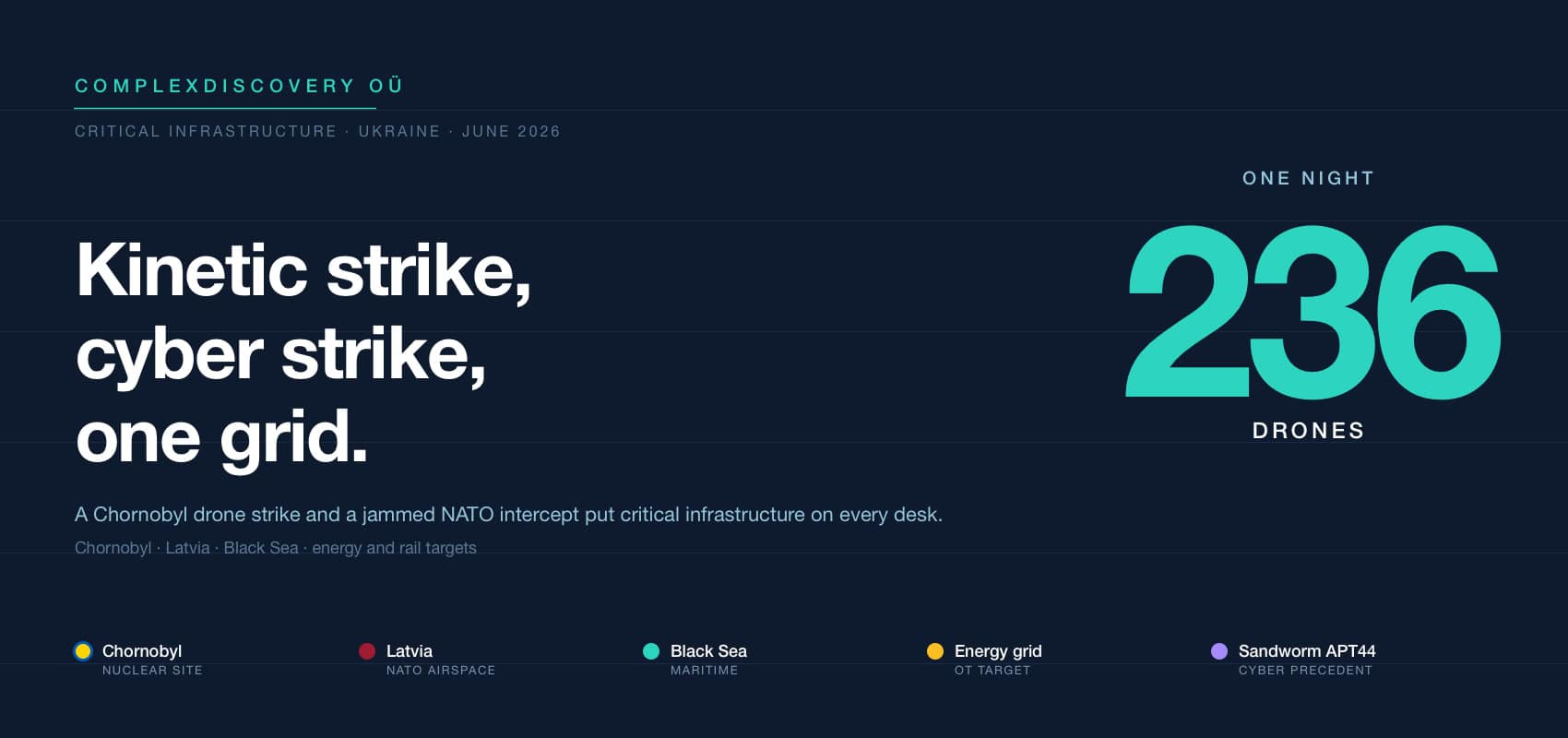
Volume compounds the threat. The Ukrainian Air Force counted 236 incoming drones the night of June 6, a mix of Shahed, Gerbera, and Italmas strike models padded out with Parodiya decoys. Crews shot down 215, but 17 got through and hit 13 locations. The next night brought 155 more. For the full week ending June 6, President Volodymyr Zelensky put the total at 88 missiles, over 3,250 strike drones, and about 1,800 glide bombs. Salting live munitions with decoys is a saturation play, and the parallel to alert fatigue in a security operations center writes itself.
When jamming pushes weapons across borders
On June 8, NATO crossed a line of its own. The Latvian National Armed Forces said French Air Force jets flying the alliance’s Baltic Air Policing mission downed a drone in Latvian airspace. A French Rafale based at Siauliai in Lithuania destroyed the aircraft over an uninhabited area near Berzgale, about 30 kilometers from the Russian border. Latvian officials said the drone entered from Russia as a result of Russian electronic warfare and did not publicly identify who launched it. Latvian reporting described the incident as the first such intercept over the country.
This was not the first spillover. Russian jamming pushed a Ukrainian uncrewed surface vehicle into Romanian waters on June 5. For anyone responsible for navigation-dependent operations, from logistics fleets to financial timing systems, the lesson is uncomfortable: signal manipulation does not respect property lines or jurisdictions. An effect aimed at one party landed inside an alliance member, and attribution stayed murky for hours. Spoofing and jamming have moved from conference-talk hypotheticals to recorded events with real airspace consequences.
Energy, rail, and a widening attack surface
The week’s strike maps doubled as an inventory of critical infrastructure. Ukrainian long-range drones hit the Grushovaya oil terminal near Novorossiysk, part of the Sheskharis transshipment system, and the Krasnyy Yar dispatch station that feeds the Volgograd refinery and the same export terminal. Earlier strikes hit oil depots in occupied Crimea. Russian strikes, in turn, damaged energy and agricultural infrastructure in Chernihiv Oblast and hit an electric locomotive operated by Ukraine’s state rail company, Ukrzaliznytsia.
Each of these is an industrial control environment. Energy, nuclear, and transportation are designated critical-infrastructure sectors on both sides of the Atlantic, and pipelines, transshipment terminals, rail traction power, and substations run on the same families of supervisory systems that cybersecurity teams inventory, segment, and monitor. The war is demonstrating that the physical layer and the digital layer share one risk register. A pumping station taken offline by a drone and one taken offline by ransomware produce the same operational outcome. Boards that still fund those two scenarios from separate budgets are working from an outdated map. The convergence is now written into policy: when the U.S. Cybersecurity and Infrastructure Security Agency rewrote its Cross-Sector Cybersecurity Performance Goals in December 2025, it folded its separate information-technology and operational-technology goals into one set, on the reasoning that operators should stop treating the two as different problems.
The cyber half of the same grid
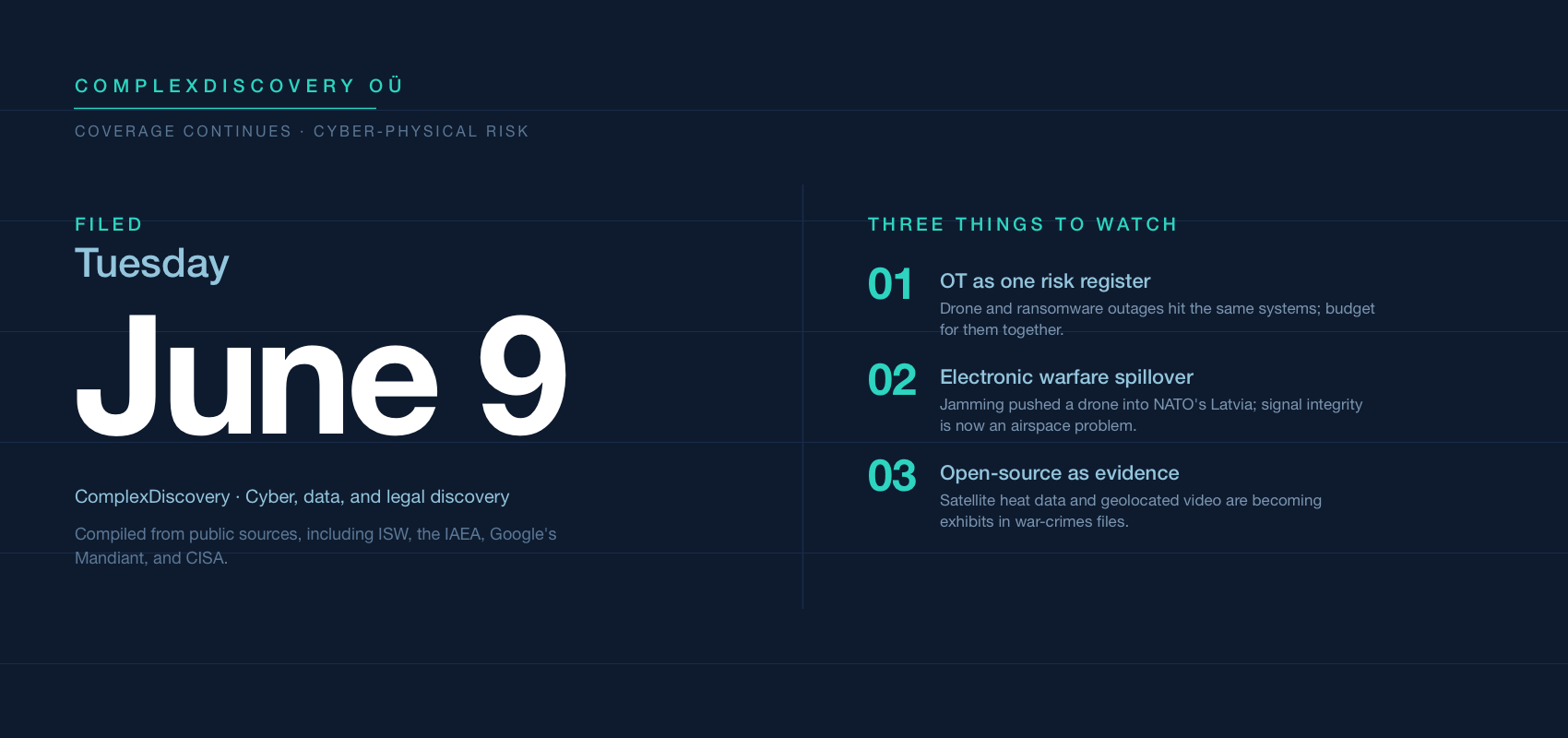
None of this is hypothetical, and the cyber version arrived first. In 2022, the Russian military intelligence hackers that Google’s Mandiant tracks as Sandworm, now cataloged as APT44, broke into the operational-technology network of a Ukrainian power utility and used the utility’s own supervisory controls to switch off substations, cutting electricity to customers. Mandiant reported that the blackout lined up with a wave of Russian missile strikes on Ukrainian infrastructure, while cautioning that it lacked the evidence to call the timing a coordinated, deliberate pairing. Moments after the lights went out, the attackers deployed wiper malware to erase the utility’s systems.
That case matters here because the June drone strikes hit the same class of target the same adversary has already reached through a keyboard. A substation can be dropped from a cabinet on the ground or from a server three time zones away, and Russia has now shown both methods against Ukraine. Treating the airborne threat and the network threat as one program, rather than two, is the practical takeaway a defender can carry out of these reports.
Crimea offered a downstream view of what infrastructure disruption looks like for civilians. Occupation authorities restricted gasoline to 20 liters per vehicle per week and began rationing fuel through QR codes available only via a Russian state-controlled messaging app. Tying a basic commodity to a single state-run digital channel is a governance choice with surveillance implications, and it shows how quickly access controls migrate onto contested platforms under stress.
Open-source data as the evidence base
The reporting itself carries a lesson for information governance and eDiscovery teams. ISW emphasizes that it uses only publicly available information, drawing on Russian, Ukrainian, and Western reporting, social media, and commercial satellite and geospatial data. Verification of the energy strikes relied on NASA’s Fire Information for Resource Management System, whose heat-anomaly data corroborated fires at the targeted terminals. Damage near Chornobyl was confirmed through geolocated images.
This is digital evidence work. Provenance, time-stamping, chain of custody, and corroboration across independent feeds are the same disciplines that govern a defensible eDiscovery collection. Ukraine’s SBU opening a war-crimes case over the Chornobyl strike turns those open-source artifacts into potential exhibits, where authentication and preservation will decide their weight. The practitioners who understand how to validate a geolocated video or a satellite overlay are the same ones who will be asked, in far less dramatic contexts, whether a screenshot or a system log can be trusted.
What practitioners should track now
The throughline across both assessments is convergence. Kinetic and cyber effects, physical and data targets, military and civilian systems are collapsing into a single operating environment, and the data layer sits underneath all of it. Critical-infrastructure defenders should treat drone-and-jamming incidents as intelligence about their own threat models, not as foreign news. Information governance leaders should watch how access to essential services is being rerouted through controlled digital platforms. eDiscovery and investigations teams should study how open-source verification holds up when the stakes include a war-crimes docket.
Grossi’s warning about nuclear sites applies more broadly than its subject. The systems societies most depend on are now reachable by cheap, increasingly data-linked weapons, and the evidence of each strike lives in public data streams that someone has to authenticate. As the distance between a kinetic strike and a data-driven one keeps shrinking, which physical systems remain outside the organization’s cyber risk register?
News sources
- Russian Offensive Campaign Assessment, June 7, 2026 (Institute for the Study of War)
- Russian Offensive Campaign Assessment, June 8, 2026 (Institute for the Study of War)
- Russian drone hit nuclear fuel storage facility near Chornobyl, Ukraine says (CBC News)
- Russian drone attack damages site near Chornobyl nuclear plant (Al Jazeera)
- IAEA warning after drone hits used fuel facility near Chernobyl (World Nuclear News)
- Latvia says NATO jets shot down drone that flew into airspace (Bloomberg)
- NATO jets shoot down drone over Latvia, extending Ukraine spillover fears (Al Jazeera)
- Sandworm Disrupts Power in Ukraine Using a Novel Attack Against Operational Technology (Google Cloud / Mandiant)
- Cross-Sector Cybersecurity Performance Goals, Version 2.0 (Cybersecurity and Infrastructure Security Agency)

Assisted by GAI and LLM Technologies
Additional reading
- When the refineries burn: Ukraine’s strikes turn Russia’s energy backbone into a cautionary tale
- The night Ukrainian drones exposed gaps in Moscow’s defenses and state TV gave it 60 seconds
- From warning to funding: Russia’s expanding media machine and the risk signals ahead
- Invisible by design: NATO’s 2026 cognitive warfare paper and the crisis of discovery
- When Your Legal Tech Vendor Gets Breached: DocketWise Incident Exposes 116,666 Immigration Records and a Profession’s Blind Spot
- The DOJ’s Cyber FCA Playbook Is Working as Enforcement Triples and Shows No Signs of Slowing
- FTC’s OkCupid Action Reframes AI Training Data as a Consumer Protection Issue
- White House AI Framework Signals New Compliance Stakes for Legal, Cybersecurity, and eDiscovery
- The Gatekeeper’s Key: How the Conformity Assessment Unlocks the EU AI Market
Source: ComplexDiscovery OÜ

ComplexDiscovery’s mission is to enable clarity for complex decisions by providing independent, data‑driven reporting, research, and commentary that make digital risk, legal technology, and regulatory change more legible for practitioners, policymakers, and business leaders.